

Acquisition financing is the collective term for the mix of debt and equity used to fund the purchase of a business, division, or set of assets, allowing buyers to complete transactions without holding the full purchase price in cash. For UK SME owners, management buyout teams, and growth-stage founders, the practical question is rarely “what is it?” and almost always “which structure works for my deal, and how do I get approved?” The ONS tracks UK M&A activity and the volume of domestic transactions confirms that acquisition finance is a mainstream tool, not a niche one. If you are preparing to buy a business, the single most useful first move is a readiness check: pull your last three years of management accounts, map your target’s EBITDA, and speak to an adviser before you approach a lender.
Table of Contents
- What does acquisition financing actually cover?
- What are the main types of acquisition finance in the UK?
- How are acquisition finance deals built?
- Where does acquisition finance come from in the UK?
- What do lenders look for when assessing an acquisition finance application?
- How to prepare a strong acquisition finance application
- How specialist advisory changes acquisition finance outcomes
- What are the benefits and risks of acquisition financing?
- What due diligence should you conduct before committing to financing?
- Common pitfalls and red flags to avoid in acquisition financing negotiations
- Tax implications of acquisition financing in the UK
- Key takeaways
- Why most acquisition deals take longer than they should
- Consult EFC supports acquisition financing from first model to close
- Useful sources and further reading
What does acquisition financing actually cover?
Acquisition finance applies whenever a buyer needs external capital to complete a transaction. The most common scenarios in the UK are a trade buyer acquiring a competitor or bolt-on, a management team buying out the existing owner (an MBO), a sponsor-led buyout where a private equity firm takes a controlling stake, and a search fund or individual acquirer purchasing an owner-managed business.
Common use cases at a glance:
- Strategic roll-up: — a platform business acquires a series of smaller targets; each bolt-on is funded from a revolving acquisition facility.
- Management buyout (MBO): the incumbent team buys the business from the founder using a mix of bank debt, mezzanine, and management equity. For a detailed breakdown of MBO funding structures, the management buyout guide covers cash, debt, vendor loan notes, and equity rollover.
It is worth distinguishing a single business acquisition loan (one instrument, usually a term loan from a bank) from the broader capital stack, which may layer several instruments across different seniority levels. Most deals above £2m use a stack rather than a single loan.
Pro Tip: Before approaching any lender, map the target’s EBITDA for the last three years and calculate a rough leverage multiple (total debt divided by EBITDA). If that number exceeds 4x, mainstream banks will likely decline and you will need private credit or mezzanine support.
What are the main types of acquisition finance in the UK?
M&A financing decisions balance cash, debt, and equity, with each option carrying distinct trade-offs on cost, control, and flexibility. The table below maps the main instruments to deal profiles.
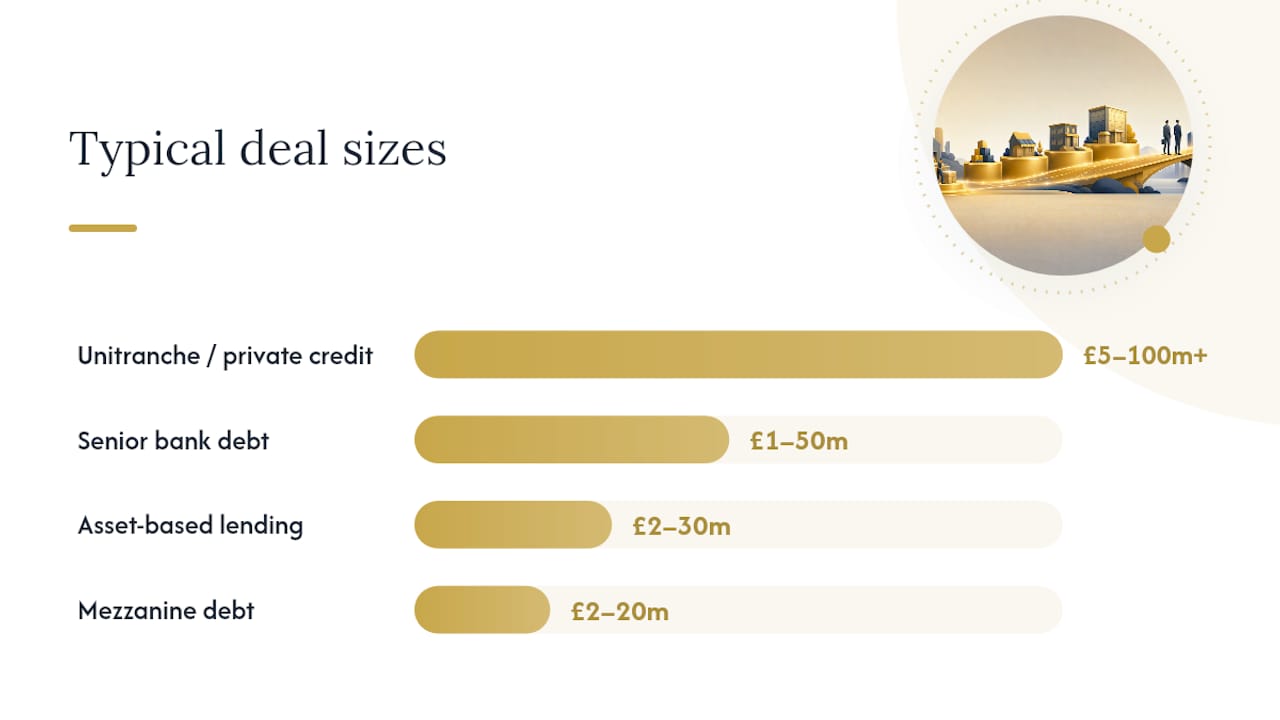
| Type | Best for | Typical deal size | Security required | Speed to close | Cost and covenant intensity |
|---|---|---|---|---|---|
| Senior bank debt (term loan) | Cash-flow-stable targets, predictable EBITDA | £1m–£50m | Fixed and floating charge over assets | 8–16 weeks | Lowest rate; tightest covenants |
| Asset-based lending (ABL) | Asset-heavy targets (stock, debtors, plant) | £2m–£30m | Specific assets (invoice ledger, inventory) | 4–8 weeks | Moderate rate; revolving structure |
| Unitranche / private credit | Mid-market speed deals, complex structures | £5m–£100m+ | Fixed and floating charge; share pledge | 4–10 weeks | Higher rate; fewer covenants |
| Mezzanine / subordinated debt | Filling the gap between senior debt and equity | £2m–£20m | Second-ranking charge or unsecured | 8 weeks | Highest debt rate; PIK option |
| Seller / vendor financing | Bridging valuation gaps; motivated sellers | Any size | Deferred consideration; loan note | Flexible | Low cash cost; earnout risk |
| Equity (new shares / sponsor) | High-growth targets; limited collateral | Any size | None (equity is unsecured) | 10–20 weeks | Dilutive; no covenants |
Senior bank debt from lenders such as Shawbrook or HSBC remains the lowest-cost option for buyers with a target that has three years of clean accounts and stable EBITDA. Shawbrook focuses on SME acquisition lending and is often faster to credit committee than a clearing bank. HSBC covers larger transactions and brings relationship banking depth, though its credit appetite for leveraged deals is more conservative.
Asset-based lending suits targets where the balance sheet carries significant debtors, stock, or plant. The facility revolves against the asset base, so headroom moves with the business rather than being fixed at close.
Unitranche combines senior and junior debt into a single facility with one lender and one set of documents. Execution is faster and the covenant package is typically lighter than a traditional bank deal, though the all-in rate is higher. For mid-market deals where speed matters, unitranche from a private credit fund is often the right call.
Mezzanine sits behind senior debt in the capital stack and is priced accordingly, often with a cash-pay coupon plus a payment-in-kind (PIK) element. It fills the gap when senior leverage alone does not cover the purchase price and the buyer wants to limit equity dilution.
Seller financing (vendor loan notes or earnouts) is underused in the UK SME market. When a seller takes a portion of the consideration as a deferred loan note, it reduces the cash needed at close and aligns seller incentives with post-acquisition performance. Earnouts tie part of the price to future results, which is useful when buyer and seller disagree on valuation.
Equity is the most expensive capital in terms of dilution but carries no covenant risk and no fixed repayment obligation. For a detailed comparison of when debt beats equity for UK SMEs, the trade-offs depend heavily on the target’s cash generation and the buyer’s risk tolerance.
Financing options for M&A also include bonds and convertible notes for larger transactions, though these are less common in the UK SME market.
How are acquisition finance deals built?
The capital stack is the layered structure of funding sources, ordered by seniority. Each layer has a different cost, risk profile, and claim on the business’s assets and cash flows.
A typical lower-middle-market (LMM) stack looks like this, from most to least senior:
- Senior debt: first-ranking charge over assets; lowest cost; repaid first.
- Unitranche or mezzanine: second-ranking or blended; higher cost; repaid after senior.
- Sponsor or management equity: residual claim; highest risk; highest potential return.
- Seller rollover equity: the seller retains a minority stake post-close, aligning their interests with the buyer’s success.
LMM capital stacks commonly include senior debt, mezzanine or unitranche, sponsor equity, and seller rollover, with the precise mix varying by deal size and lender appetite.
Security and intercreditor basics. Senior lenders typically take a fixed charge over specific assets (property, intellectual property, key contracts) and a floating charge over the remaining assets of the business. Where there are multiple lenders, an intercreditor agreement governs the order of repayment and enforcement rights. Share pledges over the acquisition vehicle are standard.
Covenants are the conditions a borrower must meet throughout the life of the loan. The most common are:
- Leverage covenant: total net debt must not exceed a multiple of EBITDA (e.g. 3.5x).
- Interest cover: EBITDA must cover interest payments by a minimum ratio (e.g. 2.0x).
- Reporting covenants: monthly or quarterly management accounts delivered within a set number of days.
- Dividend restrictions: limits on cash distributions to shareholders while debt is outstanding.
As Corporate Finance Institute notes, the cheapest debt often comes with the most restrictive covenants. A buyer who optimises purely on rate can find themselves unable to make a bolt-on acquisition or pay a dividend two years later because a covenant blocks it.
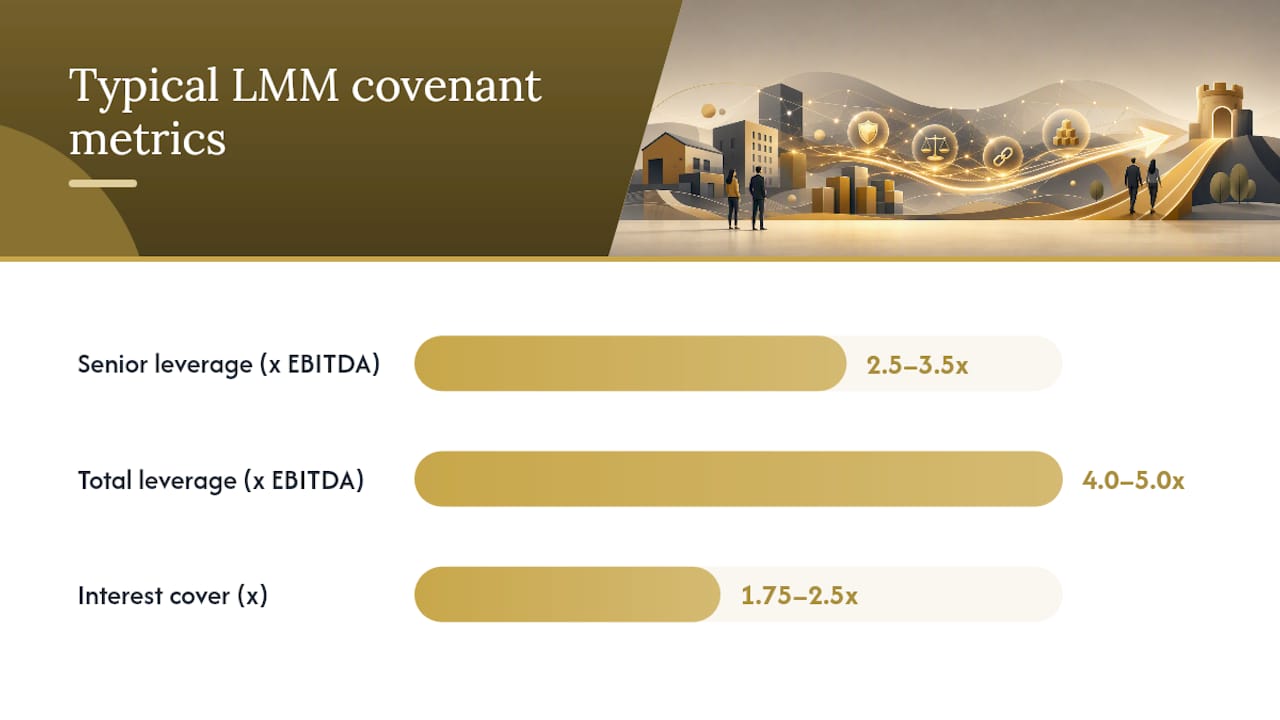
Sample term-sheet metrics: In LMM transactions, senior leverage typically sits in the range of 2.5x–3.5x EBITDA, with total leverage (including mezzanine) reaching 4.0x–5.0x on sponsor-backed deals. Interest cover covenants are commonly set at 1.75x–2.5x. These figures vary by sector, lender, and deal quality.
Negotiable terms buyers should push on:
- Covenant headroom (set at 20–25% above base-case projections, not the base case itself)
- Equity cure rights (ability to inject equity to cure a covenant breach)
- Accordion facilities (pre-agreed ability to upsize the facility for bolt-ons)
- Reporting frequency (quarterly rather than monthly for smaller deals)
Non-negotiable items include security package, cross-default provisions, and change-of-control clauses.
Where does acquisition finance come from in the UK?
Provider choice depends on deal size, complexity, and timeline. The UK market has a well-developed ecosystem across clearing banks, challenger banks, asset-based lenders, private credit funds, and mezzanine providers.
- Challenger and specialist banks (e.g. Shawbrook): — faster decisions; more appetite for SME acquisition lending; willing to look at slightly more complex structures than a clearing bank.
When to use a specialist ABL lender versus a mainstream bank comes down to the target’s balance sheet. If the target holds a large debtor ledger or significant stock, ABL can unlock more capital than a cash-flow-based term loan from a bank. If the target is asset-light but highly cash-generative, a bank term loan or unitranche is the cleaner route.
Private credit funds have grown significantly in the UK mid-market. They price higher than banks but move faster, accept more leverage, and are willing to fund deals that banks would decline. For a buyer on a tight timeline or acquiring a business with a more complex story, private credit is often the pragmatic choice.
Pro Tip: Engage your adviser before you approach any lender. The UK acquisition finance market is relationship-driven. A well-prepared information memorandum sent to the right three or four lenders will produce better terms than a cold approach to ten. Lenders talk to each other, and a poorly prepared approach can close doors.
What do lenders look for when assessing an acquisition finance application?
Lenders assess two things above all else: the target’s ability to service the debt from its own cash flows, and the quality of the management team that will run the business post-acquisition.
Key credit metrics lenders examine:
- EBITDA and historic cash flow: three years of audited or reviewed accounts; lenders normalise EBITDA for one-off items.
- Customer concentration: revenue from any single customer above 20–25% of total is a red flag; above 30% will often trigger a pricing adjustment or covenant.
- Working capital profile: seasonal swings, debtor days, and creditor days all affect the cash available to service debt.
- Asset coverage: the value of assets available as security relative to the loan amount.
- Management strength: track record, depth of the team, and whether key-person risk is mitigated.
Ancillary requirements:
- Quality of earnings (QoE) report from an independent accountant
- Three-year financial model with sensitivity cases
- Warranties and indemnities (W&I) insurance consideration for share purchases
- Solicitors’ report on title for any property in the security package
Practical Law’s acquisition finance resources provide practitioner-focused due diligence checklists and UK-specific legal framing that advisers and lenders use as a reference standard.
Lender documentation checklist:
| Document | Purpose |
|---|---|
| Three years’ audited accounts (target) | Establishes historic EBITDA and cash flow |
| Management accounts (last 3 years) | Confirms trading performance up to close |
| Three-year financial model | Demonstrates debt serviceability and covenant headroom |
| QoE report | Independent verification of normalised earnings |
| Customer contracts (top 10) | Assesses revenue quality and concentration |
| Working capital schedule | Maps seasonal cash needs and facility sizing |
| Asset register | Supports ABL or fixed-charge security |
| Management CVs and org chart | Addresses key-person risk |
| Tax compliance certificates | Confirms no outstanding HMRC liabilities |
| Property leases and title | Required for fixed-charge security |
Pro Tip: If the target has customer concentration above 25% or a single year of declining EBITDA, address it proactively in the information memorandum. Lenders will find it in diligence; better to frame it with context and a mitigation plan than to let them draw their own conclusions.
How to prepare a strong acquisition finance application
Preparation is where deals are won or lost. A buyer who arrives at a lender with a complete, well-organised finance pack will close faster and on better terms than one who assembles documents reactively during diligence.
- Conduct a pre-application self-assessment. Calculate the target’s normalised EBITDA, estimate the purchase price multiple, and derive the implied leverage. If leverage exceeds 3.5x, plan for private credit or mezzanine from the outset rather than wasting time with banks that will decline.
- Build a three-statement financial model. The model should include a profit and loss, balance sheet, and cash flow statement for the combined business, with at least three scenarios (base, downside, severe downside). Run covenant stress tests against the lender’s proposed covenant levels. For FP&A support in building deal-ready models, Consult EFC’s FP&A services are structured specifically for this purpose.
- Prepare the information memorandum (IM). The IM is the primary document lenders read. It should cover the business overview, financial history, management team, deal rationale, and proposed capital structure. A poorly written IM is the single most common reason deals take longer than they should.
- Commission a QoE report. For any deal above £2m, a QoE from an independent accountant is expected by lenders. It normalises EBITDA, identifies one-off items, and gives lenders confidence in the earnings base. Engage the QoE provider early, as the report takes four to six weeks.
- Assemble the data room. Organise all documents into a virtual data room before lender diligence begins. Use the checklist in the table above as a starting point. A well-structured data room signals professionalism and speeds up lender review. The due diligence checklist for UK founders provides a detailed item list.
- Shortlist lenders and engage a broker or adviser. Match lenders to the deal profile using the provider guide above. A corporate finance adviser or fractional CFO with transaction experience will know which lenders are active in the current market and at what pricing. For broader fundraising context, the 2026 UK founder’s fundraising guide covers the full process.
- Sequence advisers correctly. Engage your accountant and corporate finance adviser first, then your solicitor once heads of terms are agreed. Bringing in lawyers too early adds cost without benefit; bringing them in too late creates timeline risk.
Pro Tip: The working capital bridge is the document most buyers forget. Lenders want to see how much cash the business needs to operate day-to-day and whether the acquisition facility needs to include a working capital revolving credit facility. Model it before you go to market.
How specialist advisory changes acquisition finance outcomes
The difference between a deal that closes in twelve weeks and one that drags to twenty is almost always preparation and adviser quality, not the underlying business.
A typical scenario: a management team approaches a bank with three years of accounts and a one-page summary. The bank requests a financial model, a QoE, and a working capital analysis. The team spends six weeks assembling these reactively, during which time the seller becomes nervous and a competing buyer emerges. The deal closes eventually, but at a higher rate and with tighter covenants than a prepared buyer would have achieved.
With a fractional CFO engaged from the outset, the finance pack, model, and data room are ready before the first lender conversation. Lenders respond faster to complete submissions. The adviser’s knowledge of current lender appetite means the shortlist is accurate from day one, avoiding wasted weeks with lenders who would never have approved the deal.
Kishen Patel, ICAEW Chartered Accountant and founder of Consult EFC, brings transaction advisory experience to SME and SaaS acquisition deals, covering financial modelling, QoE support, lender negotiation, and covenant structuring. The services that materially change lender perception are:
- Investor-ready financial models with covenant stress tests built in
- Normalised EBITDA analysis and QoE preparation support
- Capital structure advice (debt versus equity trade-offs, mezzanine sizing)
- Data room organisation and information memorandum review
- Ongoing FP&A to maintain covenant compliance post-close
For buyers preparing for M&A, the fundraising readiness guide sets out the specific steps to get a business into lender-ready shape.
Advisory impact: Buyers who engage a qualified financial adviser before approaching lenders consistently report faster credit approvals, better covenant headroom, and lower arrangement fees — because lenders price risk, and a well-prepared submission signals lower execution risk.
What are the benefits and risks of acquisition financing?
Benefits:
- Access to capital that would otherwise take years to accumulate, enabling faster growth through acquisition.
- Interest on acquisition debt is generally tax-deductible, reducing the effective cost of borrowing (subject to HMRC’s corporate interest restriction rules — see the tax section below).
- Preserves the buyer’s cash for working capital, integration costs, and post-acquisition investment.
- Leverage amplifies equity returns when the acquired business performs above the debt service threshold.
- Seller financing and earnouts allow deals to close where there is a valuation gap between buyer and seller.
Risks:
- Over-leverage: if the acquired business underperforms, debt service consumes cash that should fund operations or growth.
- Covenant breaches: a single quarter of weaker trading can trigger a technical breach, giving lenders the right to demand repayment or impose additional restrictions.
- Refinancing risk: short-tenor facilities (three to five years) must be refinanced; market conditions at refinancing may be less favourable.
- Equity dilution: bringing in a sponsor or issuing new shares reduces the founder’s or management team’s ownership percentage.
- Integration risk: the financial model assumes synergies that may take longer to materialise than projected, straining debt service in the early years.
Risk mitigation in practice means building conservative stress tests into the financial model, negotiating covenant headroom of at least 20% above the base case, structuring earnouts with clear, measurable metrics, and maintaining a cash reserve for the first twelve months post-close.
What due diligence should you conduct before committing to financing?
Buyer due diligence and lender due diligence are not the same thing. Lender diligence focuses on downside protection; buyer diligence should focus on whether the acquisition rationale holds up under scrutiny.
Financial due diligence:
- Verify normalised EBITDA independently. Sellers routinely add back costs that a buyer will need to reinstate post-close (owner salary replaced by a market-rate hire, for example).
- Analyse working capital trends over three years. A business that has been stretching creditors to improve cash conversion will show a working capital unwind post-close.
- Review the tax position: deferred tax liabilities, HMRC enquiries, R&D tax credit claims under review, and transfer pricing arrangements all carry risk in a share purchase.
Commercial due diligence:
- Validate the customer base: speak to the top five customers where possible, or review contract terms and renewal history.
- Assess competitive position and market dynamics.
- Review key supplier contracts for change-of-control clauses that could allow termination on acquisition.
Legal due diligence:
- Review all material contracts for change-of-control provisions.
- Check employment contracts, pension obligations, and any outstanding litigation.
- Confirm intellectual property ownership, particularly for technology businesses.
Practical Law’s acquisition finance resources) provide a practitioner-level framework for structuring due diligence in UK transactions. For a founder-focused checklist, the fundraising due diligence guide covers the key items in a format designed for SME buyers.
Common pitfalls and red flags to avoid in acquisition financing negotiations
Most deals that fail or close on poor terms share a small number of recurring errors.
Pitfalls buyers make:
- Accepting the first term sheet. The first offer from a lender is rarely their best. Running a competitive process with three to five lenders consistently produces better pricing and covenant terms.
- Underestimating legal costs. Buyers routinely budget £30,000 for legal fees and spend £100,000. Get a fixed-fee estimate from your solicitor before heads of terms.
- Ignoring the working capital facility. Closing a deal without a revolving credit facility for working capital is one of the most common causes of post-acquisition cash crises.
- Setting covenants at the base case. A covenant set at exactly the base-case EBITDA leaves zero headroom. Negotiate for headroom of at least 20% above the base case.
- Conflating enterprise value and equity value. The purchase price in an acquisition is typically the enterprise value; the equity value (what the buyer actually pays) is enterprise value minus net debt and plus or minus working capital adjustments. Confusing the two leads to underfunding the deal.
Red flags in a target business:
- Revenue heavily concentrated in one customer or one contract.
- EBITDA that has grown sharply in the year before sale (sellers sometimes defer costs or pull forward revenue to inflate the sale-year number).
- Unusual related-party transactions that inflate reported profitability.
- Key employees with no contractual notice periods or non-competes.
- Deferred capital expenditure that the buyer will need to fund post-close.
M&A financing methods highlight that instrument selection and deal structure are among the most consequential decisions in any acquisition, and errors made at heads of terms are expensive to unwind.
Tax implications of acquisition financing in the UK
Tax structuring is a material part of any acquisition and should be addressed before the capital structure is finalised, not after.
Interest deductibility and the corporate interest restriction (CIR). Interest on acquisition debt is generally deductible against corporation tax, which reduces the effective cost of borrowing. However, HMRC’s corporate interest restriction rules limit the amount of net interest expense a group can deduct to 30% of UK taxable EBITDA (the fixed ratio rule), or to the group’s net interest-to-EBITDA ratio if that is higher (the group ratio rule). For highly leveraged deals, the CIR can significantly reduce the tax benefit of debt.
Share purchase versus asset purchase. The tax treatment differs materially depending on the deal structure. In a share purchase, the buyer acquires the target’s historic tax liabilities along with its assets; warranties and indemnities insurance is typically used to manage this risk. In an asset purchase, the buyer can step up the tax base of acquired assets, which may generate future depreciation deductions, but the seller typically faces a higher tax charge and will price this into the consideration.
Stamp duty. A share purchase attracts stamp duty at 0.5% of the consideration. An asset purchase may attract stamp duty land tax (SDLT) on any property transferred, at rates that vary by property type and value.
Earn-outs and deferred consideration. Earnout payments are generally treated as additional consideration for the shares or assets, taxable in the year of receipt. The tax treatment of vendor loan notes depends on their terms; specialist tax advice is required before structuring deferred consideration.
VAT on transaction costs. Advisory fees (legal, accountancy, corporate finance) incurred on an acquisition are generally not recoverable as input VAT unless the acquisition is structured as a TOGC (transfer of a going concern) and specific conditions are met.
This article provides general information on UK acquisition tax considerations, not professional tax advice. Confirm the specific treatment for your transaction with a qualified tax adviser and refer to HMRC’s published guidance.
Key takeaways
Acquisition financing is most likely to succeed when the buyer arrives with a complete finance pack, a realistic leverage assessment, and an adviser who knows which lenders are active in the current market.
| Point | Details |
|---|---|
| Definition and scope | Acquisition financing combines debt and equity to fund business purchases; most UK SME deals use a layered capital stack, not a single loan. |
| Lender priorities | EBITDA quality, customer concentration, management strength, and a complete data room are the four factors that most influence credit approval. |
| Cost and timeline | Senior bank debt prices at 2.5%–4.5% over SONIA; total deal costs including legal and QoE typically add 3%–5% of deal value; close takes — with good preparation. |
| Covenant discipline | Set covenants at least 20% below the base-case EBITDA projection; negotiate equity cure rights and accordion facilities at heads of terms. |
| Consult EFC advisory | Consult EFC, led by ICAEW Chartered Accountant Kishen Patel, provides fractional CFO and transaction advisory services that prepare SME buyers for lender approval and covenant compliance. |
Why most acquisition deals take longer than they should
The deals I see stall most often are not stalling because the business is weak or the lender is difficult. They stall because the buyer arrives unprepared. The information memorandum is a narrative document with no financial model attached. The management accounts are six months out of date. The QoE has not been commissioned. The lender asks for a working capital bridge and the buyer has never heard the term.
What changes the outcome is not a better business or a more favourable market. It is having a financial model that already answers the lender’s questions before they ask them. When a buyer can hand a lender a three-statement model with covenant stress tests, a normalised EBITDA bridge, and a working capital schedule on day one, the credit process moves in weeks rather than months. Lenders are assessing risk. A complete, well-structured submission tells them the management team understands the business they are buying. That alone shifts the conversation from “can we lend?” to “on what terms?”
The other pattern I see consistently is buyers who treat the capital structure as a commodity. They take the first term sheet, accept the covenants as given, and discover eighteen months later that a single quarter of weaker trading has triggered a breach. Covenant negotiation at heads of terms is where value is protected. A 20% headroom buffer costs nothing at the time and can be the difference between a manageable trading dip and a lender enforcement conversation.
For mid-market deals, a fractional CFO who has been through this process multiple times is not a luxury. The cost of getting the structure wrong, or the process slow, is almost always higher than the advisory fee.
Consult EFC supports acquisition financing from first model to close
Preparing for an acquisition is one of the most demanding financial processes a business owner will face, and the gap between a deal that closes cleanly and one that drags for six months usually comes down to the quality of the financial leadership behind it.
Consult EFC, led by ICAEW Chartered Accountant Kishen Patel, works with UK SMEs and growth-stage businesses at every stage of the acquisition process: building the financial model, preparing the information memorandum, supporting QoE, advising on capital structure, and maintaining covenant compliance post-close. The firm delivers Big Four rigour without the full-time cost, which means founders and management teams get the financial leadership a deal requires without a permanent hire. For buyers who need transaction-ready financial modelling and lender-facing support, fractional CFO services for UK SMEs are available on a project or retainer basis. To discuss your acquisition and assess your financing readiness, speak to the Consult EFC team directly.
Useful sources and further reading
The sources below are worth bookmarking if you are preparing for an acquisition or advising on one.
- Acquisition Financing Explained: Types, How It Works, and Key Benefits
- A guide to key resources: acquisition finance | Practical Law
- Merger and acquisition financing: 2026 Guide | CT Acquisitions
- Financing Options for Mergers and Acquisitions – Notion CFO and Advisors
- M&A Financing: Top 7 Options and Their Pros and Cons | IDEAL VDR
- UK mergers and acquisitions activity in context | ONS
Recommended
- Debt Finance for UK SMEs: What Lenders Actually Check
- Financial Due Diligence for SMEs: The Complete UK Guide
- Debt vs Equity Funding: Which is Right for Your UK SME?
- EIS for UK Startups: How to Secure Advance Assurance
Not sure where your business stands right now?
Book a free 30-minute call with Kish. Bring your numbers, your questions, or just your situation. You will leave with a clearer picture than you arrived with.
Book a Free Strategy Call
Over 12 years across Big Four audit, Investment Banking, and corporate advisory. Kish works with SaaS founders, tech companies, and ambitious UK SMEs from £1M to £50M in revenue on fundraising, valuations, exit planning, and financial strategy. ICAEW regulated. Big Four trained. Based in London.