


Asset-based lending (ABL) is business finance secured against your company’s assets, typically invoices, stock, plant and property, rather than against your general credit profile alone. It suits asset-rich UK firms with turnover from roughly £1 million upwards, particularly those in the £5m to £100m range where invoice finance plus other collateral can unlock more cash than a standard loan. If that sounds like your business, the sensible next step is a conversation with a specialist adviser before you approach lenders.
Key Takeaways
Asset-based lending works by advancing a percentage of your receivables, stock, plant and property value, and UK eligibility typically starts around £1 million turnover.
| Point | Details |
|---|---|
| ABL is asset-secured, not credit-secured | Lenders advance against a borrowing base built from invoices, stock, plant and property. |
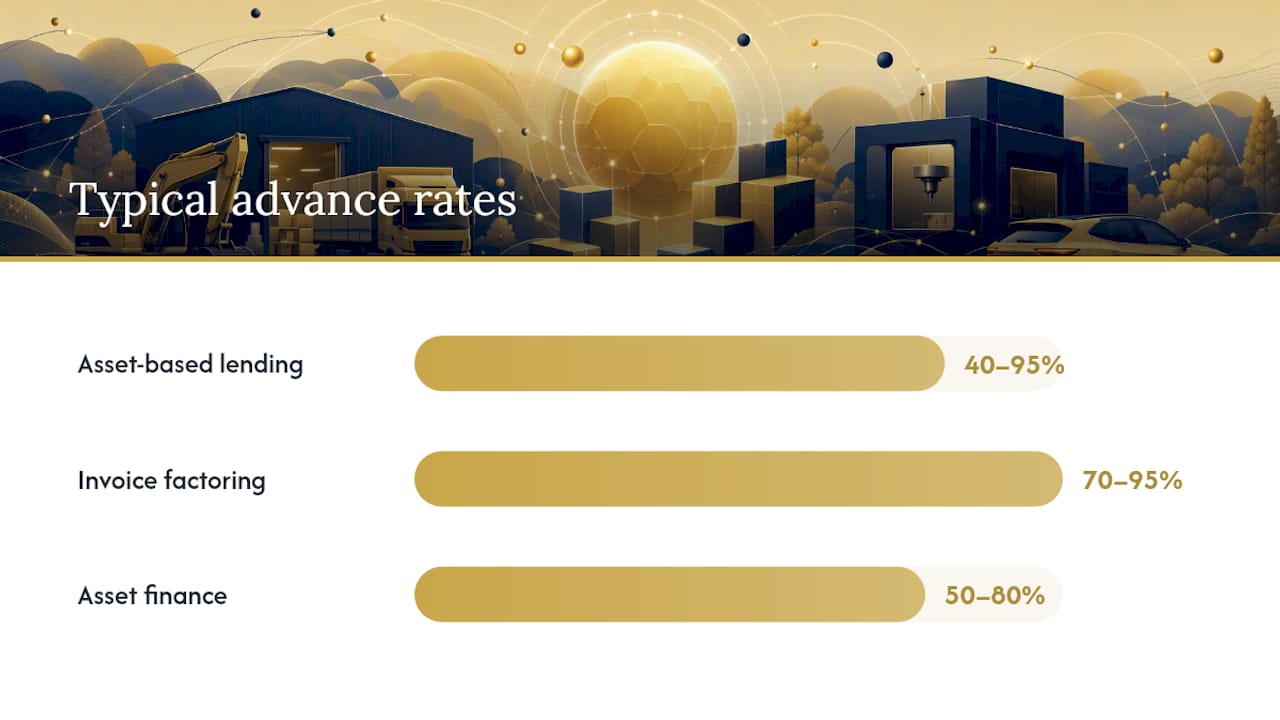
| Advance rates vary sharply by asset | Invoices support 70% to 95%, stock 40% to 60%, plant 50% to 80%, property 50% to 70%. |
| Costs go beyond interest | Expect arrangement, service, discount and periodic audit fees layered into total cost. |
| Preparation shortens diligence | Clean debtor ageings and covenant stress tests speed up approval and improve terms. |
| Consult EFC supports ABL readiness | Kishen Patel’s fractional CFO practice models borrowing bases and covenant headroom before you approach lenders. |
Table of Contents
- How does asset based lending work in the UK?
- Which assets can you use for asset-backed loans UK lenders will accept?
- What are the advantages of asset based lending for growing firms?
- What are the risks of secured lending options UK borrowers should weigh?
- Who qualifies for UK asset financing, and what does it cost?
- How to apply: what UK lenders check and how long it takes
- ABL versus invoice factoring, asset finance and overdrafts
- When to bring in a fractional CFO before applying for ABL
- My take on asset-based lending
- Getting your business ABL-ready with Consult EFC
- Frequently asked questions
- Sources
How does asset based lending work in the UK?
Every ABL facility starts with a borrowing base: the lender values your eligible assets and advances a percentage against each category, not the full book value. Invoice finance usually anchors the structure, often supplying the majority of usable funding within the facility. This is topped up with revolving or term lines against stock, equipment or property.
Say your business holds £500,000 in eligible receivables, £200,000 in stock and £300,000 in plant. A lender might advance 85% against invoices (£425,000), 50% against stock (£100,000), and 65% against plant (£195,000), giving roughly £720,000 in available funding against £1 million of gross assets. The gap between gross value and advance is the lender’s cushion against non-payment or a forced sale.
Lenders monitor the borrowing base continuously, not just at drawdown:
- Monthly or weekly reporting on debtor ageing and stock levels
- Periodic audits, often quarterly for larger facilities
- Covenants tied to minimum tangible net worth or leverage ratios
- Concentration limits capping how much one customer can contribute to the base
Pro Tip: Advance rates aren’t fixed. Lenders will often improve terms if you can demonstrate low customer concentration and clean, aged debtor data, so tidy your ledger before you negotiate, not after.
Which assets can you use for asset-backed loans UK lenders will accept?
Not every asset carries equal weight in a lender’s eyes. Valuation methods and discounts vary sharply by category, and understanding the typical advance-rate bands helps you judge how much a facility might actually release.
- Receivables: Unpaid invoices typically attract 70% to 95% advance rates, though heavy reliance on one or two customers reduces what counts towards the base.
- Inventory: Stock usually sits at 40% to 60%, reflecting the risk that it’s harder to liquidate quickly and needs regular physical checks.
- Plant and machinery: Equipment often supports 50% to 80%, though mobile or specialist kit needs independent valuation and can be harder to enforce against.
- Commercial property and IP: Property typically sits at 50% to 70%, while intellectual property is rarely funded on its own and usually demands extra legal due diligence and bespoke valuation.
What are the advantages of asset based lending for growing firms?
ABL converts assets already sitting on your balance sheet into working capital, without giving away equity. That matters most when growth outpaces cashflow: a business gearing up for a large seasonal stock build, or one funding an acquisition, can often draw more from an ABL facility than a straightforward overdraft would allow.
- Liquidity scales with your asset base, so funding grows alongside the business rather than staying fixed
- You keep full ownership and control, unlike raising equity
- Facilities can be structured for acquisitions, refinancing or turnaround, not just day-to-day cashflow
- Seasonal businesses can flex borrowing up ahead of peak trading and pay down after
A distributor building stock ahead of Christmas, for instance, can use inventory and receivables together to fund the buy, then repay as invoices clear in January.
What are the risks of secured lending options UK borrowers should weigh?
ABL isn’t free flexibility. Costs stack up beyond the headline interest rate: expect an arrangement fee, a service or admin charge, a discount rate on drawn balances, and periodic audit and monitoring fees that recur throughout the facility’s life.
- Covenant breaches (falling below a net worth threshold, say) can trigger renegotiation or, in the worst case, facility withdrawal
- Reporting burden is real: weekly or monthly submissions demand admin capacity many smaller finance teams don’t have spare
- Lender contact with your customers during invoice verification can strain commercial relationships if handled clumsily
- Cross-default clauses mean a breach on one facility can trigger default across others, and security ranks alongside or behind existing charges, which complicates refinancing
Covenant design deserves particular attention here. Modelling headroom before you sign, rather than after a shock quarter, is one of the more overlooked disciplines in UK ABL deals.
Who qualifies for UK asset financing, and what does it cost?
Eligibility hinges more on asset quality than on age or sector. Most UK banks and specialist lenders set minimum turnover signals around £1 million, with the bulk of ABL activity concentrated between £5m and £100m turnover. Below that, standalone invoice finance is usually simpler and cheaper.
- Deal sizes commonly range from a few hundred thousand pounds up to facilities in the tens of millions for larger mid-market borrowers
- Pricing typically bundles an arrangement fee, a discount or interest rate on drawn funds, a service fee, and periodic audit charges
- Many facilities carry minimum monthly fees regardless of drawdown, which matters if your funding need is genuinely seasonal
As a rough illustration, a £1 million facility might carry a one-off arrangement fee of 1% to 2%, a discount rate a few points above base rate on drawn balances, plus quarterly audit fees running into four figures. The true annualised cost depends heavily on how much of the facility you actually draw.
How to apply: what UK lenders check and how long it takes
Lenders build their offer around your management information, so the quality of what you hand over drives both speed and terms.
- Gather core documents: management accounts, an aged debtor ledger, current stock lists, and an asset register.
- Expect legal searches: lenders check for existing charges against the assets you’re offering as security.
- Prepare for site visits: audits and physical valuations are standard before funds are released, particularly for stock and plant.
- Timeline: straightforward deals can complete in four to six weeks; complex multi-asset facilities with property or IP often take longer.
Pro Tip: Clean, reconciled management accounts shave real time off due diligence. Lenders spend disproportionate effort chasing gaps in debtor ledgers, so sort that before the first meeting, not during it.
ABL versus invoice factoring, asset finance and overdrafts
| Option | Best for | Assets funded | Typical advance rate | Typical costs / fees | Speed & complexity | Minimum size signal |
|---|---|---|---|---|---|---|
| Asset-based lending | Multi-asset, growth or acquisition funding | Invoices, stock, plant, property | 40% to 95% (varies by class) | Arrangement, service, discount rate, audit fees | Moderate to high, 4-6 weeks | Turnover from ~£1m, most active £5m-£100m |
| Invoice factoring/discounting | Businesses needing cashflow from receivables only | Unpaid invoices | 70% to 95% | Discount fee, service fee | Fast, 1-3 weeks | Lower turnover thresholds than ABL |
| Asset finance | Funding a specific equipment purchase | Plant, vehicles, machinery | 50% to 80% | Fixed interest, arrangement fee | Fast for standard assets | Flexible, deal specific |
| Overdraft / unsecured loan | Short-term or smaller cashflow gaps | None or general charge | Not asset-linked | Interest, arrangement fee | Fastest, minimal diligence | Lower, but limited facility size |
Choose ABL over these alternatives when you need funding across several asset classes at once, or when the scale of the transaction (an acquisition, a large stock build) outstrips what invoice finance or an overdraft alone could support.
When to bring in a fractional CFO before applying for ABL
Preparation shapes the terms you get offered as much as the assets themselves. Before approaching lenders, get your debtor ageings clean, tighten stock controls, and run covenant headroom scenarios against a downside case.

Pro Tip: Model your covenant headroom under a stress scenario, not just your base case. Lenders respect a business plan that already shows it has been stress-tested.
A fractional CFO who has run this process before can shorten due diligence and often improve the terms on offer, simply by presenting management information the way lenders expect to see it.
My take on asset-based lending
If I were advising a founder this week, I’d check the debtor ledger first. Most deals slow down there. Three actions: reconcile your aged debtors, model a downside covenant scenario, and get independent advice before you sign anything.
Getting your business ABL-ready with Consult EFC
Consult EFC gives you the negotiating position a bank’s own credit team already has, before you sit down with them. Kishen Patel, an ICAEW Chartered Accountant, leads a fractional CFO practice built specifically for high-growth SaaS companies and ambitious UK SMEs weighing debt against equity.
Rather than walking into an ABL negotiation with whatever management information you happen to have, Consult EFC’s debt financing advisory work builds the borrowing-base modelling, covenant headroom analysis and investor-ready reporting that shortens due diligence and strengthens the terms you’re offered. If you’re weighing up ABL against other routes, start with a look at what a fractional CFO actually does for businesses in your position, then get in touch for a readiness review before you approach a lender.
Frequently asked questions
What is the minimum turnover for asset-based lending in the UK? Most lenders set informal minimum signals around £1 million turnover, with the bulk of ABL activity concentrated between £5m and £100m. Below that, invoice finance alone is often more practical.
Is asset-based lending the same as invoice factoring? No. Invoice finance often anchors an ABL facility, but ABL typically layers in stock, plant and property as additional security, giving access to more funding than receivables alone.
How quickly can a UK business secure ABL funding? Straightforward single-asset deals can complete in four to six weeks. Multi-asset facilities involving property valuations or legal searches on IP usually take longer.
Does ABL affect my relationship with customers? It can. Some lenders verify invoices directly with your customers, which needs managing carefully to avoid signalling financial strain.
Should I speak to an adviser before approaching a lender? Yes. A specialist adviser or fractional CFO can model your borrowing base and covenant headroom in advance, which typically improves both the speed of approval and the terms offered.
This article is general information, not a substitute for advice from a qualified financial advisor. Consult a qualified financial professional about your own circumstances before acting on anything here.
Sources
- What is asset-based lending?
- Asset-Based Lending (ABL) – Practical Law – Thomson Reuters
- Asset Based Lending UK 2026 – What It Is and How Invoice
- Asset Based Lending | NatWest Corporates and Institutions
Recommended
- Debt Finance for UK SMEs: What Lenders Actually Check
- Debt vs Equity Financing for UK SMEs | Consult EFC
- How to Write a Compelling Business Plan for a UK Start Up Loan – ICAEW Fractional CFO & Corporate Finance Advisers | Consult EFC
- Debt vs Equity Funding: Which is Right for Your UK SME?
Not sure where your business stands right now?
Book a free 30-minute call with Kish. Bring your numbers, your questions, or just your situation. You will leave with a clearer picture than you arrived with.
Book a Free Strategy Call
Over 12 years across Big Four audit, Investment Banking, and corporate advisory. Kish works with SaaS founders, tech companies, and ambitious UK SMEs from £1M to £50M in revenue on fundraising, valuations, exit planning, and financial strategy. ICAEW regulated. Big Four trained. Based in London.