
Most UK founders are not investor-ready. Not because their businesses are bad, but because they have not yet built the evidence, governance, and documentation that investors need to say yes. The good news: investor readiness is a solvable problem, and most gaps close within four to eight weeks of focused work.
Your three immediate actions this week:
- Score your business across the twelve readiness dimensions in the checklist below and identify your three weakest areas.
- Pull your cap table, latest management accounts, and any signed customer contracts into a single folder. If that takes more than an hour, your data room is not ready.
- Write a one-page investable thesis: the problem, your solution, the market size, your traction to date, and how much you are raising and why.
The core signals investors look for, in order of weight:
- Traction: paying customers, repeat revenue, or signed letters of intent (LOIs) with named buyers and amounts
- Aligned financials: a three-way forecast (P&L, balance sheet, cash flow) whose assumptions match the story in your deck
- Organised data room: corporate documents, cap table, contracts, and compliance records accessible in minutes, not days
UK government guidance frames investor readiness as the capacity to provide hard evidence of demand, a defensible market sizing, and a governed financial model. If you cannot do all three today, you are not yet ready to fundraise, but you are close.
Table of Contents
- Should you raise equity now, or fix your foundations first?
- Which businesses qualify for equity and what do different investors look for?
- The investor-readiness checklist: twelve dimensions to score before you fundraise
- How to build a credible market sizing and investable thesis
- What belongs in your investor pack: deck, financial model, and key numbers
- What due diligence looks like and how to build a diligence-ready data room
- The evidence investors want: what actually moves the needle
- How much to raise, which instruments to use, and what the terms mean
- What the fundraising timeline actually looks like, and what it costs
- Common mistakes that kill investor confidence, and how to fix them
- How to run a mock due-diligence session: the Consult EFC method
- Key takeaways
- The gap most founders miss, and why it costs them the deal
- How Consult EFC helps founders close their readiness gaps
- Useful UK sources and templates for founders
Should you raise equity now, or fix your foundations first?
The most expensive mistake a founder can make is raising too early. Premature dilution is permanent. If you give away a significant portion of your company before you have real traction, you may later regret not waiting until you were better prepared to raise funds.
Run this decision checklist in your next team meeting:
- Do you have at least three months of consistent revenue growth, or a signed pipeline that credibly explains the next six months?
- Can you articulate your unit economics? Specifically: customer acquisition cost (CAC), lifetime value (LTV), and gross margin?
- Do you have a clear use of funds tied to specific milestones, not just “growth”?
- Is your current runway less than nine months, making a raise genuinely urgent?
- Have you exhausted or consciously ruled out grants, revenue-based finance, or debt?
If you answered no to two or more of those, equity is probably not the right tool right now. The British Business Bank publishes guidance on alternative finance options including growth loans, the Start Up Loans programme, and innovation grants through Innovate UK. These routes preserve equity and often strengthen your story for a later raise.
Equity makes sense when you have product-market fit signals, a clear growth lever that capital unlocks, and a business model that can scale without costs rising proportionally. If you are still iterating on the product or have not yet found repeatable customer acquisition, more time is worth more than more money.

Pro Tip: Before you approach a single investor, calculate your post-money dilution at three different valuations. If the lowest realistic valuation leaves you with less than 60% of the company after a seed round, reconsider the timing or the amount you are raising.
Which businesses qualify for equity and what do different investors look for?
Not every business is a fit for equity investment, and targeting the wrong investor type wastes months. The profile that attracts each investor type differs significantly.
Angel investors
Angels typically back pre-revenue or early-revenue businesses where the founder’s conviction and the size of the problem are the primary signals. They want to see:
- A credible founding team with relevant domain knowledge
- Evidence that the problem is real (customer interviews, waitlists, early pilots)
- A market large enough to support a meaningful exit (typically £50m+ addressable)
- SEIS or EIS eligibility, which materially reduces their downside risk
Angels rarely expect polished unit economics. They are backing a thesis and a team.
Seed-stage investors and micro-VCs
At seed, the bar rises. Investors at this stage want to see early commercial validation: paying customers, a conversion rate from trial to paid, or LOIs from named buyers. The Energy Catalyst investment readiness guidance from UKRI frames this as demonstrating both evidence and governance, not just a compelling idea.
Seed investors also scrutinise the founding team’s ability to hire and retain talent, and whether the business model is repeatable.
Series A institutional VCs
By Series A, investors expect repeatable unit economics, a functioning go-to-market motion, and a financial model that holds up under scrutiny. They will run a full due diligence process, examine your cap table carefully, and want to understand your path to profitability or to the next funding milestone. Gross margin, burn multiple, and net revenue retention are the numbers they will interrogate first.
How to choose your first target investor type: be honest about your stage. If you have under £100k in annual recurring revenue, angels and pre-seed funds are your realistic audience. Pitching Series A VCs at that stage does not accelerate the process; it burns relationships you will need later.
The investor-readiness checklist: twelve dimensions to score before you fundraise
The most practical way to assess your readiness is to score yourself across twelve dimensions, then fix the weakest three before approaching investors. A structured scorecard approach helps founders focus remediation rather than trying to improve everything at once.
Score each dimension 1 (not started) to 5 (investor-grade):
- Problem-solution fit: Can you articulate the problem in one sentence and prove customers pay to solve it?
- Traction: Do you have paying customers, repeat revenue, or signed LOIs with named buyers?
- Unit economics: Do you know your CAC, LTV, gross margin, and payback period?
- Team: Does the founding team cover commercial, technical, and operational leadership?
- Governance: Are there board minutes, a shareholders’ agreement, and defined decision-making processes?
- Legal and compliance: Is your company properly incorporated, with clean IP assignment and no outstanding disputes?
- Financial model: Is there a three-way forecast with documented assumptions and scenario analysis?
- Cap table: Is it clean, with vesting schedules in place for all founders and key hires?
- Data room: Are all key documents organised, version-controlled, and accessible in under ten minutes?
- Pitch quality: Does your deck tell a coherent story in ten to twelve slides, with numbers that match the model?
- Market sizing: Is your TAM/SAM/SOM built bottom-up with named buyer evidence, not just a headline market report?
- Exit strategy: Have you articulated plausible exit routes and comparable transactions?
Any dimension scoring 1 or 2 is a deal-breaker for most investors. Dimensions scoring 3 are risks that will slow a deal or reduce your valuation.
Must-have documents and minimum standards:
- Incorporation documents and articles of association (current, filed at Companies House)
- Shareholders’ agreement with vesting schedules (signed by all parties)
- Last two years of management accounts or statutory accounts (reconciled to bank statements)
- Three-way financial forecast with a written assumptions page
- Cap table in a spreadsheet or a platform such as Vestd or Carta (UK-compatible)
- Signed customer contracts or LOIs (not just verbal commitments)
- IP assignment agreements for all founders and contractors
- HMRC compliance confirmation (PAYE, VAT, corporation tax up to date)
Templated items to prepare:
- One-page investable thesis (problem, solution, market, traction, ask)
- Ten to twelve slide pitch deck
- Three-way financial model with a base, upside, and downside scenario
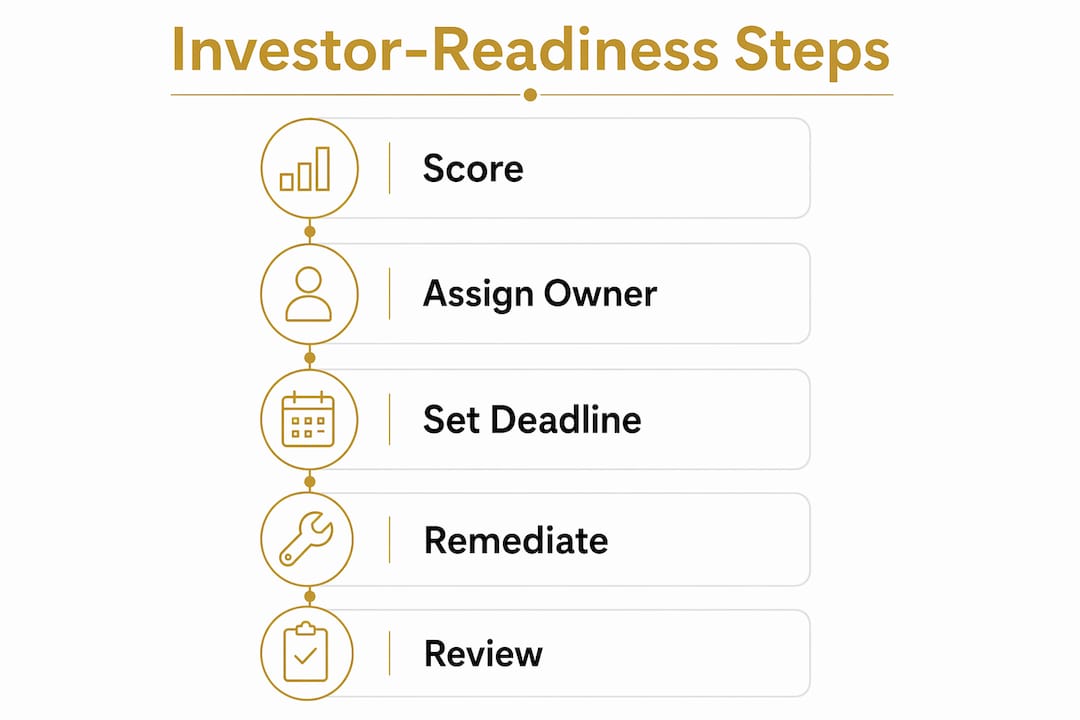
Sprint plan: identify your three lowest-scoring dimensions. Assign one owner per dimension and set a four-week deadline. Practitioners consistently find that closing the weakest dimensions first reduces time to close a round and improves the terms you receive.
Pro Tip: Many founders start fundraising before they are ready. The recommended remedy is a focused 30 or 90-day sprint on validation, unit economics, and due diligence materials, not a parallel fundraise while the gaps remain open.
How to build a credible market sizing and investable thesis
Investors see hundreds of decks with a slide showing a £10 billion total addressable market (TAM) and no explanation of how the company captures even 1% of it. That slide does not build confidence. It signals that the founder has not done the work.
GOV.UK guidance explicitly warns against overbroad market claims and recommends one to two pages of evidence-backed market sizing with direct buyer linkage, not headline figures from a market research report.
Build your TAM/SAM/SOM bottom-up, not top-down:
- TAM (total addressable market): Start with the number of potential buyers in your category, not a sector revenue figure. For a UK B2B SaaS tool targeting finance teams in mid-market companies, count the number of companies in that segment using Companies House data or the ONS Business Population Estimates.
- SAM (serviceable addressable market): Narrow to the segment you can realistically reach with your current go-to-market. Apply filters: geography, company size, industry vertical, and buying cycle.
- SOM (serviceable obtainable market): This is your three-year target. Ground it in your current conversion rates, sales capacity, and pipeline data. If you have ten customers today and a 20% month-on-month growth rate, your SOM should reconcile to that trajectory.
UK data sources that add credibility:
- ONS Business Population Estimates (company counts by sector and size)
- Companies House for sector-specific company data
- British Business Bank’s Small Business Finance Markets report for funding market context
- Beauhurst for UK startup and scaleup deal data
- Sector-specific trade association reports (e.g., techUK for technology markets)
Warning flags that make market claims unbelievable:
- A TAM figure from a US market research firm applied directly to the UK without adjustment
- No named buyer segment: “SMEs” is not a segment; “UK finance teams in companies with 50–250 employees” is
- A SOM that implies capturing 10%+ of the SAM within three years with no explanation of how
- Market sizing that does not connect to the pricing and volume assumptions in your financial model
Your investable thesis is the one-page document that ties it all together: the problem, your solution, the market size with the bottom-up evidence, your traction, and your ask. If an investor cannot understand why your business is worth backing from that single page, the deck will not save you.
What belongs in your investor pack: deck, financial model, and key numbers
GOV.UK investor readiness guidance stresses concision: investors should be able to review your materials in 60–90 seconds and understand the investment case. That means your deck and model must be tight, consistent, and self-explanatory.
The pitch deck: slide by slide
Each slide has one job. If a slide is trying to do three things, it is doing none of them well.
- Problem: One slide. Quantify the pain. Name the buyer who feels it.
- Solution: One slide. What you do and why it works better than the alternative.
- Market size: One slide. Bottom-up TAM/SAM/SOM with your buyer segment named.
- Business model: One slide. How you make money, your pricing, and your gross margin.
- Traction: One slide. Revenue, customer count, growth rate, and key contracts. This is the slide investors spend the most time on.
- Go-to-market: One slide. Your acquisition channels, CAC by channel, and conversion rates.
- Team: One slide. Relevant experience, not job titles. What has each person done that proves they can execute this?
- Financials: One slide. Three-year summary: revenue, gross margin, EBITDA, and cash position. The model is the backup.
- The ask: One slide. How much, at what valuation (or on what instrument), and what milestones the capital funds.
Ten to twelve slides total. No appendix slides in the main deck; keep them available for Q&A.
The investor-grade financial model
An investor-grade financial model is not a spreadsheet with revenue projections. It is a structured document that shows how the business works, what drives growth, and what happens under different scenarios.
Minimum requirements:
- A written assumptions page (every input is documented and sourced)
- A three-way model: P&L, balance sheet, and cash flow, all linked
- Unit economics built from first principles (not top-down revenue targets)
- A cash runway calculation showing months to zero under base and downside scenarios
- Scenario sensitivity: at minimum, a base case and a downside case
Key variables investors will interrogate:
| Metric | What investors are testing |
|---|---|
| CAC (customer acquisition cost) | Whether growth is efficient and repeatable |
| LTV (lifetime value) | Whether the business model is durable |
| Gross margin | Whether the unit economics support scale |
| Burn multiple | How much cash is consumed per £1 of new ARR |
| CAC payback period | How long before a customer becomes profitable |
| Net revenue retention | Whether existing customers expand or churn |
A single discrepancy between the revenue number in your deck and the revenue number in your model is enough to create deal fatigue. Investors notice immediately, and it raises questions about everything else. Keep the financial modelling consistent across every document.
What due diligence looks like and how to build a diligence-ready data room
Due diligence is where most deals slow down or die. Investors expect a clean, organised data room with verified historical financials, a clear cap table, and legal compliance. Founders who cannot produce documents quickly signal operational immaturity, and that costs them either time or valuation.
Canonical folder structure for your data room:
- Corporate: Certificate of incorporation, articles of association, shareholders’ agreement, board minutes (last 24 months), Companies House filings
- Financials: Last two to three years of statutory or management accounts, VAT returns, HMRC correspondence, current financial model, bank statements (last 12 months)
- Cap table: Current cap table, option scheme rules (EMI scheme documentation if applicable), any convertible notes or SAFEs outstanding
- IP and technology: IP assignment agreements for all founders and contractors, trademark registrations, software licences, any third-party code dependencies
- Commercial contracts: All signed customer contracts, supplier agreements, partnership agreements, and any LOIs or MoUs
- HR and team: Employment contracts for key hires, contractor agreements, any settlement agreements
- Compliance: GDPR data processing records, any regulatory licences, insurance certificates, HMRC PAYE and corporation tax confirmation
Pro Tip: Use a dedicated virtual data room platform such as Digify, Datasite, or even a structured Google Drive with access controls. Log who accesses what and when. Investors notice when a data room has no audit trail, and it raises questions about information security.
Documents that most often slow or break deals:
- A cap table that does not reconcile to the shareholders’ agreement (fix: rebuild from the original share certificates and have a solicitor verify)
- Missing IP assignment agreements for a technical co-founder who left (fix: contact them now, before due diligence starts)
- Unpaid HMRC liabilities or outstanding VAT returns (fix: clear these before approaching investors; they will find them)
- Customer contracts with no signed copy on file (fix: re-execute or obtain countersigned versions immediately)
- Gaps in board minutes for key decisions (fix: prepare retrospective minutes with legal advice)
For a folder-by-folder due diligence checklist tailored to UK founders, Consult EFC has published a practical template that covers each of these areas in detail.
Recognising red flags in financial reporting is not just an investor skill. Founders who understand what triggers concern can fix issues proactively rather than discovering them mid-process.
The evidence investors want: what actually moves the needle
Not all traction is equal. Investors weight evidence by how verifiable and commercially meaningful it is. Here is the ranking, from most to least persuasive:
- Signed, paid contracts with named customers: the gold standard. Include the contract value, the term, and any renewal or expansion clauses.
- Paid pilots with defined success criteria: shows commercial validation even before full deployment. Include the pilot fee, the timeline, and what happens at the end.
- Letters of intent (LOIs) or memoranda of understanding (MoUs): useful, but only if they include a named buyer, a stated value or volume, and a target date. A vague LOI from a company you met at a conference is not evidence.
- Testimonials and case studies: the weakest form of evidence. Useful for context, not for proving commercial traction.
What makes an LOI persuasive to investors:
- Named organisation and signatory (not just a job title)
- Stated value or volume (e.g., “subject to contract, we intend to purchase licences for 50 users at £X per user per year”)
- Target date for conversion to a signed contract
- Any conditions precedent clearly stated
A simple metric reporting format for investor updates:
Keep monthly investor updates to one page. Include: MRR or ARR (with month-on-month change), gross margin, cash position and runway, top three wins, top three risks, and one specific ask. Investors who receive clear, consistent updates are far more likely to follow on in future rounds.
When presenting pilot or revenue evidence, show the data in a format investors can verify: a table with customer name (or anonymised reference), contract start date, annual contract value, and renewal status. Do not summarise; let the numbers speak.
How much to raise, which instruments to use, and what the terms mean
Sizing a round incorrectly is one of the most common and costly mistakes. Raise too little and you run out of runway before hitting the milestones that justify the next round. Raise too much and you dilute unnecessarily or set a valuation expectation you cannot meet.
Milestone-based sizing: calculate the capital needed to reach your next fundable milestone, add a 20% buffer for delays, and that is your raise. A fundable milestone is a specific, measurable outcome that materially de-risks the business for the next investor: for example, reaching £500k ARR, signing three enterprise contracts, or completing a regulatory approval.
Common instruments in UK early-stage fundraising:
- Convertible loan notes: debt that converts to equity at the next priced round, typically at a discount (10–20%) and with a valuation cap. Faster and cheaper to execute than a full equity round. Common at pre-seed.
- Advanced Subscription Agreements (ASAs): the UK equivalent of a SAFE. Simpler than a convertible note, no interest, converts at the next round. HMRC has confirmed ASAs can qualify for EIS/SEIS, which matters for angel investors.
- Priced equity rounds: a full share issuance at an agreed valuation. More expensive to execute (legal costs typically £15,000–£30,000+) but gives both sides certainty on ownership.
- Mini-bridge rounds: a small convertible raise to extend runway while preparing for a larger priced round. Useful when you are three to six months from a milestone but need capital now.
Term-sheet items that matter most:
- Pre-money valuation: the value of the company before the investment. This determines how much of the company you give away.
- Option pool: investors often require an unissued option pool of 10–15% to be created before the investment, which dilutes founders, not investors. Negotiate the size carefully.
- Liquidation preference: a 1x non-participating preference is standard and reasonable. A 2x or participating preference significantly reduces founder returns in a downside exit.
- Anti-dilution provisions: broad-based weighted average is standard. Full ratchet anti-dilution is aggressive and founder-unfriendly; push back on it.
EIS and SEIS in the UK context: the Enterprise Investment Scheme (EIS) and Seed Enterprise Investment Scheme (SEIS) offer significant tax reliefs to UK investors, which makes EIS/SEIS-eligible companies materially more attractive to angels and smaller funds. SEIS applies to companies with gross assets under £350,000 and fewer than 25 employees at the time of investment. EIS applies to companies with gross assets under £15 million. Confirm eligibility with a tax adviser before raising, and consider applying for HMRC advance assurance to give investors certainty. For a detailed comparison of debt versus equity funding options for UK SMEs, Consult EFC has published a practical guide covering the trade-offs at each stage.
What the fundraising timeline actually looks like, and what it costs
Most founders underestimate how long a raise takes. From the decision to fundraise to funds in the bank, a typical UK seed round takes four to seven months. Here is a realistic breakdown:
Preparation phase (weeks 1–8):
- Weeks 1–2: Score readiness, identify gaps, assign owners
- Weeks 3–5: Build or update financial model, prepare data room, draft deck
- Weeks 6–8: Run mock due diligence, refine pitch, prepare LOIs and evidence pack
Active fundraising phase (weeks 9–20):
- Weeks 9–11: Investor outreach, warm introductions, first meetings
- Weeks 12–15: Follow-up meetings, data room access granted, term sheet negotiations
- Weeks 16–20: Legal documentation, due diligence, closing
Costs to budget:
- Legal fees (incorporation review, shareholders’ agreement, investment documents): £10,000–£35,000 depending on round size and complexity
- Accountant or financial adviser review (model review, financial due diligence support): £3,000–£10,000
- Data room platform subscription: £0 (Google Drive) to £500+ per month for a dedicated platform
- Fundraising adviser or broker: typically 3–6% of funds raised, sometimes with a retainer component; always clarify the fee structure in writing before engaging
Internal milestones and owners:
- CEO: investor narrative, relationship management, term sheet negotiation
- CFO or finance lead (or fractional CFO): financial model, data room, due diligence responses
- Legal counsel: corporate documents, IP, investment agreement review
- Operations lead: HR documents, compliance records, supplier contracts
A first-time fundraising checklist from Consult EFC covers the internal milestones in detail, with suggested owners and timelines for each task.
Common mistakes that kill investor confidence, and how to fix them
| Mistake | Why it damages credibility | Fix |
|---|---|---|
| Inconsistent numbers across deck, model, and data room | Signals poor financial control | Reconcile every figure before sending any materials |
| Overbroad TAM with no buyer linkage | Shows the founder has not done the work | Rebuild market sizing bottom-up with named segments |
| Missing or unsigned contracts | Creates legal uncertainty | Re-execute or obtain countersigned copies before diligence |
| Cap table that does not reconcile | Raises ownership and governance concerns | Rebuild from original share certificates with legal support |
| Overblown revenue projections with no assumptions | Destroys credibility on the model | Add a written assumptions page; show the drivers |
| Approaching investors before traction is established | Wastes relationships and time | Wait until you have at least three paying customers or signed LOIs |
| No clear use of funds | Suggests the founder has not thought through the plan | Tie every pound raised to a specific milestone |
High-impact actions that rebuild confidence quickly:
- Align every number in the deck to the same number in the model. Print both and check line by line.
- Prepare a one-page LOI summary: customer name, contract value, date signed, renewal terms.
- Clean the cap table and have a solicitor confirm it reconciles to the shareholders’ agreement.
- Add a written assumptions page to the financial model before any investor sees it.
When time is limited, prioritise in this order: traction evidence first (investors can forgive a rough deck but not absent revenue), then financial model consistency, then data room completeness, then governance documentation.
How to run a mock due-diligence session: the Consult EFC method
Mock due diligence is one of the highest-value preparation activities available to a founder. It surfaces inconsistencies between your story, your model, and your documents before investors find them. The exercise works best when run with an external adviser who will ask the questions an investor would actually ask, not the questions you are comfortable answering.
Step-by-step script:
- Assign roles (30 minutes before the session): one person plays the lead investor (asks financial and commercial questions), one plays the legal reviewer (asks about corporate structure, IP, and contracts), and one plays the founder (answers). An external adviser, such as a fractional CFO, should ideally play the investor role.
- Financial Q&A (45 minutes): the investor reviewer works through the financial model line by line. Sample questions:
- “Walk me through your CAC calculation. What is included in sales and marketing spend?”
- “Your gross margin is 68% in year one and 74% in year three. What drives that improvement?”
- “Show me the cash flow statement. At what point does the business become cash-flow positive under the downside scenario?”
- “Your revenue in the deck says £420k. The model says £418k. Which is correct?”
- Commercial and traction Q&A (30 minutes):
- “Can you show me the signed contracts for your top three customers?”
- “What is your net revenue retention? Can you show me the cohort data?”
- “Which of your LOIs have a stated value and a target conversion date?”
- Legal and governance Q&A (30 minutes):
- “Is the cap table reconciled to the shareholders’ agreement? Can I see both?”
- “Who owns the IP? Are all founder and contractor IP assignments signed?”
- “Are there any outstanding HMRC liabilities or disputes?”
- Create an action register: after the session, list every question that produced an unsatisfactory answer. For each item, record the owner, the priority (high/medium/low), and the target completion date. This register becomes your remediation plan.
Prioritisation matrix:
Score each gap on two axes: investor impact (how much does this gap concern investors?) and remediation effort (how long does it take to fix?). High-impact, low-effort fixes go first. High-impact, high-effort fixes need to start immediately even if they take weeks.
Pro Tip: Use the mock due-diligence action register to rework your pitch and model. Every question that stumped you in the session is a question an investor will ask. Build the answer into the deck or the model before the first real meeting, so you are never caught off-guard.
For practical guidance on responding to investor due diligence questions, Consult EFC has published a detailed Q&A framework that maps common investor questions to the documents and data that answer them.
Key takeaways
Investor readiness is not a one-off task: it is a structured programme of evidence-building, governance, and financial discipline that compounds in value with every round you raise.
| Point | Details |
|---|---|
| Score before you pitch | Use a twelve-dimension scorecard and fix the three lowest-scoring areas before approaching any investor. |
| Traction is the non-negotiable | Paid contracts, repeat revenue, or named LOIs with stated values outweigh every other signal. |
| Consistency across all materials | Every number in the deck must match the model and the data room; one discrepancy creates deal fatigue. |
| Mock due diligence first | Run a structured session with an external adviser to surface gaps before investors find them. |
| Consult EFC for expert support | Consult EFC’s fractional CFO service covers financial modelling, data room preparation, and mock due diligence for UK founders preparing to raise. |
The gap most founders miss, and why it costs them the deal
The single most common and damaging readiness gap is not a missing document or a weak pitch slide. It is misalignment: the story in the deck, the numbers in the model, and the documents in the data room tell three slightly different versions of the same business.
A founder presents a compelling narrative about 40% month-on-month growth. The financial model shows 28%. The management accounts show 22%. Each figure is technically defensible in isolation, but together they signal that the founder does not have a single source of truth for their own business. That is not a numbers problem. It is a governance problem, and experienced investors recognise it immediately.
The fix is not complicated, but it requires discipline. Start with the management accounts as the ground truth. Build the financial model from those actuals. Then write the deck narrative to reflect what the model says. Every figure that appears in the deck should be traceable, in under two minutes, to a line in the model or a document in the data room.
A practical 30-day remediation: in week one, reconcile all historical figures across deck, model, and accounts. In week two, rebuild the assumptions page of the financial model so every driver is documented. In week three, update the deck to reflect the reconciled numbers. In week four, run the mock due-diligence session and verify that every question can be answered with a document.
This is the work that separates founders who close rounds from founders who spend nine months in conversations that go nowhere.
How Consult EFC helps founders close their readiness gaps
Founders who reach the fundraising stage with gaps in their financial model, data room, or governance documentation do not need a pitch coach. They need a finance professional who has sat on both sides of the table and knows exactly what investors will find.
Consult EFC provides fractional CFO services specifically designed for UK founders preparing to raise. The work covers investor-grade financial modelling with a full assumptions page and scenario analysis, data room preparation and document remediation, mock due-diligence sessions using the method described above, and cap table review and governance structuring. For SaaS founders moving towards Series A, Consult EFC also offers a structured 90-day finance transformation roadmap that addresses unit economics, reporting, and investor-readiness in parallel.
On an initial call, Kishen Patel will work through your current readiness score, identify the two or three gaps most likely to slow or derail a raise, and outline a realistic timeline to close them. Most founders are ready to approach investors within six to ten weeks of starting the programme.
To book a discovery call or learn more about how Consult EFC supports UK founders through the fundraising process, visit consultefc.com/how-consult-efc-helps-you-become-investor-ready.
Useful UK sources and templates for founders
The following resources are authoritative starting points for UK founders working through the investor-readiness process:
- GOV.UK: Investor Readiness Do’s and Don’ts: practical guidance on evidence standards, market sizing, and common mistakes, published by the UK government’s Unlocking Space for Investment Growth Hub.
- GOV.UK: Investor Readiness Essentials Checklist: a concise checklist covering the minimum materials investors expect, including the one-page investment summary and supporting evidence standards.
- British Business Bank: Small Business Finance Markets Report: annual data on UK startup and SME funding markets, useful for benchmarking your raise size and understanding the current investor environment.
- UKRI Energy Catalyst: Investment Readiness Guide: a practitioner-level guide to investment readiness with a focus on evidence and governance, applicable beyond the energy sector.
- Consult EFC: Due Diligence Checklist for UK Founders: a folder-by-folder data room checklist and document template tailored to UK legal and regulatory requirements.
- Consult EFC: Financial Due Diligence for UK SMEs: a comprehensive guide to what investors examine during financial due diligence, with practical remediation steps for common gaps.
- Consult EFC: Investor-Grade Financial Modelling: a guide to building a financial model that meets investor expectations, including the assumptions page, three-way structure, and scenario analysis.
Recommended
- How Consult EFC Helps You Become Investor Ready
- What Exit Readiness Means for UK Founders | Consult EFC
- Fundraising Due Diligence Checklist for Founders | Consult EFC
- Business fund raising: your 2026 UK founder’s guide
Not sure where your business stands right now?
Book a free 30-minute call with Kish. Bring your numbers, your questions, or just your situation. You will leave with a clearer picture than you arrived with.
Book a Free Strategy Call
Over 12 years across Big Four audit, Investment Banking, and corporate advisory. Kish works with SaaS founders, tech companies, and ambitious UK SMEs from £1M to £50M in revenue on fundraising, valuations, exit planning, and financial strategy. ICAEW regulated. Big Four trained. Based in London.