

A fully diluted, audit-ready cap table is the single most important financial document you own before a fundraise. Appoint a cap table owner today, gather every signed agreement, and reconcile your Companies House register of members before anything else.
Immediate priorities:
- Reconcile all legal documents (shareholder agreements, option grants, board minutes) against your current cap table entries
- Model every SAFE and convertible note conversion so you know your true fully diluted position
- Lock your ESOP/EMI pool allocations and confirm HMRC compliance before approaching investors
Pro Tip: Assign a single named owner for the cap table within 24 hours. One person, one version, one source of truth. Until that is done, every other fix is provisional.
Table of Contents
- Why cap table management matters for UK fundraising and legal risk
- What your UK cap table must include for a fully diluted view
- The cap table mistakes that cost founders equity and deals
- When should you stop using spreadsheets for equity management?
- Investor-ready cap table clean-up checklist for UK founders
- How a fractional CFO fixes cap table pain points and speeds fundraising
- Key takeaways
- The cap table lesson most founders learn too late
- Consult EFC: fractional CFO cap table support for UK SaaS and SMEs
- Useful sources and further reading
Why cap table management matters for UK fundraising and legal risk
A messy cap table does not just slow a raise. It can kill one outright. Investors conduct ownership verification early in due diligence, and a table that does not mirror signed legal documents is treated as un-auditable. That single mismatch is enough to pause a term sheet.

Spreadsheet errors can compound across rounds and cost founders roughly 3–5% of equity by the time a Series A closes. That is not a rounding error; on a £5m post-money valuation, it is £150,000–£250,000 of dilution that should never have happened.
UK-specific compliance adds another layer. EMI option grants require HMRC notification within 92 days of grant. SEIS/EIS investor relief depends on correct share class structuring and Companies House filings. Get either wrong and you do not just face a messy table; you face disqualified tax relief and unhappy investors. Reviewing your funding round red flags before approaching investors is worth doing alongside any cap table clean-up.
What your UK cap table must include for a fully diluted view
The cap table must show every security and committed allocation on a fully diluted basis. Anything less is incomplete.
Required items to track:
- Authorised share capital vs issued shares, broken down by class (ordinary, A ordinary, preference)
- Founder shareholdings with vesting schedules and any reverse vesting clauses
- ESOP/EMI pool: total pool size, granted options (vested and unvested), ungranted reserved shares
- SAFEs (Simple Agreements for Future Equity) with cap, discount, and conversion trigger
- Convertible notes: principal, interest, maturity date, conversion mechanics
- Warrants issued to advisors, lenders, or investors
- Advisor grants and any unpapered promises (document or remove them)
- Signed legal documents cross-referenced to each entry
Mini definitions worth knowing:
EMI (Enterprise Management Incentives) is the UK’s tax-advantaged employee option scheme, approved by HMRC, allowing employees to acquire shares at a discount with favourable tax treatment. SAFEs are instruments that convert into equity at a future priced round, typically at a discount or valuation cap. Convertible notes are debt instruments that convert to equity, usually at the next qualifying round, accruing interest until conversion.
Pro Tip: Unissued reserved shares in your ESOP pool still dilute existing holders on a fully diluted basis. Show them. And if a departed co-founder still holds shares with no vesting cliff, that is dead equity — address it with a buyback or exit mechanism before any investor sees the table.
The cap table mistakes that cost founders equity and deals
Simple errors create outsized consequences. A misaligned cell in a vesting schedule, an unsigned option grant, or an unrecorded SAFE can each derail a raise or force corrective dilution at the worst possible moment.
Consider a common scenario: a founder issues a SAFE at seed stage, forgets to model the conversion, then raises a priced Series A. The SAFE converts at a discount, and the founder’s ownership drops further than expected. That 3–5% equity loss is not theoretical; it is the compounded result of skipping the modelling step at issuance. For a detailed breakdown of the most frequent errors, the cap table mistakes guide from Consult EFC covers the patterns that appear most often in UK engagements.
Warning signs of a problematic cap table:
- Multiple versions circulating with different totals
- Option grants that lack board minutes or signed agreements
- SAFEs or notes not reflected in the fully diluted share count
- Departed employees still showing unvested or unreclaimed shares
- Companies House filings that do not match internal records
When should you stop using spreadsheets for equity management?
The answer is earlier than most founders think. Spreadsheets are workable at day one with two founders and no external capital. The moment you issue a SAFE or convertible note, or grant formal options to employees, the risk of a broken formula or a version-control error becomes material.
The practical migration triggers are: 10 or more stakeholders, two or more funding rounds, or any convertible instrument on the table. Beyond those thresholds, a spreadsheet is a liability.
| Approach | Best for | Key benefit | Limitation |
|---|---|---|---|
| Spreadsheet (controlled) | Pre-seed, 2 founders, no instruments | Zero cost, fast to set up | Breaks under complexity; no audit trail |
| Entry-level cap table software | Seed stage | Audit trail, scenario modelling | Limited legal doc storage |
| Mid-market cap table platform | Series A+, complex instruments | Full waterfall, ESOP portals, integrations | Subscription cost; setup time |
| Fractional CFO managed service | Any stage with compliance needs | Expert oversight, HMRC/EMI compliance, investor-ready output | Requires engagement; not self-serve |
Pro Tip: Before migrating to any platform, clean the data first. Garbage-in, garbage-out applies to cap table software as much as spreadsheets. Collect every signed document, reconcile every entry, and only then import.
Investor-ready cap table clean-up checklist for UK founders
Follow this ordered sequence to convert a messy spreadsheet into an audit-ready single source of truth. For a full small business funding preparation context, the small business funding checklist is a useful companion read.
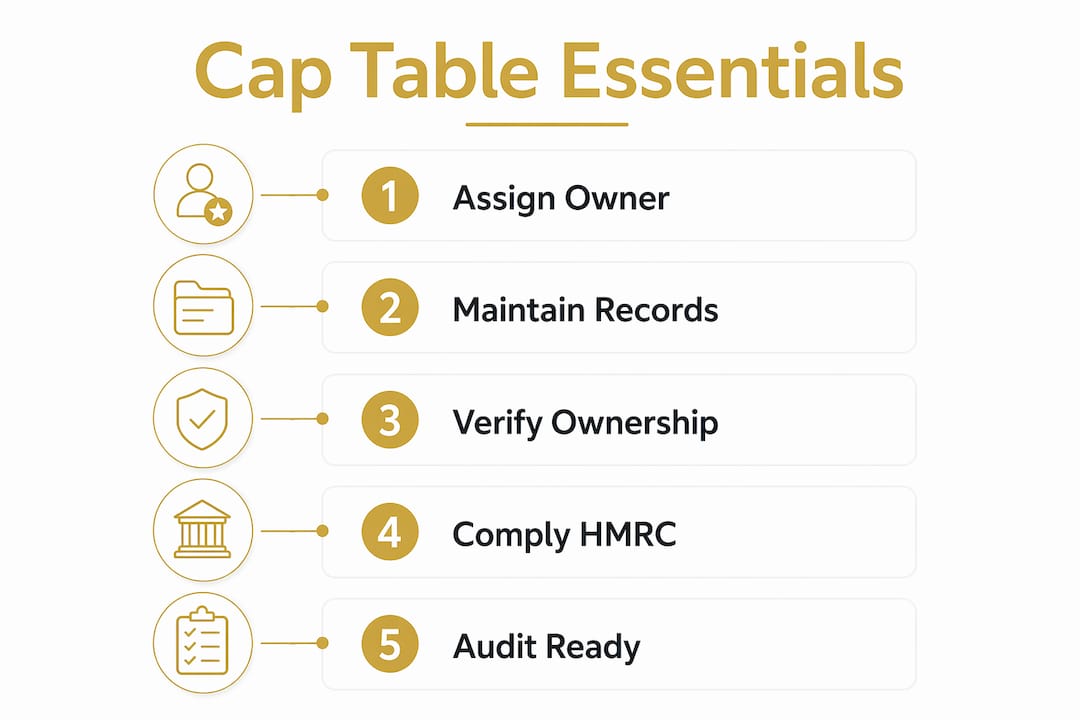
- Appoint a cap table owner — one named individual responsible for all updates and version control
- Collect signed legal documents — shareholder agreements, option grant letters, board minutes, SAFE/note agreements
- Reconcile with Companies House — confirm the register of members matches your internal records exactly
- Verify valuation evidence — confirm any EMI valuation has HMRC approval; document the basis for SAFE caps
- Model SAFE and convertible note conversions — run multiple scenarios (base, upside, downside) before the next round
- Confirm ESOP/EMI compliance — check HMRC notification deadlines, pool size, and any unapproved grants
- Clean dead equity — address departed co-founders and inactive advisors via buyback, cancellation, or accelerated vesting
- Refresh board consents — obtain board minutes approving all outstanding option grants
- Migrate to a single platform — move to cap table software or a managed service once the data is clean
- Schedule quarterly reconciliation — set a recurring review against Companies House and HMRC records
| Phase | Realistic timeline | Typical UK cost band |
|---|---|---|
| Audit and document collection | 1–2 weeks | DIY; Fractional CFO |
| Legal fixes and board consents | 2–4 weeks | Legal counsel |
| Conversion modelling and scenarios | 1 week | Fractional CFO |
| Platform migration and setup | 1–2 weeks | Software; managed: included in CFO fee |
| Ongoing quarterly maintenance | Recurring | Fractional CFO retainer |
How a fractional CFO fixes cap table pain points and speeds fundraising
A fractional CFO brings the technical depth and investor-facing credibility that most founders lack internally. The work goes beyond tidying a spreadsheet.
What a fractional CFO delivers on cap table engagements:
- Full cap table audit against signed legal documents and Companies House filings
- SAFE and convertible note conversion modelling across multiple scenarios
- EMI scheme design and HMRC notification support
- SEIS/EIS structuring advice to protect investor tax relief
- Waterfall and liquidation preference modelling for investor negotiations
- Board minute preparation and governance documentation
- Investor-ready cap table presentation for due diligence data rooms
Consult EFC, led by ICAEW Chartered Accountant Kishen Patel, works with UK SaaS founders and SMEs on precisely this: cap table audits, EMI/HMRC compliance, SAFE modelling, and investor-ready financial presentation. A typical engagement runs on a 30/60/90-day milestone structure: audit and reconciliation in the first 30 days, legal fixes and modelling in days 31–60, and investor-ready output with ongoing maintenance from day 61. For founders thinking about investor-grade financial modelling alongside cap table work, the two are closely linked.
Key takeaways
A fully diluted, audit-ready cap table reconciled against Companies House and HMRC records is the foundation every UK fundraise depends on.
| Point | Details |
|---|---|
| Appoint an owner immediately | One named person controls all updates; multiple versions destroy investor confidence. |
| Model SAFEs and notes early | Run conversion scenarios at issuance, not at the next round close, to avoid unexpected dilution. |
| EMI and SEIS/EIS compliance | Confirm HMRC notification deadlines and share class structuring before approaching investors. |
| Migrate off spreadsheets at the right trigger | Move when you have 10+ stakeholders, 2+ rounds, or any convertible instrument on the table. |
| Consult EFC cap table audit | Consult EFC delivers a 30/60/90-day audit, legal reconciliation, and investor-ready output for UK SaaS and SMEs. |
The cap table lesson most founders learn too late
The founders who arrive at a Series A with a clean cap table did not get lucky. They treated ownership tracking as a governance discipline from day one, not a pre-fundraise fire drill. The ones who did not spend weeks in legal remediation, often at the worst possible moment in a deal timeline.
What I see repeatedly in client work is a specific pattern: a founder who issued SAFEs at seed, never modelled the conversion, and then discovered at Series A that their ownership had dropped materially below what they expected. The fix is not complicated. Model every instrument at issuance, keep one version of the table, and reconcile it quarterly against your legal documents and Companies House filings. The discipline takes an hour a quarter once the table is clean. The cost of skipping it can be measured in a 3–5% loss of equity.
Equity splits structured on emotion rather than contribution and long-term risk are another recurring issue. Investor-ready startups show logical splits with reverse vesting, not equal founder shares with no cliff.
Consult EFC: fractional CFO cap table support for UK SaaS and SMEs
For UK SaaS founders and SME owners who need their cap table investor-ready without the cost of a full-time CFO, Consult EFC provides exactly that: ICAEW-level technical rigour, delivered fractionally.
The firm’s cap table services cover the full scope: audit and reconciliation, EMI scheme design and HMRC compliance, SAFE and convertible note modelling, SEIS/EIS structuring, Companies House filing support, and investor-ready waterfall analysis. Kishen Patel and the Consult EFC team work on a structured engagement model, so founders know exactly what they are getting and when.
If your cap table is not audit-ready, the time to fix it is before investors ask. Book a discovery call with Consult EFC to start a cap table audit, or explore the full fractional CFO services to understand how ongoing financial leadership fits your stage.
Useful sources and further reading
- HMRC: Enterprise Management Incentives (EMI) — primary guidance on EMI notification deadlines, valuation approval, and compliance requirements
- Companies House: register of members and share filings — the authoritative source for reconciling your cap table against statutory records
- HMRC: SEIS and EIS guidance — essential reading before structuring share classes for investor tax relief
- Consult EFC: cap table clean-up for UK founders — EMI, HMRC, and SEIS/EIS checklist tailored to UK SaaS and SME fundraising
- Consult EFC: common cap table mistakes — practical guide to the errors that appear most often in UK engagements
- Consult EFC: EIS for startups — guidance on structuring SEIS/EIS-compliant rounds and protecting investor relief
- Startup funding explained for founders — partner resource covering funding stages and when to prepare your cap table for each round
This article is general information for UK founders and does not constitute legal, tax, or financial advice. Confirm current HMRC rules, Companies House requirements, and EMI/SEIS/EIS eligibility with a qualified chartered accountant or legal adviser for your specific situation.
Recommended
- What Exit Readiness Means for UK Founders | Consult EFC
- Cap Table Mistakes That Stall Fundraises in 2026 | Consult EFC
- Business fund raising: your 2026 UK founder’s guide
- Management Buyouts Explained: A Founder’s Guide
Not sure where your business stands right now?
Book a free 30-minute call with Kish. Bring your numbers, your questions, or just your situation. You will leave with a clearer picture than you arrived with.
Book a Free Strategy Call
Over 12 years across Big Four audit, Investment Banking, and corporate advisory. Kish works with SaaS founders, tech companies, and ambitious UK SMEs from £1M to £50M in revenue on fundraising, valuations, exit planning, and financial strategy. ICAEW regulated. Big Four trained. Based in London.