

Company valuation is the systematic estimation of a business’s economic worth, derived from financial performance, market comparisons, and asset assessments. For business owners, understanding how to value a company is not an academic exercise. It determines how much funding you can raise, what price you can negotiate in a sale, and how credibly you can plan for succession or exit. The result is always a range, not a single number, and knowing why that range exists gives you real negotiating power.
What are the main business valuation methods?
Three primary approaches underpin every professional company worth assessment: the market approach, the income approach, and the asset-based approach. That requirement exists because no single method tells the complete story.
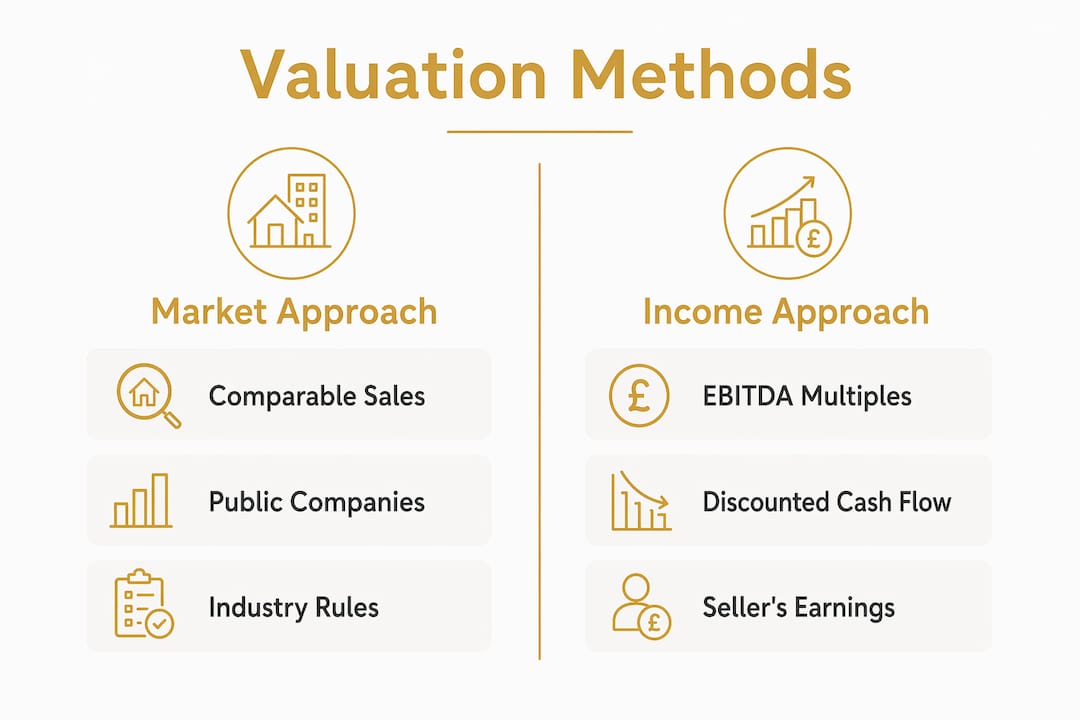
The market approach compares your business to similar companies that have recently sold or are publicly traded. It produces multiples based on earnings or revenue, which are then applied to your own financials. The income approach projects future cash flows and discounts them back to a present value. The asset-based approach values the net assets on your balance sheet, adjusted to fair market value. This method suits asset-heavy or holding companies more than trading businesses.

| Method | Typical application | Key data needed |
|---|---|---|
| EBITDA multiple | Profitable SMEs, lower middle market | Normalised EBITDA, comparable transactions |
| SDE multiple | Owner-operated businesses under £1M EBITDA | Seller’s discretionary earnings, deal comps |
| Revenue multiple (EV/ARR) | SaaS, pre-profit, high-growth firms | Annual recurring revenue, growth rate |
| Discounted cash flow (DCF) | Any business with forecastable cash flows | 5–10 year projections, WACC, terminal growth |
| Net asset value | Asset-heavy, property, or holding companies | Balance sheet, fair market asset values |
Industry-specific rules of thumb offer quick sanity checks but must be corroborated with multiples or income approaches for accuracy. A rule of thumb for a dental practice or a recruitment firm gives you a starting point, not a defensible number.
How do EBITDA, SDE, and revenue multiples work?
Multiples-based valuation is the dominant method in the lower middle market. EBITDA multiples account for over 75% of M&A valuation practice for founder-owned businesses with £1M or more in EBITDA, with typical ranges of 4–15 times earnings depending on sector. That wide range reflects how much buyers pay for quality, not just size.
For smaller owner-operated businesses, the Seller’s Discretionary Earnings (SDE) method is the standard. SDE multiples typically range from 1.5 to 5 times earnings for businesses below the £1M EBITDA threshold. SDE adds back the owner’s salary and personal benefits to reported profit, reflecting the total economic benefit the owner extracts from the business.
Revenue multiples are the preferred benchmark for SaaS and high-growth pre-profit companies that lack positive earnings. Metrics like EV/ARR (enterprise value divided by annual recurring revenue) allow buyers to price growth potential rather than current profitability. The key SaaS metrics that drive these multiples include net revenue retention, growth rate, and gross margin.
Several factors push multiples up or down:
- Industry and sector. Technology and healthcare attract higher multiples than traditional manufacturing or retail.
- Revenue growth rate. Faster growth commands a premium, particularly for SaaS businesses.
- Customer concentration. A business where one client represents 40% of revenue carries more risk and attracts a lower multiple.
- Management depth. Buyers pay more for businesses that do not depend entirely on the founder.
- Recurring revenue. Predictable, contracted income reduces buyer risk and supports higher multiples.
Pro Tip: Always normalise earnings before applying any multiple. Normalised EBITDA adds back one-off costs, owner perks, and non-recurring items to reflect true maintainable earnings. Failing to do this can materially distort your valuation in either direction.
What is discounted cash flow (DCF) valuation and how does it complement multiples?
DCF valuation is the income approach in its most rigorous form. DCF projects free cash flows for 5–10 years, applies a terminal value to capture value beyond the forecast period, and discounts everything back to today using the Weighted Average Cost of Capital (WACC). WACC reflects the blended cost of debt and equity funding, adjusted for risk.
The method’s strength is also its weakness. DCF is the most methodologically defensible approach, but it is highly sensitive to the assumptions you feed it. A 1% change in the terminal growth rate or WACC can shift the output by millions. That sensitivity is why DCF results should always be presented as a range, not a single figure.
DCF works best when triangulated with market multiples. Triangulating results from EBITDA multiples, DCF, and comparable company methods creates a defensible valuation range and cross-checks the underlying assumptions. If your DCF produces a value 40% above your EBITDA multiple result, that gap demands explanation, not averaging.
Pro Tip: Run sensitivity analyses on both WACC and the terminal growth rate. Present your valuation as a matrix showing how the output changes across a realistic range of assumptions. Investors and acquirers will respect the transparency, and you will avoid anchoring to a number that cannot withstand scrutiny.
Structured annual report analysis supports DCF inputs by grounding revenue and margin assumptions in audited historical data rather than optimistic projections.
How to interpret valuation: from enterprise value to owner proceeds
Enterprise value is the headline figure most people focus on. It represents the total operating value of the business before accounting for debt, cash, or deal-specific adjustments. Enterprise value is distinct from owner proceeds, which are reduced by net debt, working capital adjustments, transaction costs, earnouts, and rollover equity. The gap between the two surprises many owners at the point of sale.
The table below illustrates a simplified proceeds bridge for a business with a £5M enterprise value.
| Item | Amount |
|---|---|
| Enterprise value | £5,000,000 |
| Less: net debt | (£800,000) |
| Less: working capital shortfall | (£150,000) |
| Less: transaction costs (legal, advisory) | (£200,000) |
| Deferred consideration (earnout) | (£300,000) |
| Estimated cash proceeds at completion | £3,550,000 |
Earnouts defer part of the purchase price, contingent on future performance. Rollover equity requires the seller to reinvest a portion of proceeds into the acquiring entity. Both reduce the cash you receive on day one. Understanding this bridge before you enter negotiations means you can structure the deal to protect your actual outcome, not just the headline number.
Valuation is a negotiation anchor, not a guaranteed outcome. The final price depends on buyer strategy, due diligence findings, and market conditions at the time of the transaction.
What do business owners need to know when preparing for valuation?
Preparation determines whether your valuation holds up under scrutiny. The single most common mistake is presenting unadjusted management accounts without normalising for owner-specific costs. Buyers will make those adjustments themselves, and they will not do so in your favour.
A structured preparation process covers these areas:
- Normalise your earnings. Remove one-off costs, personal expenses run through the business, and non-recurring income. Present a clean, maintainable EBITDA or SDE figure.
- Improve the quality of your reporting. Monthly management accounts, board packs, and KPI dashboards signal a well-run business. Poor reporting raises due diligence risk and depresses multiples.
- Understand market conditions. Sector multiples shift with interest rates, deal volumes, and buyer appetite. A business worth 8x EBITDA in one market cycle may attract 6x in another.
- Cross-check your methods. Use at least two approaches and compare the outputs. A large gap between your DCF and your market multiple result signals an assumption worth revisiting.
- Seek professional advice early. Formal valuations for M&A, funding, or legal purposes require a qualified professional. Rigorous financial due diligence protects deal value and reduces the risk of post-completion price adjustments.
Pro Tip: Start preparing 12–24 months before any planned transaction. Buyers pay for track record, not potential. Clean financials over two or three years carry far more weight than a single strong year.
Valuation is a structured analysis process, not guesswork. It requires documented method choices and a range of outputs, not a single confident number.
Key takeaways
A defensible company valuation requires triangulating at least two methods, normalising earnings, and understanding the gap between enterprise value and actual cash proceeds.
| Point | Details |
|---|---|
| Use multiple methods | Triangulate EBITDA multiples, DCF, and comparable transactions to produce a credible range. |
| Normalise earnings first | Adjust reported profit for owner perks and one-off items before applying any multiple. |
| Enterprise value is not proceeds | Net debt, transaction costs, and earnouts reduce cash received well below the headline figure. |
| Multiples vary by business type | EBITDA multiples suit profitable SMEs; SDE suits smaller firms; EV/ARR suits SaaS and pre-profit companies. |
| Prepare at least 12 months early | Clean, consistent financials over multiple years support higher multiples and smoother due diligence. |
Valuation is a range, not a verdict
The most persistent mistake I see business owners make is treating their valuation as a fixed number. They receive an indicative figure from an adviser or a rule of thumb from an industry contact, and they anchor to it completely. When the buyer’s offer comes in lower, or the due diligence process surfaces adjustments, it feels like a betrayal. It is not. It is how valuation works.
Every method I use with clients at Consult EFC produces a range. DCF outputs shift with WACC assumptions. EBITDA multiples move with sector sentiment. The gap between those outputs is not a problem to solve. It is information. It tells you where the uncertainty lives and which assumptions matter most.
What I have found consistently is that owners who understand the mechanics of their own valuation negotiate better. They can challenge a buyer’s normalisation adjustments with evidence. They can explain why their recurring revenue justifies a premium multiple. They can assess whether an earnout structure is fair or punitive. That knowledge does not come from a single valuation report. It comes from working through the numbers with someone who can explain the reasoning behind each figure.
The other thing worth saying plainly: market conditions matter as much as your financials. A business with strong EBITDA growth can still attract a lower multiple in a high-interest-rate environment because buyers’ cost of capital rises and deal volumes fall. Timing a sale is a financial decision, not just an operational one. Start the preparation early, understand the methods, and treat the valuation as the beginning of a conversation, not the end of one.
— Kishen Patel
How Consult EFC supports UK businesses through valuation
Knowing your business’s worth is one thing. Presenting it credibly to investors, acquirers, or lenders is another.
Consult EFC works with UK scaleups and SMEs at every stage of the valuation process, from building the financial models that underpin a DCF to preparing the normalised earnings schedules that support a sale. As an ICAEW Chartered Accountant, Kishen Patel brings the rigour of Big Four advisory to businesses that need senior financial guidance without a full-time CFO cost. Whether you are preparing for a funding round, assessing an acquisition offer, or planning an exit, Consult EFC’s fractional CFO services give you the financial clarity to negotiate from a position of strength. You can also learn more about what a fractional CFO does and whether the model fits your current stage.
FAQ
What is company valuation?
Company valuation is the process of estimating a business’s economic worth using financial performance, market comparisons, and asset assessments. It produces a range of values rather than a single fixed figure.
Which valuation method is most commonly used for SMEs?
EBITDA multiples are the dominant method for profitable SMEs with over £1M in EBITDA, accounting for over 75% of lower middle-market transactions. Smaller owner-operated businesses typically use SDE multiples instead.
How does enterprise value differ from what the owner receives?
Enterprise value is the total operating value of the business before deductions. Owner proceeds are reduced by net debt, working capital adjustments, transaction costs, and any deferred consideration such as earnouts.
When should a business owner get a formal valuation?
A formal valuation is advisable at least 12–24 months before a planned sale, funding round, or succession event. Early preparation allows time to address weaknesses that would otherwise reduce the final figure.
What is the difference between EBITDA and SDE?
EBITDA measures operating profit before interest, tax, depreciation, and amortisation. SDE adds back the owner’s salary and personal benefits, making it the standard metric for smaller owner-operated businesses where the owner’s compensation is part of the total return.
Recommended
- Business Valuation Guide 2026: How to Value Your UK Company Like a Pro
- Business Valuation Services | Consult EFC
- Business Valuation for Pre-Revenue Start-ups (2026 Guide)
- Business Valuation Guide: How Much Is Your Business Worth?
Not sure where your business stands right now?
Book a free 30-minute call with Kish. Bring your numbers, your questions, or just your situation. You will leave with a clearer picture than you arrived with.
Book a Free Strategy Call
Over 12 years across Big Four audit, Investment Banking, and corporate advisory. Kish works with SaaS founders, tech companies, and ambitious UK SMEs from £1M to £50M in revenue on fundraising, valuations, exit planning, and financial strategy. ICAEW regulated. Big Four trained. Based in London.