


What is an EMI valuation and why does it matter?
An EMI valuation is the process of agreeing the market value of shares with HMRC, establishing the price at which options are granted under an Enterprise Management Incentive scheme. Without it, employees face uncertain tax treatment at exercise, and companies expose themselves to disputes as valuations grow.
The 2026 eligibility criteria require companies to be independent, hold gross assets under £30m, and employ fewer than 250 full-time equivalent staff. Banking, insurance, and legal services are excluded. Individual employees may hold options up to a UMV of £250,000, and from 6 April 2026 the company-wide limit for unexercised EMI options rises to £6 million, doubled from the previous £3 million.
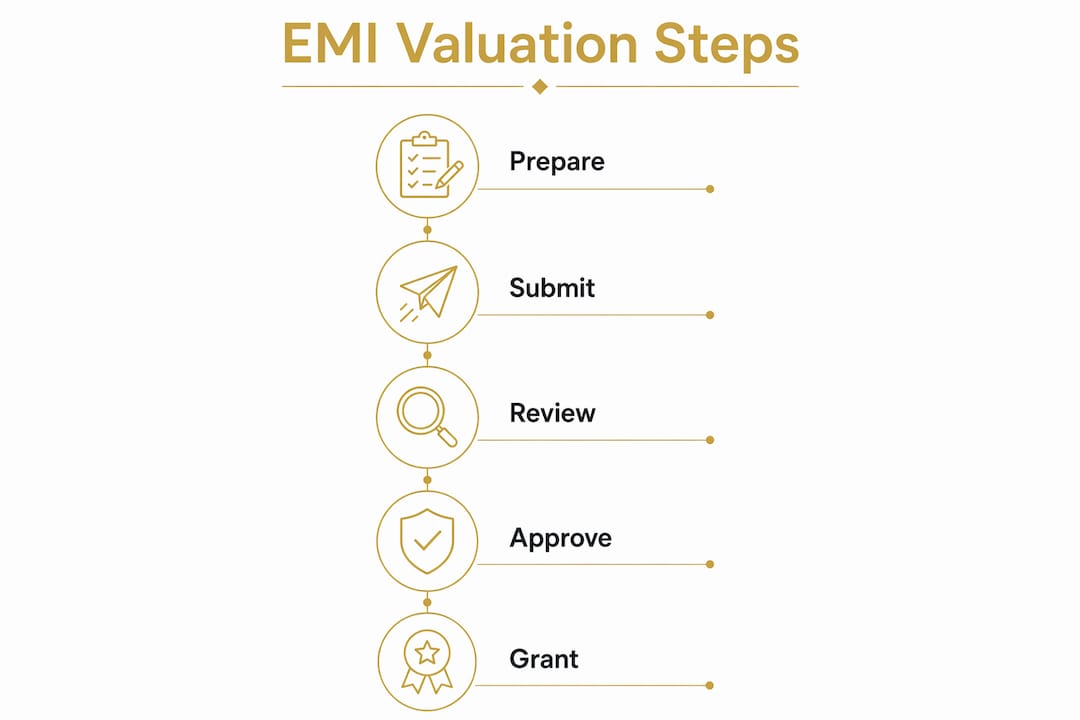
The process runs in three stages: prepare a formal valuation report, submit UMV and AMV proposals to HMRC using form VAL231, then receive written agreement from the Shares and Assets Valuation (SAV) team. HMRC prioritises EMI submissions and typically responds within 2–4 weeks. The agreed valuation is then valid for 90 days.
Key points at a glance:
- UMV values shares as if unrestricted; AMV reflects real-world transfer restrictions and sets the income tax point on exercise.
- Failing to secure agreement risks costly tax disputes as company value grows between grant and exercise.
- Professional advisors with ICAEW Chartered Accountant credentials, such as Consult EFC, bring the technical rigour HMRC expects.
Table of Contents
- How to prepare and submit an EMI valuation to HMRC
- Which valuation methods work best for EMI reports?
- Common questions from UK SMEs and SaaS founders
- What has changed for EMI valuations since 2026?
- Consult EFC handles EMI valuations for scaling UK businesses
- Key takeaways
How to prepare and submit an EMI valuation to HMRC
Getting the submission right matters more than getting it in quickly. HMRC’s SAV team scrutinises reports rigorously and expects defensible logic that reflects the company’s current circumstances, not aspirational projections.
Preparation steps:
- Confirm the company meets all 2026 eligibility criteria before starting.
- Prepare management accounts; stale published accounts are insufficient for a credible report.
- Calculate both AMV and UMV separately, documenting the basis for any discount applied.
- Complete form VAL231 in full and sign it — unsigned forms are rejected outright.
- Submit by email to the SAV mailbox for the fastest turnaround.
- Monitor the 90-day validity window; grants made after expiry require a fresh submission.
- After any significant event (new funding round, dividend declaration, flotation preparations), reapply before issuing further options.
Pro Tip: Submit only when the company is genuinely ready to grant options. Premature submissions that require resubmission after a funding round waste the 90-day window and create inconsistencies HMRC will question.
The 90-day clock is a genuine operational risk for high-growth SaaS firms, where funding rounds can close quickly. Build the valuation timeline into your option grant planning, not as an afterthought.
Which valuation methods work best for EMI reports?
The valuation methodology must be defensible, internally consistent, and grounded in comparable market data. HMRC’s own guidance illustrates several approaches.
AMV is typically calculated using:
- Earnings per share multiplied by a price-to-earnings ratio, discounted to reflect a minority holding in an unquoted company.
- Dividend yield cross-check: maintainable dividend divided by an adjusted yield percentage.
- EBITDA multiples for companies carrying significant debt, using enterprise value as the starting point.
- Recent arm’s-length transactions in the company’s own shares, where available.
The UMV then adds back a premium, typically around 20%, to strip out transfer restrictions. Many firms mistakenly propose identical UMV and AMV figures, missing legitimate discounts that reduce employee income tax on exercise. A well-modelled AMV discount of 30% or more is entirely defensible where share transfer vetoes exist.
Choosing the right advisor matters. For high-growth SaaS companies), HMRC reviews valuation logic inconsistencies strictly; a good report tells a coherent valuation story.

| Advisor criterion | Why it matters |
|---|---|
| ICAEW Chartered Accountant qualification | Signals technical credibility to HMRC reviewers |
| Experience with SAV submissions | Reduces back-and-forth and processing delays |
| SaaS and SME sector knowledge | Enables defensible comparable selection |
| Ability to liaise directly with HMRC | Handles queries without involving founders |
Consult EFC combines ICAEW Chartered Accountant expertise with fractional CFO services for scaling firms, integrating valuation work into broader financial strategy rather than treating it as a one-off compliance task.
Common questions from UK SMEs and SaaS founders
Is an EMI valuation legally required? No, but it is standard practice. Granting options without HMRC agreement exposes employees to income tax risk and removes the certainty that makes EMI schemes attractive as a recruitment tool.
How long does HMRC take to respond? The SAV team typically responds within 2–4 weeks for email submissions. Priority handling applies to EMI valuations.
What happens if the valuation expires before options are granted? A fresh VAL231 submission is required. Grants made outside the 90-day window do not benefit from the agreed valuation.
Can the valuation be extended? Yes, by contacting SAV directly. Extensions are not guaranteed and depend on whether company circumstances have changed.
Does a new funding round invalidate the valuation? A completed or actively contemplated arm’s-length share transaction is a significant event requiring reapplication before further options are issued.
What has changed for EMI valuations since 2026?
The most material change for 2026 is the doubling of the company-wide EMI option limit from £3 million to £6 million, effective 6 April 2026. This significantly increases the scheme’s utility for companies with larger headcounts or higher share prices, making EMI viable for a broader range of option grant programmes.
HMRC’s SAV team has also continued tightening its expectations around valuation report quality. Submissions that rely on outdated accounts, ignore the UMV/AMV distinction, or fail to document the basis for comparable selection face longer review cycles. The practical effect is that the bar for a first-pass acceptance has risen, reinforcing the case for professional preparation.
For SaaS firms specifically, the absence of tangible assets and reliance on recurring revenue multiples means the comparable selection methodology carries more weight than in asset-heavy businesses. Rigorous financial reporting, including sound financial modelling, underpins every credible submission.
Consult EFC handles EMI valuations for scaling UK businesses
Getting an EMI valuation right the first time saves weeks of back-and-forth with HMRC and protects your employees’ tax position from day one. Consult EFC, led by ICAEW Chartered Accountant Kishen Patel, delivers technically rigorous EMI valuations built on the same Big Four methodology that HMRC expects, without the full-time cost.
For SaaS founders and SME leaders, Consult EFC integrates the valuation into your wider financial strategy: option scheme design, investor-ready reporting, and exit planning all sit under one advisory relationship. There is no need to coordinate between a standalone valuation firm and your finance function.
Book a consultation to get your EMI valuation prepared and submitted with confidence.
Key takeaways
An EMI valuation agreed with HMRC is the single most effective way to protect employees’ tax position and prevent disputes as company value grows.
| Point | Details |
|---|---|
| 2026 company-wide limit | The unexercised EMI option limit doubles to £6 million from 6 April 2026. |
| 90-day validity window | Agreed valuations expire after 90 days; grants made after this require a fresh VAL231 submission. |
| UMV vs AMV distinction | AMV reflects share restrictions and sets the income tax point; conflating the two misses legitimate employee tax savings. |
| Submission timing | Submit only when ready to grant; premature submissions waste the validity window and invite HMRC scrutiny. |
| Consult EFC | Provides ICAEW-qualified EMI valuations integrated with fractional CFO support for SaaS and SME businesses. |
Recommended
- EMI Share Valuations for UK Founders, HMRC Rules for 2026
- EMI Valuations for UK Companies: The Complete Guide
- EMI Share Valuations: How to Pass HMRC Scrutiny in 2026
- HMRC EMI Share Valuation 2026: How to Price Option Shares | Consult EFC
Not sure where your business stands right now?
Book a free 30-minute call with Kish. Bring your numbers, your questions, or just your situation. You will leave with a clearer picture than you arrived with.
Book a Free Strategy Call
Over 12 years across Big Four audit, Investment Banking, and corporate advisory. Kish works with SaaS founders, tech companies, and ambitious UK SMEs from £1M to £50M in revenue on fundraising, valuations, exit planning, and financial strategy. ICAEW regulated. Big Four trained. Based in London.