


Exit advisory for small business is the multi-year process of preparing a company’s finances, structure, and ownership for a successful transition that maximises the owner’s net proceeds. The industry term for this discipline is exit planning, and it covers far more than simply listing a business for sale. It aligns tax strategy, business valuation, succession arrangements, and personal financial goals into a single coordinated plan. 40% of small business owners plan to retire within the next decade, yet only 8% report being fully prepared to hand over ownership. That gap between intention and readiness is precisely where professional exit advisory makes its greatest impact.
What is exit advisory for small business and why does it matter?
Exit planning is the deliberate preparation of both the business and the owner, and it is conceptually distinct from the act of selling. Selling is an event. Exit planning is a discipline that spans years and touches every part of the business. It covers succession to family or management, sales to third parties, employee ownership schemes, and even orderly wind-downs.
Many owners treat exit planning as something to think about six months before they want to leave. That is the single most expensive mistake a business owner can make. Structural problems discovered late in a sale process kill deals or force price reductions that take years of profit to recover.

The stakes are significant. Nearly 12 million businesses are projected to change hands over the next 15 years, yet 60% lack formal succession plans. Owners who engage professional exit advisory early are the ones who sell, and sell well.
Why start exit planning 3 to 5 years before your planned exit?
Time is the most valuable resource in exit planning. Starting exit planning 3 to 5 years ahead can increase the final sale price by 20–50% compared to owners who list with only 60 days of preparation. That uplift comes from having time to fix the problems that buyers use to justify lower offers.
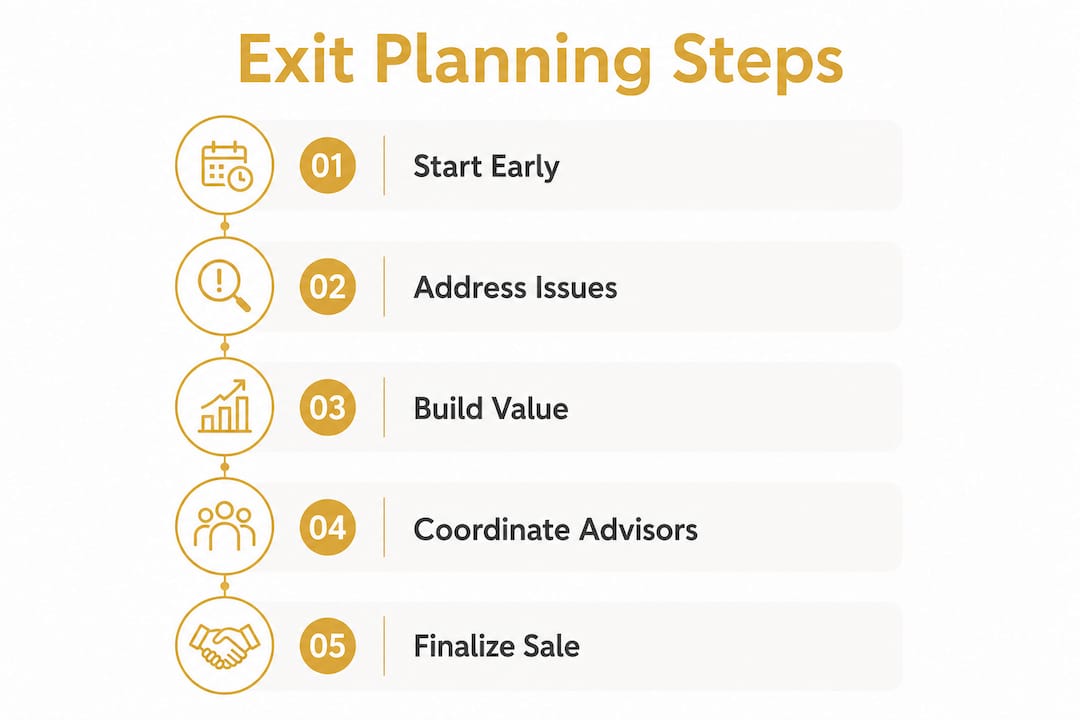
The structural issues that erode value are rarely quick fixes. Customer concentration, weak management depth, undocumented processes, and messy financial records each take months or years to resolve properly. A buyer’s due diligence team will find every one of them.
Only 20–30% of businesses that go to market actually sell. The businesses that fail to sell are almost always the ones where owners started preparing too late. Deal-killing issues surface during due diligence, and by that point, the owner has already invested time, legal fees, and emotional energy into a process that collapses.
The benefits of early engagement include:
- Valuation uplift. Time allows you to build recurring revenue, reduce customer concentration, and document systems that buyers pay a premium for.
- Tax efficiency. Certain tax structures require years of preparation to qualify. Leaving this to the last moment means paying more tax than necessary.
- Negotiating strength. An owner who is not desperate to sell holds the power in any negotiation. Early planning creates that position.
- Deal certainty. Buyers pay more for businesses that are ready. Clean financials, clear contracts, and a capable management team all reduce buyer risk and support a higher price.
Pro Tip: Treat value-building as a continuous ownership responsibility from day one. Life events, health changes, and market shifts can accelerate your exit timeline without warning. The owners who achieve the best outcomes are those who are always ready to sell, even when they have no immediate plans to do so.
Who should be in your exit advisory team?
No single adviser covers the entire exit process. The most successful exits involve a coordinated team of specialists, each contributing expertise that the others cannot replicate. Assembling this team early, rather than scrambling at the point of sale, is what separates a clean exit from a chaotic one.
The core roles in a well-structured exit advisory team are:
- Chartered accountant or CPA. Handles transaction tax modelling, identifies the most tax-efficient deal structure, and prepares the financial documentation that buyers scrutinise. Tax-efficient deal structuring including instalment sales and trust vehicles often requires years of preparation to be effective.
- Business valuation specialist. Produces an independent, third-party valuation that separates the owner’s expectations from what the market will actually pay. This is the foundation of any realistic exit plan.
- Estate planner or solicitor. Structures ownership through appropriate legal vehicles, addresses inheritance considerations, and ensures the exit aligns with the owner’s broader estate objectives.
- Financial planner. Models post-exit cash flow, retirement income requirements, and investment strategy so the owner knows exactly what they need from the sale to fund the life they want afterwards.
- Fractional CFO. Provides ongoing financial leadership across the full advisory period, coordinating the team, building investor-ready reporting, and ensuring the business’s financial function can withstand buyer scrutiny. Consult EFC occupies this role for UK SMEs preparing for exit.
Pro Tip: Brief all your advisers on each other’s work. Siloed advice creates gaps. A tax structure that looks efficient in isolation can conflict with your estate plan or undermine your valuation. Integrated planning catches these conflicts before they become expensive.
What are the main exit options for small businesses?
Effective exit advisory balances competing goals: maximising sale price, preserving company culture, supporting employee retention, and aligning with family interests. The right exit route depends on which of these priorities matters most to you, and the advisory process exists to help you make that choice clearly.
The three most common exit paths for UK small business owners are a sale to a third party, a succession to family or management, and an employee ownership trust (EOT).
| Exit route | Tax position | Liquidity | Legacy control | Complexity |
|---|---|---|---|---|
| Sale to strategic buyer | Capital Gains Tax applies; Business Asset Disposal Relief may reduce rate | High, often immediate | Low post-sale | Moderate to high |
| Management buyout (MBO) | Similar CGT treatment; structured payments common | Moderate, often staged | Moderate during transition | High |
| Family succession | Inheritance tax and gift considerations apply | Low to moderate | High | High |
| Employee Ownership Trust | Significant CGT exemption available in the UK | Moderate, often deferred | High, culture preserved | High |
A sale to a strategic or financial buyer typically delivers the highest immediate cash return. The buyer pays a premium for synergies or market position, and the owner exits cleanly. The trade-off is loss of control over what happens to the business and its people afterwards.
Family succession preserves legacy but introduces complexity around fair treatment of non-business family members, management capability, and funding the departing owner’s retirement. Without careful planning, it can create family conflict and leave the owner financially exposed.
Employee Ownership Trusts have grown significantly in the UK following generous tax treatment introduced by HMRC. Qualifying sales to an EOT are exempt from Capital Gains Tax for the seller, and the business remains in the hands of the people who built it. The exit planning process must be tailored to each route, because the financial, legal, and tax preparation required differs substantially between them.
How does exit advisory integrate tax, valuation, and personal planning?
The three disciplines of tax planning, business valuation, and personal financial planning must work together. When they operate independently, owners routinely discover late in the process that their tax structure undermines their valuation, or that the sale proceeds will not fund the retirement they planned.
An independent, third-party valuation early in the process separates the owner’s hopes from market realities and strengthens the negotiating position. Owners who commission a valuation three or more years before sale have time to act on its findings. Those who commission one at the point of listing simply discover what they are worth, with no time to change it.
Tax planning during the exit advisory period focuses on:
- Structuring the business to qualify for available reliefs, including Business Asset Disposal Relief in the UK.
- Considering whether an instalment sale or deferred consideration structure reduces the immediate tax burden.
- Using trust vehicles where appropriate to support estate planning alongside the business exit.
- Timing the sale to align with the owner’s personal tax position in a given year.
Personal financial planning closes the loop. The financial planner models the owner’s post-exit income requirements and works backwards to establish the minimum net proceeds needed from the sale. That figure then informs the valuation target and the tax structure. Without this step, owners sometimes accept offers that look large in gross terms but leave them financially short once tax and lifestyle costs are accounted for.
Pro Tip: Commission your independent business valuation at least three years before your target exit date. Use it as a diagnostic tool, not just a price guide. The gaps it reveals are your value-building roadmap for the years that follow.
Key takeaways
Owners who engage exit advisory at least three years before their planned sale consistently achieve higher valuations, cleaner deals, and better post-exit financial outcomes than those who prepare reactively.
| Point | Details |
|---|---|
| Start early | Beginning exit planning 3–5 years ahead can increase sale price by 20–50%. |
| Build a coordinated team | A chartered accountant, valuation specialist, solicitor, and financial planner must work together, not in isolation. |
| Choose the right exit route | Sale, MBO, family succession, and EOT each carry different tax, liquidity, and legacy implications. |
| Commission an independent valuation | An early valuation reveals gaps and sets a realistic price baseline with time to act on findings. |
| Align personal and business goals | Post-exit income planning must inform the valuation target and tax structure from the outset. |
Why most owners leave money on the table at exit
I have worked with founders across the UK who built genuinely excellent businesses and then sold them for far less than they were worth. The reason is almost never the business itself. It is the preparation, or the lack of it.
Owner emotional attachment is the primary blind spot I encounter. Owners know their business intimately, and that intimacy creates a valuation in their head that has little to do with what a buyer’s model will produce. An independent valuation is uncomfortable precisely because it is objective. But that discomfort is the most valuable thing an adviser can deliver.
The second pattern I see is owners treating the sale process as the planning process. The sale itself is a sprint of 3–6 months. By the time you are in that sprint, every major decision that affects your valuation has already been made. The management team is what it is. The customer concentration is what it is. The financial records are what they are. You cannot fix structural problems during due diligence.
What I advocate for is treating exit readiness as part of how you run the business every year. Clean financials, documented processes, a management team that does not depend entirely on you, and a tax structure that was built with an exit in mind. These are not exit tasks. They are ownership disciplines that happen to make you far more valuable when the time comes.
The owners who achieve the best exits are not the ones who worked hardest in the final six months. They are the ones who made good decisions consistently over the preceding five years.
— Kishen Patel
How Consult EFC supports your exit planning
Preparing a business for sale is a multi-year financial undertaking, not a single transaction. Consult EFC works with UK SME owners as a fractional CFO across the full exit advisory period, building the financial rigour, investor-ready reporting, and valuation foundations that buyers expect.

Kishen Patel and the Consult EFC team bring ICAEW Chartered Accountant expertise to every engagement, without the cost of a full-time finance director. Whether you are three years from a planned sale or just beginning to think about your options, Consult EFC can help you build a business that is worth more and ready to sell. Reach out to discuss your exit planning strategy and what a structured advisory process could mean for your final sale price.
FAQ
What is exit advisory for small business?
Exit advisory for small business is the professional process of preparing a company’s finances, structure, and ownership for a successful transition. It covers valuation, tax planning, succession, and personal financial alignment, typically over a 3–5 year period before the planned exit.
How early should I start exit planning?
Starting 3–5 years before your target exit date gives you time to address structural issues, build value, and implement tax-efficient structures. Owners who begin with only 60 days of preparation typically achieve significantly lower sale prices.
What exit routes are available to UK small business owners?
The main options are a sale to a third party, a management buyout, family succession, and an Employee Ownership Trust. Each carries different tax, liquidity, and legacy implications, and the right choice depends on your personal and financial priorities.
Do I need a business valuation before selling?
An independent valuation is one of the most important steps in exit planning. It establishes a realistic price baseline, strengthens your negotiating position, and reveals the gaps you need to address before going to market.
What does a fractional CFO do in an exit advisory process?
A fractional CFO provides ongoing financial leadership across the exit advisory period, coordinating advisers, building investor-ready financial reporting, and preparing the business’s finance function to withstand buyer due diligence. Consult EFC delivers this service for UK SMEs at a fraction of the cost of a full-time hire.
Not sure where your business stands right now?
Book a free 30-minute call with Kish. Bring your numbers, your questions, or just your situation. You will leave with a clearer picture than you arrived with.
Book a Free Strategy Call
Over 12 years across Big Four audit, Investment Banking, and corporate advisory. Kish works with SaaS founders, tech companies, and ambitious UK SMEs from £1M to £50M in revenue on fundraising, valuations, exit planning, and financial strategy. ICAEW regulated. Big Four trained. Based in London.