

Thorough exit preparation consistently delivers materially higher valuations than going to market unprepared, and the 12 months before a sale are where most of that premium gets built. Exit preparation, known in professional practice as exit readiness, is the process of aligning your business’s financial records, operations, legal structures, and management team so that a buyer can trust what they are buying and pay accordingly. It is not the same as the sale process itself. The sale is a sprint of three to six months. Exit readiness is the multi-year discipline that makes the sprint worth running.
For UK business owners, the most common exit routes are:
- Trade sale to a strategic acquirer or private equity buyer
- Management buyout (MBO), where the existing leadership team purchases the business
- Initial public offering (IPO), typically reserved for larger, high-growth businesses
- Family succession, transferring ownership to the next generation
- Liquidation, the least desirable outcome and usually a last resort
Whichever route you choose, the fundamentals are the same: audited financials covering at least three years, documented processes, reduced owner dependency, and a clean legal structure. ICAEW Chartered Accountants, advisers at Consult EFC, and platforms such as Maven, RetierStack, HelloExit, and Dai Magister all point to the same conclusion: businesses that start preparation at least 12 months before going to market achieve materially better outcomes than those that rush.
What exit objectives should you clarify before choosing a strategy?
The single most common planning error is choosing a route before defining what you actually want from the exit. Liquidity, legacy, partial exit, and succession are four genuinely different objectives, and they lead to different strategies with different trade-offs.

A founder who wants maximum cash at close should look at trade sales or private equity. Someone who wants the business to survive intact, with the culture and team preserved, will lean towards an MBO or family succession. A partial exit, where you retain equity and take some chips off the table, suits a recapitalisation or a minority stake sale. These are not interchangeable.
Four primary exit categories cover the full range: internal transfers (MBO, family succession), external sales (strategic acquisitions, private equity), IPOs, and liquidation. IPOs generally yield the highest financial return but demand the most preparation and regulatory compliance. Liquidation is the floor, not a plan.
The trade-offs matter practically. An MBO preserves continuity but typically produces a lower headline price, since the management team is financing the purchase. A trade sale to a strategic buyer can command a premium if your business fills a gap in their portfolio, but you lose control of what happens next. Family succession preserves legacy but can take four to six years to implement properly, particularly if an Employee Stock Ownership Plan (ESOP) is involved.
Pro Tip: Engage a valuation professional before you settle on a strategy. Knowing your realistic market value changes the conversation entirely. Owners who skip this step consistently overprice their businesses, which is the leading reason good businesses fail to sell.
Linking your personal objectives to the right strategy early also shapes everything downstream: the documentation you prioritise, the advisers you engage, the timeline you set, and the tax planning you need to do. Clear objectives do not just feel good on paper. They cut preparation time and reduce the risk of a late-stage deal collapse.
How does the exit preparation process work, step by step?
A well-run exit typically runs across five phases, with the full end-to-end process taking 18–24 months from a standing start. Businesses with clean books and a functioning management team can compress this to 12 months. Most owners underestimate how long the preparation phase takes.
- Valuation and planning (18+ months before sale). Commission a formal business valuation from a qualified adviser. This is not optional. It establishes your income gap, the difference between what you need from the sale and what the market will actually pay, and it defines your entire preparation roadmap. Consult EFC’s 12-month exit plan covers this phase in detail.
- Business preparation (12–18 months before sale). This is the most labour-intensive phase. Clean up your financials: convert to accrual accounting if you are on cash basis, separate personal expenses, and build a properly documented EBITDA add-back schedule. Every £100,000 of defensible EBITDA add-back is worth £500,000–£700,000 in deal value at a 5–7x multiple. Simultaneously, begin reducing owner dependency. Document every recurring decision and process that runs through you, then delegate systematically.
- Deal preparation (6–12 months before sale). Engage a broker or M&A adviser, build your data room, and prepare your Confidential Information Memorandum (CIM). A well-organised data room reduces due diligence time and signals transaction readiness. Common oversights at this stage include missing IP assignments, incomplete customer contracts, and unsigned key personnel agreements.
- Negotiation and close (0–6 months before sale). Evaluate offers carefully. Price matters, but so do cash at close, earnout structures, seller financing, non-compete obligations, and transition requirements. Buyers will use every gap they find in your preparation as a negotiating lever.
- Post-close transition (first 90 days after sale). Honour your transition obligations, support the incoming owner, and manage stakeholder communication carefully. A clean handover protects your reputation and, in earnout structures, your remaining financial upside.
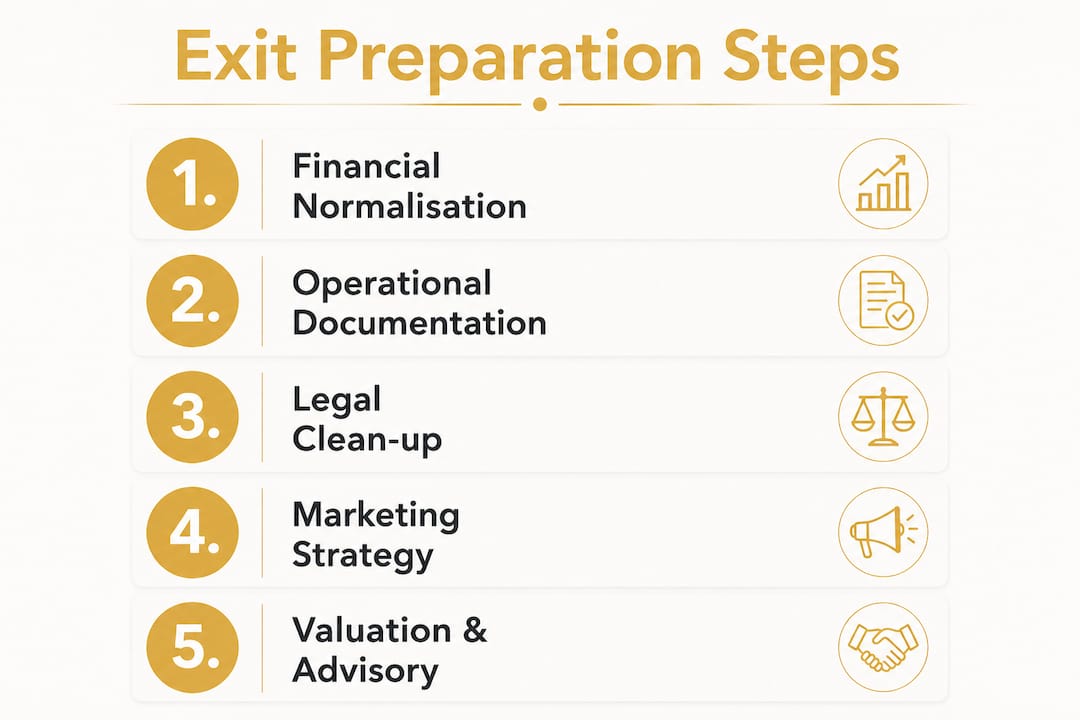
The exit plan checklist across these phases covers financial normalisation, operational documentation, legal clean-up, tax planning.None of these steps is optional for a buyer conducting serious due diligence.
Why does starting early make such a difference to your exit outcome?
Businesses that prepare for 12 months or more sell for significantly more than those that do not.

The biggest single reason for that gap is owner dependency. Removing owner dependency typically takes 6–12 months and is the hardest item to compress. Buyers discount heavily for founders who represent a key client relationship or a single point of operational failure. Building a management team that can run the business without you is not something you can fake in the final weeks before going to market. It has to show up in your financial track record.
Early preparation also gives you time to fix problems rather than disclose them. A pending legal dispute resolved 18 months before sale is a non-issue. The same dispute surfacing in due diligence becomes a price chip or a deal-breaker. The same logic applies to customer concentration, IP assignments, and deferred maintenance.
Exit readiness is also good business stewardship regardless of whether you sell. A business with documented processes, clean financials, and a capable management team runs more efficiently and is easier to step back from. The preparation work creates value whether or not a transaction ever happens.
How do expert advisers and trust signals maximise your exit value?
The difference between a well-advised exit and a self-managed one shows up in the final price. Professional involvement, from fractional CFOs to M&A advisers to specialist accountants, directly affects both the valuation you achieve and the speed at which you close.
Trusted third-party valuations and audited financials give buyers confidence that the numbers are real. A buyer who trusts your financials moves faster and negotiates less aggressively. A buyer who does not trust them will either walk away or extract the uncertainty as a price reduction.
Consult EFC, led by ICAEW Chartered Accountant Kishen Patel, provides fractional CFO services specifically designed for this phase. The firm builds investor-ready financial models, prepares EBITDA normalisation schedules, and supports the full exit readiness process for UK SMEs and SaaS businesses. The value of that kind of engagement is not just the deliverables. It is the credibility it lends to your numbers when a buyer’s adviser is sitting across the table.
Selecting advisers well matters too. For your M&A process, interview at least three brokers before signing. For tax and financial preparation, engage a CPA or chartered accountant with specific transaction experience, not just your regular tax adviser. For legal matters, use a solicitor who has handled business sales at your deal size. The due diligence checklist for UK founders covers the documentation each of these advisers will need from you.
Platforms such as HelloExit offer structured exit readiness tools that help founders identify the gaps most likely to affect buyer confidence. RetierStack provides a phased checklist with auto-saved progress tracking across all five exit phases. These tools are useful for self-assessment, but they complement rather than replace specialist advisory support for a transaction of material size.
What are the tax implications of a UK business exit?
Tax planning is one of the areas where early preparation pays the highest dividend. The structure of your exit, and the timing of key decisions, can make a material difference to your net proceeds.
Business Asset Disposal Relief (formerly Entrepreneurs’ Relief) remains the most significant relief available to UK business owners. It reduces Capital Gains Tax to 10% on qualifying gains up to a lifetime limit of £1 million, provided you meet the ownership and trading conditions. The lifetime limit was reduced from £10 million in 2020, so understanding whether your gain falls within it is a first-order planning question.
The structure of the deal matters as much as the headline price. An asset sale and a share sale carry different tax treatments for both buyer and seller. Buyers typically prefer asset sales because they can step up the tax base of acquired assets. Sellers typically prefer share sales because gains are subject to Capital Gains Tax rather than Income Tax, and Business Asset Disposal Relief may apply. Negotiating the right structure requires a tax adviser involved early, not at the point of signing.
Earn-out arrangements, where part of the consideration is deferred and linked to future performance, create their own tax complexity. Depending on how the earn-out is structured, payments may be taxed as capital gains or as income, with very different effective rates. HMRC’s treatment of earn-outs is not always intuitive, and getting this wrong is expensive.
For family succession, Inheritance Tax Business Property Relief can reduce or eliminate IHT on qualifying business assets, but the conditions are specific and the planning horizon is long. Engaging a specialist well before the transfer is the only way to use this relief effectively.
How should you communicate an exit to stakeholders and employees?
Communication planning is consistently underestimated in transition planning for exit, and the consequences of getting it wrong are real. Employees who hear about a sale through rumour rather than from you will assume the worst. Key staff may leave. Customer relationships can destabilise. Buyers notice all of this.
The sequencing matters. Approach your investors and board first, before any wider disclosure. They need to understand the plan and how their interests are protected. Then move to key employees, particularly those whose retention is critical to the deal. Retention incentives, sometimes structured as stay bonuses tied to close, are a standard tool for this. Finally, communicate to the broader team and, where appropriate, to customers.
Timing the employee announcement requires judgement. Too early and you risk unsettling the business before a deal is certain. Too late and people feel blindsided. A common approach is to inform a small inner circle during preparation, then communicate more broadly once a letter of intent is signed and confidentiality obligations allow.
Customer communication after signing should be led by the incoming owner wherever possible. Introducing the new owner directly to key accounts, rather than sending a letter, preserves the relationship and reduces churn risk. For businesses where customer relationships sit with the founder personally, this transition is one of the most consequential parts of the whole process.
Pro Tip: Build your employee and transition communication plan as part of your exit plan checklist, not as an afterthought. Buyers will ask how you plan to manage it, and a clear answer builds confidence.
Consistency is the governing principle throughout. Employees, customers, and suppliers all respond better to a clear, stable message than to uncertainty. The communication plan should align with your operational transition plan so that what you say and what actually happens are the same thing.
Key takeaways
Thorough exit preparation, started at least 12 months before going to market, is the single most reliable way to maximise sale value and reduce deal risk for UK business owners.
| Point | Details |
|---|---|
| Start at least 12 months early | Businesses prepared for 12 months or more typically achieve 20–35% higher valuations than those unprepared. |
| Remove owner dependency first | Reducing founder reliance typically takes 6–12 months and is the largest single valuation driver. |
| Normalise your EBITDA | Every £100,000 of defensible add-back is worth £500,000–£700,000 in deal value at a 5–7x multiple. |
| Build a data room before you need it | An organised data room shortens due diligence and signals professionalism to serious buyers. |
| Plan tax structure early | Business Asset Disposal Relief, deal structure, and earn-out treatment all require advance planning to use effectively. |
How Consult EFC supports your exit preparation
Consult EFC works with UK SMEs and SaaS businesses at every stage of exit preparation, from initial valuation through to deal close. Led by ICAEW Chartered Accountant Kishen Patel, the firm provides fractional CFO services that deliver Big Four rigour without the full-time cost. That means investor-ready financials, EBITDA normalisation, data room support, and strategic advisory, all from a team that has done this before.
If you are beginning to think about an exit in the next one to three years, the right time to start is now. Explore Consult EFC’s exit planning advisory to understand where your business stands and what it would take to go to market at full value.
Recommended
- Business Exit Strategy UK: The 2026 Guide to a High-Value Sale
- Preparing a UK Business for Sale: How Long It Really Takes
- What Exit Readiness Means for UK Founders | Consult EFC
- Preparing a business for sale checklist: UK SME guide
Not sure where your business stands right now?
Book a free 30-minute call with Kish. Bring your numbers, your questions, or just your situation. You will leave with a clearer picture than you arrived with.
Book a Free Strategy Call
Over 12 years across Big Four audit, Investment Banking, and corporate advisory. Kish works with SaaS founders, tech companies, and ambitious UK SMEs from £1M to £50M in revenue on fundraising, valuations, exit planning, and financial strategy. ICAEW regulated. Big Four trained. Based in London.