

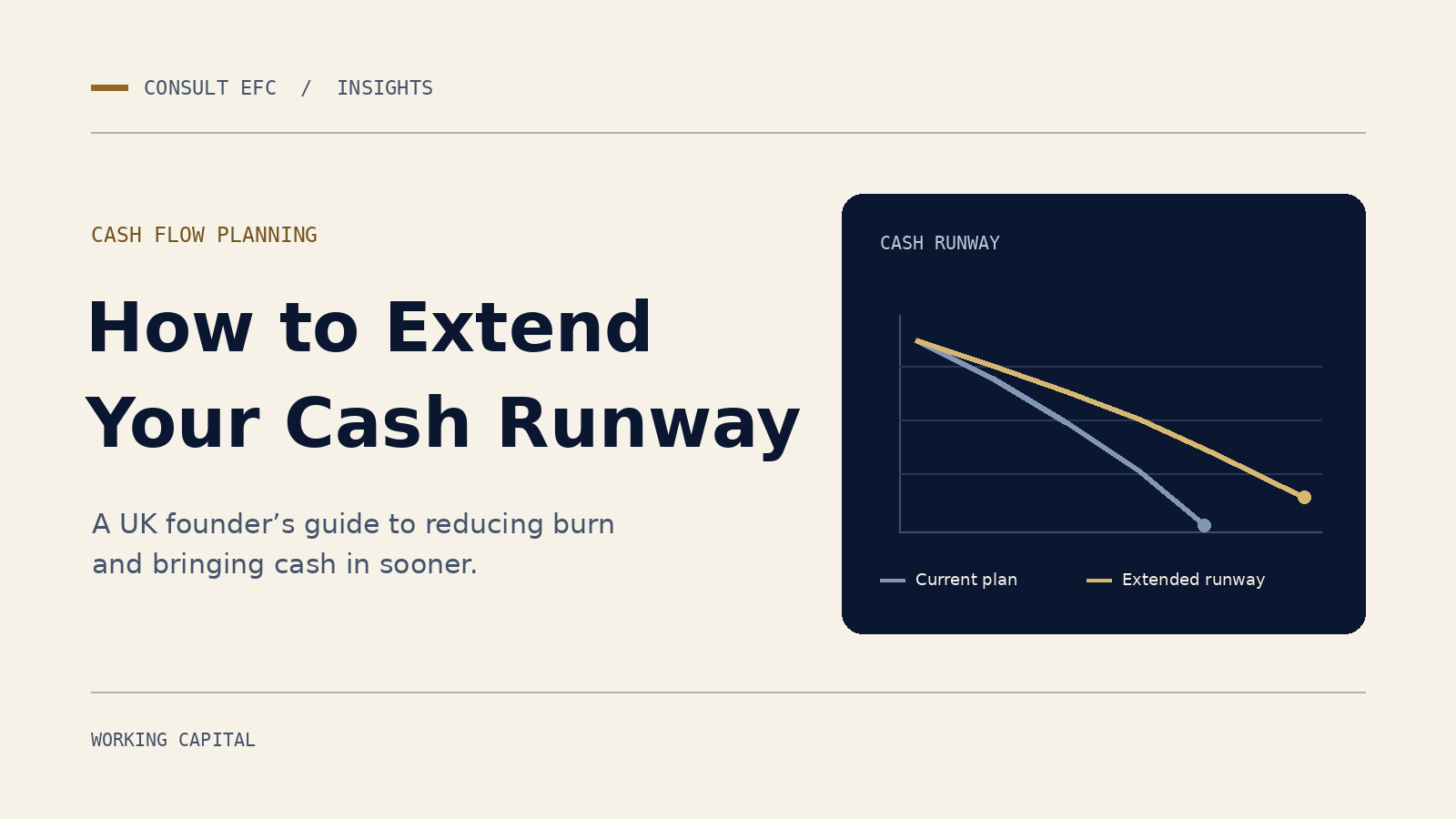
You extend your cash runway in three ways: reduce net burn, bring cash in faster, or add funding. The order matters. Fix the numbers first, because you cannot choose the right lever until you know your true monthly net burn and the month your cash hits its low point. This guide shows how to calculate runway, which costs and receipts to work on, when debt or equity makes sense, and how to present the plan to investors.
TL;DR
- Runway is cash in the bank divided by average monthly net burn. Use net burn, not gross, so revenue is counted.
- Build a month-by-month forecast with base, downside and upside cases, and review it at least monthly. ICAEW recommends a rolling 13-week view for the near term.
- The fastest gains usually come from cost visibility, supplier terms, tighter credit control and moving customers to annual prepayment.
- Venture debt can add a few months of runway with less dilution than equity, but it must be repaid and often carries security and warrants.
- Treat the forecast low point as a decision date, well before the balance reaches zero.
Table of Contents
- How to calculate your runway
- Forecast to find the date cash runs out
- Reduce burn without damaging the business
- Bring cash in faster
- Add funding: debt, equity and non-dilutive options
- Our view: runway is a leadership decision
- Get senior help with your runway plan
- Monitor runway and explain it to investors
- FAQ
- Sources
How to calculate your runway
The calculation is simple: divide the cash you hold by your average monthly net burn. Net burn is cash going out minus cash coming in. HSBC Innovation Banking explains that net burn accounts for revenue, which makes it a more accurate guide to runway than gross burn. It also notes that where spending fluctuates from month to month, many companies use a quarterly, half-yearly or annual average of net burn.
Here is a worked example with illustrative numbers:
| Item | Figure |
|---|---|
| Cash in the bank | £360,000 |
| Monthly cash costs (payroll, hosting, rent, tools) | £78,000 |
| Average monthly cash receipts | £48,000 |
| Net burn | £30,000 |
| Runway | 12 months |
Now stress it. If receipts slip by £8,000 a month because two customers pay late, net burn becomes £38,000 and runway falls to about 9.5 months. A small change in collections moves your cash-out date by more than two months. That is why the headline figure is only a starting point.
What the figure does not show
A flat average hides lumpy payments. A new hire’s full employment cost, quarterly VAT, PAYE, corporation tax, annual software renewals and the month an R&D tax credit actually lands all change the shape of your cash curve. Two businesses with the same average burn can have very different low points. Your real runway ends in the first month the balance cannot cover what is due, not when the average says it should.
Forecast to find the date cash runs out
A runway number is only useful if it comes from a forecast you trust. ICAEW’s guidance on cash-flow pitfalls for scale-ups is to keep a detailed, regularly updated forecast of inflows and outflows on a rolling 13-week basis, reviewed at least monthly. It also says a separate cash-flow management statement can help summarise key risks, upcoming obligations and contingency plans.
The same article makes the point that matters most: it is far better to learn about a problem four or five months out than to be blindsided by one two weeks away. Early warning is what gives you levers to pull.
A practical set-up:
- Start from the actual bank balance at the end of last month, not from last month’s forecast.
- Build bottom-up from drivers such as customers, pricing, headcount and payment terms, rather than applying a growth percentage to last year.
- Run three cases: base, downside and upside. Write down what you would do in the downside, not just the red number it produces.
- Mark the low point and treat that month as a decision date. If you are heading for a pinch, the time to act is when you first see it, not when the account is empty.
- Reconcile monthly against actuals and fix the assumptions that missed.
If you want to see what a short-term view looks like in practice, our 13-week cash flow forecast example walks through the layout, and our guide to cash flow forecasting covers the wider method. SaaS founders can go further with SaaS runway planning from seed to Series A.
If there is any risk the company will be unable to pay its debts as they fall due, take advice from a licensed insolvency practitioner or your accountant promptly rather than waiting for the next forecast cycle.
Reduce burn without damaging the business
Cutting cost is the most direct way to lengthen runway, but blunt cuts can remove the capacity that produces revenue. The aim is to remove spend that does not support growth or delivery.
ICAEW recommends putting cost management processes in place early, benchmarking spend against historical data, negotiating with suppliers, reviewing variable and fixed costs regularly, naming budget owners, requiring pre-approval for discretionary spend and tracking variances monthly. It also suggests part-time or seasonal hiring for large spending commitments.
The British Business Bank’s start-up to scale-up guide adds a useful test: before taking on a new cost, consider how strongly it supports growth. It points to software, outsourcing choices and careful hiring as areas where costs can be kept manageable.
In practice, we would work through the cost base in this order:
- Software and tools. List every subscription, who uses it and what it costs per month. Overlapping tools and unused seats are the quickest savings, and they hurt no one.
- Suppliers and contracts. Renegotiate renewals, ask for quarterly rather than annual terms where that eases cash, or consolidate vendors.
- Premises. If rent is disproportionate to the business, flexible space may cost less.
- Hiring. Delay roles that do not unlock revenue in the next two quarters, and consider contractors or part-time cover for peaks.
- Discretionary spend. Put an approval step on anything non-essential, with one named owner per budget line.
Protect the spend that drives acquisition efficiency and retention. Cutting the activity that brings in next quarter’s receipts can shorten runway rather than extend it.
Good controls make this easier to sustain. Our guides to financial controls for startups and financial controls for growing UK SMEs set out approval limits, budget ownership and month-end routines that stop burn creeping back up.
Bring cash in faster
Runway is a function of timing as much as totals. Many growing companies spend cash on delivery before customers have paid, so growth itself can drain the account.
Collect what you are owed
Start by looking at the debtor ledger by age. Send invoices on the day work is delivered, ask for deposits where the market allows it, and chase promptly and politely when the due date passes. Where payment terms with suppliers are fixed in your favour, negotiate extended terms; where they are not, find out what is possible before you need it. Streamlined invoicing and billing processes shorten the time to cash, as Deloitte UK has recommended in its guidance on cost and cash management.
Move SaaS customers to annual billing
For subscription businesses, annual prepayment is one of the strongest levers. It brings twelve months of cash forward and locks the customer in for the year. One published pricing experiment by Remery reported that a 20% discount for annual payment lifted annual sign-ups by 342%, raised average customer lifetime value from £420 to £680 and cut churn from 6.2% for monthly customers to 2.8% for annual ones. That is one company’s result, not a promise for yours, and a discount costs margin, so model the trade-off before you offer it: what you lose on price against what you gain in upfront cash and retention.

Report recurring revenue honestly
When you forecast recurring revenue, the UK Business Angels Association advises building it in parts: opening balance, new business, churn and expansion, never merged into one net figure. Showing only the net movement can hide strong new sales masking a retention problem. Churn is a runway issue as much as a growth one, because every customer lost has to be replaced just to stand still. For more on this, see our guide to SaaS forecasting.
Add funding: debt, equity and non-dilutive options
Funding extends runway but changes your obligations, so match the instrument to the problem.
| Option | What it does for runway | Trade-off |
|---|---|---|
| Equity round | Adds cash with no repayment | Dilution and a longer process |
| Venture debt | Typically 3 to 9 months of extra runway | Repayable, often secured, may carry warrants |
| Grants and innovation funding | Adds cash without giving up equity | Eligibility rules and application effort |
| Crowdfunding | Raises from many small investors | Takes campaign time and public disclosure |
Venture debt
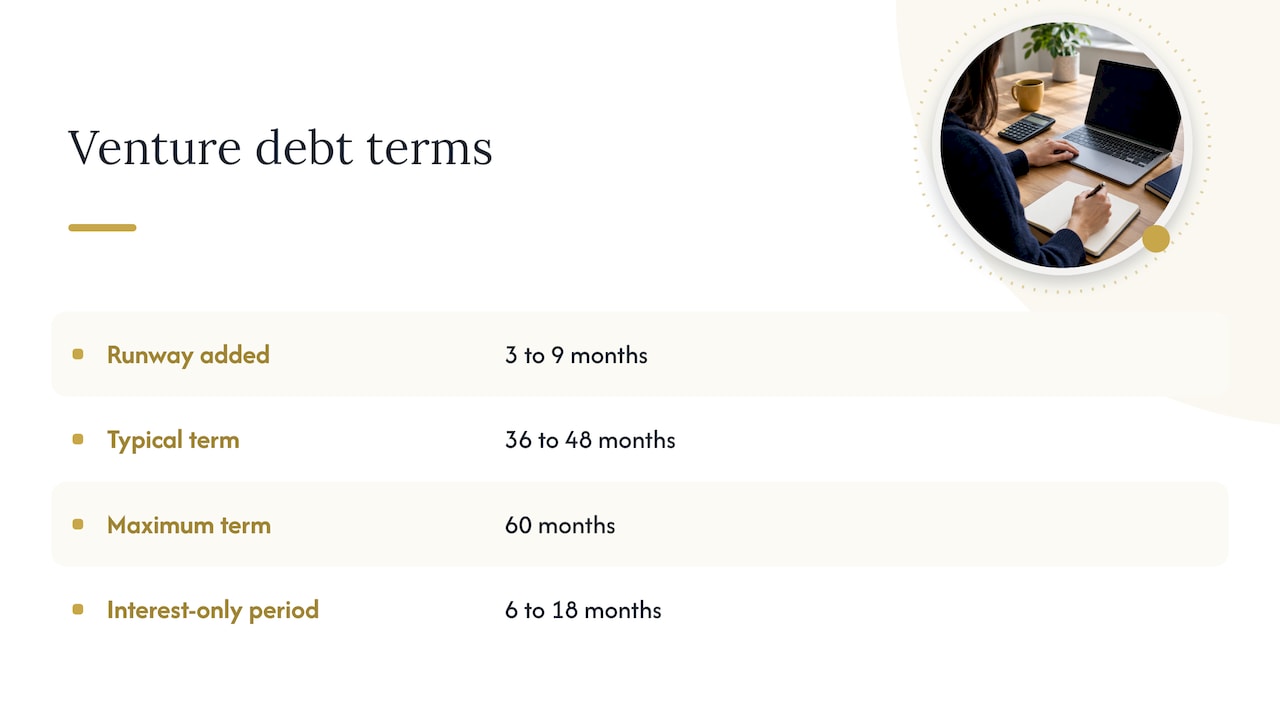
According to HSBC Innovation Banking, venture debt is often used to provide 3 to 9 months of runway to reach the next funding round or a strategic milestone. It says terms are typically 36 to 48 months, up to a maximum of 60, with an interest-only period of 6 to 18 months followed by amortisation. It is less dilutive than equity, but it must be repaid and may involve security and warrants, which can dilute ownership if exercised.
The important point is to look at total cash impact. Because it amortises, repayments will eat into the runway the loan bought. Add up interest, fees, and any warrants or terminal bonus before you compare it with an equity round. Our guides to debt versus equity funding and what lenders check on SME debt finance cover how to assess both routes.
Non-dilutive routes
Wise’s UK guide on extending your startup funding runway lists government grants, crowdfunding and strategic partnerships as ways to add cash without giving up equity, and identifies Innovate UK as the national innovation agency and a major source of support. If your team does qualifying technical work, R&D tax relief may also bring cash back; see our guide to R&D tax credits for SaaS, and build the month the claim is paid into your forecast so the timing is not a surprise.
If you are raising equity
Investors now look closely at how long the money lasts. Size the round to reach a meaningful milestone with room to spare, and make sure the model behind it stands up. GOV.UK’s Financial Model Essentials says a robust model should include at least two years of historic data and five years of forecast, covering revenue, gross margin progression, operating expenses, EBITDA, cash runway, breakeven analysis and funding requirements. It adds that investors will compare historic performance with past forecasts to judge your track record. Our guides to financial modelling for tech startups and pre-seed versus Series A financial models show how the model should change as you grow.
Our view: runway is a leadership decision
Most founders treat runway as a number on a dashboard. We treat it as a decision calendar. The useful question is never “how many months do we have?” but “by which month must we have chosen what to do, and what will we know by then?”
In our experience the businesses that extend runway well do three things early. They build a forecast driven by operating assumptions rather than hope. They agree in advance what the downside case triggers, whether that is a hiring pause, a supplier renegotiation or opening a debt conversation. And they present the same numbers to investors, lenders and their own board, so the story is consistent.
That is the discipline we bring as a fractional CFO: senior, ICAEW-qualified financial leadership applied to your cash, without the cost of a full-time hire. We would rather help you act in month nine of twelve than in month two of three.
Kishen Patel
Get senior help with your runway plan
If you are weighing cuts, a raise or a debt facility and want an experienced finance lead to own the numbers, our fractional CFO services are built for that stage. We can rebuild your forecast, stress-test the downside and prepare the figures investors and lenders will ask for. Where a raise is the answer, our investor-grade financial modelling gives you a model that holds up in diligence.
You can also see the full range of what we do on the Consult EFC site.
Monitor runway and explain it to investors
Review rhythm should follow how close you are to the edge. ICAEW’s baseline is a monthly review of a rolling forecast; as your runway shortens, move to a shorter cycle so you see changes while you can still act. Each review should answer four questions: where did actuals differ from forecast, which assumption was wrong, what has changed in receipts or commitments, and has the low point moved.
When you explain assumptions to investors, the UK Business Angels Association suggests four checks before a revenue forecast goes out:
- Capacity: does the plan need more selling than your team can physically do?
- Market: what share of the addressable market does year three imply?
- Backtest: run the driver model against the last two quarters.
- Downside: halve new business and double churn, then see what remains.
If the plan survives those tests, you can explain it with confidence. If it does not, you have found the problem before an investor did. Our guide to the 2026 financial forecast for startups shows how to lay this out.
FAQ
What is a good cash runway for a UK startup?
There is no single right figure, because it depends on how soon you can raise or reach breakeven. If you plan to raise, aim to have enough runway to complete the process and still reach your next milestone, which in practice means starting a raise well before the last six months. Your forecast low point is a better guide than a fixed number of months.
Should I use gross burn or net burn to calculate runway?
Use net burn. It subtracts your revenue from your outgoings, so it reflects the cash you actually lose each month. Gross burn is still useful for seeing your total cost base, but it understates runway for any company with income.
How often should I update my cash flow forecast?
At least monthly, reconciled against actuals, with a rolling 13-week view for the near term, as ICAEW recommends. If cash is tight, review more often so you can act on changes in receipts or commitments quickly.
Does venture debt extend runway more than equity?
Not necessarily. It is typically used to add around 3 to 9 months and avoids the dilution of a new equity round, but it must be repaid, may be secured and can include warrants. Compare the total cash cost and repayment schedule with what an equity round would cost in ownership.
Can annual billing really extend runway?
Yes, because it brings a year of cash forward and can improve retention. The effect depends on your customers and the discount you offer, so model the margin cost against the upfront cash before changing pricing.
Sources
- Understanding your burn rate, HSBC Innovation Banking
- Cash-flow pitfalls for scale-ups, ICAEW
- Start-up to scale-up guide, British Business Bank
- 17 SaaS pricing experiments, Remery
- Revenue forecasting for startups, UK Business Angels Association
- Venture debt, HSBC Innovation Banking
- How to extend your startup funding runway, Wise
- Financial Model Essentials, GOV.UK
Recommended
- SaaS Runway Planning: Seed to Series A
- Cash Runway Stress Test
- 13-Week Cash Flow Forecast Example UK
- Financial Controls for Startups: A Practical UK Guide
This article is for general information only and is not professional advice.
Not sure where your business stands right now?
Book a free 30-minute call with Kish. Bring your numbers, your questions, or just your situation. You will leave with a clearer picture than you arrived with.
Book a Free Strategy Call
Over 12 years across Big Four audit, Investment Banking, and corporate advisory. Kish works with SaaS founders, tech companies, and ambitious UK SMEs from £1M to £50M in revenue on fundraising, valuations, exit planning, and financial strategy. ICAEW regulated. Big Four trained. Based in London.