

Financial due diligence is the systematic examination of a target company’s financial records to confirm their accuracy, assess potential risks, and support informed investment or acquisition decisions. Before any significant transaction completes, it answers the question every buyer and investor needs answered: does the financial reality match the story being told?
The process goes well beyond reviewing audited accounts. A thorough financial due diligence review covers:
- Verification of historical financial performance against management information
- Identification of undisclosed liabilities, contingent obligations, and off-balance-sheet items
- Assessment of cash flow quality and sustainability
- Validation of working capital requirements and debt-like items
- Support for valuation assumptions and deal structuring decisions
ICAEW guidelines frame the process as one that identifies red flags, tests the deal hypothesis, and supports overall valuation of the target. Consult EFC, led by ICAEW Chartered Accountant Kishen Patel, brings exactly this rigour to UK SME and SaaS transactions, combining Big Four methodology with the accessibility of a fractional CFO model.
Table of Contents
- What financial risks does due diligence typically uncover?
- How due diligence shapes valuation and deal terms
- What does the due diligence process look like, and how long does it take?
- Who performs financial due diligence, and why expertise matters
- Key financial statements and metrics analysed
- UK regulatory and tax considerations
- Common methodologies and practical tools
- Best practices for interviews and document reviews
- How to assess quality of earnings and cash flow stability
- Post-due diligence integration and monitoring
- Key takeaways
- Consult EFC brings CFO-level rigour to your next transaction
What financial risks does due diligence typically uncover?
The most consequential findings rarely appear in headline figures. Common balance sheet red flags include undisclosed liabilities, revenue concentration in one or two customers, and inconsistent financial statements that shift between periods without clear explanation.
Other frequent issues:
- Working capital deficiencies: normalised working capital is often understated, leaving buyers exposed to immediate cash demands post-completion
- Debt-like items: pension deficits, deferred revenue obligations, and intercompany balances that inflate reported equity value
- Contingent liabilities: unresolved tax disputes, warranty claims, or litigation that never appear on the face of the accounts
- Revenue quality problems: one-off contract wins presented as recurring income, or aggressive revenue recognition policies
Identifying these early gives buyers leverage. Findings feed directly into warranty and indemnity negotiations, price adjustment mechanisms, and sometimes the decision to walk away entirely.
How due diligence shapes valuation and deal terms
Financial due diligence is a strategic tool that distinguishes belief from fact when assessing a company’s financial health and growth potential. Sellers present a narrative; due diligence tests it.
Practically, findings influence deals in several ways:
- Valuation adjustments: normalised EBITDA figures frequently differ from management’s presentation once one-off costs, owner add-backs, and accounting policy differences are stripped out
- Price mechanisms: completion accounts or locked-box structures are chosen partly based on working capital findings
- Deal protections: ICAEW guidance confirms that identified risks inform the use of warranties, indemnities, and pass-through mechanisms in sale and purchase agreements
- Financing structure: lenders use due diligence findings to set covenant levels and assess debt serviceability
A deal that looks attractive at headline price can look very different once normalised earnings and hidden liabilities are factored in.
What does the due diligence process look like, and how long does it take?
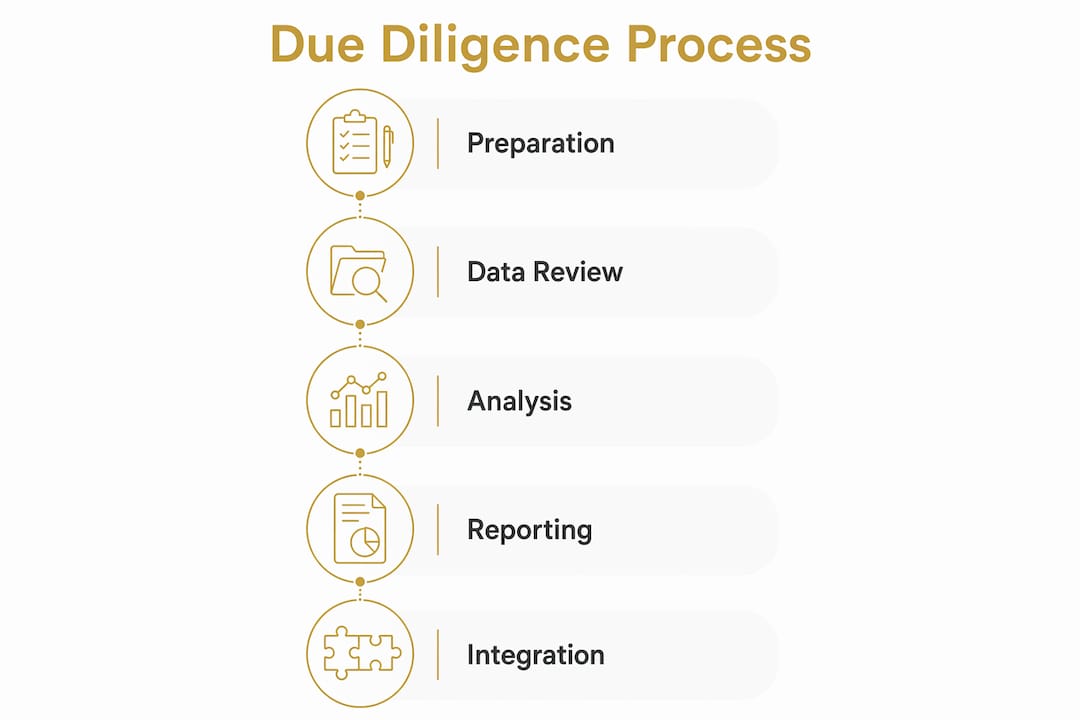
Most UK M&A transactions require 60–90 days for due diligence, with sellers expected to supply initial documents within 30 days of signing a Letter of Intent. The phased structure typically runs:
- Scope agreement and engagement letter — defining coverage, sector-specific KPIs, and deliverables
- Data room population — financial statements, management accounts, tax returns, forecasts, and contracts
- Initial analysis — review of historical performance, cash flow, and balance sheet
- Follow-up questions — clarification requests to management on anomalies and assumptions
- Final report — findings, risk summary, and recommendations for deal structuring
Preparation quality materially affects timeline. Sellers who arrive at the data room with disorganised records risk delays that erode deal momentum and, in competitive processes, valuation credibility. Having documentation well-organised before engaging buyers is not just good practice; it signals management competence.
Pro Tip: Align your due diligence checklist to the specific deal type early. An asset purchase requires different document sets than a share acquisition, and mismatches waste weeks.

Technology is reshaping the process. AI-assisted data extraction and analytics tools now allow practitioners to process larger volumes of management information faster, surfacing anomalies that manual review might miss. The ICAEW guideline explicitly acknowledges this evolution as expanding the depth and breadth of work that can be performed.
Who performs financial due diligence, and why expertise matters
Buy-side teams typically include internal finance staff, external Chartered Accountants, and sector specialists. The mix matters. Internal teams bring commercial context; external advisers bring independence and pattern recognition from dozens of comparable transactions.
ICAEW guidance specifically highlights the value of sector specialists who understand the KPIs that drive valuations in particular industries. Annual recurring revenue and net retention rates in SaaS businesses, for instance, require different analytical lenses than like-for-like sales in multi-site retail. Consult EFC’s focus on high-growth SaaS and UK SMEs means the firm brings directly relevant benchmarks, not generic financial analysis.
When selecting advisers, consider their transaction volume in your sector, their familiarity with UK-specific tax and regulatory issues, and whether they can support post-report negotiations, not just deliver a document.
Key financial statements and metrics analysed
The core documents in any financial statement review are the profit and loss account, balance sheet, and cash flow statement, typically across three to five years. Beyond the statutory accounts, practitioners focus heavily on monthly management accounts, which reveal seasonality, trend breaks, and anomalies that annual figures smooth over.
Critical metrics include normalised EBITDA, free cash flow conversion, gross margin by product or customer segment, debtor days, and net debt position. For SaaS businesses, investor-ready metrics such as monthly recurring revenue, churn rate, and customer acquisition cost payback period are equally central to the financial assessment process.

UK regulatory and tax considerations
UK transactions carry specific tax exposures that due diligence must address. Corporation tax compliance, VAT treatment of revenue streams, PAYE and National Insurance obligations, and R&D tax credit claims all require scrutiny. HMRC enquiries or open tax years represent contingent liabilities that directly affect price.
Stamp Duty Land Tax applies to property-owning targets, and share purchases attract 0.5% Stamp Duty on consideration. Employment-related securities and share scheme obligations under HMRC-approved schemes such as EMI require separate review. For cross-border elements, transfer pricing compliance and permanent establishment risk add further complexity.
Common methodologies and practical tools
The two dominant frameworks are buy-side due diligence and vendor due diligence (VDD). VDD, commissioned by the seller, reduces management distraction and accelerates timelines by providing a single report that buyers can rely on, subject to top-up work. Buy-side diligence gives the acquirer full control over scope and independence of findings.
Practically, teams use structured data rooms (Ansarada, Datasite, and Intralinks are widely used in UK transactions), financial modelling in Excel or Google Sheets, and increasingly AI-assisted analytics for large data sets. A well-structured due diligence preparation process maps required documents to each workstream before the data room opens.
Best practices for interviews and document reviews
Management interviews are where due diligence moves from numbers to narrative. The goal is to test consistency: does what management says align with what the documents show? Prepare question sets in advance, organised by workstream, and revisit key topics across multiple sessions to check for contradictions.
Document reviews benefit from a tiered approach. Prioritise high-value, high-risk items first: revenue contracts with termination clauses, loan agreements with change-of-control provisions, and any document referenced in the accounts but not yet provided. Flag gaps formally in writing; undisclosed items discovered post-completion are significantly harder to remedy.
How to assess quality of earnings and cash flow stability
Quality of earnings (QoE) analysis is the centrepiece of most financial due diligence engagements. It adjusts reported EBITDA for one-off items, owner-specific costs, accounting policy differences, and non-recurring revenues to arrive at a maintainable earnings figure. The gap between reported and normalised earnings is often where deal value is won or lost.
Cash flow stability requires separate analysis. Reported profit and actual cash generation diverge when working capital is poorly managed or when revenue recognition is aggressive. Working capital requirements must be assessed on a normalised basis, stripping out seasonal peaks and one-off movements, to set a fair completion mechanism. Cash flow forecasting capability in the target business is itself a signal of financial management quality.
Post-due diligence integration and monitoring
Due diligence findings do not expire at completion. The report should feed directly into the 100-day integration plan, flagging the financial controls, reporting gaps, and risk items that need immediate attention. Identified working capital weaknesses, for instance, require a treasury and cash management response from day one.
Ongoing monitoring should track the assumptions the deal was priced on. If normalised EBITDA was built on specific customer retention or margin assumptions, those metrics need formal review at 30, 60, and 90 days post-completion. Warranty and indemnity claims have defined notice periods; missing them forfeits protection.
Key takeaways
Thorough financial due diligence, conducted by experienced Chartered Accountants with sector knowledge, is the single most reliable way to protect transaction value and avoid post-completion surprises.
| Point | Details |
|---|---|
| Start with scope | Define coverage, sector KPIs, and deliverables in the engagement letter before any document review begins. |
| Timeline is 60–90 days | Most UK M&A transactions require 60–90 days, with initial documents expected within 30 days of LOI signing. |
| QoE drives price | Normalised EBITDA from quality of earnings analysis frequently differs from management’s figures and directly sets deal value. |
| UK tax exposure is specific | Corporation tax, PAYE, VAT, and open HMRC enquiries are contingent liabilities that must be quantified before completion. |
| Consult EFC | Consult EFC provides financial due diligence for UK SMEs and SaaS businesses, led by ICAEW Chartered Accountant Kishen Patel. |
Consult EFC brings CFO-level rigour to your next transaction
Engaging a full-time CFO for a single transaction is expensive and often unnecessary. Consult EFC gives UK business buyers, investors, and founders direct access to ICAEW Chartered Accountant-level financial due diligence without the overhead of a permanent hire.
Kishen Patel and the Consult EFC team work across UK SME acquisitions and SaaS investment rounds, delivering the quality of earnings analysis, risk identification, and deal structuring support that institutional buyers expect, at a cost that works for growth-stage businesses. The firm’s fractional CFO model means you get transaction-specific depth, not a generalist review.
If you are preparing for an acquisition, raising debt finance, or approaching an exit, fractional CFO services from Consult EFC give you the financial leadership the process demands. Get in touch to discuss the scope of your transaction.
Recommended
- Financial Due Diligence for SMEs: The Complete UK Guide
- Due Diligence Preparation Services | Financial Readiness
- Due Diligence Issues in UK Business Sales & How to Fix Them
- Financial Due Diligence Services for UK SMEs | Consult EFC
Not sure where your business stands right now?
Book a free 30-minute call with Kish. Bring your numbers, your questions, or just your situation. You will leave with a clearer picture than you arrived with.
Book a Free Strategy Call
Over 12 years across Big Four audit, Investment Banking, and corporate advisory. Kish works with SaaS founders, tech companies, and ambitious UK SMEs from £1M to £50M in revenue on fundraising, valuations, exit planning, and financial strategy. ICAEW regulated. Big Four trained. Based in London.