


A fractional CFO is a senior financial executive who works with your business on a part-time or project basis, delivering the same strategic financial leadership as a full-time Chief Financial Officer without the full-time salary, benefits package, or long-term commitment. For UK SMEs and high-growth SaaS companies, this model has become the practical answer to a real problem: you need executive-level financial thinking, but you are not yet at the stage where a full-time CFO hire, which typically costs well over £150,000 in salary plus benefits, makes sense.
The value goes well beyond cost savings. A fractional CFO brings outsourced financial leadership that covers the full strategic spectrum, including:
- Investor-ready financial reporting that builds board and investor confidence
- Cash flow management to prevent the surprises that derail growth
- Financial modelling and forecasting grounded in real business data
- Fundraising support, from pitch deck financials to due diligence preparation
- M&A and exit advisory when the time comes to transact
- Risk management and internal controls that protect the business
The best fractional CFOs in the UK hold ICAEW Chartered Accountant credentials, bringing the same technical rigour you would expect from a Big Four-trained executive. They typically work across multiple clients simultaneously, which means you also benefit from pattern recognition across industries and business stages that a single-company hire simply cannot offer.
Table of Contents
- When should you hire a fractional CFO for your UK business?
- Fractional CFO vs full-time CFO: which model fits your business?
- What does fractional CFO engagement cost in the UK?
- What does a fractional CFO actually do day to day?
- How does the fractional CFO engagement process work?
- Consult EFC: fractional CFO expertise for UK SaaS and SME businesses
- Consult EFC gives you Big Four rigour without the full-time cost
- Key takeaways
When should you hire a fractional CFO for your UK business?
The timing question is where most business owners get stuck. The honest answer is that you probably need one earlier than you think.
UK SMEs and startups most commonly bring in a fractional CFO when one of the following situations arises:
- Rapid growth that has outpaced the finance team’s capacity, typically from seed funding through to Series A
- Fundraising or debt financing, where investor expectations around forecasts and due diligence require senior financial expertise
- Mergers, acquisitions, or exit planning, where the stakes are too high for a generalist accountant
- Leadership transitions, such as a departing finance director leaving a gap before a permanent hire
- Financial complexity, including multi-entity structures, international expansion, or SaaS-specific metrics like ARR, churn, and CAC payback
The cost argument is straightforward. A fractional CFO supplements your existing finance team rather than replacing it, giving you flexible financial control that scales with your needs. A bookkeeper handles the historical record; a fractional CFO looks forward, shapes strategy, and advises on the decisions that actually move the needle. For a SaaS founder preparing a Series A, having someone who can model unit economics and respond credibly to investor questions is not a luxury. It is the difference between a successful raise and a painful one.

Fractional CFO vs full-time CFO: which model fits your business?
The choice between a fractional and a full-time CFO comes down to three factors: your current financial complexity, your budget, and how much dedicated time the role genuinely requires.
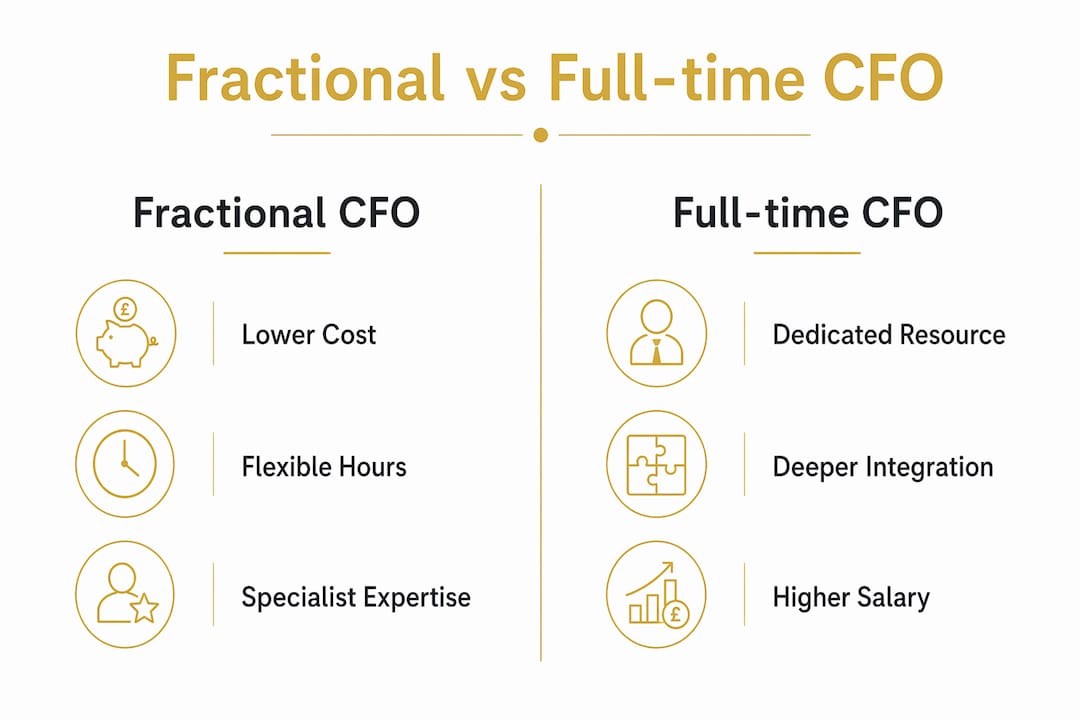
| Factor | Fractional CFO | Full-time CFO |
|---|---|---|
| Cost | Lower fees, no benefits or equity overhead | Full salary plus benefits, typically a high annual cost |
| Commitment | Part-time, flexible hours or days per week | Full-time, permanent or long-term contract |
| Availability | Shared across clients; responsive but not always on-site | Fully dedicated to your business |
| Expertise breadth | Cross-industry experience from multiple engagements | Deep institutional knowledge of your specific business |
| Best fit | SMEs, startups, scaleups, transition periods | Businesses with complex, high-volume financial operations |
| Flexibility | Scales up or down as needs change | Fixed commitment regardless of workload |
Most UK SMEs and early-stage SaaS companies sit firmly in the fractional column. The tipping point toward a full-time hire usually comes when the business reaches a size where the CFO role genuinely demands five days a week, often post-Series B or when the finance function spans multiple geographies and product lines. Until then, a fractional arrangement gives you the expertise without the overhead.
One practical note: fractional CFOs often work alongside an existing finance manager or controller. The controller owns the historical numbers; the fractional CFO owns the forward-looking strategy. That division of labour works well and avoids duplication.
What does fractional CFO engagement cost in the UK?
Pricing for part-time CFO services in the UK varies by experience, scope, and the hours or days committed per month. Daily rates often start around £600/day for UK fractional CFOs, with senior practitioners and specialist SaaS or M&A advisers commanding higher fees depending on the complexity of the engagement.
| Engagement model | Typical structure | Best suited to |
|---|---|---|
| Hourly | Ad hoc advisory, billed per hour | One-off projects, early-stage businesses |
| Monthly retainer | Fixed days per month, ongoing advisory | Growing SMEs needing consistent support |
| Project-based | Fixed fee for a defined deliverable | Fundraising rounds, M&A transactions, exit prep |
| Interim / part-time | Set days per week, often 1–3 days | Businesses covering a leadership gap |
The advantages of these flexible arrangements are worth spelling out:
- No long-term employment commitment, so you can adjust scope as the business evolves
- Predictable monthly costs on a retainer, making budgeting straightforward
- Access to senior expertise at a fraction of the annual cost of a full-time hire
- Project-based fees that align cost directly with a specific outcome, such as closing a funding round
The real saving is not just the salary differential. When you factor in employer National Insurance contributions, pension, benefits, and the time cost of a full recruitment process, the gap between a fractional arrangement and a full-time hire widens considerably.
What does a fractional CFO actually do day to day?
The role covers far more ground than most business owners expect. Fractional CFOs provide services spanning both the operational and the strategic, and the balance shifts depending on your business stage.
Core responsibilities typically include:
- Financial modelling and forecasting: building three-statement models, scenario analyses, and long-range plans that inform board decisions
- Budgeting: creating annual budgets with the discipline and accuracy of a larger organisation
- Cash flow management: monitoring inflows and outflows, identifying shortfalls before they become crises, and building cash buffers
- Investor relations: preparing board packs, responding to investor queries, and maintaining the transparency that builds investor confidence
- Fundraising support: structuring the financial narrative for a raise, preparing due diligence materials, and stress-testing assumptions
- M&A and exit advisory: leading or supporting transaction processes with prior deal experience
- Financial reporting: producing management accounts, KPI dashboards, and the investor-ready reports that underpin credibility
- Risk management and internal controls: identifying weaknesses in financial processes and building the controls that protect the business
For SaaS businesses specifically, a fractional CFO will typically own the metrics layer: ARR, net revenue retention, CAC payback, LTV, and burn multiple. These are the numbers that drive SaaS valuation multiples, and getting them right before an investor conversation is not optional.
Pro Tip: Ask any prospective fractional CFO to walk you through a financial model they have built for a business at a similar stage. The quality of that model tells you more about their capability than any CV.

How does the fractional CFO engagement process work?
Getting started is more straightforward than most business owners assume. Engagement timelines typically run from a few weeks for a defined project to ongoing retainer arrangements for continuous advisory support.
- Discovery call: an initial conversation to understand your business, its current financial position, and the specific challenges or goals driving the need for support.
- Needs assessment: the CFO reviews your existing financial data, reporting, and team structure to identify gaps and priorities.
- Scope agreement: both parties agree on the deliverables, hours or days per month, fee structure, and the initial focus areas.
- Contract and onboarding: a services agreement is signed, access to financial systems is granted, and the CFO gets up to speed on your business model, key metrics, and stakeholder relationships.
- Active delivery: the CFO begins work on the agreed priorities, whether that is building a financial model, preparing for a fundraise, or establishing a monthly reporting cadence.
- Regular review: monthly or quarterly check-ins assess progress, adjust the scope if the business’s needs have shifted, and set priorities for the next period.
The onboarding phase is where the quality of a fractional CFO becomes apparent quickly. A strong practitioner will identify the two or three things that matter most within the first few weeks and focus there, rather than producing a lengthy audit that sits unread. UK-specific considerations, such as HMRC compliance, Companies House reporting obligations, and EIS or SEIS structuring for fundraising rounds, should be part of the conversation from day one.
Consult EFC: fractional CFO expertise for UK SaaS and SME businesses
Consult EFC was built specifically for the businesses that need this kind of support most: high-growth SaaS companies and ambitious UK SMEs navigating the gap between early traction and institutional scale. Kishen Patel, an ICAEW Chartered Accountant with Big Four-trained experience, leads the firm’s fractional CFO practice.
The firm’s approach combines the technical rigour of a Big Four consultancy with the flexibility and accessibility that growing businesses actually need. That means investor-ready financial models, clean management reporting, and the kind of financial planning and analysis that gives founders and boards genuine confidence in their numbers.
For SaaS founders preparing a Series A, Consult EFC focuses on the metrics and reporting that institutional investors scrutinise most closely: unit economics, net revenue retention, and the financial narrative that explains why the business deserves a premium multiple. For SMEs approaching an exit or an acquisition, the work centres on clean financials, defensible valuations, and transaction readiness.
Pro Tip: Investor-ready does not mean polished. It means your numbers are accurate, your assumptions are documented, and your CFO can defend every line in a due diligence call.
The ROI of fractional CFO services is most clearly felt when a business avoids a costly mistake or closes a funding round on better terms because its financials were credible. Consult EFC’s clients benefit from that combination of accountability and expertise without the overhead of a full-time executive hire.
Consult EFC gives you Big Four rigour without the full-time cost
If you have read this far, you already know that a part-time CFO is not a compromise. For most UK SMEs and SaaS companies, it is the right model for this stage of growth.
Consult EFC offers fractional CFO services tailored to UK SaaS businesses and SMEs, with ICAEW Chartered Accountant expertise at every engagement. Whether you are preparing for a fundraising round, building out your financial reporting, or planning an exit, the firm provides the financial leadership your business needs without a permanent hire on the payroll.
The engagement is flexible by design. You choose the scope, the hours, and the focus areas. Consult EFC brings the expertise, the models, and the investor-ready reporting that give you and your stakeholders genuine confidence. To find out how Consult EFC can support your business, visit the fractional CFO services page and get in touch directly.
Key takeaways
A fractional CFO delivers executive-level financial leadership to UK SMEs and SaaS companies on a flexible, part-time basis, at a fraction of the cost of a full-time hire.
| Point | Details |
|---|---|
| Cost efficiency | Daily rates for UK fractional CFOs often start around £600/day, far below the total cost of hiring a full-time CFO. |
| Right timing | The strongest triggers are fundraising rounds, rapid growth, leadership transitions, and financial complexity beyond the current team’s capacity. |
| Core responsibilities | Financial modelling, cash flow management, investor reporting, fundraising support, and M&A advisory are the primary areas of focus. |
| Engagement flexibility | Hourly, retainer, and project-based models allow you to match cost directly to the scope and duration of support you need. |
| Consult EFC | Led by ICAEW Chartered Accountant Kishen Patel, Consult EFC provides fractional CFO services for UK SaaS companies and SMEs preparing to scale, raise, or exit. |
Recommended
- What is a fractional CFO? A guide for UK businesses
- Fractional CFO Services UK | SaaS & SMEs | Consult EFC
- Fractional CFO Services for UK Scaleups | Consult EFC
- SaaS Fractional CFO Cost UK 2026: What You Will Pay | Consult EFC
Not sure where your business stands right now?
Book a free 30-minute call with Kish. Bring your numbers, your questions, or just your situation. You will leave with a clearer picture than you arrived with.
Book a Free Strategy Call
Over 12 years across Big Four audit, Investment Banking, and corporate advisory. Kish works with SaaS founders, tech companies, and ambitious UK SMEs from £1M to £50M in revenue on fundraising, valuations, exit planning, and financial strategy. ICAEW regulated. Big Four trained. Based in London.