


Growth shares are a class of shares issued by UK private companies that give holders a stake only in the company’s value above a defined threshold, known as the hurdle. Below that hurdle, the shares are worth nothing. Above it, holders participate in the upside alongside ordinary shareholders. That single design feature is what makes them a genuinely tax-efficient incentive: because the shares carry little or no value at the point of issue, employees typically face a minimal income tax charge on acquisition, with future gains taxed as capital gains rather than income.
The formal term you will encounter in legal and accountancy circles is “growth shares,” and it is the recognised industry label, not an informal shorthand. They are widely used by UK startups, scaleups, family businesses, and subsidiaries of AIM-listed companies, particularly in sectors like technology and life sciences where salary competition is fierce but cash is constrained. The key features at a glance:
- Shares participate only in value above the hurdle, not in historic company value
- Employees subscribe at a low but positive market value, minimising upfront tax
- Gains on exit are subject to capital gains tax (CGT), not income tax, if correctly structured
- No expiry date, unlike Enterprise Management Incentive (EMI) options
- Available to employees, directors, consultants, family members, and trusts
- Require amendments to the company’s articles of association to create a new share class
How growth shares work: hurdle pricing and exit mechanics
The hurdle is the engine of the whole arrangement. It is set at the company’s current market value at the date of issue, often with a premium of 10–40% above that value to reflect future growth expectations and to keep the shares’ day-one value low. If a company is currently valued at £10 million and the hurdle is set at £12 million, the growth shares have no economic value today. They only become valuable if the company is sold, listed, or otherwise exits above £12 million.
The difference between the hurdle and the current share price is called the “hope value.” This is the premium that justifies issuing the shares at a very low market price, sometimes fractions of a penny per share. Employees pay that low market value in cash at the point of subscription, which is why the upfront tax charge is typically negligible. Growth shares can be issued at a low initial market value reflecting this hope value, so employees pay a modest sum that minimises their tax exposure from day one.
On exit, say the company sells for £20 million against a £12 million hurdle. The growth class participates in the £8 million excess, on whatever ratio was agreed at issue. A holder with 1% of the growth class receives £80,000. Their gain is the exit proceeds less the original subscription price, and that gain is taxed as a capital gain. If the company sells for less than £12 million, the growth shares lapse with no value and no CGT event.
Governance rights attached to growth shares are usually minimal. Growth shares typically confer no dividend or voting rights, and participation is often restricted to exit events such as a sale or IPO. Founders retain control; existing shareholders retain their share of historic value. The growth class is, in effect, an option on enterprise value above the hurdle, which is why option-pricing models such as Black-Scholes feature in growth share valuations.
Pro Tip: Set the hurdle at a level that is genuinely above current value but still reachable within a realistic exit horizon. A hurdle that is too low invites an HMRC challenge; one that is too high destroys the incentive before it starts.
Key mechanics to understand:
- The hurdle is expressed as a cash amount, sometimes with an annual coupon that increases it over time
- Participation above the hurdle is defined by a ratio versus ordinary shares, agreed at issue
- Dividend rights are usually absent or minimal, to keep day-one value low
- Voting rights are typically excluded to preserve founder control
- Good leaver and bad leaver provisions govern what happens to shares if an employee departs
- Tag-along and drag-along rights protect growth shareholders in a sale
Why growth shares benefit both companies and employees
The core appeal for companies is that growth shares align employee interests with shareholder value without giving away any of the value already built. Existing shareholders face no dilution in respect of the company’s current worth, which matters enormously when founders have spent years building equity. The incentive is forward-looking by design.

For employees, the attraction is real ownership rather than a promise. Unlike options, which are a contractual right to buy shares later, growth shares are actual shares held from day one. That status creates a genuine psychological stake in the company’s success, and it comes with legal protections that options do not automatically carry. Actual share ownership can be used to enforce retention through forfeiture provisions, meaning a departing employee loses unvested shares rather than simply walking away.
The tax position is the other major draw. When the hurdle is set correctly, the income tax charge at acquisition is negligible because the shares have minimal value. All future appreciation is taxed as a capital gain, currently at lower rates than income tax for most higher-rate taxpayers. Business Asset Disposal Relief (BADR) may also be available on exit, subject to meeting the standard qualifying conditions.
Growth shares also offer flexibility that EMI options cannot match. They can be issued to consultants, advisers, family members, and trusts, not just employees. There is no cap on the number that can be issued, and they carry no expiry date. For companies that do not expect a near-term exit, growth shares do not expire after 10 years the way EMI options do, making them a better fit for long-term or family business planning.
Benefits at a glance:
- Low acquisition cost for employees, with minimal upfront income tax
- CGT treatment on exit gains rather than income tax
- No dilution of existing shareholders’ historic value
- No time limit on the shares, unlike EMI options
- Suitable for non-employee participants including consultants and family trusts
- Retention enforced through leaver provisions and forfeiture clauses
- Aligns employee incentives directly with company growth above the hurdle
Tax treatment of growth shares in the UK
The tax position at acquisition is usually the most important question founders ask. When the hurdle is set at a genuine premium to current value and the employee pays the full market value of the growth shares, there is no income tax or National Insurance contributions (NICs) charge at the point of issue. The shares have no taxable value because the employee would only profit if the company grows beyond the hurdle.
The risk arises when shares are issued at a discount to their actual market value. If an employee receives growth shares for free, or below their assessed market value, the discount is treated as employment income and is subject to income tax and potentially employer NICs at the date of issue. This is why a robust, independent valuation is not optional; it is the foundation of the whole tax case.

On disposal, the employee pays CGT on the gain, calculated as the exit proceeds less the original subscription price. BADR may reduce the effective rate further, subject to the standard qualifying tests. As an employer, you cannot claim corporation tax relief on the growth in share value, unlike with EMI or Company Share Option Plan (CSOP) schemes. That is a genuine cost to weigh against the flexibility growth shares provide.
The single most important administrative step is filing a section 431 election. A section 431 election must be filed within 14 days of acquisition to lock in CGT treatment and prevent HMRC from later reclassifying gains as employment income. The election is a joint filing by employer and employee, and it deems the shares to have been acquired at their unrestricted market value. Because the gap between the restricted and unrestricted value of a well-designed growth share is typically small, the election usually costs little or nothing in upfront tax, and it protects all future growth from income tax reclassification.
Reporting obligations also apply. The acquisition must be reported on the annual Employment-Related Securities (ERS) return, and missing this filing creates penalties and weakens the evidential record if HMRC ever challenges the valuation.
Key tax points:
- No income tax or NICs at acquisition if shares are issued at full market value with a genuine hurdle
- Discounted issue triggers income tax and potentially employer NICs on the discount
- CGT applies to gains above the subscription price on exit
- BADR may be available subject to standard qualifying conditions
- Section 431 election must be filed within 14 days of issue to secure CGT treatment
- Annual ERS return is mandatory; missing it carries penalties
- HMRC will not pre-agree a growth share valuation, unlike with EMI options
Growth shares vs EMI options: which should you choose?
EMI options are the preferred tool where a company qualifies. They carry no day-one cost for the employee, no income tax event at grant, a well-trodden HMRC approval route, and simpler valuation requirements. Growth shares are the right answer when EMI is not available or when the structure needs to include non-employee participants or ringfence existing value for succession purposes.
The eligibility gap is the most common reason founders turn to growth shares. EMI is restricted to trading companies with fewer than 250 employees and gross assets below £30 million, and it excludes certain activities. Growth shares carry none of those restrictions. Any UK company can issue them, to any participant, in any quantity.
For a detailed look at how valuations differ across these instruments, the Consult EFC guide on ordinary shares and EMI options covers the mechanics in depth.
| Feature | EMI options | Growth shares |
|---|---|---|
| Eligible holders | Employees only | Employees, directors, consultants, family, trusts |
| Company eligibility | Trading, under 250 employees, under £30m gross assets | Any company |
| Tax at grant or issue | None | Income tax on market value at issue (often nil) |
| Tax on exit | CGT only (BADR available) | CGT only if section 431 election filed within 14 days |
| Day-one cost to holder | Nil (option, no upfront payment) | Subscription at market value (low but positive) |
| Valuation | HMRC-agreed VAL231 | Independent valuation, no HMRC pre-clearance |
| Expiry | 10 years from grant | No expiry |
| Annual ERS reporting | Required | Required |
| Dilution timing | On exercise | On issue |
Practical scenarios where growth shares win:
- Company has exceeded the EMI gross assets or employee headcount limits
- Non-employee participants (advisers, family members, trusts) need to be included
- The ordinary share price is so high that meaningful EMI grants would breach the £250,000 individual limit
- The company does not expect an exit within 10 years, making EMI’s expiry a problem
- Succession or estate planning requires ringfencing existing value for family members
Who can use growth shares and how they are typically structured
Growth shares can be issued to almost anyone: employees, executive directors, non-executive directors, consultants, advisers, family members, and discretionary trusts. That breadth is one of their defining advantages over EMI. A founder who wants to bring a key adviser into the equity story without giving away historic value, or who wants to pass future growth to the next generation without triggering an immediate inheritance tax event, can use growth shares where EMI simply cannot reach.
Common commercial uses include:
- Incentivising senior employees or management teams in companies that have outgrown EMI
- Including non-employee advisers and consultants in equity arrangements
- Succession planning in family businesses, where growth shares pass future value to the next generation
- Estate planning, using the two-year holding period to qualify for Business Property Relief under inheritance tax rules
- Complementing an existing EMI scheme where individual limits have been reached
Structuring the shares requires careful thought on several fronts. Vesting schedules, leaver provisions, and shareholders’ agreements must be designed to protect both the company and its existing shareholders. A typical arrangement includes time-based vesting over three to four years, with a cliff at year one, and clear good leaver and bad leaver definitions that determine whether departing employees keep their shares at fair value or forfeit them at par.
The articles of association must be amended to create the new share class, and shareholders must approve the amendment. A growth share subscription agreement is then entered into with each participant, setting out the hurdle, the participation ratio, the leaver provisions, and any other rights. Dividend rights are usually excluded or kept minimal to avoid creating taxable income before exit. Voting rights are typically excluded to preserve founder and investor control.
Pro Tip: Draft the leaver provisions before you issue a single share. Ambiguous good leaver and bad leaver definitions are the most common source of shareholder disputes on exit, and they are far harder to fix after the fact.
Growth share valuation: getting the hurdle right
The hurdle valuation is the most technically demanding part of any growth share scheme, and it is where most mistakes happen. Setting it too low means the shares carry immediate value, which triggers an income tax charge at issue. Setting it too high means the shares are so far out of the money that they cease to function as an incentive. The standard approach is to set the hurdle at a 10–40% premium above current company value, calibrated to the company’s realistic growth trajectory and expected exit horizon.
HMRC will not pre-agree a growth share valuation the way it does for EMI options through the VAL231 process. That means the burden of proof sits entirely with the company. A robust, documented, independent valuation is the only defence if HMRC challenges the figure in the future. The methodology matters: option-pricing models such as Black-Scholes or binomial lattice are commonly used because growth shares are economically equivalent to a call option on enterprise value above the hurdle. Using an anchored volatility assumption is critical; an unsupported volatility figure is one of the first things HMRC’s Share and Assets Valuation (SAV) team will challenge.
Valuation is not a one-time exercise. Failure to update the hurdle valuation after material corporate events like funding rounds can dilute the scheme’s effectiveness and expose holders to tax risk. If a Series A round closes at a valuation significantly above the original hurdle, any growth shares issued after that point need a fresh valuation to reflect the new baseline. Issuing shares on a stale valuation is one of the most common and costly errors in practice.
Consult EFC works with founders and finance teams to build defensible growth share valuations that withstand HMRC scrutiny, covering both the initial hurdle-setting and the recurring valuation events that follow funding rounds or corporate restructuring.
Common valuation mistakes to avoid:
- Setting the hurdle below current market value, creating an immediate income tax event
- Using a Black-Scholes model with an unsupported or generic volatility assumption
- Failing to update the valuation after a funding round or material corporate event
- Issuing growth shares immediately before a known sale, when the day-one value approaches the exit price
- Skipping the annual ERS return, which weakens the evidential record
- Drafting participation rights ambiguously, leading to disputes over the exit waterfall
Pro Tip: Commission an independent valuation from a specialist with experience of HMRC’s SAV team, not just a generic accountancy firm. The methodology and documentation standard are different from a standard business valuation, and the difference shows under scrutiny.
How long does it take to set up a growth share scheme?
Setting up a growth share scheme from scratch typically takes four to eight weeks, assuming the company’s articles of association do not already include a growth share class and that a valuation needs to be commissioned. The timeline compresses if the company has already obtained a recent valuation and the legal documentation is straightforward.
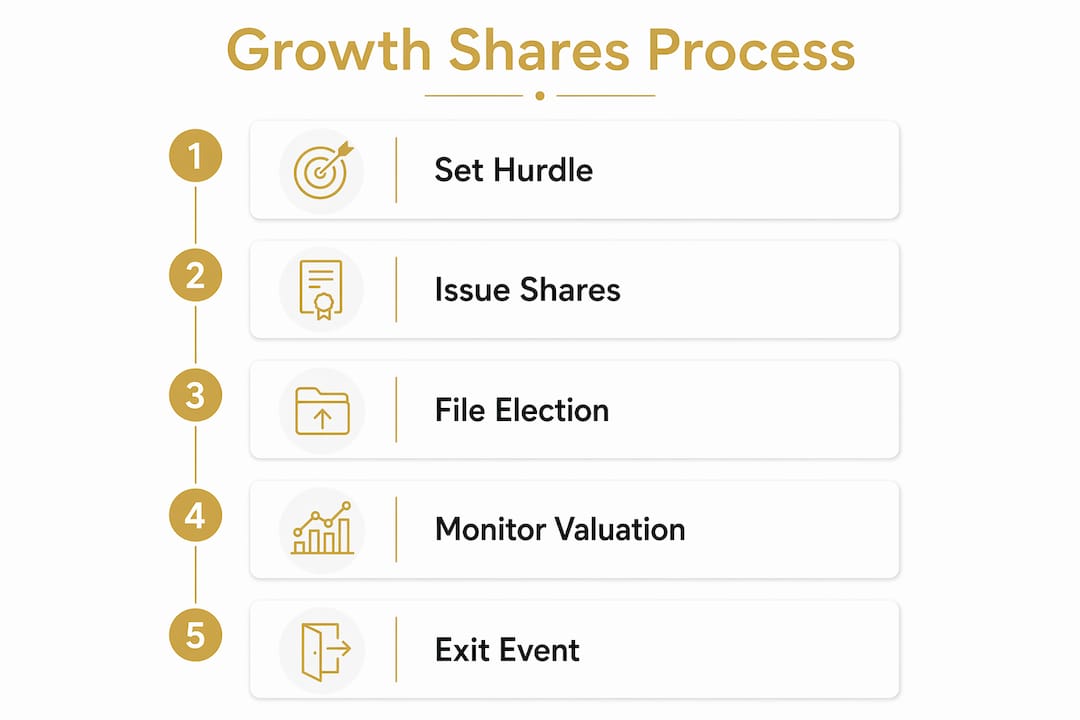
The process follows a clear sequence. First, the company commissions an independent valuation to establish the current market value and set the hurdle. Second, solicitors draft amendments to the articles of association to create the new share class, defining its rights, restrictions, and participation mechanics. Third, shareholders approve the amendments, usually by written resolution for private companies. Fourth, the growth share plan rules are established, covering vesting, leaver provisions, and any performance conditions. Fifth, subscription agreements are signed with each participant, and the shares are issued. Sixth, the section 431 election is filed within 14 days of issue, and the acquisition is reported on the annual ERS return.
The valuation is usually the longest single step, particularly if the company has a complex capital structure or has recently completed a funding round that needs to be reflected in the methodology. Founders who try to compress this step by using a rough internal estimate rather than a documented independent valuation create a significant HMRC risk that can surface years later on exit.
For companies that want to understand the full valuation process before committing to a scheme, the Consult EFC guide on valuation before issuing equity covers the methodology and documentation requirements in detail.
Legal and administrative requirements for issuing growth shares
The legal requirements for growth shares are more demanding than for EMI options, partly because there is no HMRC-approved template to follow. Every scheme is bespoke, and the documentation must be watertight.
The articles of association must be amended to create the growth share class. This requires a special resolution of shareholders (75% majority) and filing the amended articles at Companies House using Form SH01 for the allotment of shares. The articles must define the hurdle, the participation mechanics, dividend rights, voting rights, pre-emption rights, and the leaver provisions with precision. Ambiguous drafting in the articles is the single most common source of exit disputes.
A shareholders’ agreement or deed of adherence should also be updated to bring growth shareholders into the governance framework. This covers tag-along and drag-along rights, information rights, and any restrictions on transfer. Growth shareholders who are not party to the shareholders’ agreement can create complications on exit if a buyer requires all shareholders to sign the sale documents.
Each participant must sign a growth share subscription agreement, pay the subscription price, and file the section 431 election jointly with the employer within 14 days. The acquisition is then reported on the annual ERS return, which is filed online with HMRC by 6 July following the end of the tax year in which the shares were issued.
Administrative requirements at a glance:
- Amend articles of association by special resolution and file at Companies House
- File Form SH01 with Companies House to record the allotment
- Commission and document an independent valuation
- Draft and execute growth share plan rules and subscription agreements
- File section 431 election within 14 days of each participant’s acquisition
- Report on annual ERS return by 6 July each year
- Update the shareholders’ agreement or deed of adherence for new participants
Risks and challenges founders should not underestimate
Growth shares carry real risks for both companies and employees, and the most dangerous ones are the ones that surface years after the shares are issued.
The biggest risk for employees is an unexpected income tax bill on exit. This happens when the section 431 election was not filed, when the original valuation is successfully challenged by HMRC, or when the hurdle was set below current market value at issue. In any of these scenarios, HMRC can argue that some or all of the exit gain is employment income rather than a capital gain, which means income tax rates rather than CGT rates apply, plus potential employer NICs. Issuing growth shares without a section 431 election creates a significant and ongoing tax risk that cannot be remedied after the fact.
For companies, the risks are primarily governance and administrative. Growth shareholders are real shareholders with legal rights, and they must be managed accordingly. A disgruntled growth shareholder who believes their participation rights were misrepresented can disrupt a sale process at the worst possible moment. Poorly drafted leaver provisions create disputes when a key employee departs before exit. Missing the annual ERS return filing creates penalties and, more seriously, weakens the company’s evidential position if HMRC later challenges the valuation.
There is also a risk that the tax treatment changes. CGT rates and BADR rules are subject to legislative change, and employees should be informed that the tax efficiency of growth shares depends on the current regime remaining in place. The Autumn 2024 Budget made changes to BADR rates, and further changes cannot be ruled out.
Key risks to manage:
- Missing the section 431 election window (14 days from issue, no exceptions)
- HMRC challenging an underdocumented or stale valuation
- Ambiguous participation rights creating exit waterfall disputes
- Leaver provisions that are too vague to enforce cleanly
- Issuing shares immediately before a known exit, when the tax risk is highest
- Failing to update the valuation after a funding round or material corporate event
- Changes to CGT rates or BADR rules altering the expected tax outcome
How Consult EFC helps you structure growth shares correctly
Growth shares are one of the most flexible equity incentive tools available to UK founders, but they are also one of the easiest to get wrong. A missed section 431 election, a stale valuation, or ambiguous articles can turn a well-intentioned incentive into a tax liability that surfaces at the worst possible moment: on exit.
Consult EFC, led by ICAEW Chartered Accountant Kishen Patel, works with high-growth SaaS companies and ambitious UK SMEs to design and implement growth share schemes that hold up under HMRC scrutiny. From setting a defensible hurdle valuation to coordinating the legal documentation and ERS filings, the firm brings the rigour of Big Four advisory without the full-time cost. If you are considering growth shares as part of your incentive strategy, or if you need to review an existing scheme before your next funding round, fractional CFO services from Consult EFC give you the financial leadership to do it properly.
Key takeaways
Growth shares give employees a tax-efficient stake in future company value above a hurdle, but the scheme only works if the valuation is defensible, the section 431 election is filed within 14 days, and the legal documentation is precise.
| Point | Details |
|---|---|
| Hurdle pricing is the foundation | The hurdle defines when growth shares have value; set it at a genuine premium to current company value. |
| Section 431 election is non-negotiable | File within 14 days of issue to lock in CGT treatment and protect all future gains from income tax reclassification. |
| Valuation must be independent and documented | HMRC will not pre-agree a growth share valuation; a robust, documented methodology is your only defence on challenge. |
| Growth shares suit wider participants than EMI | Unlike EMI options, growth shares can be issued to consultants, family members, and trusts, with no company size limits. |
| Leaver provisions must be precise | Ambiguous good leaver and bad leaver definitions are the most common source of exit disputes in growth share schemes. |
Recommended
- Growth Shares for UK Startups: Complete Founder Guide | Consult EFC
- Growth shares valuation: a guide for businesses
- Growth Share Valuation: Why Founders Need It Before Issuing Equity
- Growth Shares Valuation Mistakes That Hurt Tax & Trust
Not sure where your business stands right now?
Book a free 30-minute call with Kish. Bring your numbers, your questions, or just your situation. You will leave with a clearer picture than you arrived with.
Book a Free Strategy Call
Over 12 years across Big Four audit, Investment Banking, and corporate advisory. Kish works with SaaS founders, tech companies, and ambitious UK SMEs from £1M to £50M in revenue on fundraising, valuations, exit planning, and financial strategy. ICAEW regulated. Big Four trained. Based in London.