



Growth shares valuation is the process of quantifying the option-like premium of shares that participate only in a company’s value above a defined hurdle. Unlike ordinary shares, growth shares carry no rights to existing equity, which means their value at issue is a fraction of the underlying company’s worth. Formal, defensible valuations matter for two reasons: they determine the tax treatment under HMRC rules, and they set the baseline from which investor returns are measured. Get the valuation wrong and gains can be reclassified as income taxed at up to 45%. This guide explains the methods, pitfalls, and practical considerations every investor and analyst needs to understand.
What is growth shares valuation and why does it matter?
Growth shares valuation is the discipline of pricing shares that entitle holders only to company value above a predetermined threshold, known as the hurdle. The hurdle is typically set at the company’s current market value, sometimes with an additional uplift, so growth shareholders receive nothing unless the business grows beyond that point. This structure makes growth shares fundamentally different from ordinary equity and requires a distinct valuation approach.
Professional valuations place growth shares at 1%–5% of the underlying company’s value at issue. That range reflects the embedded optionality: the shares have real but limited value because they depend entirely on future performance. A company worth £10 million today might issue growth shares valued at £100,000 to £500,000 in aggregate, not at the full £10 million.

The valuation is not merely an accounting exercise. HMRC treats the issue price as the starting point for capital gains tax and, in some cases, income tax. An indefensible valuation can convert what should be a capital gain into employment income, triggering a far higher tax charge. That makes rigorous valuation a legal and financial necessity, not an optional refinement.
What are growth shares and how do they differ from ordinary shares?
Growth shares are a class of equity that participates only in the increase in company value above the hurdle. Ordinary shareholders own a proportionate slice of the entire business from day one. Growth shareholders own nothing until the company’s value exceeds the agreed threshold.
The key structural differences are:
- Economic rights. Ordinary shares carry rights to existing retained value and future growth. Growth shares carry rights only to future growth above the hurdle.
- Risk profile. Growth shares are higher risk because they can expire worthless if the company never exceeds the hurdle. Ordinary shares retain value as long as the company has assets.
- Voting and dividend rights. Growth shares often carry limited or no voting rights and typically receive no dividends, though specific terms vary by company articles.
- Tax treatment at issue. Because growth shares have a low initial value, they can be issued to employees or family members at a modest cost, making them popular for employee incentive schemes and estate planning within family investment companies.
- Hurdle setting. The hurdle is usually set at the company’s current market value, sometimes plus a percentage uplift, to reflect the arm’s length nature of the transaction.
Growth shares are common in UK private companies, particularly in high-growth businesses and family investment company structures. Their appeal lies in allowing founders to share future upside without diluting existing equity value.
How are growth shares valued? Methods and key models explained
The standard approach to growth shares valuation borrows from options pricing theory. Growth shares behave like call options: they have value only if the underlying asset (the company) rises above the strike price (the hurdle). Two models dominate professional practice.
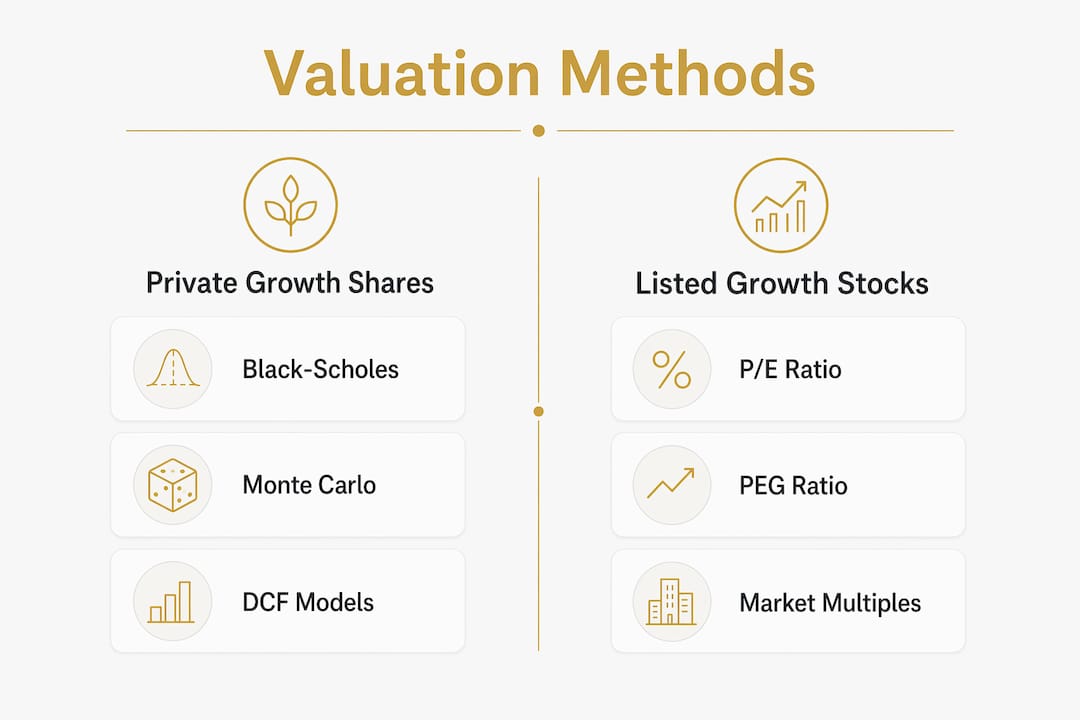
- Black-Scholes model. This closed-form formula prices an option using five inputs: current asset value, hurdle (strike price), time to realisation, risk-free rate, and volatility. It is fast and auditable, making it the most common choice for straightforward growth share structures.
- Monte Carlo simulation. This method runs thousands of scenarios for future company value, averaging the outcomes to produce a fair value. It handles complex capital structures, multiple share classes, and non-standard payoff profiles that Black-Scholes cannot accommodate cleanly.
The key valuation inputs are:
- Expected growth rate. Higher projected growth increases the probability of exceeding the hurdle, raising the option value.
- Volatility. Higher volatility increases the optionality premium because it widens the range of possible outcomes.
- Time to realisation. A longer horizon gives more time for the company to grow past the hurdle, increasing value.
- Dividend coupon on freezer shares. Where a separate freezer share class pays dividends, those payments reduce the residual value available to growth shareholders, lowering the growth share value.
These inputs contrast sharply with traditional equity valuation methods. Discounted cash flow (DCF) analysis and comparable company multiples value the whole business. Growth shares valuation then applies an option-pricing layer on top to isolate the slice of value above the hurdle.
Formal third-party reports for growth shares cost between £3,000 and £8,000. That fee reflects the specialist modelling required and the legal weight the report must carry if HMRC ever raises an enquiry.
Pro Tip: Commission the valuation report before shares are issued, not after. A contemporaneous report carries far more evidential weight with HMRC than a retrospective one.
| Valuation method | Best suited for | Key limitation |
|---|---|---|
| Black-Scholes | Simple single-class structures | Assumes constant volatility |
| Monte Carlo simulation | Complex multi-class capital structures | Time-intensive and model-dependent |
| DCF with option layer | Companies with strong cash flow forecasts | Sensitive to discount rate assumptions |
Why rigorous growth share valuations are critical for tax and compliance
The tax stakes in growth shares valuation are high and asymmetric. A well-documented valuation protects capital gains tax treatment. A poorly documented one can trigger income tax at up to 45% on the same gain.
Growth share schemes must use recognised option-pricing models to justify the hurdle rate and satisfy HMRC scrutiny. HMRC does not offer formal advance clearance for growth shares, unlike Enterprise Management Incentive (EMI) or Company Share Option Plan (CSOP) schemes. That absence of clearance means the independent valuation report is the primary evidence in any future enquiry.
Common valuation pitfalls include:
- Setting the hurdle too low. If the hurdle sits materially below current company value, growth shares carry immediate economic value. HMRC treats that as a deemed gift triggering CGT and potentially inheritance tax liabilities.
- Relying on internal estimates. A spreadsheet prepared in-house does not constitute a defensible valuation. Formal, contemporaneous reports by qualified specialists are the required standard.
- Ignoring ongoing valuation events. Subsequent gifts, transfers, or restructurings each require a fresh valuation. The original report does not cover later transactions.
- Mismatching assumptions with company reality. Inflated growth rate assumptions may reduce the apparent value of growth shares, but HMRC will challenge inputs that are inconsistent with the company’s own business plan.
Pro Tip: Understand how HMRC values shares in private companies before commissioning a growth share report. Aligning your methodology with HMRC’s own approach reduces the risk of challenge.
The compliance burden is real, but the cost of getting it right is modest relative to the tax exposure of getting it wrong. A £5,000 valuation report is a rational investment when the alternative is a reclassification that turns a 20% capital gains tax charge into a 45% income tax charge.
Practical valuation considerations when assessing growth shares
Investors and analysts examining growth shares need to look beyond the headline valuation figure. The 1%–5% initial value range is a starting point, not a fixed rule. Several factors push the value higher or lower within that band.
- Growth rate assumptions. A company projecting 40% annual revenue growth will produce a higher growth share value than one projecting 10%. Scrutinise whether the growth assumptions are consistent with the company’s track record and market conditions.
- Volatility inputs. Private companies lack observable market volatility, so valuers use proxies such as comparable listed company volatility or sector benchmarks. Challenge the proxy if it does not reflect the company’s actual risk profile.
- Time horizon. A five-year realisation horizon produces a materially different value than a two-year one. Understand what exit or liquidity event the valuation assumes.
- Capital structure complexity. Multiple share classes, loan notes, and preference shares all affect the waterfall of proceeds above the hurdle. A clean capital structure produces a more reliable growth share valuation.
- Due diligence on the report itself. Review the valuation assumptions, the model used, and the qualifications of the preparer. A report from an ICAEW-qualified specialist carries more weight than one from an unregulated adviser.
For long-term growth investment decisions, the growth share valuation also sets the cost base for capital gains purposes. A higher initial valuation means a higher base, which reduces the eventual gain. That is not always bad: it reflects genuine optionality value and provides a more accurate picture of the investment’s economics.
How does growth shares valuation fit within broader equity investment analysis?
Growth shares in private companies and growth stocks on public markets share a common logic: both derive value primarily from future performance rather than current earnings. The valuation disciplines, however, differ significantly.
For listed growth stocks, analysts use metrics such as price-to-earnings (P/E), price-to-earnings-to-growth (PEG), price-to-sales, and DCF modelling. Growth investors typically seek companies growing revenue at 15%–25% or more annually. Valuation discipline matters because high-growth listed stocks can suffer significant drawdowns when sentiment shifts or interest rates rise.
Growth shares in private companies use option-pricing models rather than market multiples, because there is no observable market price. The table below contrasts the two contexts.
| Dimension | Private growth shares | Listed growth stocks |
|---|---|---|
| Valuation method | Black-Scholes, Monte Carlo | P/E, PEG, DCF, Price-to-Sales |
| Price discovery | Specialist report | Continuous market trading |
| Liquidity | Low, event-driven | High, daily |
| Regulatory framework | HMRC valuation rules | FCA disclosure rules |
| Key risk | Hurdle not exceeded | Valuation multiple compression |
Growth investing in listed equities requires balancing growth rates with valuation discipline to avoid overpaying during periods of market exuberance. The same principle applies to private growth shares: the hurdle must be set at a level that genuinely reflects current value, or the tax and economic logic breaks down.
Long-term success in both contexts historically favours sustained conviction and disciplined valuation over attempts to time style rotations. For analysts assessing growth shares, that means treating the valuation report as a living document that should be revisited at each material event, not a one-time formality.
Key takeaways
Growth shares valuation requires formal option-pricing models, a contemporaneous specialist report, and a hurdle set at current market value to protect tax efficiency and accurately reflect investor returns.
| Point | Details |
|---|---|
| Initial value range | Growth shares are typically valued at 1%–5% of underlying company value at issue. |
| Preferred valuation models | Black-Scholes and Monte Carlo simulation are the recognised methods for defensible valuations. |
| HMRC compliance risk | Poor valuation can reclassify gains as income taxed at up to 45%, making specialist reports essential. |
| No advance clearance | Unlike EMI schemes, growth shares have no formal HMRC clearance process, so the valuation report is the primary evidence. |
| Hurdle discipline | Setting the hurdle below current value creates immediate economic value and triggers CGT and IHT liabilities. |
Why I think most growth share valuations are commissioned too late
In my experience working with UK founders and high-growth businesses, the most costly valuation mistakes are not methodological. They are timing errors. Companies commission the valuation report after shares have already been issued, or worse, after a transaction has completed. At that point, the report is retrospective and carries far less evidential weight with HMRC.
The second pattern I see repeatedly is over-reliance on the 1%–5% rule of thumb. That range is a useful sanity check, not a substitute for a properly modelled valuation. I have reviewed cases where the actual option value, correctly calculated, sat well outside that range because of unusual capital structures or aggressive growth assumptions. Applying the rule of thumb without running the model produces a number that looks defensible but is not.
There is also a broader point about investor education. Growth shares are increasingly used in family investment companies and employee incentive structures, but many investors and analysts still treat them as a simpler instrument than they are. The option-like payoff profile means that small changes in volatility assumptions or time horizon can shift the valuation materially. Analysts who understand ordinary shares, growth shares, and EMI options as distinct instruments make better investment decisions and ask better questions of the valuers they engage.
My recommendation is straightforward: engage a qualified valuation specialist before the share structure is finalised, not after. The cost is modest. The protection is substantial.
— Kishen Patel
How Consult EFC supports growth share valuations
Growth share valuation sits at the intersection of financial modelling, tax compliance, and investor strategy. Getting it right requires more than a spreadsheet.
Consult EFC provides fractional CFO services for high-growth UK companies, including support for growth share structuring, valuation oversight, and investor-ready financial reporting. Kishen Patel and the Consult EFC team bring ICAEW-qualified expertise to each engagement, ensuring that valuation methodologies are defensible, assumptions are grounded in company reality, and compliance obligations are met. If you are issuing growth shares, planning a restructuring, or preparing for an exit, Consult EFC can provide the financial rigour your business needs without the cost of a full-time CFO.
FAQ
What is the typical value of growth shares at issue?
Growth shares are typically valued at 1%–5% of the underlying company’s value at issue, reflecting the optionality premium embedded in the hurdle structure.
Which valuation models does HMRC expect for growth shares?
HMRC expects recognised option-pricing models such as Black-Scholes or Monte Carlo simulation. Internal estimates or simple rule-of-thumb calculations are not considered sufficient evidence.
What happens if growth shares are incorrectly valued?
Poor valuation risks reclassification of gains as income taxed at up to 45%. HMRC focuses on the robustness of the valuation methodology as its primary evidence in enquiries.
Do growth shares qualify for HMRC advance clearance?
No. Unlike EMI or CSOP schemes, growth shares have no formal HMRC advance clearance process. The independent valuation report is the principal defence in any future enquiry.
How much does a formal growth share valuation report cost?
Formal third-party valuation reports typically cost between £3,000 and £8,000, depending on the complexity of the capital structure and the model required.
Recommended
- Growth Share Valuation: Why Founders Need It Before Issuing Equity
- Ordinary Shares, Growth Shares & EMI Options: Valuation Impact
- Growth Shares for UK Startups: Complete Founder Guide | Consult EFC
- Growth Shares Valuation Mistakes That Hurt Tax & Trust
Not sure where your business stands right now?
Book a free 30-minute call with Kish. Bring your numbers, your questions, or just your situation. You will leave with a clearer picture than you arrived with.
Book a Free Strategy Call
Over 12 years across Big Four audit, Investment Banking, and corporate advisory. Kish works with SaaS founders, tech companies, and ambitious UK SMEs from £1M to £50M in revenue on fundraising, valuations, exit planning, and financial strategy. ICAEW regulated. Big Four trained. Based in London.