

Responding to investor due diligence questions is defined as the structured process by which founders and executives provide accurate, consistent, and verifiable answers to investor queries during formal fundraising or acquisition reviews. Done well, it accelerates deal timelines and builds credibility. Done poorly, it raises red flags that can stall or kill a transaction. Standard due diligence questionnaires often run to 100 questions or more, and initial drafts alone can take four to five hours to complete. That time investment demands a repeatable system, not an ad hoc scramble.
How to respond to investor due diligence questions: the preparation foundation
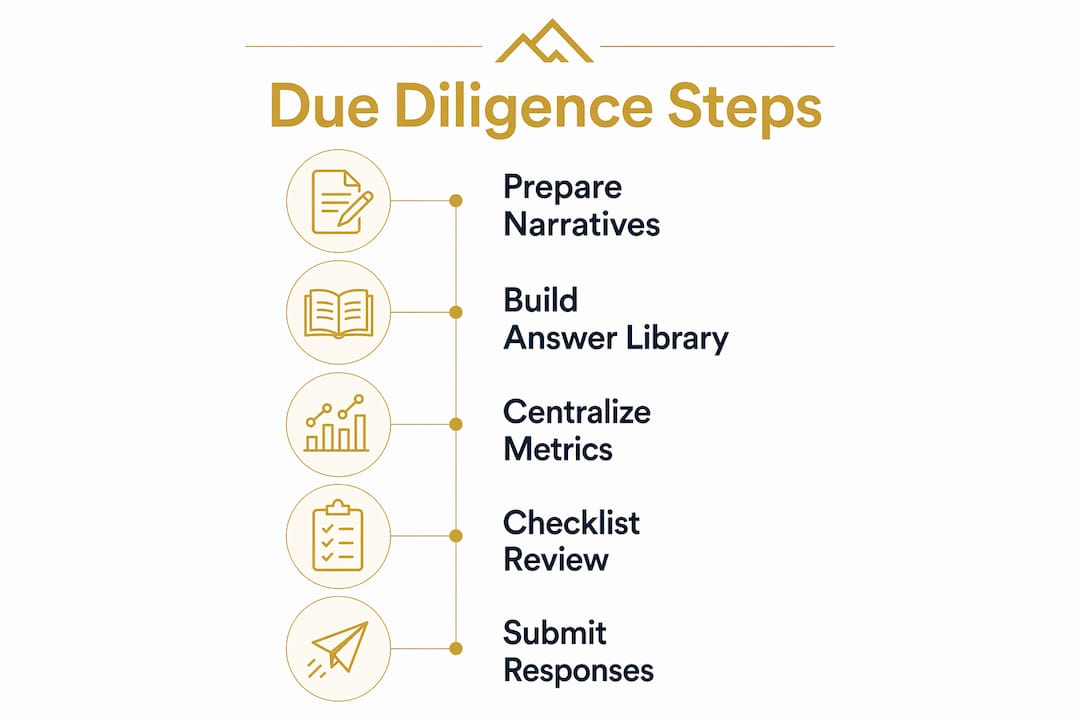
The single most effective thing a founding team can do before any investor sends a questionnaire is lock its core narratives. Company overview, product description, revenue model, and market positioning should exist as fixed, approved documents before the first due diligence request arrives. Locking core narratives early prevents wording and number drift across responses, which is one of the most common causes of investor follow-up queries.
Building a standard answer library is the logical next step. Many due diligence questionnaires, whether from venture capital firms, private equity houses, or strategic acquirers, repeat the same categories: financial history, customer concentration, team background, intellectual property, and regulatory compliance. Cataloguing approved answers to these recurring questions means your team is not rewriting from scratch each time. Manually recreating answers for each questionnaire leads to drift and errors that compound across a multi-investor process.

The third pillar of preparation is a single source of truth for financial and operational metrics. Every figure that appears in your pitch deck, your data room, and your questionnaire answers must trace back to the same underlying model or report. Tools such as Notion, Confluence, or a dedicated virtual data room (VDR) can centralise this content and enforce version control. Cap table management platforms like Carta and Pulley integrate ownership data directly, removing one common source of inconsistency.
Pro Tip: Before any fundraising round opens, run a mock due diligence exercise internally. Ask a trusted adviser to submit a standard 50-question DDQ and time how long it takes your team to respond accurately. The gaps you find will be exactly what investors find.
Key preparation steps include:
- Finalising a one-page company overview that all team members use verbatim
- Creating a metrics glossary that defines ARR, churn, and gross margin consistently
- Uploading all core documents to a VDR before the first investor request arrives
- Reviewing founder LinkedIn profiles and employment histories against your own disclosures, since pre-empting background checks on public profiles avoids avoidable red flags
A well-prepared due diligence checklist for founders can serve as the master reference document throughout this preparation phase.
How should ownership be organised for multi-team questionnaires?
A due diligence questionnaire is not a single-author document. Finance owns revenue and cost data. Legal owns contracts, IP, and regulatory matters. Product owns technical architecture and roadmap. HR owns headcount, equity, and employment terms. Without clear ownership, answers arrive late, contradict each other, or get written by whoever happens to be available. Assigning clear ownership to DDQ sections by domain prevents delays and conflicting information from different contributors.
A practical ownership model works as follows:
- Map every DDQ section to a named individual, not a team or department. One person is accountable for each section’s accuracy and timeliness.
- Set internal deadlines two days ahead of investor deadlines. This buffer absorbs the inevitable last-minute queries and review cycles.
- Designate a single DDQ coordinator, typically the CFO or a senior finance lead, who collates all sections, checks for cross-section consistency, and owns the final submission.
- Use a shared tracker (a Google Sheet or project management tool like Asana or Linear) to show completion status, outstanding items, and reviewer sign-off in real time.
- Schedule a pre-submission review checkpoint where the coordinator and at least one other senior leader read the full document as a whole, not section by section.
Managing subject matter expert (SME) input without creating bottlenecks requires discipline. SMEs should provide raw data and context, but the DDQ coordinator should write or edit the final answer. This prevents overly technical or legally cautious language from confusing investors. Treating DDQ responses as an auditable system with assigned owners and change controls builds a professional, efficient investor experience and reduces the number of follow-up rounds.
Pro Tip: Colour-code your tracker by status: not started (red), in progress (amber), ready for review (blue), approved (green). A single glance tells the coordinator where the bottlenecks are without a single status meeting.
What communication strategies maintain investor trust during due diligence?
Investor trust during due diligence is built or destroyed by communication behaviour, not just answer quality. Acknowledging due diligence requests promptly, even when the full answer is not yet ready, maintains deal momentum and signals organisational competence. A response that says “We have received your request and will provide a full response by Thursday” is far more confidence-inspiring than silence followed by a late submission.
Proactive disclosure of known material issues is one of the most counterintuitive but effective investor engagement strategies available to founders. Most founders fear that raising a problem will derail the deal. The opposite is usually true. Incomplete or evasive answers are interpreted by investors as potential disclosure problems and escalate scrutiny. Disclosing a known issue with clear context and a mitigation plan demonstrates maturity and honesty. Investors who discover an undisclosed issue independently will question what else has been omitted.
“Transparency about material risks, with clear context, prevents deal delays caused by investor discovery of unexpected facts later on.”
Practical communication principles for the due diligence process include:
- Acknowledge every request within 24 hours, even if only to confirm receipt and provide a timeline
- Send weekly status updates to the investor’s deal team during active due diligence periods
- Flag any question you cannot answer fully, and explain why, rather than leaving it blank
- Never provide a partial answer without noting that it is partial
- Avoid copying and pasting boilerplate that does not directly address the specific question asked
The balance sheet red flags that most often trigger investor concern are not the underlying issues themselves. They are the signs that a founder was aware of an issue and chose not to address it directly.
How do you maintain consistency and avoid common pitfalls?
Inconsistency across due diligence documents is the most common reason investor queries multiply. A revenue figure in the pitch deck that differs from the same figure in the DDQ by even a rounding convention will generate a follow-up question. Inconsistent or contradictory DDQ answers relative to other disclosures trigger investor concern and prolong diligence cycles. The fix is not more careful writing. It is a centralised, single source of truth for all metrics and narratives.
The table below contrasts two approaches to answering investor inquiries:
| Approach | Outcome |
|---|---|
| Rewriting answers from memory each time | Introduces wording drift, metric inconsistencies, and version conflicts |
| Reusing approved answers with context adjustments only | Maintains consistency, reduces review time, and accelerates submission |
| Defining metrics in a shared glossary | Prevents ARR, MRR, and churn figures from being calculated differently across documents |
| Auditing responses before submission | Catches contradictions between sections before investors do |
High-performing teams avoid starting questionnaires from scratch. They use content libraries or AI-assisted platforms to generate strong first drafts, then apply context-specific adjustments. Automated tools can detect internal conflicts and outdated content before submission, which dramatically improves accuracy and reduces the risk of embarrassing corrections mid-process.
Pro Tip: After completing a DDQ, run a simple word search for your key metrics (ARR, churn rate, headcount) across all submitted documents. If the same metric appears with different values in different documents, you have a consistency problem that needs resolving before the investor finds it.
What tools help manage investor due diligence responses efficiently?
The right technology stack for answering investor inquiries removes manual effort, enforces consistency, and protects sensitive data. Virtual data rooms and secure sharing platforms with watermarking, access controls, and audit trails safeguard DDQ data and enhance investor confidence. Platforms such as Datasite, Ansarada, and SendNow provide document-level analytics showing which files investors have viewed and for how long. This intelligence helps founders prioritise follow-up conversations.
| Tool category | Example platforms | Primary benefit |
|---|---|---|
| Virtual data rooms | Datasite, Ansarada, SendNow | Secure sharing, audit trails, access controls |
| AI response management | Inventive AI, Responsive | Maps new questions to existing approved answers |
| Cap table management | Carta, Pulley | Accurate, real-time ownership and equity data |
| Project tracking | Asana, Linear, Notion | Ownership assignment and deadline management |
| Document collaboration | Google Workspace, Confluence | Version control and centralised content storage |
AI-assisted response management platforms deserve particular attention. Using AI to map new questions to existing standardised answers reduces repetitive work and leads to greater response consistency across multiple investor processes. Rather than treating each new DDQ as a blank page, these tools surface the most relevant approved answer and flag where customisation is needed.
Security features matter as much as efficiency features. Screenshot protection, dynamic watermarking, and granular permission settings prevent sensitive financial data from circulating beyond the intended recipient. For SaaS founders preparing for Series A or growth rounds, a SaaS due diligence preparation guide provides a tailored framework for structuring the data room alongside the questionnaire response process.
Key takeaways
Responding to investor due diligence questions successfully requires a centralised content system, clear ownership, proactive communication, and consistent use of approved answers across all documents.
| Point | Details |
|---|---|
| Lock narratives before fundraising | Approve core company, product, and financial descriptions before any investor request arrives. |
| Assign named owners per section | One person per DDQ section prevents delays, contradictions, and accountability gaps. |
| Acknowledge requests within 24 hours | Prompt acknowledgement maintains deal momentum even when full answers take longer. |
| Use a single source of truth | All metrics in pitch decks, data rooms, and questionnaires must trace to one master document. |
| Audit before submission | Cross-check all responses for metric and wording consistency before sending to investors. |
What I have learned from watching founders handle due diligence
The founders who handle due diligence best are almost never the ones with the cleanest businesses. They are the ones who prepared the most thoroughly and communicated the most honestly. I have seen Series A rounds stall not because of a genuine problem in the business, but because the founding team gave three different answers to the same revenue question across three different documents. The investor did not doubt the revenue. They doubted the team’s grip on their own numbers.
The most underrated due diligence process tip I can offer is this: start building your answer library the day you decide to raise, not the day an investor sends a questionnaire. By the time a term sheet is on the table, your data room should be 80% complete and your core narratives should be locked. The due diligence phase should feel like a review, not a construction project.
Ownership is the other area where I see founders consistently underestimate the risk. Asking the whole team to “chip in” on a DDQ without clear accountability produces documents that read like they were written by a committee, because they were. Assign one coordinator, give every section a named owner, and set internal deadlines that give you real review time. The difference in output quality is significant.
Technology helps, but it does not replace judgement. AI tools that surface approved answers are genuinely useful for reducing repetitive work. They do not replace a senior leader reading the full submission as a coherent document and asking whether it tells a consistent, credible story.
— Kish
How Consult EFC supports founders through investor due diligence
Preparing to respond to investor due diligence questions is one of the most time-intensive phases of any fundraising process, and it is one where financial expertise makes a measurable difference to outcomes.
Consult EFC provides fractional CFO services specifically designed for high-growth SaaS companies and UK SMEs preparing for investment or exit. From building investor-ready financial models and data rooms to drafting DDQ narratives that hold up under scrutiny, Consult EFC brings Big Four rigour without the cost of a full-time hire. The team also provides cash flow forecasting that gives investors the forward-looking financial clarity they expect at Series A and beyond. If your next fundraising round is on the horizon, getting the financial infrastructure right now will save significant time and stress later.
FAQ
How long does it take to respond to a due diligence questionnaire?
A standard 100-question investor DDQ typically takes four to five hours for an initial draft. Total response time, including review and approval cycles, is usually several days to two weeks depending on team readiness.
What are the most common mistakes founders make when answering investor questions?
The most common mistakes are inconsistent metrics across documents, incomplete answers left without explanation, and failing to disclose known material issues proactively. Each of these raises investor concern more than the underlying issue itself.
How should you handle a due diligence question you cannot fully answer?
Acknowledge the question, explain why a complete answer is not immediately available (for example, pending legal advice or an ongoing audit), and provide a clear timeline for the full response. Never leave a question blank without explanation.
What is a virtual data room and why does it matter for due diligence?
A virtual data room (VDR) is a secure online repository for sharing confidential documents with investors during due diligence. Platforms such as Datasite, Ansarada, and SendNow provide access controls, audit trails, and watermarking that protect sensitive data and demonstrate organisational professionalism.
How do you keep due diligence answers consistent across multiple investors?
Build a centralised answer library with approved responses to common questions, define all key metrics in a shared glossary, and use a single master financial model as the source for all figures. Reuse approved answers with context-specific adjustments rather than rewriting from scratch for each investor.
Recommended
- Due Diligence Preparation Services | Financial Readiness
- Fundraising Due Diligence Checklist for Founders | Consult EFC
- 90-Day Due Diligence Prep Plan for SMEs: The Week-by-Week Guide
- SaaS Due Diligence Preparation: Guide for Sellers
Not sure where your business stands right now?
Book a free 30-minute call with Kish. Bring your numbers, your questions, or just your situation. You will leave with a clearer picture than you arrived with.
Book a Free Strategy Call
Over 12 years across Big Four audit, Investment Banking, and corporate advisory. Kish works with SaaS founders, tech companies, and ambitious UK SMEs from £1M to £50M in revenue on fundraising, valuations, exit planning, and financial strategy. ICAEW regulated. Big Four trained. Based in London.