


A management buyout (MBO) is the purchase of a business by its existing management team, typically funded through a combination of personal equity, debt, and external backing from private equity or other financiers. The management team moves from being employees to owners, acquiring a controlling stake in the business they already run. This distinguishes an MBO from a management buy-in (MBI), where an external management team acquires a business, or a trade sale, where ownership passes to a third-party acquirer entirely outside the existing structure.
MBOs became a defining feature of UK corporate activity from the 1980s onwards, and they remain one of the most common business acquisition methods for owner-managed businesses and corporate subsidiaries today. The financing structure typically resembles a leveraged buyout, with debt carrying a significant portion of the purchase price and equity making up the rest.
Key features of a management buyout:
- The buying team already manages the business and understands its operations, customers, and risks
- Financing usually combines management equity, bank debt, mezzanine finance, and sometimes private equity
- The seller receives a clean exit while the business continues under familiar leadership
- Private equity firms often co-invest alongside management, taking a minority or majority stake
- A new holding company is typically incorporated to acquire the trading business
- The deal is negotiated directly between management and the vendor, often outside a formal auction
Why a management buyout can be the right exit strategy
MBOs offer a genuinely attractive proposition for both sides of the transaction. For vendors, the appeal is continuity. Sellers can be assured of company continuity under a team they already trust, which reduces operational disruption and protects the culture they spent years building. That matters enormously to founders who care about what happens after they leave.

For the management team, the incentive is direct ownership of the upside they have been generating for someone else. Entrepreneurial drive shifts from “doing a good job” to “building something we own.” The deal process also tends to be faster and less adversarial than a trade sale, because both parties know the business and each other.
Advantages at a glance:
- Continuity of leadership reduces customer and supplier anxiety during ownership transition
- Management’s personal financial stake aligns their interests tightly with business performance
- Vendors often accept slightly lower prices in exchange for certainty and speed
- No competitive auction means fewer information leaks and lower transaction costs
- Management gains access to entrepreneurial rewards previously unavailable as employees
- Private equity backing brings not just capital but governance discipline and growth expertise
What are the main challenges of a management buyout?
The risks in an MBO are real and worth confronting honestly before committing. High leverage is the most obvious one. Debt financing commonly accounts for 50–70% of the purchase price in leveraged buyouts, and that debt sits on the business from day one. If trading conditions soften, the pressure of debt service can constrain investment and create genuine financial distress.
The shift from manager to owner catches many teams off guard. Running a business when you own it feels different from running it for someone else. Decisions carry personal financial consequences, and the psychological weight of that changes how people behave, sometimes productively, sometimes not.
Common challenges and risks:
- High leverage limits financial flexibility and amplifies downside risk
- Management teams must negotiate price with their employer, creating inherent conflicts of interest
- The dual-track challenge of maintaining business performance while managing a transaction over a 3–6 month window is genuinely demanding
- Team dynamics can fracture when equity splits and roles are debated
- Improper tax structuring can create unexpected liabilities for both vendors and buyers
- Without external advisors, management teams often lack the transaction experience to negotiate effectively
How do you finance a management buyout in the UK?
Most MBOs are funded through a blend of sources, and getting that blend right determines whether the deal is affordable and sustainable. Debt financing typically covers 50–70% of the purchase price, with the remainder coming from management equity, private equity, and sometimes a vendor loan note. Understanding each component is worth the effort before you approach any funder.

Private equity firms back MBOs because the management team’s insider knowledge reduces investment risk. Financial sponsors value that insider perspective and are often willing to pay a competitive price precisely because they are backing a team that already knows where the value lies. For more detail on how these structures work in practice, Consult EFC’s guide to MBO funding structures covers the mechanics of debt, equity, and vendor loan notes in depth.
| Financing source | Typical proportion | Key characteristics |
|---|---|---|
| Senior bank debt | 40–60% | Secured on assets or cashflow; lowest cost; strict covenants |
| Mezzanine finance | 10–20% | Subordinated debt; higher interest; often includes equity warrants |
| Private equity | 20–40% | Equity stake; brings governance and growth support |
| Vendor loan note | 5–20% | Deferred payment to seller; bridges valuation gaps |
| Management equity | 5–15% | Personal investment; signals commitment to all other funders |
Management’s own equity contribution carries weight beyond its monetary value. Funders treat it as a commitment signal. A team that has remortgaged homes and invested personal savings is demonstrably aligned with success in a way that a team with no skin in the game simply is not.
Pro Tip: Get independent advice on outsourced accounting services early in the financing process. Funders scrutinise financial records closely, and clean, well-presented accounts accelerate due diligence and improve your negotiating position.
How is a management buyout valued and structured?
Valuation in an MBO sits at the intersection of what the business is worth and what the management team can actually afford to pay. Those two numbers are not always the same, and the deal structure exists to bridge the gap.
UK businesses are typically valued using earnings multiples (most commonly EBITDA multiples), discounted cashflow analysis, or asset-based methods for capital-heavy businesses. MBO valuations often come in slightly below trade sale prices because the buyer pool is smaller and the vendor is trading price certainty for continuity. Factors that push valuations up include strong recurring revenues, a diversified customer base, and a management team with a credible growth plan. For a detailed breakdown of how these methods apply in practice, Consult EFC’s MBO valuation guide covers UK SME-specific approaches.
Deal structuring tools that help bridge affordability gaps include:
- Earn-outs: a portion of the price is paid over time, contingent on post-completion performance
- Vendor loan notes: the seller accepts deferred payment, effectively lending part of the price to the buyer
- Rollover equity: management retains or rolls existing equity into the new structure, which can also be tax-efficient
- Staged payments: agreed milestones trigger additional payments, reducing upfront cash requirements
The negotiation itself requires care. Management teams are negotiating against their employer, which creates an inherent tension. Getting the price wrong in either direction creates problems: overpay and the debt burden becomes unmanageable; underpay and the vendor feels aggrieved, which can sour the transition.
Tax considerations you cannot afford to overlook
Tax planning in an MBO is not something to address after the deal is agreed. Late or insufficient tax engagement is one of the most common pitfalls in UK MBOs, and it can create avoidable tax liabilities for both vendors and the management team.
For vendors, the most significant relief is Business Asset Disposal Relief (formerly Entrepreneur’s Relief), which reduces the Capital Gains Tax rate on qualifying disposals. Eligibility depends on meeting specific conditions around ownership period and the nature of the business, so early engagement with a tax adviser is not optional.
For management teams, the risk runs in the opposite direction. If the equity structure is not set up correctly, HMRC may treat gains as income rather than capital, which carries a materially higher tax charge. Vendor loan notes also carry their own tax treatment, and getting that wrong can create unexpected liabilities on both sides.
Key tax planning points:
- Vendors should confirm Business Asset Disposal Relief eligibility before agreeing deal terms
- Management equity must be structured carefully to preserve capital gains treatment
- Vendor loan notes require specific structuring to avoid income tax reclassification
- The new holding company structure affects stamp duty and corporation tax positions
- Early engagement with a specialist tax adviser, not a generalist accountant, is the standard for any MBO above a modest size
What does the management buyout process look like in the UK?
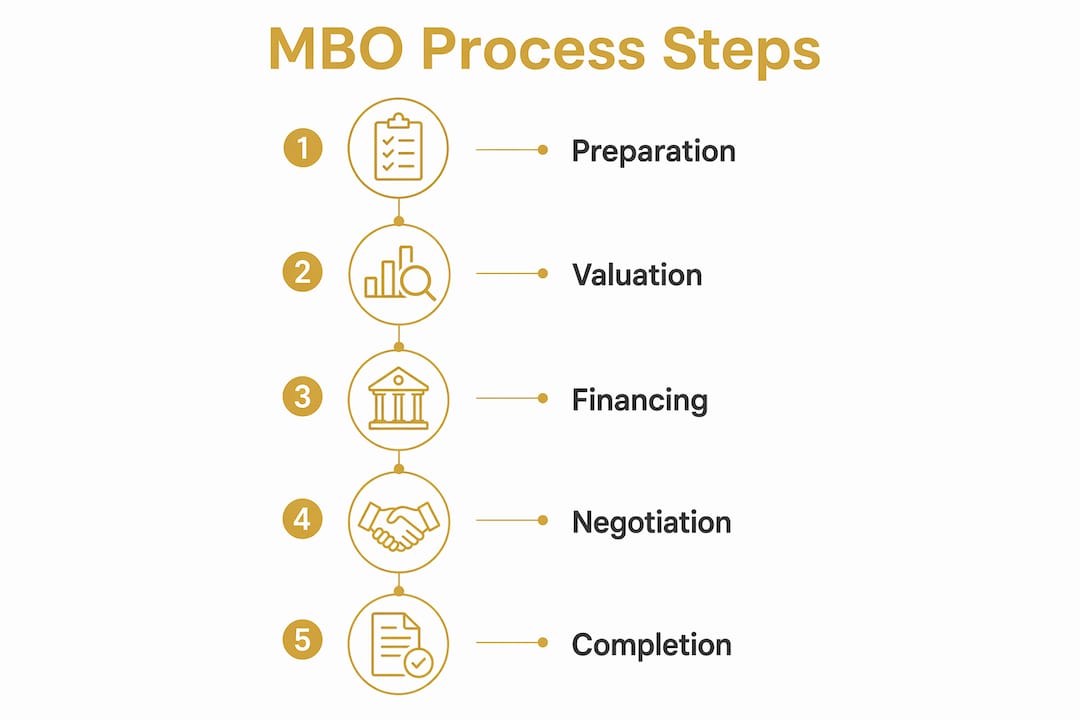
A typical UK MBO runs over several months from initial appraisal to completion, with most transactions completing within a 3–6 month window. The process has a clear sequence, though in practice stages overlap and the timeline depends heavily on funder responsiveness and due diligence complexity.
The MBO process step by step:
- Initial appraisal: management assesses whether an MBO is viable, including a preliminary view on valuation and financing capacity
- Business plan development: a detailed plan and financial forecast is prepared, demonstrating the investment case to funders
- Valuation and deal structuring: formal valuation is agreed or negotiated, and the deal structure is designed
- Approach to funders: management approaches banks, private equity firms, and other financiers with the business plan
- Financing offers and selection: term sheets are received, compared, and negotiated
- Heads of terms: a non-binding agreement sets out the key commercial terms between buyer and seller
- Due diligence: legal, financial, and tax due diligence is conducted by all parties
- Legal documentation: sale and purchase agreement, shareholder agreement, and financing documents are drafted and negotiated
- Completion: funds are drawn down, documents are signed, and ownership transfers
The dual-track challenge is most acute in the middle stages. Maintaining business performance during the transaction is critical. A deterioration in trading during the process gives funders grounds to reprice or withdraw, and it hands the vendor leverage in renegotiation. Management teams that let the business slip while chasing the deal often find the deal slips too.
Why the human factor determines whether an MBO succeeds
The financials get most of the attention in an MBO, but the human element is the most overlooked success factor. Management teams that are technically capable but misaligned on vision, equity splits, or post-completion roles create problems that no amount of clever deal structuring can fix.
The mindset shift from employee to owner is genuinely difficult. As an employee, you execute within a structure someone else built. As an owner, you are the structure. Decisions about capital allocation, hiring, and risk tolerance now carry personal financial consequences, and teams that have not had that conversation explicitly before completion often have it badly after.
Pro Tip: Before approaching any funder, hold a structured session with all buying team members to agree on equity splits, roles, decision-making authority, and exit horizons. Funders will probe these questions directly, and a team that cannot answer them coherently rarely gets to completion.
Human factors that determine MBO outcomes:
- Alignment on long-term vision and individual roles post-completion
- Clarity on equity splits and the rationale behind them
- Willingness to accept external governance from private equity backers
- Entrepreneurial drive and appetite for personal financial risk
- Ability to maintain team cohesion under the pressure of a live transaction
- Openness to professional coaching or advisory support during the transition
For management teams preparing for this transition, Consult EFC’s guide to team cohesion in MBOs covers the practical steps for building a buying group that funders will back.
Legal considerations and documentation in an MBO
The legal architecture of an MBO is more complex than a standard share purchase, because the same individuals are simultaneously negotiating as buyers and operating as the management of the target business. That dual role creates specific legal risks that require careful handling.
The core documents in any MBO include the sale and purchase agreement (SPA), the shareholder agreement governing the relationship between management and any private equity backer, and the financing documents from lenders. The SPA in an MBO typically carries fewer warranties from the vendor than a trade sale would, because the management team is assumed to know the business as well as the seller does. That warranty gap transfers risk to management, who then face warranty claims from their private equity backers if undisclosed issues emerge post-completion.
Disclosure is therefore critical. Management teams should conduct their own thorough review of the business before completion, even though they believe they already know it. Issues that seemed minor as employees can become material liabilities as owners. Intellectual property ownership, employment contracts, customer agreements, and property leases all warrant specific legal review. Engaging a solicitor with dedicated MBO experience, rather than a general corporate lawyer, makes a measurable difference to both the quality of documentation and the speed of completion.
Post-MBO management: what changes after completion
Completion day feels like the finish line. It is actually the starting gun. The operational challenges that follow an MBO are distinct from those of the transaction itself, and teams that do not plan for them often find the first year harder than expected.
The most immediate challenge is debt service. The business now carries a level of debt it did not have before, and that changes cashflow planning fundamentally. Capital expenditure decisions, hiring plans, and dividend policy all need to be reassessed through the lens of debt covenants and repayment schedules. A financial model that worked at the deal stage needs to be maintained and updated as a live management tool, not filed away after completion.
Governance also changes. If private equity is involved, the business will have a board with investor representation, formal reporting requirements, and agreed KPIs. Management teams that have never operated in a governed environment sometimes find this adjustment uncomfortable. The discipline it imposes, however, is also what drives the performance improvements that make the investment worthwhile for everyone.
Culture and staff communication deserve early attention. Employees notice ownership changes, and uncertainty breeds rumour. A clear, honest communication plan for the period immediately after completion reduces anxiety and retains the people the business depends on.
Why external advisors are worth every penny in an MBO
Most management teams complete one MBO in a career. Their advisors complete dozens. That experience gap is the core reason external advisory support pays for itself, and it shows up most clearly in the areas where inexperienced buyers make costly mistakes: valuation, tax structuring, and legal documentation.
A good corporate finance adviser does more than introduce funders. They help management build a credible business plan, stress-test the financial model, manage the funder process, and negotiate term sheets. They also provide a buffer in negotiations with the vendor, allowing management to maintain a working relationship with their employer while the adviser handles the harder commercial conversations.
Legal advisers with MBO experience understand the specific risks of the warranty gap, the shareholder agreement dynamics with private equity, and the financing document terms that can constrain management post-completion. A solicitor who has not done an MBO before will take longer and miss nuances that an experienced one catches immediately.
Tax advisers should be engaged before heads of terms are agreed, not after. The structure of the deal, the treatment of vendor loan notes, and the eligibility for Business Asset Disposal Relief all depend on decisions made early in the process. Changing the structure after heads of terms is expensive and sometimes impossible.
Key takeaways
A successful management buyout requires the right financing structure, early tax planning, and a management team that is genuinely aligned before the deal begins.
| Point | Details |
|---|---|
| Debt carries most of the price | Debt typically funds 50–70% of an MBO, so cashflow resilience is critical from day one. |
| Tax planning must start early | Late tax engagement is a leading cause of avoidable liabilities for both vendors and buyers. |
| Management equity signals commitment | Funders treat personal investment as proof of alignment, not just a financial contribution. |
| The human factor is decisive | Team cohesion and mindset shift from employee to owner determine outcomes as much as the numbers do. |
| Advisors close the experience gap | Corporate finance, legal, and tax advisers with MBO experience prevent the mistakes that derail first-time buyers. |
How Consult EFC supports management buyout teams
Consult EFC works with management teams and business owners across the UK who are preparing for or navigating a buyout. Led by ICAEW Chartered Accountant Kishen Patel, the firm brings Big Four rigour to the financial modelling, valuation, and transaction support that MBOs demand, without the full-time cost of an in-house CFO.
Whether you need a credible financial model to take to funders, a valuation that stands up to scrutiny, or ongoing financial leadership through the post-completion integration period, Consult EFC’s fractional CFO services are built for exactly this stage of a business’s life. If you are earlier in the process and want to understand what the role involves, the guide to what is a fractional CFO is a practical starting point.
Recommended
- Management Buyouts Explained: A Founder’s Guide
- Management Buy-Out Valuation UK Guide – Consult EFC
- Management Buyout Valuation: How to Prepare for a Fundable Deal
- Management Buyout (MBO): Can You Sell & Stay Involved?
Not sure where your business stands right now?
Book a free 30-minute call with Kish. Bring your numbers, your questions, or just your situation. You will leave with a clearer picture than you arrived with.
Book a Free Strategy Call
Over 12 years across Big Four audit, Investment Banking, and corporate advisory. Kish works with SaaS founders, tech companies, and ambitious UK SMEs from £1M to £50M in revenue on fundraising, valuations, exit planning, and financial strategy. ICAEW regulated. Big Four trained. Based in London.