


A preparing a business for sale checklist is a structured set of tasks that covers every area a buyer will scrutinise, from reconciled financials to documented operations and clean legal records. For UK SME owners, working through this checklist methodically is the single most reliable way to protect your asking price and give buyers the confidence to proceed. Rushed sales cost real money. A rushed sale typically leaves 15%–30% of enterprise value on the table due to undiscovered issues or poor preparation causing deal renegotiations. The good news is that disciplined preparation, started early enough, removes that risk entirely.
What financial documents and reconciliations prepare your business for sale?
Clean financials are the foundation of every successful business sale. Buyers and their advisers will tear apart your numbers, and any inconsistency gives them grounds to reduce their offer or walk away entirely.
Buyers expect at least three years of reconciled profit and loss statements, balance sheets, and tax returns before they will take a transaction seriously. That standard applies whether you are selling a manufacturing firm in Manchester or a professional services business in London.

Beyond the headline figures, buyers want to see adjusted EBITDA with clearly documented add-backs. Add-backs are one-off or owner-specific costs, such as personal vehicle expenses or a one-off legal fee, that a new owner would not incur. Present these transparently, with supporting evidence, or buyers will simply ignore them.
Customer concentration is another financial red flag. Revenue concentrated above 15%–20% in a single customer is a risk that buyers will price into their offer. If you have that concentration, document your plan to diversify before you go to market.
- Three years of reconciled profit and loss statements, balance sheets, and tax returns
- Adjusted EBITDA with clearly evidenced add-backs
- Customer concentration analysis with a written diversification plan
- VAT returns and corporation tax computations for the same period
- Management accounts for the current year to date
- Bank reconciliations with no unexplained variances
Pro Tip: Commission a Quality of Earnings review before you go to market. These reviews, which typically cost £20,000 to over £100,000, surface issues on your terms rather than the buyer’s, giving you time to fix them without losing negotiating power.
How do you reduce owner dependency before selling your business?
Buyers value businesses that operate independently from the founder. A business that stops functioning when the owner leaves is not a business. It is a job, and buyers will pay a fraction of what an independently run operation commands.
The practical fix is process documentation combined with deliberate delegation. Documenting 10–15 key weekly operational processes is sufficient to demonstrate business continuity and boost buyer confidence without creating voluminous manuals. Focus on the processes that would cause the most disruption if the owner were absent: invoicing, customer onboarding, supplier ordering, and scheduling.
- Map your role. List every task you personally perform each week. Be honest. Most founders underestimate how much the business depends on them.
- Document each process. Write step-by-step instructions for the 10–15 highest-impact tasks. Use screenshots or short videos where text alone is unclear.
- Delegate and test. Assign each process to a team member and run it without your involvement for at least one full cycle.
- Build an organisational chart. Show buyers a clear reporting structure with named individuals and defined responsibilities.
- Prepare a key employee retention plan. Identify the two or three people a buyer cannot afford to lose and document what keeps them in place, whether that is salary, equity, or contractual notice periods.
Pro Tip: Start this process at least 12 months before you plan to sell. Buyers will ask to speak with your management team during due diligence. If the team cannot answer basic operational questions without you in the room, your valuation suffers.
You can find more detail on exit readiness planning for UK SMEs, including how to structure your management team for a sale.
What legal and compliance documents do buyers expect?
Legal preparation is where many sellers lose time and money. Buyers conduct thorough legal due diligence, and gaps in your documentation create delays, price chips, or deal collapse.
Gather and organise the following before you go to market:
- Contracts and agreements. All customer contracts, supplier agreements, and partnership arrangements. Check each one for change of ownership clauses, which can give counterparties the right to terminate on a sale.
- Leases. Property and equipment leases, with confirmation of remaining terms and any landlord consent requirements on assignment.
- Licences and permits. Every regulatory licence, trade permit, or professional accreditation your business holds. Confirm each is current and transferable.
- Intellectual property. Registered trademarks, patents, domain names, and software licences. Confirm ownership sits with the company, not with you personally.
- Employment records. Contracts for all staff, including directors. Confirm compliance with UK employment law, including right-to-work checks.
- Litigation and disputes. Disclose any ongoing or threatened claims transparently. Buyers will find them in due diligence. Surprises at that stage destroy trust and price.
A clean legal record does not mean a perfect history. It means full disclosure, organised documentation, and no hidden liabilities. Buyers can price known risks. They cannot price surprises.
For guidance on balance sheet red flags that commonly surface during legal and financial due diligence, Consult EFC has published a detailed UK-focused resource.
When should you start, and how do you manage the sale timeline?
Timing is the most underestimated variable in preparing your business for sale. Owners who maximise value begin preparing 24–36 months in advance. Business sales themselves often take 6–12 months to complete. That means the total process from first preparation to completion can run three to four years.
The table below shows the difference between a prepared and an unprepared sale approach.
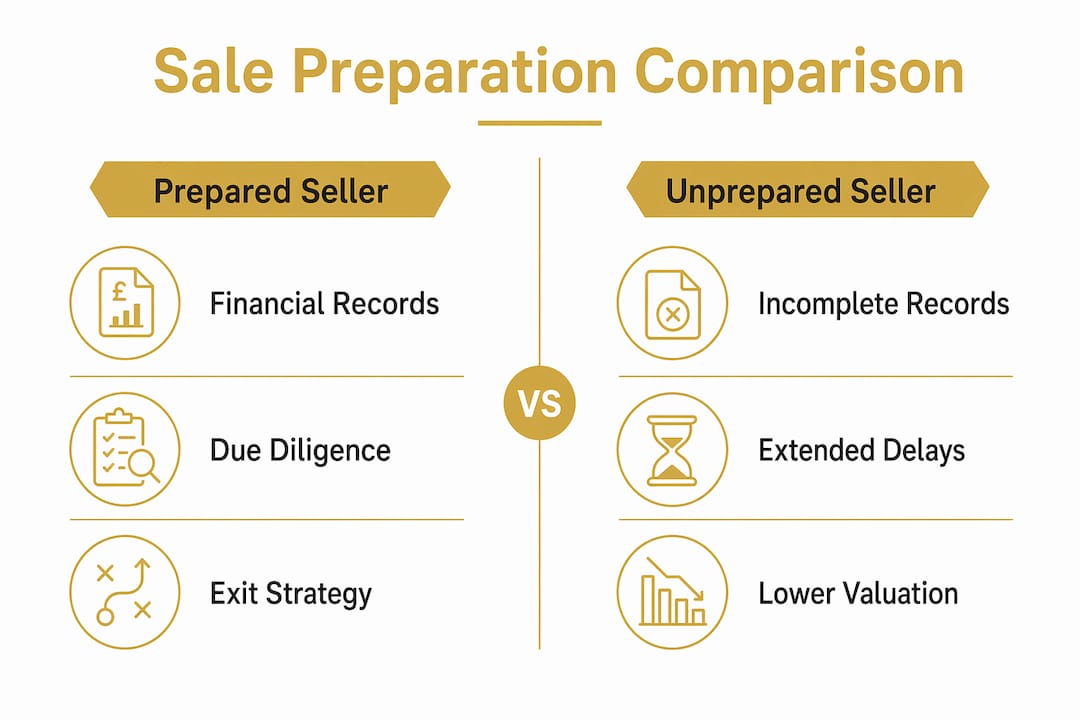
| Stage | Prepared seller | Unprepared seller |
|---|---|---|
| Financial records | Three years reconciled, add-backs documented | Gaps, inconsistencies, missing tax returns |
| Operations | Documented processes, delegated roles | Owner-dependent, no written procedures |
| Legal | Contracts organised, IP confirmed | Missing agreements, undisclosed disputes |
| Due diligence response | Prompt, complete, pre-organised data room | Slow, incomplete, reactive |
| Outcome | Full asking price, clean completion | Price chip, delay, or deal collapse |
Due diligence typically lasts 6–12 weeks after a Letter of Intent is signed. Slow or incomplete responses from sellers during this window give buyers grounds to renegotiate. Prepare a data room before you receive an offer, not after.
Set clear exit objectives before you begin. Know your minimum acceptable price, your preferred deal structure (asset sale versus share sale), and your post-sale role, if any. Sellers who enter negotiations without clear objectives are easier to pressure. For a full framework on exit strategy planning in the UK, including how to set realistic financial expectations, Consult EFC’s 2026 guide covers each stage in detail.
For owners considering business transfer solutions and long-term value maximisation, external specialist advice at the planning stage pays for itself many times over.
What are the most common mistakes in business sale preparation?
The most damaging mistakes in preparing a business for sale are predictable. Knowing them in advance means you can avoid them.
- Cutting staff or product lines before sale. Avoid cutting staff or product lines to boost short-term profits. Buyers model future performance, not just historical margins. A leaner cost base that signals operational fragility will reduce your multiple, not increase it.
- Inconsistent or incomplete financial records. A single year of clean accounts surrounded by two years of messy records raises more questions than no records at all. Consistency across the full three-year period is what buyers need.
- Undocumented customer relationships. Verbal agreements with key customers are invisible to buyers. Convert them to written contracts before you go to market.
- Slow due diligence responses. Delays signal disorganisation and give buyers time to find alternative targets. Prepare your data room in advance and commit to responding within 48 hours of any buyer request.
- Unrealistic price expectations. Valuation is a function of earnings, growth, risk, and market conditions. Sellers who anchor to an emotional number rather than a market-derived multiple waste months in failed negotiations.
“Top-performing sellers follow a disciplined, vertical-specific playbook with meticulous preparation to satisfy private equity requirements before a Letter of Intent is signed. Improvisation is the enemy of value.”
The most reliable way to avoid these mistakes is to treat the sale as a project with a defined timeline, clear milestones, and external accountability. A structured exit plan built 24–36 months out gives you the time to fix problems before buyers find them.
Key takeaways
Preparing a business for sale requires clean financials, documented operations, organised legal records, and a defined exit timeline started at least 24 months before going to market.
| Point | Details |
|---|---|
| Start 24–36 months early | Owners who begin preparation this far in advance consistently achieve higher sale prices. |
| Clean three-year financials | Reconciled accounts with documented add-backs are the minimum buyers expect before proceeding. |
| Reduce owner dependency | Document 10–15 key processes and delegate them so the business runs without you. |
| Organise legal records | Contracts, leases, IP, and licences must be current, complete, and transferable before sale. |
| Prepare a data room early | Prompt due diligence responses protect your price and prevent deal renegotiation. |
What I have learned from watching founders sell their businesses
By Kishen Patel, ICAEW Chartered Accountant and founder of Consult EFC
The founders who get the best outcomes are not always the ones with the best businesses. They are the ones who prepared the longest. I have seen genuinely excellent companies sell at a discount because the owner spent six months trying to tidy up three years of messy financials under buyer scrutiny. The pressure of a live deal is the worst possible time to fix your accounts.
The insight that most founders miss is this: good preparation removes buyer leverage. When your data room is complete, your financials are clean, and your management team can answer questions without you, buyers have very little to push back on. The negotiation becomes about price, not about risk.
My honest advice is to treat your business as if it is always for sale. That means monthly management accounts, documented processes, and no personal expenses running through the company. Founders who operate this way find that when they do decide to sell, preparation takes months rather than years.
Advisory support matters too. A fractional CFO engaged 18–24 months before a planned sale will do more for your final price than any last-minute fix. The value of exit planning is not in the documents it produces. It is in the problems it surfaces early enough to solve.
— Kishen Patel
How Consult EFC supports your business sale preparation
Consult EFC works with UK SMEs and founders who are preparing for a sale and need financial clarity fast. Kishen Patel and the team bring ICAEW-qualified rigour to your management accounts, adjusted EBITDA presentation, and due diligence data room, without the cost of a full-time CFO.
Whether you are 24 months from a planned exit or already in early conversations with buyers, Consult EFC’s fractional CFO for growth service gives you the financial leadership your sale demands. From reconciling three years of accounts to building a buyer-ready information memorandum, the team handles the financial preparation that protects your price. Speak to Consult EFC to find out where your business stands today.
FAQ
How long does it take to prepare a business for sale?
Owners who maximise value begin preparing 24–36 months before going to market, with the sale process itself taking a further 6–12 months to complete.
What financial records do buyers require?
Buyers expect three years of reconciled profit and loss statements, balance sheets, and tax returns, along with adjusted EBITDA and documented add-backs.
What does owner dependency mean for my sale price?
A business that relies on the founder to operate commands a lower valuation. Buyers pay more for businesses that can run independently after the founder departs.
What is a Quality of Earnings review?
A Quality of Earnings review is an independent analysis of your financial records, typically costing £15,000 to over £100,000, that surfaces accounting issues before buyers find them in due diligence.
How do I avoid losing value during due diligence?
Prepare a complete data room before you receive an offer and commit to responding to buyer requests within 48 hours. Slow responses give buyers grounds to renegotiate price or walk away.
Recommended
- How to Prepare a SaaS Business for Sale in the UK (2026 Guide) | Consult EFC
- Selling My Business UK 2025, Exit Plan | Consult EFC
- Sell My Business UK | M&A Advisor for SMEs – Consult EFC
- Business Exit Strategy UK: The 2026 Guide to a High-Value Sale
Not sure where your business stands right now?
Book a free 30-minute call with Kish. Bring your numbers, your questions, or just your situation. You will leave with a clearer picture than you arrived with.
Book a Free Strategy Call
Over 12 years across Big Four audit, Investment Banking, and corporate advisory. Kish works with SaaS founders, tech companies, and ambitious UK SMEs from £1M to £50M in revenue on fundraising, valuations, exit planning, and financial strategy. ICAEW regulated. Big Four trained. Based in London.