

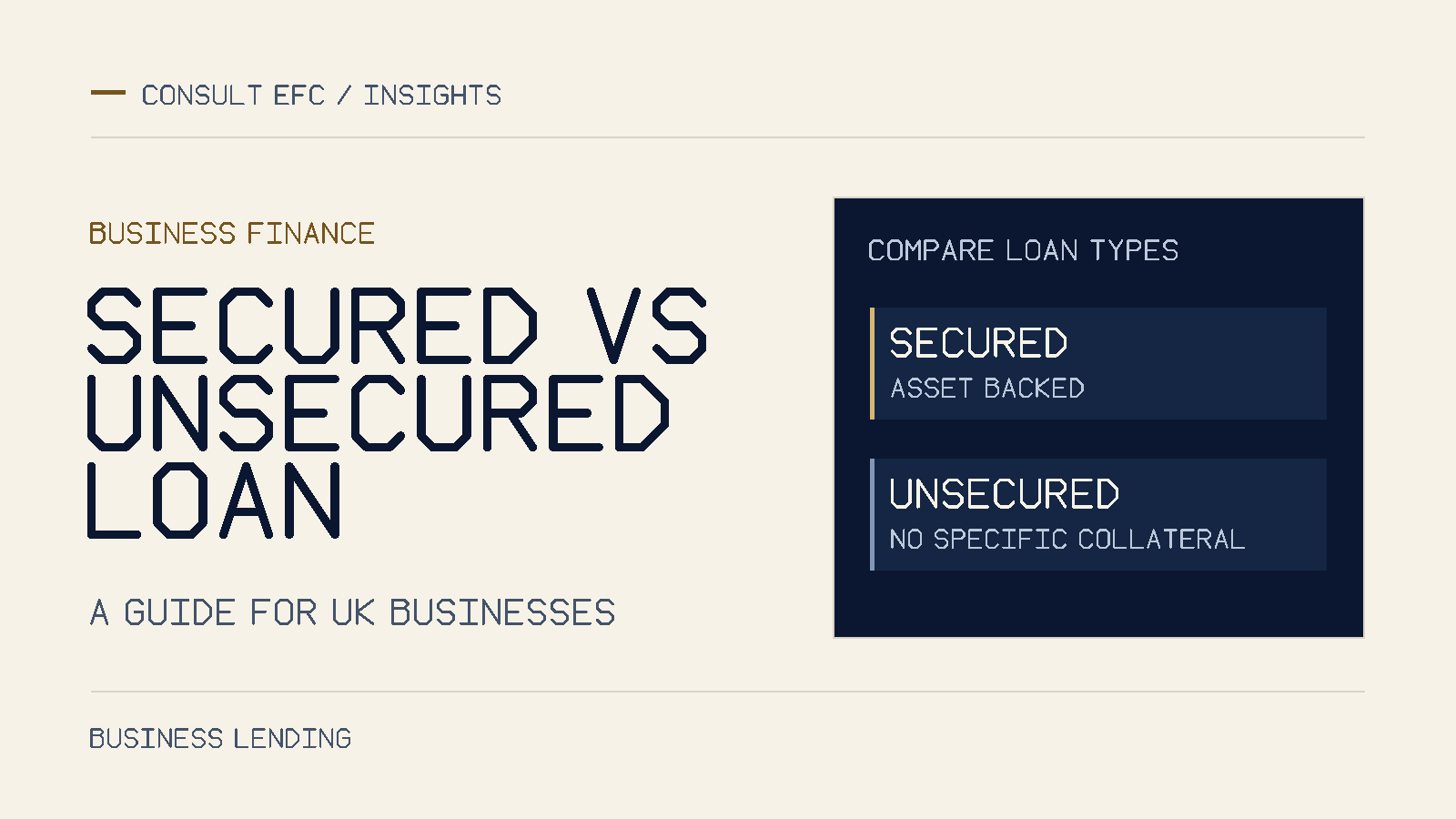
A secured loan is backed by an asset the lender can take and sell if you stop repaying. An unsecured loan is not, so the lender relies on your credit record and your ability to repay. In practice, secured borrowing usually means lower rates, larger amounts and longer terms, but slower approval and a real asset at risk. Unsecured borrowing is quicker and keeps your assets free, but it usually costs more and often still comes with a director’s personal guarantee.
This guide is written for UK founders and SME owners weighing up a business loan. It covers how the two types differ, what counts as security, what lenders look at, what happens if repayments fail, and how to decide.
TL;DR
- Secured: you pledge an asset (property, equipment, invoices, stock). Rates are usually lower and limits higher, but approval takes longer and the asset is at risk.
- Unsecured: no asset is pledged, so rates are typically higher and amounts smaller. Many still require a personal guarantee, so “unsecured” does not mean “no recourse”.
- Lenders decide on affordability first: security helps, but free cash flow to service the debt is what a well-run application proves.
- Choose by purpose and timing: long-life assets and large sums suit secured; short-term needs and speed suit unsecured.
- Prepare the numbers before you apply. A clear forecast and clean management accounts improve both the offer and your negotiating position.
Table of Contents
- The core difference in plain terms
- Interest rates, amounts and terms
- What counts as security
- The “unsecured” loan that is not really unsecured
- What lenders look at before they say yes
- What happens if you cannot repay
- How to choose: a practical decision guide
- Why the numbers behind the application matter
- Get your finances lender-ready with Consult EFC
- FAQ
- Sources
The core difference in plain terms
The British Business Bank explains that an unsecured business loan lets you borrow without using business assets as security, often requires a personal guarantee, and typically carries a higher interest rate than a secured loan. A secured loan requires you to use an asset from your balance sheet as security, usually property, though stocks and shares can also be used.
The logic is about the lender’s risk. If you default on a secured loan, the lender has the right to sell the pledged asset to recover what it is owed, which is why secured loans typically cost less. With an unsecured loan the lender is relying only on your creditworthiness, so it prices in more risk.
| Secured loan | Unsecured loan | |
|---|---|---|
| Backed by | A specific asset or charge over assets | Your credit profile (often plus a personal guarantee) |
| Interest rate | Usually lower | Usually higher |
| Borrowing amount | Larger | Smaller |
| Term | Longer | Shorter |
| Speed | Slower (valuation, legal work) | Faster |
| Main risk | Losing the pledged asset | Personal liability if you have guaranteed it |
Interest rates, amounts and terms
No two lenders price alike, so treat any figure as a range rather than a quote. As a guide, standard unsecured business loan rates in the UK start at about 6% and can reach 20% or more, and the same source notes that putting up a business asset as security often brings lower rates. For context on the wider market, the effective rate on new loans to SMEs was 6.8% in April 2025, down from 7.6% a year earlier, based on Bank of England data.
That spread of rates is the point. The rate you are offered depends on where you borrow, the strength of your accounts, your credit history and how your application is presented. Representative APRs also deserve care: the same money.co.uk page notes that lenders only have to offer the advertised representative APR to 51% of approved applicants, so the other 49% may be charged more.
On size and term, the pattern is consistent across the UK market. Secured lending generally supports larger sums over longer periods, particularly when backed by property. Unsecured facilities tend to be smaller and shorter, repaid over a few years. If you are borrowing to fund something that will earn for a decade, such as premises or heavy machinery, a long secured term matches the asset’s life. If you are bridging a few months of working capital, a short unsecured facility often fits better.
What counts as security
Security is simply something of value the lender can fall back on. In UK business lending it commonly takes these forms:
- Property: commercial premises, or in some cases a director’s home. A first charge puts the lender first in line to be repaid from a sale; a second charge sits behind an existing mortgage.
- Equipment, vehicles and machinery: the basis of asset finance.
- Unpaid invoices and stock: used in invoice finance and similar facilities. If this is your route, our guide to asset based lending in the UK explains how it works.
- Cash and investments: funds in a bank account or a share portfolio can serve as security.
- Intangibles: some lenders will consider trademarks, intellectual property, licences and patents.
- Personal or third-party guarantees: ACCA notes that security can include business assets, personal assets, guarantees or third-party guarantees.
Fixed charges, floating charges and debentures
A limited company can give a lender a fixed charge over a specific asset, such as a piece of machinery, or a floating charge over a changing pool of assets, such as stock and receivables. A floating charge becomes fixed on default. A debenture is the legal document granting a lender a charge over a company’s assets, and it can only be granted by a limited company or LLP, not a sole trader.
Charges are public. A company must submit the application to register a charge at Companies House within 21 days of its creation, so future lenders and investors can see what is already pledged. That matters because every asset you pledge is one you cannot easily pledge again.
The “unsecured” loan that is not really unsecured
Many founders assume unsecured means nothing at risk. It rarely does. The British Business Bank notes that unsecured business loans often require a personal guarantee. A personal guarantee makes you personally liable if the company cannot pay, and it can expose your home, savings and other personal assets. The same source says you can often negotiate caps, time limits or the removal of joint and several liability, and that you should take independent legal advice before signing.
So when comparing offers, do not stop at the label. Ask what is pledged, what you personally guarantee, and whether the lender can call the loan in early.
What lenders look at before they say yes
Security is only part of the decision. According to the British Business Bank, common requirements include showing the business can afford repayments, being UK-based, and having no late payments or outstanding CCJs. Your business credit score affects approval, and lenders are likely to check your personal credit report too.
Business Wales adds that most lenders ask for security, or a personal guarantee where the business cannot offer enough, and want a good credit record. New businesses with no track record can find it harder to secure a loan.
The strongest applications lead with serviceability. One UK bank’s business team points out that the industry tends to fixate on loan-to-value, while the real driver is the free cash available to service the debt. Working backwards from that figure keeps the facility manageable. For a deeper look, read what lenders actually check in our guide to debt finance for UK SMEs.
What happens if you cannot repay
The consequences differ by structure, and this is where the choice has real weight.
Secured loan. The lender can enforce its security. ACCA says that if the business cannot meet its financial commitments, the lender may take action to seize the security. With property, that can mean the premises, or a home if it was pledged. With a floating charge, the pool of assets is frozen and the charge becomes fixed.
Unsecured loan with a personal guarantee. The lender pursues the company first, then you personally under the guarantee. Your home, savings and investments can be in play.
Unsecured loan with no guarantee. The lender can still pursue the debt through the courts, and a missed payment will damage your business credit score. That in turn makes later borrowing dearer.
In every case, the practical step is the same: talk to the lender early, before you miss a payment. If cash is tightening, speak to your accountant or a finance adviser about restructuring, and take legal advice on any guarantee you have signed. Do not wait for the first default.
How to choose: a practical decision guide
Work through these questions in order.
- What is the money for? Match the term to the life of what you are funding. Long-life assets point to secured; short working-capital gaps point to unsecured.
- How much do you need? Larger sums generally need security. Smaller sums are often available unsecured.
- How fast do you need it? Secured applications take longer because of valuation and legal work. Unsecured facilities can complete in days.
- What can you afford to put at risk? Be honest about whether you could lose the asset, and whether you would sign a personal guarantee.
- What do you want to keep free? Pledging your best asset now can limit what you can offer a future lender or acquirer.
- Is debt the right tool at all? If you are growing fast with uncertain revenues, equity may suit better. Our comparison of debt versus equity funding sets out the trade-offs.
Worked example
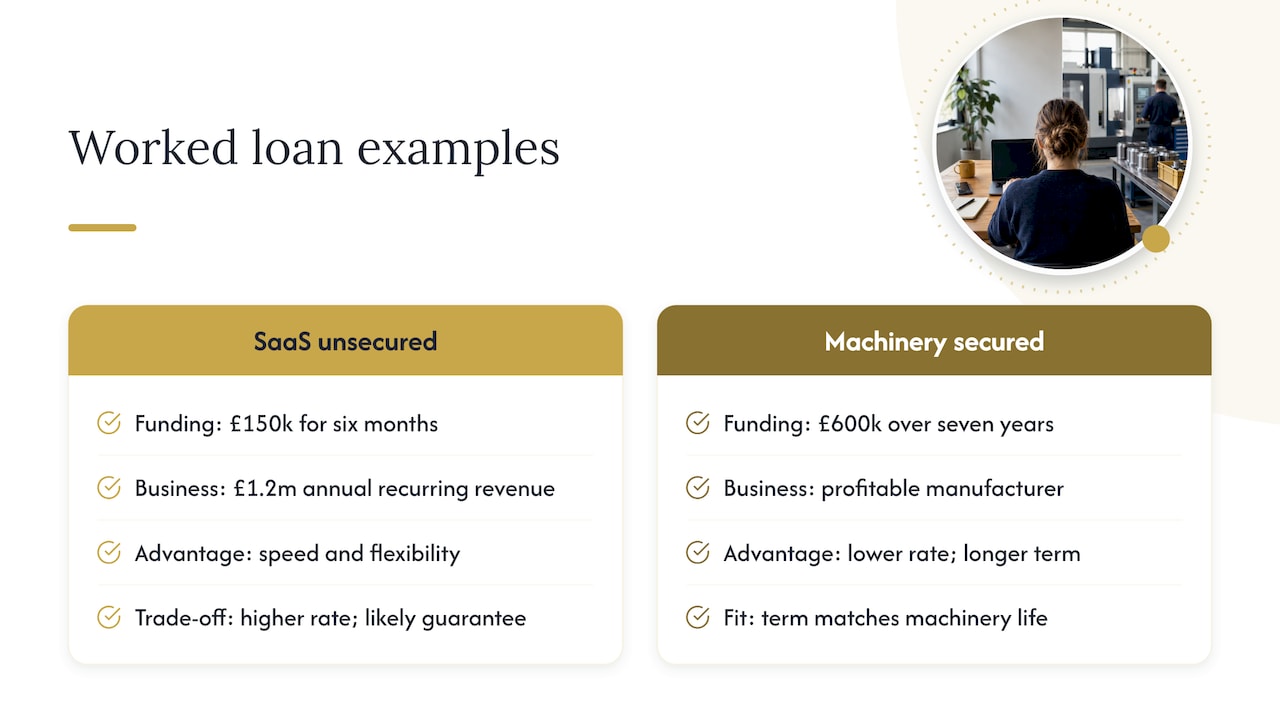
Imagine a SaaS company with £1.2m of annual recurring revenue wanting £150,000 to extend its runway for six months while a Series A is arranged. Speed and flexibility matter more than the lowest rate, and the company has few hard assets, so an unsecured facility is the natural fit. The cost is a higher rate and probably a director’s guarantee.
Now imagine a profitable manufacturer with £600,000 of equipment needs over seven years. Here an asset-backed loan over the machinery gives a longer term and a lower rate, and the asset’s life matches the repayment period. The trade-off is slower completion and a charge over the equipment.
These are illustrations, not quotes. Your numbers, credit profile and lender will change the answer.
Why the numbers behind the application matter
Whichever route you choose, the lender is judging your finances. Reliable management accounts, a cash-flow forecast that holds up, and a clear picture of covenants and headroom all strengthen your position. Lenders price risk, and a business that can demonstrate predictable cash generation gives them less to price in.
Perspective
In our experience, founders spend too long comparing headline rates and too little time on the question that actually decides the outcome: can the business show, in numbers, how it will service the debt? A secured loan can lower the rate, but pledging an asset or signing a guarantee is a decision about your balance sheet and your personal exposure, and it should be taken with a forecast in front of you.
We would rather see a business choose the structure that fits its cash flow and growth plan than the one with the lowest advertised rate. That means modelling repayments under realistic and downside scenarios, understanding what each charge does to your ability to raise further capital or sell the company, and negotiating guarantees rather than accepting them as standard.
This is where senior finance input pays for itself. A fractional CFO, led by an ICAEW Chartered Accountant, brings the rigour you would expect from a large consultancy without the cost of a full-time hire. We build the model, prepare the lender or investor pack, and help you decide whether debt, equity or a blend suits your stage.
Kishen Patel
Get your finances lender-ready with Consult EFC
If you are preparing to borrow, the quality of your financial model and reporting will shape the terms you are offered. Our debt financing advisory helps UK SMEs structure and present borrowing, and our fractional CFO services give you senior finance leadership on a flexible basis, from funding rounds through to exit.

We also build investor-grade financial models that show lenders and investors exactly how repayments are covered. If you want to talk through your options, start from the Consult EFC homepage.
FAQ
Is a secured or unsecured loan better for a small business?
Neither is better in every case. Secured loans usually offer lower rates, larger amounts and longer terms, but put an asset at risk and take longer to arrange. Unsecured loans are faster and keep assets free, but typically cost more. Match the choice to what you are funding, how quickly you need the money and what you can afford to pledge.
Do unsecured business loans need a personal guarantee?
Often, yes. The British Business Bank says unsecured business loans often require a personal guarantee, which makes you personally liable if the company cannot repay. Before signing, take independent legal advice and ask whether the guarantee can be capped or time-limited.
What can I use as security for a business loan?
Common forms include commercial property, equipment, vehicles, unpaid invoices, stock, cash and investments, and in some cases intellectual property. A limited company can also grant a fixed or floating charge over its assets. Which assets a lender accepts depends on the lender and the facility.
Can I get a secured loan if my credit is poor?
Security can make a lender more willing to lend, because it reduces their risk. Your credit record still affects approval and the rate, since lenders are likely to check both business and personal credit. Clearing late payments and showing strong cash flow improves your position.
What happens if I default on a secured business loan?
The lender can take action to seize and sell the pledged asset to recover what it is owed. If you also gave a personal guarantee, your personal assets may be exposed. Contact the lender as early as possible and take advice from an accountant or solicitor before a payment is missed.
Sources
- Business loans, British Business Bank
- How to apply for a business loan, British Business Bank
- Security, ACCA
- A guide to business loans, Handelsbanken
- Bank loans, Business Wales
- The average business loan interest rates for 2026, money.co.uk
- Economic Intelligence Wales Annual Report September 2025
- Personal Guarantee UK: Legal Risks, Enforcement and How to Limit Liability, Go Legal
- Registering a charge at Companies House, 1st Formations
Recommended
- Debt vs Equity Funding: Which is Right for Your UK SME?
- Asset based lending UK: what business owners need to know
- Debt Finance for UK SMEs: What Lenders Actually Check
- Debt Financing UK — Corporate Debt Advisory
This article is for general information only and is not professional advice.
Not sure where your business stands right now?
Book a free 30-minute call with Kish. Bring your numbers, your questions, or just your situation. You will leave with a clearer picture than you arrived with.
Book a Free Strategy Call
Over 12 years across Big Four audit, Investment Banking, and corporate advisory. Kish works with SaaS founders, tech companies, and ambitious UK SMEs from £1M to £50M in revenue on fundraising, valuations, exit planning, and financial strategy. ICAEW regulated. Big Four trained. Based in London.