



SEIS advance assurance is HMRC’s non-binding opinion that a proposed share issue is likely to qualify under the Seed Enterprise Investment Scheme. It is discretionary, not a statutory right, and it is not a guarantee. For any investor-led round, you should obtain it. Most angels and early-stage funds will not commit without it, because the 50% income tax relief and CGT exemption they are counting on depend on the shares actually qualifying.
HMRC’s VCR Team handles applications, and a complete, correctly prepared submission typically receives a response within a few weeks. Kishen Patel, ICAEW Chartered Accountant at Consult EFC, prepares investor-ready SEIS submissions for SaaS and scale-up clients, reducing HMRC back-and-forth and shortening that window.

Table of Contents
- What is SEIS advance assurance, and what does it not cover?
- Does your company pass the SEIS eligibility checklist?
- What documents does HMRC expect in your application?
- How long does HMRC take, and what causes delays?
- What happens after HMRC issues advance assurance?
- What mistakes do founders make most often?
- When can you skip advance assurance, and what risk does that carry?
- How does a fractional CFO reduce HMRC delays and investor friction?
- Key takeaways
- The part of advance assurance most founders get wrong
- Consult EFC can prepare your SEIS application from start to submission
- Useful sources and further reading
What is SEIS advance assurance, and what does it not cover?
Advance assurance is HMRC’s written view, issued by the VCR Team, that a specific proposed share issue looks likely to qualify for SEIS relief based on the facts you have provided. The operative word is “likely.” It is not a contract, and it does not bind HMRC once shares are actually issued.
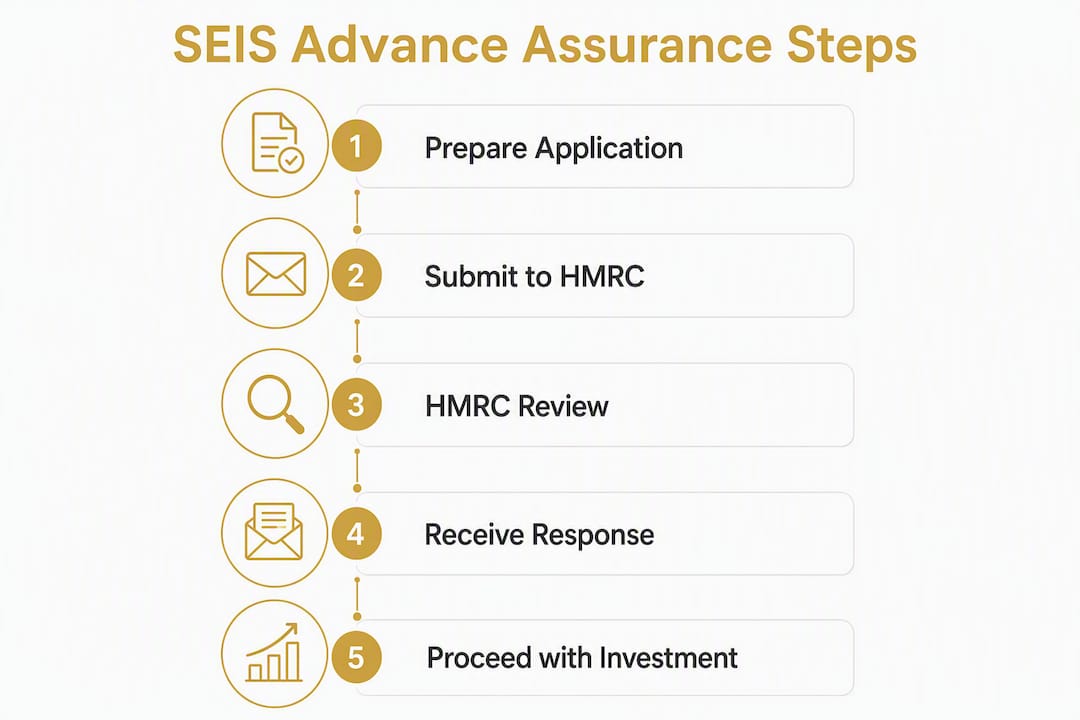
Three stages follow each other in sequence:
- Advance assurance — HMRC reviews your application before any shares are issued and confirms the proposal looks eligible.
- Share issue and SEIS1 — you issue shares on the terms described, then file a SEIS1 compliance statement once the funds are deployed.
- SEIS3 certificates — HMRC processes the SEIS1 and issues SEIS3 certificates, which investors use to claim their tax relief.
That absence of appeal rights matters. If HMRC refuses, your only route is to address the reasons given and reapply. Treat any HMRC feedback as a correction list, not a legal dispute. For context on how HMRC approaches similar discretionary opinions, the EMI valuation process follows comparable logic.
Does your company pass the SEIS eligibility checklist?
Before drafting a single document, run this self-check. HMRC’s statutory eligibility criteria require all of the following:
- The company is incorporated and established in the UK.
- It carries out a new qualifying trade (not a continuation of an existing trade acquired from another entity).
- It has been trading for less than three years at the time of the share issue.
- It has fewer than the allowed full-time equivalent employees.
- Gross assets are within the permitted limit immediately before the share issue.
- It has not previously raised money under EIS or SEIS beyond the lifetime cap.
Excluded trades include property development, financial activities, legal services, and certain energy generation activities. If your SaaS product touches any adjacent activity in these categories, flag it explicitly in your application rather than hoping HMRC will not notice.
Pro Tip: For marginal cases, assemble a one-page trade analysis before applying: describe the revenue model, name the customers, and show that the primary activity is software development or a qualifying service. This pre-empts the most common VCR Team query and can shave weeks off the process.
What documents does HMRC expect in your application?
HMRC’s guidance sets out a clear document pack. Missing any item is the single fastest route to a delay.
Core document pack:
- Covering letter — addresses the ‘risk to capital’ condition, summarises the proposal, and cross-references every supporting document.
- Business plan or detailed narrative — describes the trade, the market, the team, and how the investment will be deployed.
- Three-year financial forecasts — revenue, costs, and cash flow, reconciled to the business plan narrative.
- Latest accounts or management accounts — confirms gross assets and trading history.
- Structure chart and cap table — shows current shareholders, share classes, and post-round ownership.
- Memorandum and articles of association — confirms share rights and any restrictions.
- Register of members — current shareholder list.
- Use-of-funds schedule — a line-by-line breakdown of how SEIS proceeds will be spent.
Evidence of investor interest:
- Named investor(s) with contact details, or
- A signed term sheet or platform acceptance letter, or
- A letter of intent from an angel or fund.
HMRC’s VCR Team will not consider speculative applications without a concrete funding proposal. No named investor means a likely refusal or a request for more information, which adds weeks.
Pro Tip: Copy this list into an email to your adviser or fractional CFO at the start of the engagement. A document gap analysis on day one prevents a scramble the week before submission.
How long does HMRC take, and what causes delays?
A complete, correctly prepared application takes 4–8 weeks to receive a response. That is the benchmark for a clean submission. Incomplete or inconsistent packs routinely push that to three months or more.
The most common causes of delay:
- Incomplete documentation (missing accounts, no use-of-funds schedule).
- A vague covering letter that does not address ‘risk to capital.’
- No named investor or evidence of a concrete funding proposal.
- Forecasts that do not reconcile with the business plan narrative.
- An inconsistent or unclear cap table.
- Undisclosed activities that might be excluded trades.
How to prevent them:
- Run a pre-flight checklist against the document pack above before submission.
- Reconcile your forecasts line by line with the business plan before the covering letter is drafted.
- Address ‘risk to capital’ explicitly in the covering letter — state why the investment carries genuine risk and how the business plan mitigates it.
- Name at least one investor and include their contact details or a letter of intent.
Pro Tip: Submit at least eight weeks before your target close date. If HMRC comes back with queries, you need buffer time to respond without losing investor momentum.
What happens after HMRC issues advance assurance?
Receiving the assurance letter is not the finish line. The sequence from here to investors holding their SEIS3 certificates runs as follows:
- Issue shares on the exact terms described in the assurance application. Any material change to the round — different share class, different use of funds, different investor — requires a fresh application.
- Deploy funds in line with the use-of-funds schedule submitted to HMRC.
- Maintain eligibility throughout the three-year qualifying period: continue the qualifying trade, stay within headcount limits, and avoid disqualifying activities.
- File SEIS1 (the compliance statement) once shares are issued and funds are substantially deployed. HMRC expects this within two years of the end of the tax year in which the shares were issued.
- HMRC processes SEIS1 and issues SEIS3 certificates to each investor.
- Investors claim relief by submitting their SEIS3 certificate with their self-assessment tax return.
Archive every document: the assurance letter, the share issue paperwork, board minutes approving the issue, and the use-of-funds records. HMRC may request these during the SEIS1 review.
The full journey from submitting the advance assurance application to investors holding SEIS3 certificates typically spans six to twelve months, depending on HMRC workload and how quickly you deploy the funds.
What mistakes do founders make most often?
Three misconceptions cause the majority of problems.
- “The assurance letter is a guarantee.” It is not. HMRC’s view is based on the facts provided; if the company’s actual behaviour after the share issue diverges from what was described, relief can be withdrawn.
- “Investor details are optional.” They are not. HMRC will not process a speculative application.
- “One assurance covers all future rounds.” It covers the specific share issue described. A materially different round requires a new application.
Common pitfalls in the application itself:
- Forecasts that contradict the business plan narrative (HMRC will spot it).
- A covering letter that ignores ‘risk to capital’ entirely.
- An undisclosed activity that looks like an excluded trade.
- A cap table that does not match the register of members.
When can you skip advance assurance, and what risk does that carry?
Skipping is occasionally reasonable. It is rarely advisable.
- Friends-and-family closes where investors explicitly understand and accept the tax risk.
- Time-critical deals where the investor has reviewed eligibility independently and is comfortable proceeding.
- Very small raises where the tax relief is not the primary investor motivation.
The risks investors accept when there is no assurance:
- Potential loss of 50% income tax relief on their investment.
- Loss of CGT exemption on gains if shares are held for three years.
- Higher scrutiny during their own self-assessment if HMRC later questions eligibility.
- Pricing concessions or reduced commitment from institutional co-investors who require assurance.
Pro Tip: Ask three questions before deciding to skip: Does the investor require it? Is there a named investor whose commitment depends on it? Is the amount large enough that losing the tax relief would materially affect the investor’s return? If any answer is yes, apply.
How does a fractional CFO reduce HMRC delays and investor friction?
The covering letter is the single most important document in the pack. It should explicitly address the ‘risk to capital’ condition and proactively reconcile forecasts with the business plan to answer HMRC’s likely queries before they are raised. Most founders underestimate how much weight HMRC places on it.
Consult EFC’s typical engagement for an advance assurance submission covers:
- Document gap analysis — identifying what is missing or inconsistent before anything is drafted.
- Covering letter drafting — addressing ‘risk to capital,’ cross-referencing all supporting documents, and pre-empting likely VCR Team queries.
- Forecast reconciliation — ensuring the three-year model ties to the business plan narrative and the use-of-funds schedule.
- Cap table review — confirming the structure is HMRC-friendly and the register of members is consistent.
- HMRC agent filing — submitting as authorised agent and handling any follow-up queries directly.
Kishen Patel, ICAEW Chartered Accountant, leads these engagements at Consult EFC. Advisory fees for a complete application pack are typically scoped on a project basis; founders should expect a range rather than a fixed price, depending on the complexity of the trade and the state of existing financial records. For founders preparing investor-ready financials alongside the application, the two workstreams overlap significantly.
Key takeaways
SEIS advance assurance is a discretionary HMRC opinion, not a guarantee, and a complete application with named investor evidence and a reconciled document pack is the only reliable way to achieve the 4–8 week turnaround investors expect.
| Point | Details |
|---|---|
| Discretionary, not binding | Advance assurance is HMRC’s opinion; actual relief depends on post-issue behaviour matching the application. |
| Eligibility threshold | Fewer than 25 FTE and gross assets at or below £350,000 immediately before the share issue. |
| HMRC timeline | A complete, correctly prepared submission receives a response within 4–8 weeks. |
| No appeal right | HMRC refusals cannot be formally appealed; treat feedback as a correction list and reapply. |
| Consult EFC | Kishen Patel (ICAEW) prepares the full application pack, covering letter, and HMRC agent filing for SaaS and SME founders. |
The part of advance assurance most founders get wrong
Most articles about SEIS advance assurance treat it as a compliance box to tick. That framing misses the real opportunity. The process of preparing a rigorous application pack forces founders to reconcile their forecasts, tighten their cap table, and articulate their trade in terms that satisfy HMRC’s ‘risk to capital’ test. That is exactly the same work an institutional investor will ask for in due diligence.
Founders who treat the application as a forcing function come out of it with a sharper investor narrative, a cleaner data room, and a shorter fundraise. Those who treat it as paperwork tend to submit incomplete packs, wait three months for HMRC queries, and then scramble to fix the same issues under investor pressure.
The absence of an appeal mechanism is also underappreciated. There is no safety net. A refusal does not pause your fundraise politely; it stops it. Getting the application right the first time is not caution, it is the only viable strategy.
Consult EFC can prepare your SEIS application from start to submission
Preparing a SEIS advance assurance pack that clears HMRC first time is not complicated, but it requires every document to be present, consistent, and correctly framed. That is exactly where most founder-prepared submissions fall short.
Consult EFC handles the complete process: document gap analysis, covering letter drafting, forecast reconciliation, cap table review, and HMRC agent filing. Kishen Patel, ICAEW Chartered Accountant, leads each engagement personally. There are no junior handoffs and no generic templates. Founders working with Consult EFC typically avoid the HMRC follow-up queries that add weeks to the timeline, and arrive at investor meetings with a cleaner, more credible pack.
If you are preparing a SEIS round and want the application done properly, book a scoping call with Consult EFC to discuss your situation and get a clear view of what the engagement involves.
Useful sources and further reading
- HMRC VCM33025: advance assurance — discretionary status — the primary HMRC manual entry confirming the non-binding, discretionary nature of advance assurance.
- HMRC VCM60110: advance assurance timeline and appeal rights — covers the 4–8 week turnaround benchmark and the absence of a statutory appeal mechanism.
- HMRC VCM60210: speculative applications and investor evidence — explains why HMRC will not process applications without a concrete funding proposal and named investor details.
- GOV.UK: apply to use SEIS — the statutory eligibility criteria including the 25 FTE and £350,000 gross assets thresholds.
- GOV.UK: apply for advance assurance — the official application guidance and document checklist.
- Consult EFC: EIS advance assurance for UK startups — practical guidance on preparing EIS and SEIS advance assurance applications, with adviser support.
Recommended
- EIS for UK Startups: How to Secure Advance Assurance
- What Exit Readiness Means for UK Founders | Consult EFC
- How Consult EFC Helps You Become Investor Ready
- Business fund raising: your 2026 UK founder’s guide
Not sure where your business stands right now?
Book a free 30-minute call with Kish. Bring your numbers, your questions, or just your situation. You will leave with a clearer picture than you arrived with.
Book a Free Strategy Call
Over 12 years across Big Four audit, Investment Banking, and corporate advisory. Kish works with SaaS founders, tech companies, and ambitious UK SMEs from £1M to £50M in revenue on fundraising, valuations, exit planning, and financial strategy. ICAEW regulated. Big Four trained. Based in London.