


Start your preparation now: commission a valuation, reconcile three years of accounts, reduce customer concentration, and engage a fractional CFO or transaction adviser. Owners who compress preparation into less than 18 months commonly leave 15–30% of enterprise value on the table. That is not a rounding error; on a £3m deal, it is £450,000–£900,000 walking out the door.
Buyers buy predictability. The businesses that command the strongest multiples are not necessarily the fastest-growing; they are the ones where earnings are clean, customers are diversified, and the business runs without the owner in the room. Every preparation step below is aimed at building that picture.
Your first-month action list:
- Commission an independent business valuation to establish a baseline and identify the biggest value gaps
- Pull three years of management accounts and reconcile them to your filed tax returns; flag every discrepancy now
- Map your top ten customers by revenue concentration and identify any single client with a high proportion of turnover
- Identify every task only you can perform and begin delegating or documenting them
- Engage a fractional CFO or transaction finance lead to own the financial preparation workstream
- Brief a corporate solicitor on your ownership structure and intended deal type (share sale vs asset sale)
- Begin a simple data-room folder on a secure platform (SharePoint, Datasite, or Ansarada) and start populating it
Avoid what advisers call the compression error: the assumption that a short period of tidying will substitute for years of disciplined preparation. It will not. A rushed process typically surfaces diligence flags that buyers use to re-trade the price downward, and by the time the Letter of Intent is signed, your negotiating leverage is largely spent.
Table of Contents
- When should you sell, and what does a good exit look like for you?
- Who should be on your deal team, and what does each adviser actually do?
- How do you get your financials buyer-ready?
- What operational fixes make your business more transferable?
- What UK legal and tax checks must you complete before listing?
- How do you prepare for buyer due diligence and build a data room?
- How is your business valued, and what price should you expect?
- What are the most common preparation mistakes, and how long does it really take?
- How does a fractional CFO accelerate your sale readiness?
- Key takeaways
- Why disciplined preparation is the only thing that actually moves the price
- Consult EFC supports UK owners preparing for exit
- Useful sources and further reading
When should you sell, and what does a good exit look like for you?
The honest answer on timing: a 12–24 month runway is the minimum for most UK SMEs; 2–3 years gives you enough time to move the multiple, not just polish the presentation. Structured preparation of 12–18 months before launch, followed by a 9–12 month active sale process, consistently produces better outcomes than compressing both into a single year.
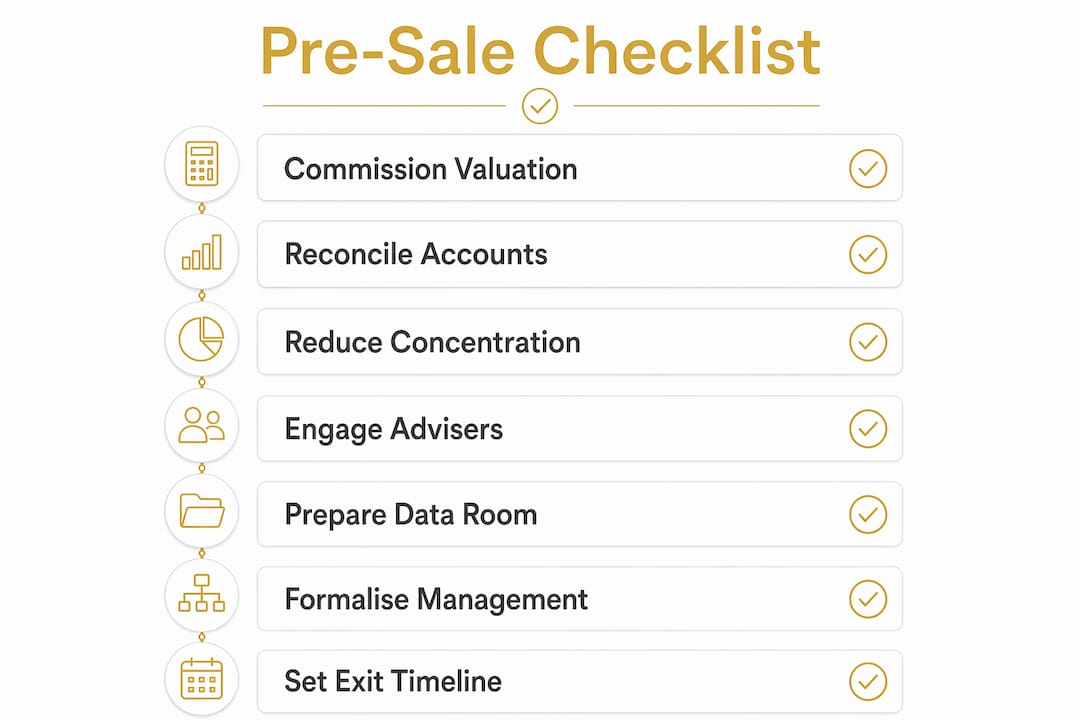
Before you build a preparation plan, define what a good exit actually means for you personally. Price is one variable. Net proceeds after tax, deal structure, your role post-close, and the buyer’s intentions for your team are all equally real considerations.
Exit goal checklist:
- Net proceeds target: work backwards from a post-tax number, not a headline price; share sales and asset sales carry different tax treatments under UK law
- Timing: identify your preferred close window and count back 18–24 months to set your preparation start date
- Role post-sale: decide now whether you want a clean break, a short transition, or an earn-out arrangement, because each changes how you structure the deal
- Deal structure tolerance: understand your appetite for deferred consideration (earn-outs, loan notes) versus cash at close
- Legacy and people: if retaining staff or preserving culture matters, factor it into buyer selection criteria early
Once those goals are written down, convert them into a backwards timeline. If your target close is Q4 2027, your data room should be ready by Q1 2027, your sell-side Quality of Earnings (QoE) commissioned by mid-2026, and your financial housekeeping complete by the end of 2025. Work the calendar backwards, not forwards.
Pro Tip: The single most overlooked governance step is formalising a management team that can run the business for two weeks without you. Buyers discount heavily for key-person risk, and no amount of financial polish compensates for a business that stops when the founder goes on holiday. Start delegating decision-making authority now, document it, and let the team demonstrate it.
Who should be on your deal team, and what does each adviser actually do?
Engage a fractional CFO or transaction finance lead first, then an M&A adviser or broker, a corporate solicitor, and a specialist tax adviser. These four roles cover the financial, commercial, legal, and tax workstreams that run in parallel through preparation and the active sale.

The core four advisers
Fractional CFO or transaction finance lead owns the financial preparation: normalising EBITDA, building the financial model, commissioning and managing the sell-side QoE, and producing the investor-ready reporting pack. Engage this person 18–24 months out. For most SMEs and SaaS founders, this is the highest-leverage hire in the entire process.
M&A adviser or corporate broker manages the buyer process: preparing the Information Memorandum (IM), running the buyer outreach, managing NDAs, and negotiating the headline terms in the Letter of Intent. Engage 6–9 months before planned launch. Fee models vary: retainer plus success fee is common; pure success fees are available but tend to attract less senior attention.
Corporate solicitor handles the legal workstream: reviewing the share purchase agreement (SPA), warranties and indemnities, employment and TUPE matters, IP assignments, and change-of-control consents. Brief them early on structure; they become intensive at Heads of Terms stage.
Tax specialist reviews the ownership structure, advises on Business Asset Disposal Relief (BADR, formerly Entrepreneurs’ Relief), and models the after-tax proceeds under different deal structures. Engage at least 12 months before close; some tax planning steps (restructuring, trust arrangements) require 24 months or more to be effective.
Pro Tip: Sequence your adviser outreach carefully. Engage your fractional CFO and tax adviser before your M&A broker. Brokers sometimes move faster than sellers are ready for, and once a Confidential Information Memorandum is circulating, your ability to fix financial or structural issues without buyers noticing is gone. Get the house in order first.
When evaluating advisers, look for ICAEW membership for accountants and QoE experience for the finance lead. For M&A advisers, ask for a track record in your sector and deal size range. Fees for a sell-side QoE vary depending on complexity; M&A advisory success fees are usually structured as a percentage of enterprise value, often with a minimum floor.
How do you get your financials buyer-ready?
The minimum financial package buyers expect: three years of reconciled management accounts, monthly profit and loss statements, cashflow statements, and filed tax returns, with every discrepancy between the accounts and the tax filings explained. Buyers typically request 3–5 years of financial statements plus monthly year-to-date P&Ls during diligence. Starting with clean, reconciled records is not optional; poor financial records and unreconciled add-backs are a leading cause of re-trades and deal failure.

Normalising EBITDA
EBITDA normalisation means adjusting reported earnings to reflect the true, recurring profitability of the business. Common add-backs include owner salary above market rate, personal expenses run through the business, one-off costs (restructuring, legal disputes), and non-cash charges. Every add-back needs a backup document: an invoice, a payroll record, or a board resolution. Undocumented add-backs are the first thing a buyer’s QoE team will challenge.
Related-party transactions require particular care. Rent paid to a connected entity, management fees, or intercompany loans all need to be disclosed and normalised at arm’s-length rates. Proper related-party transaction disclosure is not just good practice; it prevents buyers from treating the entire accounts as unreliable.
KPIs that matter
For SMEs, the headline metrics are EBITDA margin, cash conversion (EBITDA to free cash flow), revenue growth rate, and working capital trend. For SaaS businesses, add Annual Recurring Revenue (ARR), net revenue retention (NRR), customer acquisition cost (CAC) payback period, and monthly churn. Present these in a consistent monthly format going back at least 24 months.
Sell-side QoE: when and why
A sell-side QoE, commissioned by the seller before going to market, validates your EBITDA normalisation and reconciles it to your tax returns. It costs roughly £25,000–£100,000 depending on business complexity, but can deliver 5–20x ROI by protecting add-backs during buyer diligence and reducing re-trade risk. Commission it 6 months before your planned launch date.
| Document | Who prepares it | Who verifies it |
|---|---|---|
| 3 years’ statutory accounts | Accountant / auditor | Fractional CFO cross-checks to management accounts |
| Monthly management P&Ls (24 months) | Finance team / fractional CFO | Reconciled to filed returns |
| Cashflow statements | Finance team | Fractional CFO |
| Filed tax returns (CT600s) | Tax adviser | Cross-referenced to accounts |
| EBITDA bridge and add-back schedule | Fractional CFO | QoE accountant |
| Working capital analysis | Fractional CFO | M&A adviser sense-check |
| Forward 12-month forecast | Fractional CFO | M&A adviser |
| SaaS ARR / NRR schedule (if applicable) | Finance team | Fractional CFO |
Pro Tip: Run a dry-run reconciliation between your management accounts and your CT600s before you engage a QoE firm. Gaps that surprise you will also surprise the QoE team, and fixing them on the clock is expensive. A weekend with your accountant now saves weeks of diligence later.
What operational fixes make your business more transferable?
The three operational areas with the biggest impact on transferability are: documented SOPs and a capable management bench, contract robustness (especially customer contracts), and customer and supplier concentration. Owner dependence is consistently cited as the single largest transferability risk in lower-middle-market deals.
SOPs and management depth
- List every process that currently lives only in your head or relies on your personal relationships
- Assign a team member to own each process and document it in a simple written SOP
- Run the business without your direct involvement for a defined period (two weeks minimum) and record what breaks
- Fix the breaks, then repeat the test before going to market
- Formalise a management team with clear reporting lines, documented authority levels, and employment contracts
Customer and supplier concentration
A single customer representing a very large portion of revenue is a material diligence flag. Buyers and their lenders will apply a risk discount, and some will walk away entirely. Steps to address it:
- Renew top customer contracts at 3–5 year terms with auto-renewal clauses and, where possible, remove change-of-control provisions 12–18 months before going to market
- Cross-sell additional services to existing customers to deepen relationships and spread revenue
- Actively develop new customer relationships to reduce the top customer concentration.
- Review supplier concentration on the same basis; a single-source supplier is a diligence flag too
IP and licence housekeeping
Buyers check that intellectual property is owned by the company, not by a founder personally or a connected entity. Common issues include software developed by contractors without a proper IP assignment, trade marks registered in a founder’s name, and domain names held outside the company. Fix these before launch; transferring IP mid-diligence is slow and raises questions about what else was overlooked. Check that all material licences (software, regulatory, professional) are transferable or assignable, and flag any that require third-party consent.
What UK legal and tax checks must you complete before listing?
Engage a corporate solicitor and a tax specialist at least 12 months before your target launch date. The immediate items to check are your corporate structure, the share sale versus asset sale decision, and any personal tax planning that requires time to implement.
Legal checklist:
- Review all material contracts for assignment and change-of-control clauses; identify which require third-party consent before a sale can complete
- Check employment contracts for key staff; consider retention arrangements for individuals a buyer will regard as critical
- Assess TUPE (Transfer of Undertakings (Protection of Employment) Regulations) implications if the deal is structured as an asset sale
- Confirm that all IP is owned by the company and that assignments from contractors and founders are documented
- Verify that all regulatory licences, permits, and professional registrations are current and transferable
- Identify any outstanding litigation, tax disputes, or regulatory investigations and take advice on disclosure obligations
Tax considerations:
Business Asset Disposal Relief (BADR) can reduce Capital Gains Tax on qualifying business disposals to 10% on the first £1m of lifetime gains for eligible individuals, but the qualifying conditions (including the 5% shareholding and two-year holding period requirements) must be met at the time of disposal. Many owners discover too late that a recent share restructuring or option grant has inadvertently affected their eligibility. Take independent tax advice early; some planning steps require 24 months to be effective.
The share sale versus asset sale decision also has significant tax implications for both parties. Sellers generally prefer share sales (cleaner, potentially more tax-efficient); buyers often prefer asset sales (step-up in asset base, no inherited liabilities). Understanding the after-tax proceeds under each structure before you enter negotiations gives you a much stronger position.
Pro Tip: Check your company’s Articles of Association and any shareholders’ agreement for drag-along and tag-along provisions, pre-emption rights, and consent requirements before you approach any buyer. A minority shareholder who can block or delay a sale is a material deal risk that buyers will price in.
This article provides general information only, not professional legal or tax advice. Confirm the current rules with a qualified solicitor and tax adviser for your specific situation.
How do you prepare for buyer due diligence and build a data room?
Buyers typically run 45–90 days of due diligence after Heads of Terms are agreed. Have a populated data room ready before the Confidential Information Memorandum (CIM) goes out, not after. A clean, well-organised data room can shave two to four weeks off the diligence timeline and materially reduces re-trade risk.
Data room folder structure
- Financials: statutory accounts (3–5 years), management accounts, CT600s, VAT returns, EBITDA bridge, working capital analysis, forward forecast
- Corporate: certificate of incorporation, Articles of Association, shareholders’ agreement, board minutes, cap table, any shareholder loan agreements
- Commercial: customer contracts (top 10–20 by revenue), supplier contracts, partnership agreements, CIM or teaser document
- HR and employment: organisation chart, employment contracts for key staff, TUPE analysis (if relevant), pension arrangements, any settlement agreements
- IP and technology: trade mark registrations, software IP assignments, domain and hosting records, data processing agreements, SaaS architecture overview (if applicable)
- Legal: any ongoing or threatened litigation, regulatory correspondence, insurance schedules, property leases
- Tax: HMRC correspondence, R&D tax credit claims, any open enquiries, PAYE and NIC records
Aim to have 70–80% of the data room populated before you go to market. Name files clearly and consistently; no duplicates, no outdated versions. Buyers and their advisers form an impression of operational quality from the data room before they have spoken to you.
Triage diligence flags before launch
The highest-value diligence preparation is not assembling documents — it is identifying your own red flags before a buyer does, and either fixing them or preparing a clear, honest explanation. A seller who surfaces an issue proactively retains far more credibility and negotiating leverage than one who appears to be hiding it.
Work through your data room and flag: contracts with change-of-control clauses that require consent, any tax positions that could be challenged, unresolved litigation, and any gap between your management accounts and your filed returns. Resolve what you can; document what you cannot.
Confidentiality and staged disclosure
Use a tiered NDA process. Initial teasers go out without the company name. Full CIMs go only to buyers who have signed a non-disclosure agreement. Detailed financial schedules and customer lists go only to buyers who have submitted a credible indicative offer. Never share sensitive operational or customer data with a buyer who has not been properly qualified. Your M&A adviser should manage this process; if they are not doing so, ask why.
How is your business valued, and what price should you expect?
The most common valuation approaches for UK SMEs are EBITDA multiples, discounted cashflow (DCF), and, for SaaS businesses, revenue multiples. The single highest-leverage way to move your multiple is to improve the predictability and quality of earnings, not just the headline number.
EBITDA multiples are the dominant method for profitable SMEs. The multiple applied depends on sector, growth rate, customer diversification, management depth, and the quality of earnings. A business with recurring revenue, diversified customers, and a capable management team commands a meaningfully higher multiple than an identical business with concentrated revenue and owner dependence. Documented SOPs, diversified customers, and long-term contracts remove the buyer’s risk premium and support higher multiples.
DCF analysis is used alongside EBITDA multiples for businesses with strong, visible forward cashflows. It requires a credible 3–5 year financial model with documented assumptions. For SaaS businesses, revenue multiples (typically applied to ARR) are common, particularly where the business is growing fast but not yet highly profitable. You can benchmark your performance against sector peers using public filings to understand where your metrics sit relative to comparable businesses.
| Valuation method | Best suited to | Key inputs buyers focus on |
|---|---|---|
| EBITDA multiple | Profitable SMEs, established businesses | Normalised EBITDA, add-back quality, revenue concentration |
| Revenue multiple | High-growth SaaS, pre-profit businesses | ARR, NRR, churn, growth rate |
| DCF | Businesses with visible long-term contracts | Forecast cashflows, discount rate, terminal value assumptions |
| Asset-based | Asset-heavy or distressed businesses | Net asset value, tangible asset quality |
Setting a realistic price range
Use your valuation plus scenario modelling to define three numbers: an aspirational price (best-case multiple on normalised EBITDA), a realistic price (mid-case, accounting for likely QoE adjustments), and a fallback (the minimum you would accept given your personal financial goals). Enter negotiations knowing all three. Sellers who anchor only on the aspirational number and have not modelled the realistic case are the ones who feel blindsided by buyer adjustments during diligence.
Customer concentration, owner dependency, and unresolved QoE adjustments are the three factors most likely to compress the multiple below your aspirational figure. Address them in preparation, not in negotiation.
What are the most common preparation mistakes, and how long does it really take?
The most common and costly mistake is compressing preparation into too short a window. Owners who start 12–24 months before listing fix their gaps; owners who start 30 days before listing merely disclose them, and every disclosed gap becomes a price reduction or an indemnity.
The four most damaging mistakes
- Starting too late. The value-building work (reducing owner dependence, cleaning multiple years of financials, diversifying customers) takes 12–24 months. It cannot be faked in the final weeks.
- Skipping the sell-side QoE. Without a validated EBITDA bridge, buyers will apply their own adjustments, which are almost always more conservative than yours.
- Leaving customer concentration unchecked. A single client at 40–50% of revenue will either kill the deal or force a significant price reduction.
- Letting performance slip mid-process. The period between signing the LOI and closing is when sellers lose focus. Buyers use any performance deterioration to re-trade.
A realistic phased timeline
Owners who get the best exits work the preparation checklist for 18–24 months before going to market. They identify the gaps early, fix the ones that take real time, and disclose the ones that cannot be fixed cleanly. By the time they go to market, the only diligence surprises are the ones the buyer brings themselves.
| Phase | Timeframe | Key actions |
|---|---|---|
| Foundation | 3–5 years before sale | Build recurring revenue, develop management team, clean accounting practices |
| Structural cleanup | 2–3 years before sale | Reduce customer concentration, formalise IP, review corporate structure |
| Deal readiness | 12–18 months before sale | Commission valuation, normalise EBITDA, engage fractional CFO, begin QoE |
| Active sale | 9–12 months | CIM, buyer outreach, NDAs, Heads of Terms, diligence, close |
Pro Tip: After the LOI is signed, due diligence moves the price in one direction only. Negotiate hardest before you sign, not after. Every gap a buyer finds during diligence becomes a re-trade conversation, and your leverage at that point is minimal. The preparation work you do now is what protects the LOI number.
How does a fractional CFO accelerate your sale readiness?
A fractional CFO in the 12–24 month preparation window does four things that most owner-managed businesses cannot do for themselves: normalises EBITDA with documented add-backs, builds investor-ready monthly reporting, leads the sell-side QoE preparation, and implements the KPI cadence that gives buyers confidence in the forward numbers. Sellers who engage experienced financial leadership to lead EBITDA normalisation and QoE preparation frequently secure institutional-level multiples that DIY preparation rarely achieves.
What to expect from a fractional CFO engagement during preparation:
- A financial model built to buyer and investor standards, with scenario analysis for aspirational, realistic, and fallback valuations
- Monthly management accounts closed within 10 business days, with a consistent format buyers can interrogate
- A documented EBITDA bridge with backup for every add-back
- SaaS KPI reporting (ARR, NRR, churn, CAC payback) presented in the format acquirers and their advisers expect
- Coordination of the sell-side QoE process, including briefing the QoE firm and managing their information requests
- A data-room-ready financial pack, pre-populated and reviewed before the CIM goes out
The fractional CFO is the missing link for many SME and SaaS owners preparing for exit. They lead QoE readiness, standardise reporting, and craft the financial narrative buyers underwrite — work that a broker cannot do and that a part-time bookkeeper is not equipped for.
The practical outcomes are measurable: reduced re-trades (because the financial story holds up under scrutiny), a stronger multiple (because earnings quality is demonstrably high), and a faster close (because the data room is ready and diligence requests are answered quickly).
To assess whether a fractional CFO is right for your business, ask one question: if a serious buyer asked for a fully reconciled EBITDA bridge, 24 months of monthly P&Ls, and a forward cashflow model tomorrow, could you produce them within a week? If the answer is no, that is the gap a fractional CFO fills. For SaaS founders, the financial due diligence metrics buyers will validate are specific and demanding; having someone who knows exactly what buyers expect is the difference between a smooth process and a painful one.
Pro Tip: Engage a fractional CFO before you engage your M&A broker, not after. Brokers set buyer expectations based on the financial story you present at launch. If that story is not yet clean and well-documented, you are negotiating from a weaker position from day one. Get the numbers right first.
Key takeaways
Selling your business preparation is a 12–24 month project, not a sprint: the owners who close at premium multiples start early, fix their gaps, and arrive at the market with clean financials, diversified customers, and a management team that runs without them.
The five highest-value actions to start immediately:
- Commission an independent valuation to establish your baseline and identify the biggest value gaps
- Reconcile three years of accounts to your filed tax returns and document every add-back
- Reduce customer concentration below 20–25% for any single client
- Engage a fractional CFO to lead financial preparation and QoE readiness
- Brief a corporate solicitor and tax specialist on your structure and intended deal type
Single recommended next step: commission a valuation and engage a fractional CFO or transaction finance lead. These two actions, done together, give you a clear picture of where you stand, what needs to change, and who will lead the financial workstream through to close. Everything else in this guide follows from that foundation.
| Point | Details |
|---|---|
| Start 12–24 months out | Owners who compress preparation into less than 18 months commonly leave 15–30% of enterprise value on the table; fix gaps early rather than disclosing them in diligence. |
| Clean financials are non-negotiable | Reconcile accounts to tax returns, document all add-backs, and commission a sell-side QoE 6 months before launch. |
| Reduce owner dependence | Document SOPs, delegate authority, and demonstrate the business runs without you — buyers discount heavily for key-person risk. |
| Diversify customer concentration | A single client above 20–25% of revenue is a material diligence flag; renew contracts at longer terms 12–18 months before launch. |
| Consult EFC | Provides fractional CFO and transaction finance support to UK SMEs and SaaS founders preparing for exit, led by ICAEW Chartered Accountant Kishen Patel. |
Why disciplined preparation is the only thing that actually moves the price
Most owners I speak with have a number in their head. A price they believe the business is worth, based on a conversation with a broker, a rule of thumb, or what a competitor sold for three years ago. The preparation work is what closes the gap between that number and what a buyer will actually pay.
The businesses that achieve the strongest multiples are not always the most profitable or the fastest-growing. They are the ones where the financial story is clean, the management team is credible, and the buyer’s diligence process confirms what the seller said rather than contradicting it. That outcome is entirely within an owner’s control, but it requires time and the right financial leadership to get there.
The owners who start preparation two years before they intend to sell, who invest in a proper QoE process, and who build a management team that can run the business without them, are the ones who get to choose their buyer and their terms. The ones who start six months out are the ones who accept whatever the market offers, because they have no leverage left.
Consult EFC supports UK owners preparing for exit
Preparing a business for sale is the most financially consequential project most owners will ever undertake. Consult EFC, led by ICAEW Chartered Accountant Kishen Patel, provides the fractional CFO and transaction finance support that turns a preparation plan into a buyer-ready business.
The engagement covers the full financial preparation workstream: EBITDA normalisation and add-back documentation, investor-ready monthly reporting, sell-side QoE coordination, financial modelling for valuation and scenario analysis, and data-room-ready financial packs. For SaaS founders, the team builds the ARR, NRR, and cohort reporting that acquirers expect to see. For SME owners, the focus is on clean accounts, a credible forward forecast, and a financial narrative that holds up under scrutiny.
Engagements are structured around your timeline, whether you are 24 months from a planned exit or 12 months from a target launch. You get Big Four-level financial rigour without the full-time cost, and a lead adviser who has done this before and knows exactly what buyers will ask.
To start, explore Consult EFC’s fractional CFO services or book a conversation directly to discuss where your business stands and what preparation looks like for your specific situation.
Useful sources and further reading
External guides:
- Pre-Sale Business Preparation Checklist: 12 Months (Horizon M&A Advisors) — a practitioner month-by-month checklist covering financial, operational, and legal preparation; useful for building your own timeline
- Selling a Business Checklist: 47 Items (CT Acquisitions) — detailed 47-item checklist organised by category with timing guidance; particularly strong on sequencing financial and operational items
- The Selling a Business Checklist (East Coast Advisory Team) — eight-phase walkthrough from pre-decision to transition; good for understanding the full arc of a deal
- Due Diligence Checklist for Selling a Small Business (1800BizBroker) — buyer-oriented document list; use it to stress-test your data room before launch
Consult EFC resources:
- Quality of Earnings for founder-led businesses — technical guide to what a sell-side QoE covers and why it matters for UK SME and SaaS exits
- What is a fractional CFO? — practical introduction to fractional CFO roles and when to engage one
- When to hire a fractional CFO — guidance on timing the hire relative to your preparation and exit timeline
- SaaS financial due diligence: UK guide — comprehensive due-diligence guidance for UK SaaS sellers, including the metrics buyers will validate
- UK business valuation services — Consult EFC’s valuation service for UK SMEs and SaaS founders; the logical first step in any preparation plan
- Investor-grade financial modelling — service page covering the financial modelling work required for exits and investor due diligence
Recommended
- Preparing a business for sale checklist: UK SME guide
- Preparing a UK Business for Sale: How Long It Really Takes
- Selling My Business UK 2025, Exit Plan | Consult EFC
- How to Prepare a SaaS Business for Sale in the UK (2026 Guide) | Consult EFC
Not sure where your business stands right now?
Book a free 30-minute call with Kish. Bring your numbers, your questions, or just your situation. You will leave with a clearer picture than you arrived with.
Book a Free Strategy Call
Over 12 years across Big Four audit, Investment Banking, and corporate advisory. Kish works with SaaS founders, tech companies, and ambitious UK SMEs from £1M to £50M in revenue on fundraising, valuations, exit planning, and financial strategy. ICAEW regulated. Big Four trained. Based in London.