


To sell your UK business for the highest net proceeds, start with three actions: (1) prepare clean, normalised accounts and a virtual data room, (2) decide your exit structure and target buyer type, and (3) get tax and legal advice before you approach anyone. That last point is more urgent than most owners realise. Business Asset Disposal Relief (BADR) moved to 18% from 6 April 2026, and the relief requires at least two years’ qualifying ownership. If you are close to that threshold, timing your completion date could save tens of thousands of pounds.
If an inbound approach has already landed on your desk, the immediate next steps differ slightly from a planned exit, but the priorities are the same.
Your first five actions this week:
- Get three years of statutory accounts and management accounts into one folder
- Instruct a solicitor experienced in business sales (not a general commercial lawyer)
- Brief an accountant or fractional CFO on your likely sale price and structure to model the tax position
- Decide whether you want a clean break, an earn-out, or a partial exit
- Check your two-year BADR ownership clock and confirm your qualifying shareholding
The single most time-sensitive item is tax planning. Owners who engage a tax adviser after heads of terms are signed routinely leave money on the table because the deal structure is already fixed.
Key takeaways
Selling your business for the best net proceeds requires preparation, the right advisers, and tax planning that starts before any buyer is in the room.
| Point | Details |
|---|---|
| Start with clean accounts | Three years of normalised accounts with a formal add-back schedule are the foundation of every defensible valuation. |
| BADR rate is now 18% | From 6 April 2026, BADR applies at 18% on qualifying gains up to £1m; two years’ ownership is required to qualify. |
| Multiples range 2–12× | UK SME multiples run 2–4× SDE for small firms and 4–12× EBITDA for larger or recurring-revenue businesses. |
| Allow 10–12 months total | Median listing-to-close is around 170 days; preparation extends total elapsed time to 10–12 months for most SME deals. |
| Consult EFC | Consult EFC provides fractional CFO and exit planning support to help UK SME owners build a higher-multiple, due-diligence-ready business before going to market. |
Table of Contents
- How do you prepare your business for sale?
- How is a business valued before selling?
- What exit routes are available, and which suits your goals?
- What deal terms actually determine how much you receive?
- What are the UK legal and regulatory requirements when selling?
- How does tax affect your net proceeds in 2026?
- What happens on completion day and after?
- How do you maximise value in the 12–24 months before going to market?
- What does selling a business actually cost, and how long does it take?
- A fractional CFO’s perspective on what actually goes wrong in UK exits
- How Consult EFC gets you exit-ready faster
- Sources
How do you prepare your business for sale?
Buyers pay multiples of earnings, so anything that makes those earnings look uncertain, owner-dependent, or undocumented will compress the multiple they offer. The pre-sale checklist below covers the documents buyers expect and the operational fixes that move the needle most.
Documentation buyers will request:
- Three years of statutory accounts (audited where possible) and monthly management accounts
- Corporation tax returns and any open HMRC correspondence
- Payroll records, employment contracts, and a current organisation chart
- All material customer and supplier contracts, with assignment clauses highlighted
- IP registrations, licences, and any pending litigation
- Insurance schedules and regulatory licences
Operational fixes ranked by impact on multiple:
- Reduce owner dependency. If the business cannot function for two weeks without you, buyers will price that risk in. Document your role, delegate decisions, and let the management team run the business visibly before you go to market.
- Formalise processes. Written SOPs, a CRM with clean data, and a documented sales pipeline all reduce perceived risk.
- Secure key contracts. Verbal arrangements with major customers or suppliers are a red flag. Get them on paper with notice periods and, where possible, change-of-control consent.
- Address customer concentration. A single customer representing more than 20–25% of revenue will trigger a discount or an earn-out. Start diversifying 12–18 months before sale.
- Tidy recurring revenue. Subscription or retainer income is valued at a premium. If you have informal repeat customers, formalise those relationships.
- Check licences and insurance. Gaps discovered in due diligence become price chips.
Confidentiality before you go to market: prepare a one-page anonymous teaser (no company name, no identifying details) and a non-disclosure agreement before any conversation with a potential buyer. Never share financials without a signed NDA.
Pro Tip: The single highest-ROI pre-sale activity is building a management team that can credibly run the business without you. Document the role of the owner, create a transition plan, and let the team present to buyers. This one change can shift a 3× multiple to 4× or higher.
How is a business valued before selling?
Buyers use two primary metrics depending on business size: Seller’s Discretionary Earnings (SDE) for smaller owner-managed firms, and EBITDA for larger SMEs. According to YourCompanyFormations, UK multiples for small businesses typically range 2–4× SDE, while mid-market EBITDA multiples often range 4–12× depending on sector and scale.
SDE vs EBITDA: which applies to you?
SDE adds back the owner’s salary, personal benefits, and one-off costs to net profit. It reflects the total economic benefit a new owner-operator would receive. Use SDE when the business generates under roughly £1m in adjusted profit and the owner is operationally central.
EBITDA strips out interest, tax, depreciation, and amortisation from operating profit. It is the standard metric for businesses with a management team in place, where a buyer is acquiring a going concern rather than buying a job.
The adjusted earnings × multiple formula
The formula is straightforward:
Enterprise Value = Adjusted Earnings × Multiple
Equity Value = Enterprise Value + Surplus Cash − Debt ± Working Capital Adjustment
Buyers routinely deduct debt and normalise working capital, converting enterprise value to equity value pound-for-pound.
Worked example
A manufacturing SME with £500,000 statutory pre-tax profit:
Apply a 4.5× multiple (mid-range for a stable, profitable SME): Enterprise Value = £2,520,000
Then convert to equity value:
- Surplus cash: +£150,000
- Bank debt: −£200,000
- Working capital shortfall: −£50,000
- Equity Value: £2,420,000
That £2.42m is the cheque before tax. The add-backs in this example are modest; RFB Legal notes that badly documented add-backs are the most contested element in SME due diligence, so prepare a formal add-back schedule with supporting invoices or payroll records for every line.
A defensible valuation uses the EBITDA multiple as primary evidence, cross-checks with a discounted cash flow (DCF) model, and uses asset value as a floor. Optival makes the point well: valuation is best presented as a range, and the quality and sustainability of earnings matter more than any single formulaic number.
Typical UK multiple ranges by business type
| Business type | Metric | Typical multiple range |
|---|---|---|
| Small owner-managed (under £500k profit) | SDE | 2–4× |
| Established SME with management team | EBITDA | 4–7× |
| High-growth SaaS or recurring revenue | ARR / EBITDA | 5–12× |
| Professional services (people-dependent) | EBITDA | 3–5× |
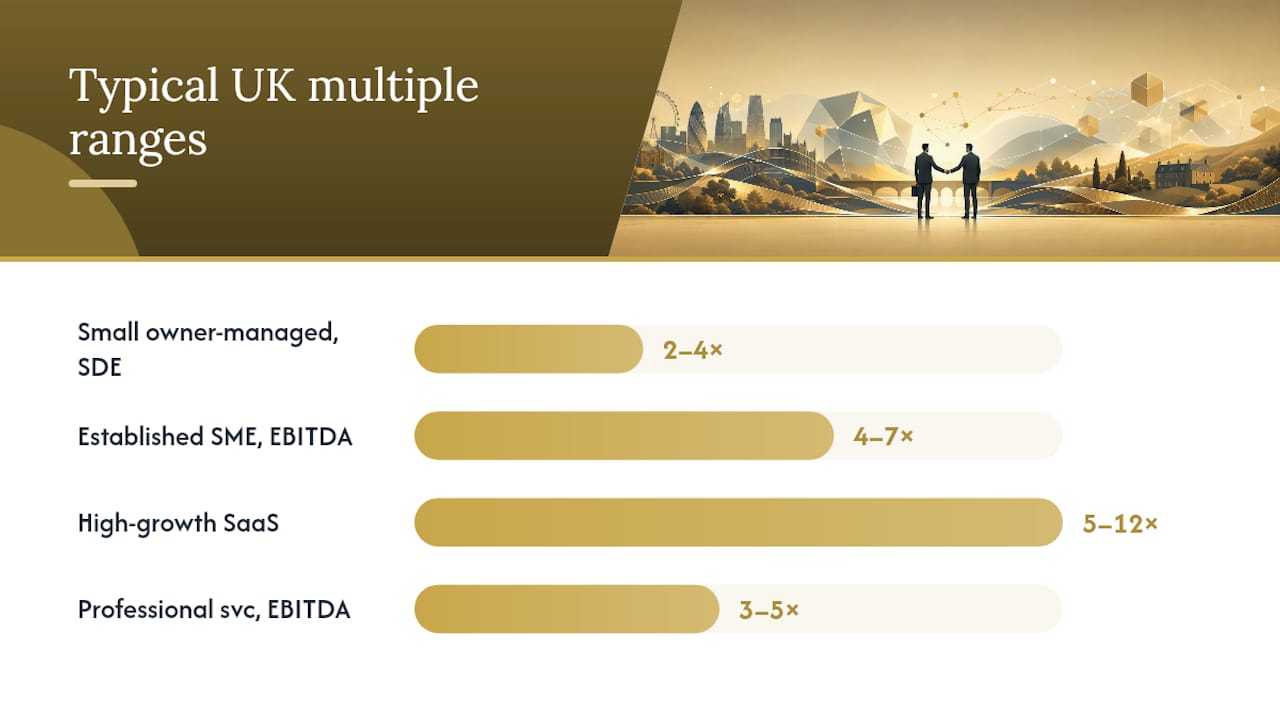
These ranges are indicative. Sector, growth rate, customer concentration, and contract quality all shift the multiple up or down.
What exit routes are available, and which suits your goals?
The buyer type you choose shapes the price, the timeline, the deal structure, and what happens to your staff and brand after you leave. There is no universally correct answer; the right route depends on what you want from the exit.
Common exit routes for UK SMEs:
- Trade sale to a strategic acquirer in your sector. Usually achieves the highest headline price because the buyer can extract synergies. Best when you want a clean exit and maximum cash.
- Private equity (PE) or financial buyer. PE firms buy for returns, not synergies. They often want the owner to stay for 3–5 years and take a rollover stake. Best when you want a second bite of the apple.
- Management buyout (MBO). Your existing management team buys the business, often with debt financing. Price is typically lower than a trade sale, but the process is faster and more confidential.
- Employee Ownership Trust (EOT). The business transfers to a trust for the benefit of employees. Sellers can receive full market value free of Capital Gains Tax under current rules. Best when legacy and employee welfare matter as much as price.
- Family succession. Transfers ownership within the family. Price and terms are negotiable, but tax planning and governance are critical to avoid disputes.
- Minority sale or partial exit. Sell a stake to a growth investor while retaining control. Useful if you want capital and a partner but are not ready for a full exit.
Matching buyer type to your goals:
If maximum price is the priority, run a competitive process with multiple trade buyers. If speed and confidentiality matter, an MBO or a single known acquirer is faster. If staff legacy is the priority, an EOT deserves serious consideration. For M&A advisory on which route fits your specific situation, the decision is worth modelling before you commit.
Finding buyers in practice:
- Business brokers handle the majority of SME transactions under £5m. They charge a success fee (typically 3–8% of deal value) and manage the process.
- Corporate finance advisers and M&A boutiques handle larger deals and can run a structured competitive process.
- Direct approaches to trade buyers through your own network often produce the best price but require more seller time.
- Private equity databases and platforms list active buyers by sector and deal size.
The confidential marketing sequence: send an anonymous teaser first. Only share the information memorandum (CIM) after an NDA is signed. Qualify buyers on financial capacity before sharing detailed financials.
What deal terms actually determine how much you receive?
The headline price is not the cheque. Deal structure, price mechanisms, and deferred consideration all affect what you actually receive, and when.
Asset sale vs share sale
In a share sale, the buyer acquires the company’s shares and inherits all its liabilities. Sellers generally prefer share sales because BADR applies to share disposals and the tax treatment is cleaner. In an asset sale, the buyer cherry-picks assets and the company retains liabilities. Asset sales are common when a buyer wants to avoid historic liabilities or when the business is not incorporated. Sellers in asset sales face a double tax risk: the company pays tax on the gain, and the owner pays again on extracting the proceeds.
Price mechanisms: locked box vs completion accounts
A locked-box mechanism fixes the price at a historical balance sheet date. The seller retains economic risk up to that date and the buyer takes risk from then. It gives sellers price certainty and is increasingly common in well-prepared SME deals.
Completion accounts adjust the price after completion based on the actual balance sheet at closing. The buyer gets protection against value leakage between signing and completion, but the seller faces uncertainty about the final number. Disputes over completion accounts are one of the most common sources of post-sale litigation.
Deferred consideration tools
- Earn-outs tie part of the price to future performance. They are common when buyer and seller disagree on value, or when the business is growing fast. Negotiate hard on the metrics, the measurement period, and your operational autonomy during the earn-out.
- Vendor loans let the buyer defer part of the payment. They carry credit risk for the seller and should be secured where possible.
- Rollover equity lets the seller reinvest part of the proceeds into the acquiring entity. Common in PE deals; useful if you believe in the combined business.
Warranties, indemnities, and escrow
Sellers give warranties about the accuracy of information provided. Breaches trigger claims. Negotiate a cap on warranty liability (typically 10–30% of deal value) and a time limit (12–24 months for general warranties). Warranty and Indemnity (W&I) insurance is now accessible for deals above £2m and can shift warranty risk to an insurer.
Pro Tip: Insist on a locked-box mechanism when your accounts are clean and your advisers can defend the balance sheet. Completion accounts give buyers a second negotiation after you have already agreed the price, and the adjustments rarely move in the seller’s favour.
What are the UK legal and regulatory requirements when selling?
Legal obligations begin before you sign anything and continue after completion. Missing a step creates personal liability for directors and can unwind parts of the deal.
Companies House and share transfer requirements
For a share sale, Companies House requires a stock transfer form and an update to the register of members. If the company has a PSC (Person with Significant Control) register, that must be updated within 14 days of the change. GOV.UK’s guidance on selling a limited company sets out the full list of filing and notification obligations.
Employment law and TUPE
When a business or part of a business transfers to a new owner, the Transfer of Undertakings (Protection of Employment) Regulations (TUPE) apply. Employees transfer automatically on their existing terms. Both the outgoing and incoming employer must inform and, where there are 10 or more employees, consult employee representatives before the transfer. Failure to consult can result in a tribunal award of up to 13 weeks’ pay per affected employee.
Key legal steps in order:
- Instruct a solicitor to review all material contracts for change-of-control clauses
- Check whether any contracts require third-party consent to assign
- Identify pension scheme obligations and engage trustees early if a defined benefit scheme is involved
- Confirm VAT treatment: a share sale is outside the scope of VAT; an asset sale may qualify as a Transfer of a Going Concern (TOGC) if conditions are met, which avoids VAT on the assets
- Notify relevant regulators if the business holds a regulated licence (FCA, CQC, SRA, etc.)
- After completion, file share transfer forms with Companies House and update statutory registers
Documents your solicitor will need:
- Statutory books (register of members, directors, PSC register)
- All material contracts with customers, suppliers, and landlords
- Employment contracts and any settlement agreements
- IP ownership documents and domain registrations
- Any existing shareholder agreements or articles of association
The GOV.UK selling your business guidance covers the full compliance checklist and is the definitive starting point for UK sellers.
How does tax affect your net proceeds in 2026?
Tax is where most owners get an unpleasant surprise. The difference between a well-structured exit and a poorly structured one can easily exceed six figures on a £2m deal.
Capital Gains Tax basics
When you sell shares in a trading company, the gain (sale proceeds minus your original cost) is subject to Capital Gains Tax (CGT). The standard CGT rate for higher-rate taxpayers on business assets is 24% (as of 2026). BADR reduces that rate, but only if you qualify.
Business Asset Disposal Relief in 2026
BADR now applies at 18% from 6 April 2026, up from 14% between 6 April 2025 and 5 April 2026, and 10% before that. The lifetime limit remains £1m of qualifying gains. To qualify, you must have owned at least 5% of the shares and voting rights for at least two years before the disposal, and the company must be a qualifying trading company.
Worked net-proceeds example
Equity value from the sale: £2,420,000. Assume original cost basis of £20,000 (typical for a founder).
Without BADR, the full £2.4m gain at 24% would cost £576,000 in CGT, leaving £1,844,000. BADR saves £60,000 even at the higher 18% rate, so qualifying for it still matters.
How deal structure affects tax timing
Deferred consideration (earn-outs, vendor loans) is taxed when it is received, not when the deal signs, unless an election is made to pay tax upfront on the estimated total. Get specific advice on this from a tax adviser before heads of terms are agreed. For practical tax-saving strategies that apply to UK business owners, early planning is consistently the highest-return activity.
Asset sales create a different tax profile: the company pays corporation tax on the gain, and the owner then pays income tax or CGT on extracting the proceeds. This double-tax effect makes share sales structurally preferable for most sellers.
What happens on completion day and after?
Completion is not the end of the process. Several financial and administrative steps follow, and missing them creates liability.
On completion day:
- All parties sign the Share Purchase Agreement (SPA) or Asset Purchase Agreement (APA)
- The buyer’s solicitor releases funds from escrow or transfers directly to the seller’s nominated account
- Stock transfer forms are executed and delivered to the buyer
- Board minutes are passed to approve the share transfer and appoint new directors
- The seller resigns as director (if agreed) and hands over access to systems, bank mandates, and keys
Post-completion adjustments
If the deal used completion accounts rather than a locked box, the buyer will prepare a completion balance sheet within 30–60 days of closing. This is compared to a target working capital figure agreed in the SPA. If actual working capital is below target, the seller pays the difference; if above, the buyer pays the seller. These adjustments are frequently disputed, which is why a locked-box mechanism is preferable when the accounts are clean.
Handover plan
Prepare a written handover document covering: key customer relationships and contacts, supplier terms and renewal dates, staff responsibilities and any pending HR matters, IT system access and passwords, and any ongoing projects or commitments. A structured handover protects goodwill and reduces the risk of earn-out disputes.
Immediate post-sale admin:
- File the stock transfer form and update Companies House records within 14 days
- Notify HMRC of the disposal and file a Self Assessment return for the tax year of the sale
- Cancel or transfer business insurance, utilities, and subscriptions
- Inform key customers and suppliers of the change of ownership (timing agreed with the buyer)
How do you maximise value in the 12–24 months before going to market?
The owners who achieve the highest multiples are not the ones who prepare for three months before listing. They are the ones who spent 12–24 months making the business look like something a buyer would pay a premium for.
Priorities ranked by impact on multiple:
- Strengthen management depth. A business that runs without the owner is worth materially more than one that does not. Hire or promote a strong number two and give them visible responsibility.
- Build recurring revenue. Move customers from project or one-off billing to retainers, subscriptions, or long-term contracts. Recurring revenue is valued at a premium because it reduces buyer risk.
- Tidy contracts. Renew contracts that are rolling month-to-month. Remove personal guarantees where possible. Resolve any disputes before going to market.
- Improve gross margin. Buyers scrutinise gross margin trends. A margin that has been stable or improving for three years is a strong signal; one that has been declining needs an explanation.
- Reduce customer concentration. Win new customers in the 12 months before sale to bring any single customer below 20% of revenue.
Financial house-clean:
Formalise all add-backs and remove owner perks from the P&L at least one full financial year before sale. A buyer who sees a personal expense disappear in the year of sale will question every other line. Stabilise working capital by tightening debtor days and managing stock levels. A 12-month exit plan that maps these improvements to a target valuation is the most practical tool for owners who want to track progress.
What a 12-month programme looks like:
Months 1–3: financial clean-up, management documentation, and a baseline valuation. Months 4–6: contract renewals, customer diversification, and process formalisation. Months 7–9: management team visible and running the business, forward financial model prepared. Months 10–12: data room built, advisers instructed, go-to-market preparation.
Pro Tip: The most common owner mis-step is going to market too early. Owners who list before the management team is credible, before contracts are renewed, and before the accounts are clean consistently achieve lower multiples and face more due-diligence attrition. One extra year of preparation routinely adds more value than six months of negotiation.
What does selling a business actually cost, and how long does it take?
Median listing-to-close time for SME deals is typically several months, but that clock starts after preparation is complete. From the decision to sell to a closed cheque, most UK SME transactions take 10–12 months in total. Budget for that timeline when planning cashflow and personal liquidity.
Typical adviser fees for UK SME exits:
These ranges widen significantly for complex deals, cross-border transactions, or businesses with pension liabilities or regulatory issues. A £1m deal might cost tens of thousands in total adviser fees; larger deals have proportionally higher costs.
Cashflow considerations:
Most adviser fees are success-based, meaning you pay on completion. Legal and accounting fees are typically billed as incurred. Budget for out-of-pocket costs of £20,000–£50,000 before you see a penny from the sale, and keep enough working capital in the business to run normally throughout the process. A sale process that drains management attention and cash simultaneously is a common cause of value leakage.
For a detailed timeline and milestones specific to UK SME exits, the preparation phase is almost always longer than owners expect.
A fractional CFO’s perspective on what actually goes wrong in UK exits
The pattern I see most often is not a bad business. It is a good business that was not ready to be sold.
Three mistakes come up repeatedly. The first is undocumented add-backs. Owners have been running personal expenses through the business for years, which is entirely normal, but when a buyer’s accountant asks for evidence of every add-back and the seller cannot produce it, those adjustments get stripped out of the earnings calculation. On a 4× multiple, a £50,000 undocumented add-back costs £200,000 in enterprise value. Prepare a formal add-back schedule with supporting documents at least 12 months before sale.
The second mistake is owner dependency that is not addressed until the buyer spots it. By then, it is too late to fix. The buyer either walks, reduces the price, or insists on a long earn-out. The solution is simple but requires lead time: hire or promote a strong operational manager, give them real authority, and let them run the business for at least one full year before you go to market.
The third mistake is poor timing on tax advice. Owners who engage a tax adviser after heads of terms are agreed have already lost the ability to restructure the deal. The BADR two-year ownership clock, the choice between asset and share sale, and the treatment of deferred consideration all need to be planned before the buyer is in the room.
A one-page readiness checklist:
- Three years of clean, normalised accounts with a formal add-back schedule
- Management team documented and visibly running the business
- All material contracts on paper, renewed, and reviewed for change-of-control clauses
- Customer concentration below 20–25% for any single customer
- BADR eligibility confirmed (two-year ownership, 5% shareholding, qualifying trade)
- Tax adviser briefed on deal structure before any buyer conversation
- NDA template prepared and data room started
- Solicitor with M&A experience instructed
How Consult EFC gets you exit-ready faster
Most owners underestimate how much the numbers presentation affects the final price. Buyers and their advisers will recast your financials their way if you do not present them first. Consult EFC’s fractional CFO services for UK SMEs address exactly this: building the normalised earnings model, preparing the add-back schedule, stress-testing the working capital position, and producing the forward financial model that supports your asking price rather than undermining it.
The practical outcomes owners achieve working with Consult EFC before a sale: a defensible valuation range backed by formal financial modelling, a data room that passes buyer due diligence without surprises, and a cleaner earnings story that supports a higher multiple. The work typically starts 6–18 months before a planned exit, which is exactly when it has the most leverage. If you are within that window, a conversation with an exit planning adviser is the most productive hour you will spend this month. Book a call with Consult EFC to start the process.
Consult EFC resources for exit planning:
This article is general information, not a substitute for advice from a qualified financial advisor. Consult a qualified financial professional about your own circumstances before acting on anything here.
Recommended
- Business Exit Strategy UK: The 2026 Guide to a High-Value Sale
- Exit preparation for UK business owners: 2026 guide – ICAEW Fractional CFO & Corporate Finance Advisers | Consult EFC
- How to Prepare a SaaS Business for Sale in the UK (2026 Guide) | Consult EFC
- Preparing a UK Business for Sale: How Long It Really Takes
Not sure where your business stands right now?
Book a free 30-minute call with Kish. Bring your numbers, your questions, or just your situation. You will leave with a clearer picture than you arrived with.
Book a Free Strategy Call
Over 12 years across Big Four audit, Investment Banking, and corporate advisory. Kish works with SaaS founders, tech companies, and ambitious UK SMEs from £1M to £50M in revenue on fundraising, valuations, exit planning, and financial strategy. ICAEW regulated. Big Four trained. Based in London.