


A fractional CFO is an experienced chief financial officer who provides senior financial leadership to a business on a part-time or contract basis. The term “fractional” refers to the allocation of their time: rather than working full-time for one employer, they divide their capacity across several clients. This model gives growing UK businesses access to Big Four-calibre financial expertise without the full-time salary that comes with it. Businesses typically engage a fractional CFO when revenue sits between £1 million and £20 million, or when CFO-level work does not yet justify a full-time hire.
What is a fractional CFO, and how does the role differ from other finance functions?
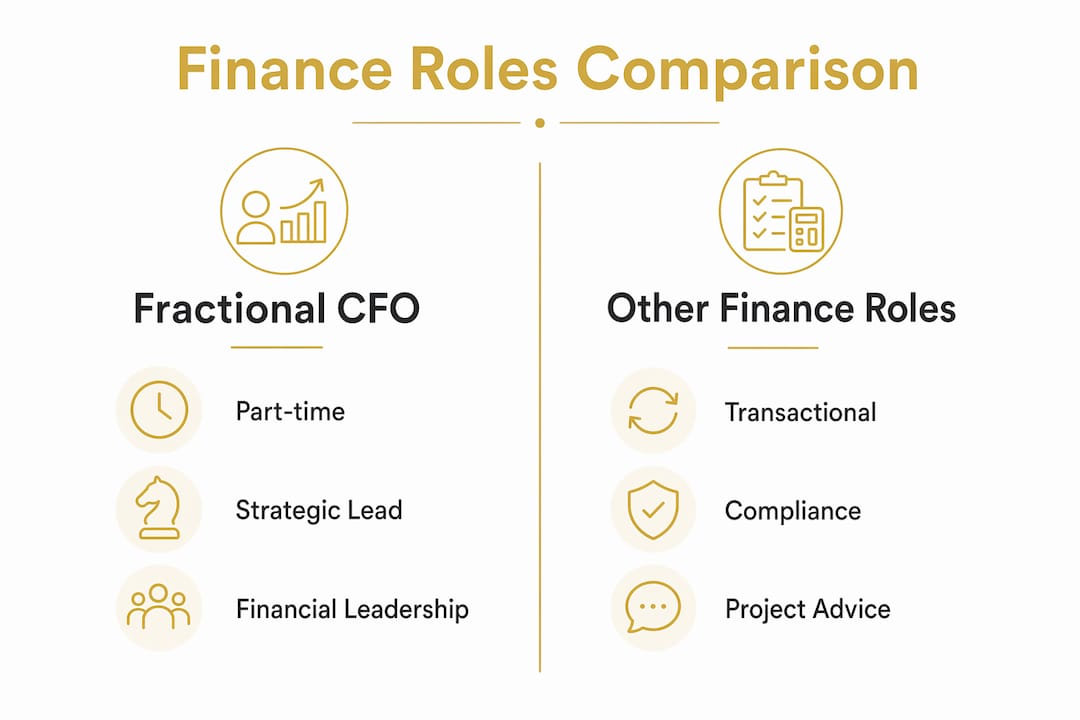
A fractional CFO is not a bookkeeper, a management accountant, or a financial consultant. The distinction matters, and confusing these roles leads to expensive misalignments.
A fractional accountant focuses on historical accuracy and compliance: preparing statutory accounts, filing tax returns, and reconciling ledgers. A fractional CFO looks forward. Their work centres on cash flow forecasting, budgeting, KPI design, and financial modelling. They answer the question “where is this business going?” rather than “what happened last quarter?”

The other common misconception is that a fractional CFO is purely an advisor who delivers opinions and leaves. That is the role of a financial consultant. A fractional CFO acts as an operator, owning financial functions directly. They manage controllers, run board reporting, and are accountable for the accuracy of financial data presented to investors and directors.
Pro Tip: If your finance team produces reports but no one interprets them for strategic decisions, you need a CFO function, not more accountants.
| Finance role | Primary focus | Typical output |
|---|---|---|
| Bookkeeper | Transaction recording | Ledgers, bank reconciliations |
| Management accountant | Historical reporting | Monthly management accounts |
| Financial consultant | Project-based advice | Reports, recommendations |
| Fractional CFO | Forward-looking strategy | Forecasts, KPIs, board packs, fundraising support |
The fractional CFO model also commonly brings backgrounds from Big Four firms or large corporates, delivering senior-level seniority to businesses that could not otherwise afford it. That experience gap is precisely why the model has grown so quickly.
Why are fractional CFOs becoming essential for scaling businesses?
The global virtual CFO market was valued at US$7.8 billion in 2024 and is projected to reach US$17.9 billion by 2030. That growth rate reflects a structural shift: businesses are choosing flexible financial leadership over fixed overhead.
The driver is straightforward. A full-time CFO in the UK commands a salary well above £100,000 per year, plus benefits, pension contributions, and National Insurance. For a business turning over £3 million, that cost is disproportionate. A fractional engagement delivers the same quality of thinking at a fraction of the price.
Fractional CFO engagements typically span 10–20 hours per month. That time allocation is enough to run monthly reporting cycles, attend board meetings, manage a finance team, and lead fundraising preparation. The flexibility also means businesses can scale the engagement up during critical periods, such as a funding round, and reduce it during quieter phases.
The scenarios where fractional CFOs add the most value include:
- Fundraising preparation: Building investor-ready financial models, preparing board packs, and managing due diligence data rooms.
- Rapid scaling: Designing financial controls and reporting infrastructure that keeps pace with headcount and revenue growth.
- Restructuring: Identifying cash flow risks, renegotiating supplier terms, and rebuilding financial forecasts during periods of change.
- Exit preparation: Producing the clean financial records and projections that buyers and their advisors scrutinise during acquisition processes.
Fractional CFOs provide boards and investors with reliable financial reports and projections, and they help businesses prepare for funding and exit events. That credibility with external stakeholders is often the most tangible return on the engagement.
How does a fractional CFO integrate into a business effectively?
Integration is where fractional CFO engagements succeed or fail. The quality of the professional matters, but so does the readiness of the business.
Clean internal accounting is a prerequisite. If the books are in disarray, the CFO’s first weeks are consumed by correcting historical errors rather than building forward-looking strategy. Many engagements include an initial audit phase of 30–60 days focused entirely on stabilising financial systems before strategic work can begin. Businesses that invest in tidy records before onboarding get significantly more value from day one.
A practical onboarding sequence looks like this:
- Grant authenticated access to financial software such as Xero, QuickBooks, or a similar platform, along with banking portals and payroll systems.
- Conduct a financial health audit covering cash flow, margins, working capital, and existing reporting structures.
- Agree on a reporting rhythm that includes monthly management accounts, a rolling cash flow forecast, and a quarterly board pack.
- Define KPIs aligned to the business model, whether that is monthly recurring revenue for a SaaS company or gross margin per project for a services firm.
- Establish communication touchpoints covering weekly check-ins with the finance team and monthly sessions with the founder or CEO.
Pro Tip: Treat your fractional CFO as a member of the leadership team, not a supplier. Give them access to commercial conversations, not just financial data. The best insights come from understanding the full business context.
Providing authenticated access to financial platforms and scheduling regular touchpoints within the 10–20 hours per month framework is what enables effective forecasting and data-driven decisions. The owner-CFO relationship works best when it operates as a genuine partnership, with the CFO challenging assumptions and the founder providing commercial context.
What are the scenarios where a fractional CFO adds the most value?
Certain business situations make fractional CFO involvement not just useful but necessary. Recognising these moments early prevents costly delays.
- Pre-fundraising: Investors expect financial models built to institutional standards. A fractional CFO builds the three-statement model, stress-tests assumptions, and prepares the narrative that supports the numbers. Founders who attempt this without CFO support frequently face investor questions they cannot answer.
- Post-investment scaling: Once capital arrives, the pressure to deploy it efficiently is immediate. A fractional CFO designs the budget, tracks burn rate, and reports against milestones that investors expect to see.
- Professionalising the finance function: Many growing businesses rely on a bookkeeper and a spreadsheet. A fractional CFO introduces proper management accounts, a cash flow forecasting process, and financial controls that reduce founder reliance on gut instinct.
- Mentoring the internal finance team: Fractional CFOs often mentor in-house finance staff, increasing the team’s capability and reducing dependence on the founder for financial decisions.
- Strategic decision support: Pricing changes, new market entry, acquisition analysis, and cost restructuring all require financial modelling. A fractional CFO runs the numbers and presents options with clear trade-offs rather than leaving the decision to instinct.
The fractional CFO’s ability to anticipate risks and opportunities before they become crises is what separates them from reactive financial reporting. They see patterns across multiple businesses and apply that pattern recognition to your specific situation.
Key takeaways
A fractional CFO delivers senior financial leadership on a part-time basis, giving growing businesses the strategic oversight of a full-time CFO without the associated cost.
| Point | Details |
|---|---|
| Definition | A fractional CFO provides part-time, senior-level financial leadership focused on forward-looking strategy. |
| Role distinction | Unlike accountants or consultants, fractional CFOs own financial functions and are accountable for results. |
| Market growth | The global virtual CFO market is projected to grow from US$7.8 billion in 2024 to US$17.9 billion by 2030. |
| Integration readiness | Clean financial records and authenticated software access are prerequisites for a productive engagement. |
| Highest-value scenarios | Fundraising preparation, rapid scaling, and exit readiness deliver the strongest return on fractional CFO investment. |
Why I think most businesses bring in a fractional CFO too late
The businesses I see getting the most from fractional CFO engagements are not the ones in crisis. They are the ones that brought in financial leadership six months before they needed it. By the time a founder realises their financial reporting is not investor-ready, they are already in a funding conversation. That is the worst possible moment to start building a financial model.
The other pattern I see repeatedly is businesses treating the fractional CFO as a cost-saving measure rather than a growth investment. When that mindset is in place, the CFO gets limited access to commercial decisions, attends fewer leadership meetings, and ends up producing reports nobody acts on. The engagements that produce measurable results are the ones where the CFO sits at the table when pricing decisions, hiring plans, and market expansion strategies are being discussed.
The fractional model works because it brings genuine seniority, often from Big Four or corporate backgrounds, into businesses that are moving fast and cannot afford to make expensive financial mistakes. The cost of not having that expertise is almost always higher than the cost of the engagement itself. If your business is scaling and your finance function is still reactive, that gap is costing you more than you realise.
— Kishen
How Consult EFC supports your financial leadership
Consult EFC works with high-growth SaaS companies and ambitious UK SMEs that need senior financial leadership without a full-time hire. Led by ICAEW Chartered Accountant Kishen Patel, the firm provides fractional CFO services covering cash flow forecasting, financial modelling, fundraising preparation, and board reporting. Every engagement is built around the specific stage of your business, whether you are preparing for a Series A, managing rapid growth, or planning an exit. If you are ready to move from reactive reporting to forward-looking financial strategy, Consult EFC provides the rigour of Big Four consultancy at a cost that makes sense for a scaling business. Explore the full range of fractional CFO services for UK businesses to find the right engagement model for your stage.
FAQ
What is a fractional CFO in simple terms?
A fractional CFO is a senior finance professional who works with your business on a part-time or contract basis, providing the same strategic financial leadership as a full-time CFO but without the full-time cost.
How many hours does a fractional CFO work per month?
Typical fractional CFO engagements run for 10–20 hours per month, covering monthly reporting, cash flow forecasting, board meetings, and strategic financial planning.
What is the difference between a fractional CFO and a financial consultant?
A financial consultant delivers project-based advice and recommendations. A fractional CFO owns the financial function, manages the finance team, and is accountable for the accuracy of financial data presented to boards and investors.
When should a business hire a fractional CFO?
Businesses most commonly engage a fractional CFO when revenue reaches £1 million or above, when preparing for a funding round, or when financial complexity has outgrown the capacity of an accountant or bookkeeper.
Can a fractional CFO help with fundraising?
A fractional CFO builds investor-ready financial models, prepares board packs, and manages the financial due diligence process, making them directly valuable during any fundraising round or exit preparation.
Recommended
Not sure where your business stands right now?
Book a free 30-minute call with Kish. Bring your numbers, your questions, or just your situation. You will leave with a clearer picture than you arrived with.
Book a Free Strategy Call
Over 12 years across Big Four audit, Investment Banking, and corporate advisory. Kish works with SaaS founders, tech companies, and ambitious UK SMEs from £1M to £50M in revenue on fundraising, valuations, exit planning, and financial strategy. ICAEW regulated. Big Four trained. Based in London.