

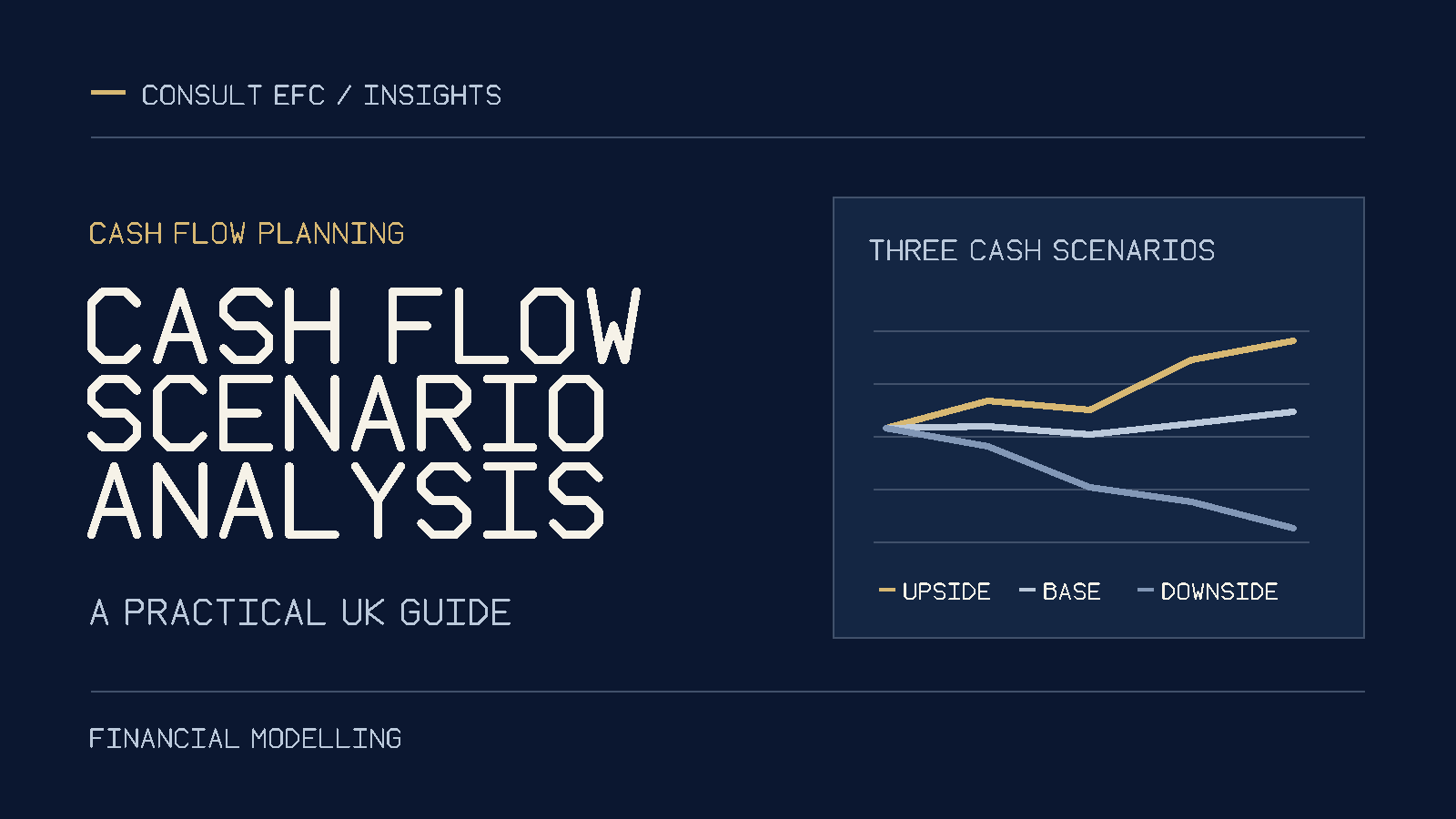
Cash flow scenario analysis means building several versions of your cash forecast, each describing a coherent possible future, and comparing when and by how much your cash runs short or comfortable in each. You do it by taking a base case you believe in, then changing a related set of assumptions together to create a downside and an upside. The output is a decision: what you do, and when, if a given future starts to arrive.
This guide walks through the method step by step, with a worked example, the drivers UK businesses should model, how to read the results, and the mistakes that make scenario models useless.
TL;DR
- Scenario analysis changes several linked assumptions at once to describe a realistic future. Sensitivity analysis changes one variable at a time. You need both, but they answer different questions.
- Build three cases (worst, most likely, best) on one model, and make the only difference between them the assumptions.
- Choose drivers that actually move cash in your business: customer payment timing, payroll, VAT and PAYE dates, loan repayments, seasonality.
- Set a minimum cash level (a cash floor) and agree in advance what you will do if a scenario crosses it.
- Review inputs regularly, and more closely whenever the business is going through change, such as hiring, fundraising or a sale process.
Table of Contents
- What cash flow scenario analysis is, and how it differs from sensitivity analysis
- Why it is worth the effort
- Step 1: Start from a forecast you trust
- Step 2: Choose the drivers that move your cash
- Step 3: Build base, downside and upside cases
- Step 4: Set a cash floor and agree triggers in advance
- Step 5: Add a stress test for runway
- Interpreting the results
- How often to update your scenarios
- Common mistakes to avoid
- Where a fractional CFO helps
- Perspective
- FAQ
- Sources
What cash flow scenario analysis is, and how it differs from sensitivity analysis
A standard cash flow forecast gives you one line: the money you expect to come in and go out, week by week or month by month. It is useful, and it is also almost certainly wrong in detail, because the future rarely follows the base case. Scenario analysis accepts this and asks what happens to cash under different, plausible conditions.
The distinction readers search for, scenario versus sensitivity, is clear in ICAEW’s guidance on financial modelling. Scenario analysis looks at the impact of changing multiple inputs in tandem, for example an alternative decision, a contrasting economic environment or a different financing structure. Sensitivity analysis gauges the impact of changing specified individual variables, one at a time.
In practice:
| Sensitivity analysis | Scenario analysis | |
|---|---|---|
| What changes | One input, everything else held constant | A related set of inputs together |
| Typical question | “What if customers pay 10 days later?” | “What if our largest customer churns, we delay two hires and our bank tightens terms?” |
| Output | Which assumptions your cash is most exposed to | A coherent story with a cash profile and a date when funding may be needed |
| Best used | To rank the risks | To plan responses |
Run sensitivities first to find out which levers matter, then use that knowledge to design scenarios that combine them sensibly. A scenario that changes ten unrelated things is noise. A scenario that says “a slow quarter for new sales, longer payment terms from larger customers, and costs we cannot cut quickly” is a story a board can discuss.
Why it is worth the effort
The case is practical rather than theoretical. ICAEW links better cash flow forecasting to managing through a crisis and to engaging stakeholders credibly, and recommends producing relevant scenarios to generate ideas and improve response times. The advantage is speed: if you have already modelled a 20% drop in receipts, you do not start from a blank spreadsheet on the day it happens.
There is also an external reason. CFO.com notes that external stakeholders such as lenders will want a cash flow forecast to see potential risks, and that a forecast model should support iterative scenario analysis and be dynamic and easy to update. For founders heading into a funding round or a lender conversation, a forecast with clear downside handling reads as a sign of financial control. Investors and lenders tend to probe the downside first.
Step 1: Start from a forecast you trust
Scenarios are only as good as the base case beneath them. If your base forecast is built on guesses, every scenario inherits them.
For most owner-managed businesses and scaling SaaS companies, the most useful starting point is a rolling 13-week cash flow forecast built directly from your reconciled bank balance, plus expected receipts and expected payments by week. Each week you drop the week that has completed, add a new one at the end, and compare actual with forecast. Thirteen weeks is short enough to be precise about payment dates and long enough to see problems arriving. For the longer view, a 12-month monthly forecast sits above it.
If you want to see what this looks like laid out, our 13-week cash flow forecast example for UK businesses shows the structure, and our page on cash flow forecasting explains how we approach it.
Keep the model simple enough that you will actually use it. Be the Business describes the balance well: you want an accurate picture of each scenario without a model so complex that nobody updates it. Scenarios are usually run by changing inputs easily, either on a copy of the sheet or in a model that compares cases side by side.
Step 2: Choose the drivers that move your cash
The most common design error is modelling what is easy to change rather than what actually drives cash. Begin by listing the metrics that affect cash in your business. Be the Business suggests starting with the main ones, such as sales, staff costs and cost of goods sold, then building them into the forecast so you can flex them.
ICAEW’s list of forecast inputs is a good checklist for UK businesses: forecast turnover, cost of sales, the average time to pay suppliers and for customers to pay invoices, inventory, rent, monthly capital expenditure, and spending on R&D, PAYE/NI, VAT and loan repayments.
From that list, the drivers that typically carry the most weight are:
- Customer payment timing. A shift in average days to collect cash can matter more than a change in sales volume. In the UK, where late payment is common, this is usually the first lever to model.
- Revenue volume and mix. For subscription businesses, this means new MRR, churn and expansion. For project businesses, win rates and the timing of milestone invoices.
- Payroll and hiring dates. Staff costs are often the largest fixed outflow, and the date a hire starts is a decision you control.
- Tax and statutory payments. VAT quarters, PAYE/NI and corporation tax are lumpy outflows with known dates. They belong in every scenario.
- Debt service and covenants. Loan repayments and any lender conditions.
- Seasonality and one-offs. Annual software renewals, insurance, bonuses, equipment replacement.
Sector examples can help you see how drivers translate into a weekly model. A 13-week dealership cash flow forecast shows how a business with heavy inventory outlays handles weekly receipts and payments, and the same logic carries over to any business where stock or project costs go out before revenue comes in.
For SaaS companies, the specifics differ: annual prepayments flatter cash early in the year, churn compounds over months rather than weeks, and a large customer’s renewal date can swing a quarter. Our guide to financial modelling for tech startups covers these drivers in more depth.
Step 3: Build base, downside and upside cases
ICAEW says that when businesses create scenarios they should include a worst case, a most likely case and a best case, and include a prediction of the earliest date additional funding may be needed. Three cases is the right number for most businesses: fewer gives you no range, more makes the comparison hard to read.
The discipline that matters is to keep all three on the same model. The structure and formulas stay identical, and only the assumptions differ. Each case should be a story you can say in a sentence.
A worked example
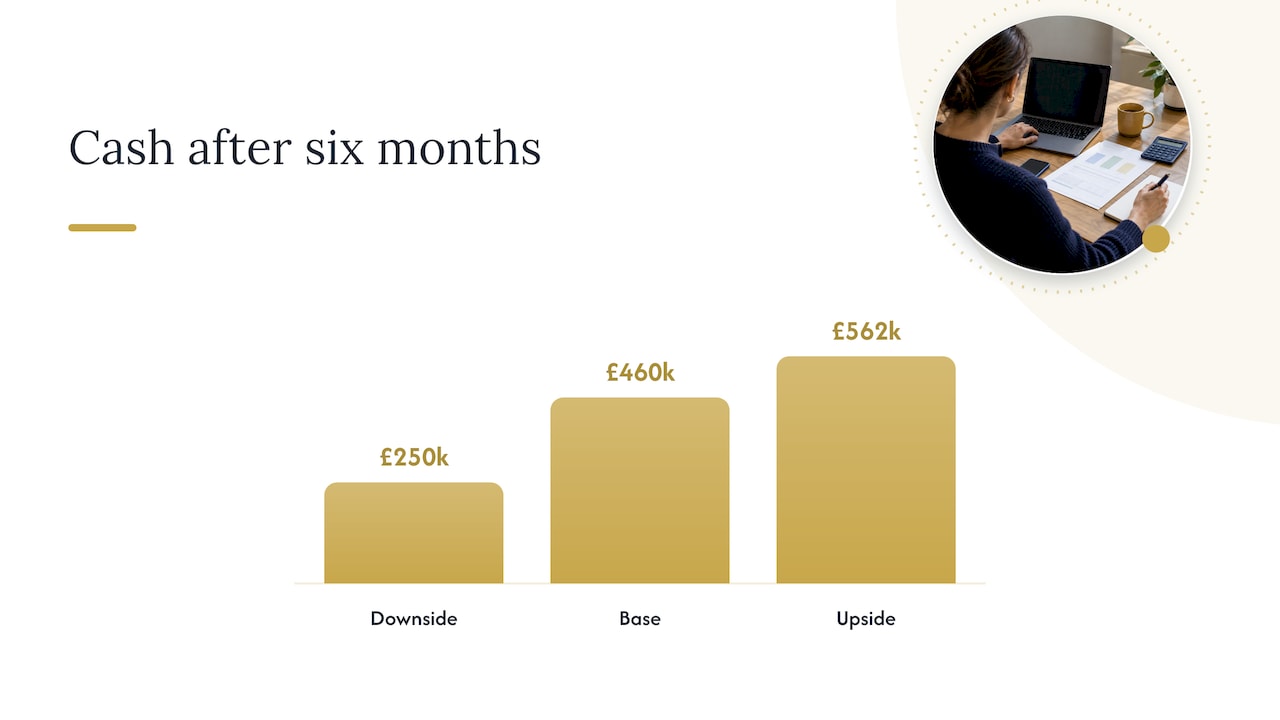
To show the mechanics, here is an illustrative, made-up business: a UK B2B software company with £400,000 in the bank, monthly operating costs of £150,000 and expected monthly receipts of £160,000 in the base case. These numbers are hypothetical, chosen only to show how the cases diverge.
| Assumption | Downside | Base | Upside |
|---|---|---|---|
| Story | Largest customer leaves, remaining customers pay 15 days later | Plans hold | Two enterprise deals close early |
| Monthly receipts | £125,000 | £160,000 | £185,000 |
| Monthly costs | £150,000 | £150,000 | £158,000 (extra delivery cost) |
| Net monthly cash | -£25,000 | +£10,000 | +£27,000 |
| Cash after six months | £250,000 | £460,000 | £562,000 |
The downside is not catastrophic on its own, but suppose the company has set a cash floor of £300,000, roughly two months of costs. Under the downside, cash crosses that line in the third month. That date is the most useful number in the table. It tells you how long you have to act, which is more actionable than a vague sense that things might go badly.
In a real model you would calculate closing cash and headroom against the floor for every week or month, then note the first period in which headroom goes negative.
Document your assumptions
ICAEW advises documenting assumptions clearly, including the timing and probability of major customer payments (for instance, that a named customer will pay a given amount on a given date with a stated probability). A scenario you cannot explain to a lender or co-founder six weeks later is not worth much. Keep a short assumptions log beside the model: what changed, why, and who agreed it.
Step 4: Set a cash floor and agree triggers in advance
A scenario only changes behaviour if it is tied to action. Two additions make that happen.
A cash floor. This is the minimum balance you are not willing to fall below. Many owners set it at a number of weeks of fixed costs, plus a buffer for the next tax payment. Whatever level you pick, write it down.
Triggers and responses. For each scenario, decide beforehand what observable event signals that you are moving towards it and what you will do. For example:
- If average debtor days rise by more than a set number for two consecutive months, start credit control escalation and pause discretionary spend.
- If monthly churn exceeds a stated rate for a quarter, freeze non-critical hires and bring forward the conversation with your lender or investors.
- If headroom against the floor falls below eight weeks in the downside case, begin funding discussions rather than waiting.
Deciding these in calm conditions avoids the poor decisions made in a panic. Funding conversations also go better when started early. If a downside scenario shows you needing external funding, our guides on debt versus equity funding and what lenders check when assessing SME debt are useful starting points for the options.
Step 5: Add a stress test for runway
For businesses burning cash, such as venture-backed SaaS companies, a scenario view and a runway view go together. Where scenario analysis asks what the plausible futures are, a stress test asks how bad things must get before you run out. You can try our cash runway stress test or the wider business decision toolkit for a quick first look, and our guide to scenario planning for seed, Series A and Series B shows how the cases change by funding stage.
Interpreting the results
The numbers are not the point; the decisions are. When you compare cases, ask:
- When does each case cross the floor? The earliest date is your planning horizon.
- What is the gap between base and downside? A narrow gap means the business is resilient. A wide one tells you which assumptions deserve the closest monitoring.
- Which actions are in your control, and how fast do they work? Cutting a marketing budget takes effect within weeks. Renegotiating a lease does not. Choose responses whose timing matches the problem.
- What would the upside require? If your best case needs hiring ahead of revenue, check whether the downside could leave you stranded with the extra cost.
ICAEW also notes that fan charts can show growing uncertainty around cash flows the further out the forecast goes. A simple chart with a central line and widening bands is often easier for a board to absorb than a table of figures.
Scenario output also helps in transactions. Buyers and investors test forecasts, and showing that you have already stress-tested yours supports the credibility of the model. If you are preparing for a raise or sale, see how this feeds into investor-grade financial modelling.
How often to update your scenarios
There is no single rule, but the principle is clear. ICAEW says to revisit cash flow inputs and assumptions regularly, and to review them closely when the business is going through change. A sensible rhythm for most growing businesses:
- Weekly: roll the 13-week forecast forward and compare actual with forecast.
- Monthly: refresh the scenario assumptions alongside management accounts and update the date at which each case crosses the floor.
- On a trigger: whenever a major event occurs, such as losing or winning a large customer, a change in payment terms, a hiring plan, a new facility, or the start of a fundraising or sale process.
Common mistakes to avoid
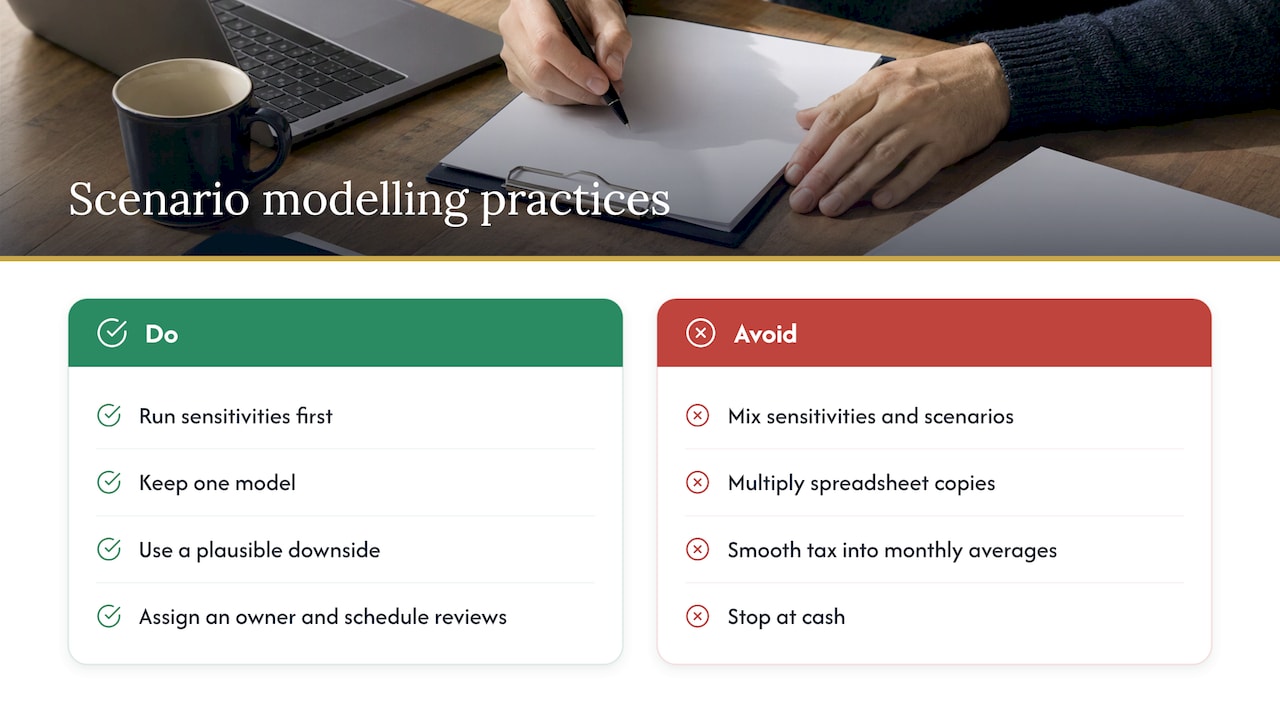
Mixing sensitivities and scenarios. Changing one input and calling it a scenario, or changing ten and calling it a sensitivity, muddies what you learn. Keep the two exercises separate, and run sensitivities first to learn what matters.
Letting versions multiply. When every scenario lives in a separate copy of the spreadsheet, the copies drift apart. Formulas break, someone hard-codes a number, and nobody knows which file is current. Keep one model with a scenario selector, or a clear structure where only the assumptions sheet differs.
Unrealistic downsides. A downside that is too mild gives false comfort. One that is so extreme that nothing could be done about it gives no guidance. Aim for a case you would be unsurprised to see, not a worst possible outcome.
Forgetting the timing of tax. VAT, PAYE/NI and corporation tax have fixed dates. Omitting them, or modelling them as a smooth monthly average, hides the weeks when cash is tightest.
No owner and no action. A scenario pack that nobody reviews is a document, not a control. Assign someone to own the model, and put the review in the calendar.
Stopping at cash. Scenarios should also flow into the covenants, headroom and funding plans that depend on them.
Where a fractional CFO helps
Most founders can build a basic three-case model. What is harder is choosing the right drivers, keeping the model reliable as the business changes, and translating results into funding and hiring decisions. That is the gap a fractional CFO fills.
At Consult EFC, our work is led by ICAEW Chartered Accountant Kishen Patel. We provide fractional CFO services, financial modelling, FP&A and fundraising support for high-growth companies and ambitious UK SMEs, designed to give you senior finance leadership and the rigour of Big Four-style analysis without the cost of a full-time hire.
If you want your cash scenarios built, stress-tested and tied to clear actions, take a look at our fractional CFO services, or talk to us through our website.

If your priority is a model that investors will test, our financial modelling and forecasting with three sales scenarios page shows how we structure it. If you are heading for a sale in the next one to three years, our exit planning service starts by understanding how resilient your cash generation is.
Perspective
In our experience, founders treat scenario analysis as something to do when a problem appears. We think it works best the other way round: build it while things are going well, because that is when you have time to choose your responses.
The most useful scenario work we do is rarely about elaborate models. It is about picking the three or four drivers that really decide whether the business has a comfortable year, agreeing a cash floor, and being clear who does what if a trigger is hit. A simple model that the leadership team reads every month beats a sophisticated one that sits in a folder.
This is also why we think senior finance input matters during rapid growth. A fractional CFO brings the discipline of a finance director, the habit of challenging assumptions, and the credibility with lenders and investors that comes from a chartered accountant standing behind the numbers, without a full-time salary. Our aim is for you to make decisions with timely, reliable insight rather than hindsight.
Kishen Patel
FAQ
What is the difference between cash flow scenario analysis and sensitivity analysis?
Sensitivity analysis changes one input at a time, such as customer payment days, to show how exposed your cash is to that variable. Scenario analysis changes a related group of inputs together to describe a coherent possible future, such as a recession with slower payments and lower sales. Use sensitivities to find your key risks and scenarios to plan responses.
How many scenarios should I model?
Three is the standard: a worst case, a most likely case and a best case, as recommended by ICAEW. This gives you a range without making the comparison unwieldy. If one specific risk worries you, such as the loss of a major customer, add it as a separate targeted scenario rather than multiplying the general cases.
What should I include in a cash flow scenario?
Include the drivers that move your cash: turnover, costs, how quickly customers pay and you pay suppliers, payroll, VAT, PAYE/NI, corporation tax, capital expenditure and loan repayments. Add seasonality and one-off items. Choose the few that matter most to your business rather than flexing every line.
How often should I update my scenarios?
Roll a 13-week forecast forward weekly and refresh your scenario assumptions at least monthly. ICAEW advises reviewing inputs regularly and more closely when the business is going through change, so update them immediately after any major event such as a new funding facility, a big contract win or loss, or a hiring plan.
When should I get help from a fractional CFO?
Consider it when you are raising funds, approaching a sale, managing fast growth without a senior finance lead, or when lenders and investors are asking for scenario-based forecasts you do not have the time to build. A fractional CFO can build and maintain the model and help you act on the results.
Sources
- ICAEW: Intro to Financial Modelling, Part 18, Sensitivities and scenarios
- ICAEW: Nine principles for finance professionals
- ICAEW: Cash flow forecasts and inventory
- Be the Business: How to integrate scenario planning into your cash flow forecasting
- CFO.com: Dynamic cash-flow forecasting
- Dealership cash flow forecast: a 13-week guide
Recommended
- 13-Week Cash Flow Forecast Example UK
- Financial due diligence: a practical guide for UK buyers
- Cash Flow Forecasting
This article is for general information only and is not professional advice.
Not sure where your business stands right now?
Book a free 30-minute call with Kish. Bring your numbers, your questions, or just your situation. You will leave with a clearer picture than you arrived with.
Book a Free Strategy Call
Over 12 years across Big Four audit, Investment Banking, and corporate advisory. Kish works with SaaS founders, tech companies, and ambitious UK SMEs from £1M to £50M in revenue on fundraising, valuations, exit planning, and financial strategy. ICAEW regulated. Big Four trained. Based in London.