

This guide walks through the covenant tests you will meet most often in a UK facility agreement: interest cover (ICR) and net debt to EBITDA, with figures you can drop straight into a spreadsheet. You will also find a repeatable testing workflow, a headroom calculation method and a documentation checklist built from the way we run quarterly covenant tests for fractional CFO clients.
TL;DR:
- Maintenance covenants are usually tested quarterly against the last twelve months of results; incurrence tests apply only after events such as borrowing, dividends, or acquisitions.
- Debt classification depends on covenant compliance at the reporting date, and a waiver secured after year end does not change that assessment retroactively.
- With £12 million in net debt, EBITDA falling from £5 million to £3.5 million pushes leverage from 2.4x to 3.43x, breaching a 3.0x limit.
- Facility agreement definitions may cap EBITDA adjustments and determine whether lease liabilities enter net debt, so reconcile each figure to the exact covenant wording.
- Project headroom through the next two or three test dates, trigger action at 10% to 15% remaining, and request waivers weeks before a likely breach.
Table of Contents
- 1. Common covenant types and when lenders test them
- 2. A repeatable process for testing covenants each period
- 3. Worked calculations: interest cover and net debt to EBITDA
- 4. Turning results into headroom projections and next steps
- 5. A practitioner checklist for defensible covenant testing
- 6. What disciplined covenant testing actually buys you
- How we support covenant testing and compliance reporting
- FAQ
- Sources
1. Common covenant types and when lenders test them
Before running any calculation, it helps to know which covenant you are actually dealing with. Facility agreements typically bundle together financial covenants, which are tested numerically against a threshold, and non-financial covenants, which are more about conduct and disclosure.
The financial covenants that come up most often each carry a specific job:
- Interest cover ratio (ICR): EBIT or EBITDA divided by interest payable, used to check trading profit comfortably covers debt servicing costs.
- Net debt to EBITDA (leverage): net debt divided by EBITDA, the standard measure of how many years of earnings it would take to clear outstanding debt.
- Fixed charge cover ratio: earnings available for debt service divided by the sum of interest, lease payments and scheduled capital repayments, a broader test than ICR alone.
- Current ratio: current assets divided by current liabilities, a liquidity check that some facilities still require alongside the leverage-based tests.
Most of these are maintenance covenants, meaning they are tested on every reporting date for the life of the facility, typically quarterly against the last twelve months of trading. Others are incurrence covenants, which only get tested when a specific event happens, such as drawing further debt, paying a dividend or completing an acquisition.
Non-financial covenants sit alongside these and rarely involve arithmetic, but a missed one can trigger the same consequences as a failed ratio test:
- Negative pledge: a promise not to grant security over assets to another lender without consent.
- Reporting obligations: deadlines for management accounts, annual audited statements and compliance certificates.
- Information undertakings: notification duties if a material event, dispute or change of control occurs.
How your test date interacts with your reporting date matters more than most borrowers realise. Under IFRS guidance on non-current liabilities with covenants, classification of debt as current or non-current depends on compliance at the reporting date itself, not at some later test date, and a waiver obtained after the year end does not retrospectively change that reporting-date assessment. If you are drafting annual accounts and a covenant test falls close to the balance sheet date, that timing detail decides whether the related debt sits in current or non-current liabilities.
Before relying on any of these definitions in practice, it is worth checking the exact wording your facility agreement uses rather than the generic version above. Our guide to bank loan covenant checks before signing sets out what to look for in the definitions section specifically.
2. A repeatable process for testing covenants each period
Running a covenant test well is less about the maths and more about having consistent inputs and a clear audit trail. The process below works whether you are testing quarterly under a maintenance covenant or ahead of a one-off incurrence event.
Start by gathering the inputs you will need every time:
- The trial balance and interim or annual accounts for the testing period, reconciled to management accounts.
- Interest schedules, including accrued but unpaid interest and any capitalised interest on new facilities.
- Lease schedules, since IFRS 16 treatment can pull lease liabilities into net debt depending on the facility agreement’s frozen GAAP election.
- The banking covenants table from the facility agreement, with the exact definitions, thresholds and testing dates recorded against each covenant.
- The prior period’s covenant workings, so you can check consistency of treatment period to period.
Once the inputs are in hand, the sequence runs in five stages: extract the relevant figures from the accounts, adjust them for permitted add-backs and any caps the agreement specifies, calculate the ratio, compute headroom against the threshold, then document the workings and route them for sign-off. Each stage should produce a distinct, saved output rather than being done in a single uncontrolled spreadsheet pass.
Mapping the facility agreement’s defined terms to your actual accounting lines is where most errors creep in. “Consolidated EBITDA” in a loan agreement rarely matches EBITDA as reported in statutory accounts: it usually carries specific add-backs for exceptional items, pro forma adjustments for recent acquisitions and sometimes a cap on how much can be added back in total. The LMA’s best practice guidance on term sheet completeness flags the drafting of consolidated EBITDA and its add-backs as one of the most heavily negotiated parts of any facility, precisely because small wording differences change headroom materially. Record which version of the definition you are using, and keep that record alongside the calculation.
The output of each test should be four things: the numeric result against the threshold, the headroom in absolute and percentage terms, a draft compliance certificate, and a clear note of any escalation trigger if headroom has fallen below an internal warning level.
Pro Tip: Keep a single master tab per covenant that links back to source schedules rather than typing figures in by hand each quarter; it cuts rework and makes the audit trail obvious to anyone reviewing it later.
3. Worked calculations: interest cover and net debt to EBITDA
These two examples cover the vast majority of maintenance covenant tests you will run, and the numbers below are structured so you can substitute your own figures directly.
Interest cover ratio is calculated as EBIT divided by interest payable for the test period. Take a business with EBIT of £12 million and interest payable of £3 million: that gives an ICR of 4x, comfortably above a typical covenant threshold of 2x to 3x.
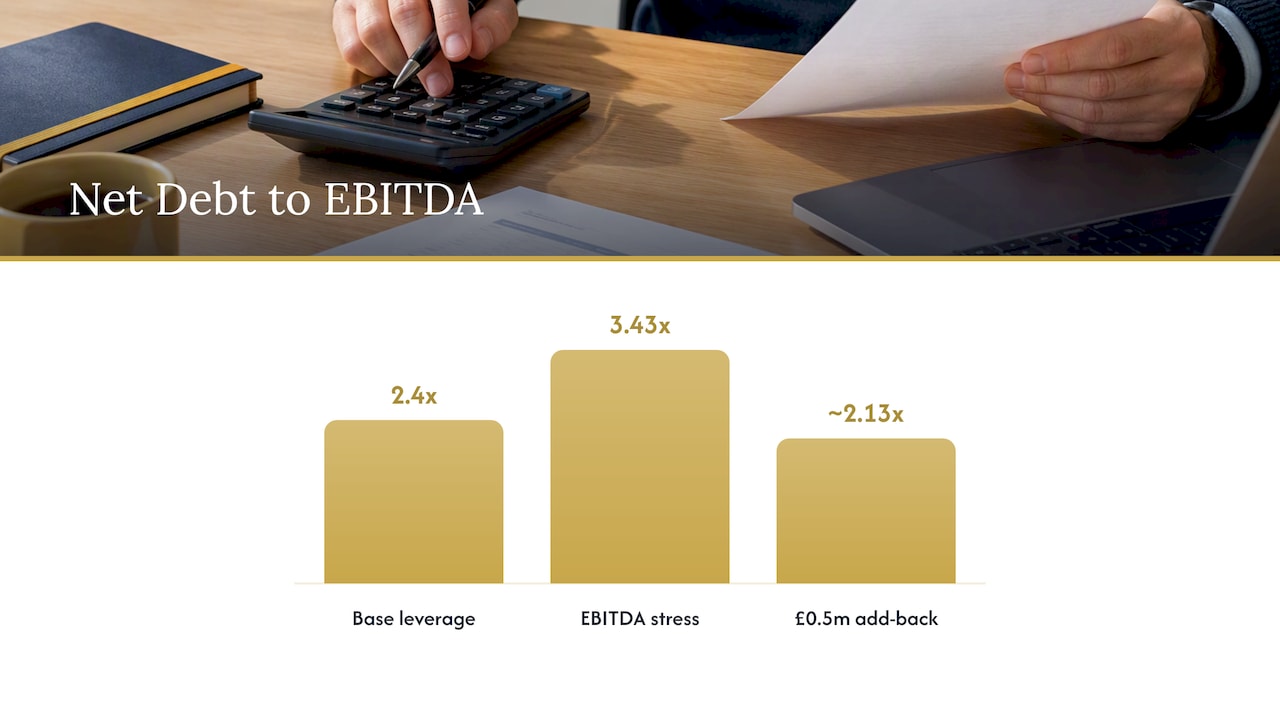
Net debt to EBITDA works the other way round: net debt divided by EBITDA, with a lower number meaning less leverage. On net debt of £12 million and EBITDA of £5 million, leverage comes out at 2.4x. Run a sensitivity on that same net debt figure with EBITDA falling to £3.5 million, perhaps from a lost contract or a seasonal dip, and leverage climbs to 3.43x, which would breach a typical 3.0x maintenance covenant even though net debt itself has not moved at all.
| Covenant | Formula | Base case | Stressed case |
|---|---|---|---|
| Interest cover ratio | EBIT ÷ interest payable | £12m ÷ £3m = 4x | £12m ÷ £5m = 2.4x |
| Net debt to EBITDA | Net debt ÷ EBITDA | £12m ÷ £5m = 2.4x | £12m ÷ £3.5m = 3.43x |
Headroom on the net debt to EBITDA test above is an amount against a typical 3.0x covenant threshold, or a certain percentage of the permitted level, once EBITDA starts to soften. That gap looks comfortable until you stress it, which is exactly why a single quarter’s weak EBITDA can turn a passing covenant into a breach without any new borrowing at all.
Definition choices change these numbers before a single pound of trading moves. Add back a one-off restructuring cost of £0.5 million to EBITDA and the base case leverage improves from 2.4x to roughly 2.13x on the same £12 million of net debt, purely from how “Consolidated EBITDA” is defined. The same applies to a frozen GAAP election: if the facility agreement fixes covenant definitions to pre-IFRS 16 treatment, operating lease liabilities stay off the net debt figure entirely, while a business testing under current GAAP would need to include them. Interest cover is tested on a similar basis, sometimes historically and sometimes on a projected three, six or twelve-month basis, and projected ICR tests require their own definition checks, particularly around items like passing rental income, because lenders may build in cure rights or require a formal waiver if a projected breach looks likely.
4. Turning results into headroom projections and next steps
A single quarter’s result tells you where you stand today. Headroom tells you how much room you have before that changes, and projecting it forward is what actually protects you from a surprise breach.
Headroom is simply the gap between your calculated ratio and the covenant threshold, expressed both in absolute terms and as a percentage of the limit. Once you have that figure for the current period, build a short projection running to the next two or three testing dates using your latest forecast EBITDA and expected debt drawdowns, so you can see whether headroom is widening or shrinking before the next certificate is due.
Set an internal escalation threshold well before the covenant limit itself, commonly at 10% to 15% headroom remaining, so action is triggered automatically rather than relying on someone noticing late.
- Request a waiver early if a projected breach looks likely, since lenders respond far better to advance notice than to a surprise.
- Size an equity cure if the facility agreement permits one, calculating the exact injection needed to restore covenant compliance on paper.
- Negotiate an amendment to the threshold or definition if the breach reflects a structural change in the business rather than a temporary dip.
- Time any request carefully, since most waiver processes take several weeks and need to land before the formal test date, not after.
Pro Tip: Build your covenant projection and your cash flow forecast off the same underlying model so the two never quietly disagree with each other by the time you need to show a lender your numbers.
Early engagement with your lender, backed by the underlying workings rather than just the headline ratio, is almost always the difference between a straightforward amendment and a drawn-out renegotiation.
5. A practitioner checklist for defensible covenant testing
Running the calculation correctly once is not the same as being able to defend it a year later when a lender, auditor or investor asks how you got there. The checklist below is what we expect to see in place before signing off a compliance certificate.
- Keep a version-controlled covenant master file recording the exact defined wording for each covenant, its source clause in the facility agreement, and the date each version was agreed or amended.
- Reconcile every input to its source schedule, with a named preparer and a separate named reviewer for each calculation, so the sign-off trail is never a single person marking their own work.
- Draft the compliance certificate from a fixed template, specifying who signs (typically a director or CFO), which schedules are attached as evidence, and which prior period’s figures are referenced for comparison.
- Store the add-back and adjustment log separately from the headline calculation, so any change in treatment between periods is visible rather than buried inside a single spreadsheet formula.
Businesses preparing for a refinancing or an investor update often find this is also where due diligence gaps first surface; our financial due diligence services page covers how we approach opening pro forma covenant positions in more detail.
6. What disciplined covenant testing actually buys you
The real value of running these tests properly is not the certificate itself. It is the three months of warning you get before a breach happens, which is the difference between negotiating a waiver on your own terms and discovering a problem the week before a test date with no time to respond.
In practice, most covenant breaches we see are not caused by a sudden collapse in trading. They are caused by a definition that was never pinned down clearly, an add-back that got treated differently this quarter to last, or a projection that nobody updated until it was too late to matter. Running a quarterly test to an investor-ready standard takes a few focused hours once the master file and reconciliation habits above are in place, but it takes considerably longer the first time you set that structure up properly. Expect to spend real time on it initially, and treat that time as the cost of never having to explain an avoidable breach to a lender.
— Kishen Patel
How we support covenant testing and compliance reporting
Running a robust covenant test every quarter takes time most finance teams do not have spare, particularly alongside closing the books and preparing board reporting in the same week. We built our fractional CFO services around exactly this gap: an ICAEW Chartered Accountant-led function that takes on the recurring mechanics of covenant testing, projection and compliance certificate preparation at a fraction of the cost of a full-time hire.
Our support typically covers:
- Building the covenant master file and testing workflow so each quarter’s calculation is reproducible rather than rebuilt from scratch.
- Investor-grade financial modelling to project headroom forward and stress-test EBITDA and net debt scenarios ahead of a test date, through our investor-grade financial modelling work.
- Debt financing advisory when a projected breach means renegotiating terms, sizing an amendment or approaching alternative lenders.
- Compliance certificate drafting and sign-off support, so the document a lender receives is backed by a clear, documented trail.
If a covenant test is coming up and you want it done to a standard a lender will not query, get in touch to discuss our fractional CFO services.
This article is general information, not a substitute for advice from a qualified financial advisor. Consult a qualified financial professional about your own circumstances before acting on anything here.
FAQ
What are some examples of debt covenants?
Common examples include the interest cover ratio, which checks EBIT against interest payable, and net debt to EBITDA, which measures leverage against earnings. Non-financial examples include negative pledge clauses, which restrict granting security to other lenders, and reporting covenants, which set deadlines for accounts and compliance certificates.
What are covenant tests?
Covenant tests are calculations run against figures set out in a loan agreement to confirm a borrower is complying with agreed financial or conduct terms. They are usually run on a fixed schedule, often quarterly, and the result determines whether a compliance certificate can be issued without triggering a waiver discussion.
What is a contract covenant?
A contract covenant is a binding promise within an agreement, such as a loan facility, that one party will do or refrain from doing something for the life of that contract. In lending, covenants are split between financial covenants, tested numerically, and non-financial covenants, which govern conduct and disclosure.
What is a personal covenant?
A personal covenant is a binding promise made by an individual, often found in property deeds or personal guarantees attached to a business loan, rather than one tested against company financial statements. It differs from a corporate financial covenant in that compliance usually depends on an individual’s actions or assets rather than a ratio calculated from company accounts.
Sources
- LMA — Best practice guide: term sheet completeness
- IFRS — Non-current liabilities with covenants (agenda paper/extract)
- IAS Plus — IAS 1 and related guidance
- CMS law — Interest cover ratio: default and testing
Recommended
This article is for general information only and is not professional advice.
Not sure where your business stands right now?
Book a free 30-minute call with Kish. Bring your numbers, your questions, or just your situation. You will leave with a clearer picture than you arrived with.
Book a Free Strategy Call
Over 12 years across Big Four audit, Investment Banking, and corporate advisory. Kish works with SaaS founders, tech companies, and ambitious UK SMEs from £1M to £50M in revenue on fundraising, valuations, exit planning, and financial strategy. ICAEW regulated. Big Four trained. Based in London.