

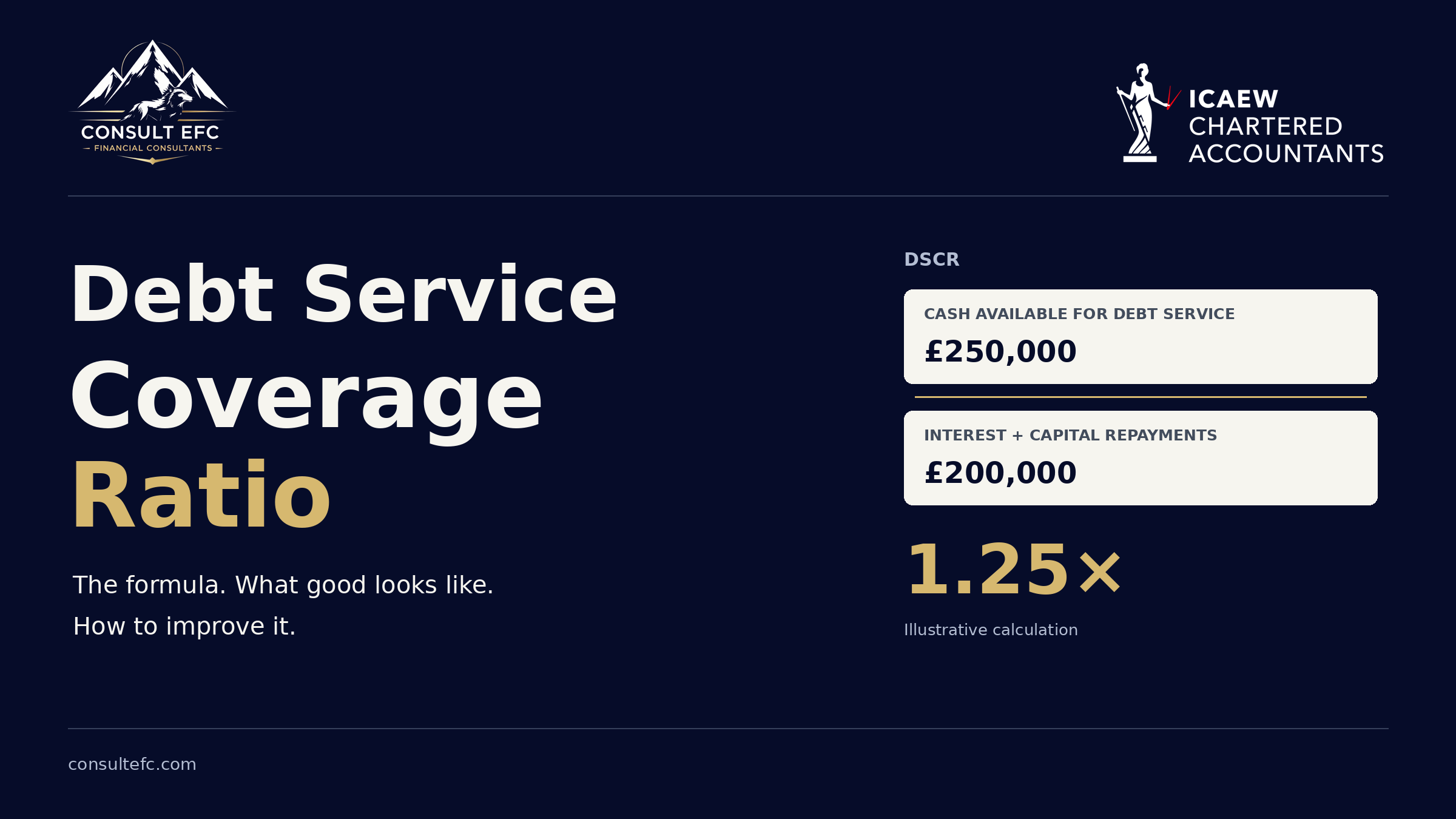
The debt service coverage ratio (DSCR) is the cash your business generates divided by the loan payments it owes in the same period. A result of 1.0 means you cover your repayments exactly. Above 1.0 you have cash to spare. Below 1.0 you cannot meet them from operations. Lenders use it to decide whether to lend and on what covenants, so it pays to know your number, and how your lender will calculate it, before you ask for money.
This guide is for founders and owners of UK growth companies and SMEs: those raising debt alongside equity, running a SaaS business with recurring revenue, or preparing a sale where a buyer will test the debt. We cover the formula, a worked example, what counts as a good ratio, the traps in the calculation and how to improve it.
TL;DR
- DSCR = cash flow available for debt service divided by total debt service (interest plus capital repayments) for the same period.
- Below 1.0 means the business cannot cover its debt from cash flow. Lenders usually want a margin above 1.0, and the exact figure varies by lender and loan.
- Use cash flow available for debt servicing (CFADS), not raw EBITDA. It deducts tax, capex and working capital movements, so it is closer to what a bank will test.
- You improve DSCR by raising cash flow, lowering the repayments the ratio sees, or both. Loan structure often moves it faster than trading does.
- Model your DSCR under stress before you sign, because covenants are tested against the lender’s definition, not yours.
Table of Contents
- What the debt service coverage ratio measures
- The DSCR formula
- A worked example
- What does a DSCR of 1.25 mean?
- What is a good DSCR?
- Why the interest rate type changes your ratio
- Common mistakes when calculating DSCR
- How to improve your DSCR
- Perspective
- Getting a lender-ready DSCR with a fractional CFO
- FAQ
- Sources
What the debt service coverage ratio measures
Debt service means everything you must pay on borrowing in a period: interest and capital repayments. DSCR asks whether operating cash flow covers that bill.
The Bank of England describes debt-servicing ratios as a business’s available cash flow set against its current debt obligations, typically total interest and principal payments relative to earnings. A business under heavier debt-servicing pressure is more likely to struggle to repay and carries a higher risk of default. That is the question every lender is trying to answer, and DSCR is the shorthand.
The ratio matters beyond banks. An investor reading your model, an acquirer running due diligence and a board setting a borrowing limit all look at how comfortably the business carries its debt. A founder who knows the ratio early negotiates from a stronger position.
The DSCR formula
The basic formula is:
DSCR = cash flow available for debt service ÷ total debt service
The numerator is the cash the business generates before paying lenders. The denominator is the interest and scheduled capital repayments due over the same period, usually twelve months.
The British Business Bank explains that cash flow available for debt servicing (CFADS) is divided by debt obligations to produce the ratio. Below 1, the business cannot service its debt. At exactly 1, it has just enough. Above 1, it can meet its obligations with money left over. It also notes that banks and investors often prefer CFADS to EBITDA because CFADS accounts for tax and other spending.
What goes into the cash flow figure
Bank of Scotland’s viability guidance says a fuller picture than EBITDA comes from CFADS: EBITDA plus or minus net movements in working capital, less tax paid and capital expenditure paid. Capex funded by asset disposals, hire purchase or finance leasing is netted off that deduction.
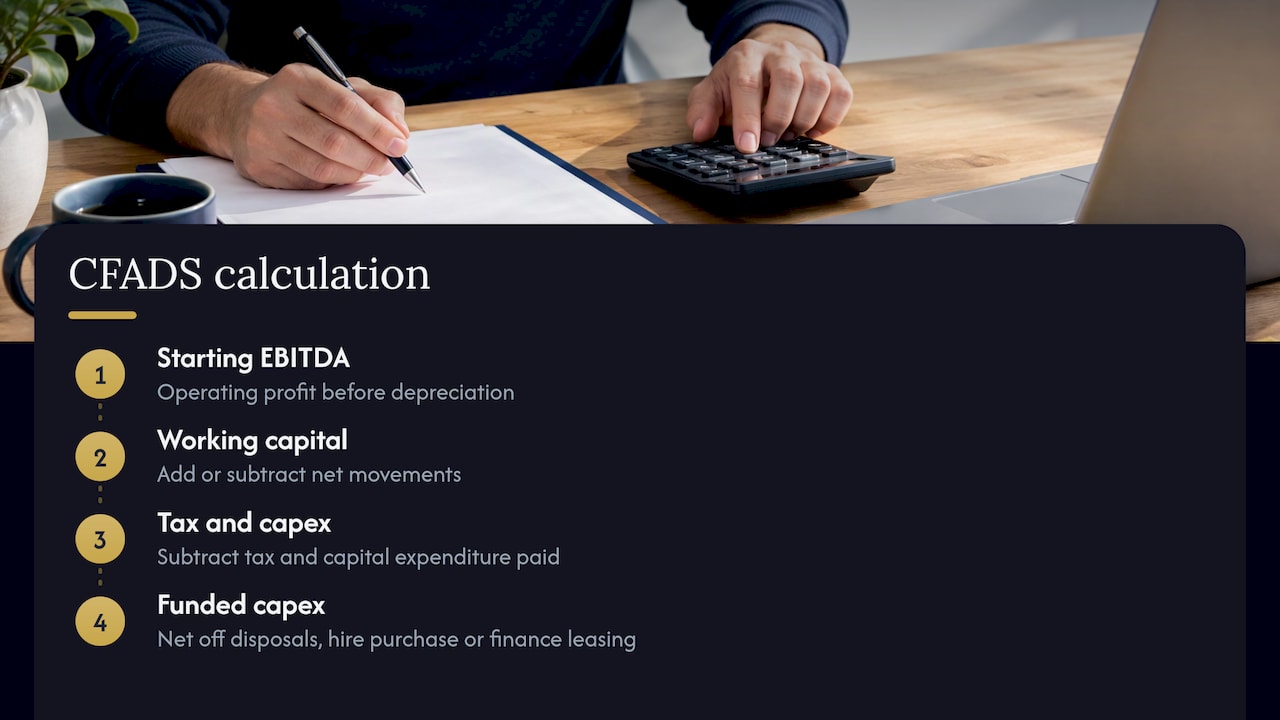
In plain terms, start with operating profit before depreciation, then ask what cash really reached the bank after customers paid late, stock was bought, HMRC was paid and equipment was replaced.
What goes into the debt service figure
Include every scheduled payment on borrowing: term loan interest and capital, asset finance and lease payments the lender treats as debt, and any revolving facility interest. Leave out voluntary early repayments. Lenders’ definitions differ on leases and shareholder loans, so check the facility agreement rather than assuming.
A worked example
Take a UK software company with the following figures for the year:
| Item | £ |
|---|---|
| EBITDA | 400,000 |
| Increase in working capital (cash tied up) | (50,000) |
| Tax paid | (40,000) |
| Capital expenditure paid | (60,000) |
| CFADS | 250,000 |
| Loan interest | 60,000 |
| Scheduled capital repayments | 140,000 |
| Total debt service | 200,000 |
DSCR = 250,000 ÷ 200,000 = 1.25
Now see what happens if someone quotes you the ratio on EBITDA alone: 400,000 ÷ 200,000 gives 2.0. Same business, same loan, a very different story. The gap is why you should ask your lender which cash flow definition its covenant uses before you compare your own figure with its threshold.
What does a DSCR of 1.25 mean?
A DSCR of 1.25 means the business generates £1.25 of available cash for every £1 of debt service. There is a cushion of 25% before repayments absorb all the cash.
In the example above, that cushion is £50,000. If CFADS fell by 20%, to £200,000, the ratio would drop to exactly 1.0: every pound goes to the lender, and nothing remains for dividends, new hires or a bad month. That is why 1.25 is often seen as a working minimum for stable businesses, and why a lender with a volatile borrower in view will want more.
What is a good DSCR?
There is no single official threshold. What counts as good depends on the lender, the type of facility and how predictable your cash flow is. Three principles hold in practice.
- Above 1.0 is the floor. Below it, repayments exceed available cash.
- A margin above 1.0 is the norm. HMRC’s guidance on cash-flow cover covenants says such a covenant should be greater than 1:1, because there will be other calls on cash flow, dividends for example. Third-party lenders reason the same way, which is why many set minimums in the region of 1.2 to 1.5 times, with the figure rising for riskier borrowers.
- Predictability earns a lower hurdle. Contracted recurring revenue with low churn is easier to underwrite than project income with lumpy receipts, so a SaaS business with stable monthly recurring revenue (MRR) can often support a tighter ratio than a one-off project business.
Treat any figure you read online as a starting point. The number that matters is the covenant in your term sheet. Our guide to what lenders actually check on SME debt covers how that assessment is built, and our piece on covenants to test before signing shows how to test your own headroom.
Is a high or low DSCR better?
Higher is better for the borrower. It signals more cash headroom, a lower default risk and usually better terms. A very high ratio is not a problem, though it can show that you are under-using cheap debt and relying on equity that costs far more. Our comparison of debt versus equity funding helps you judge that trade-off.
Why the interest rate type changes your ratio
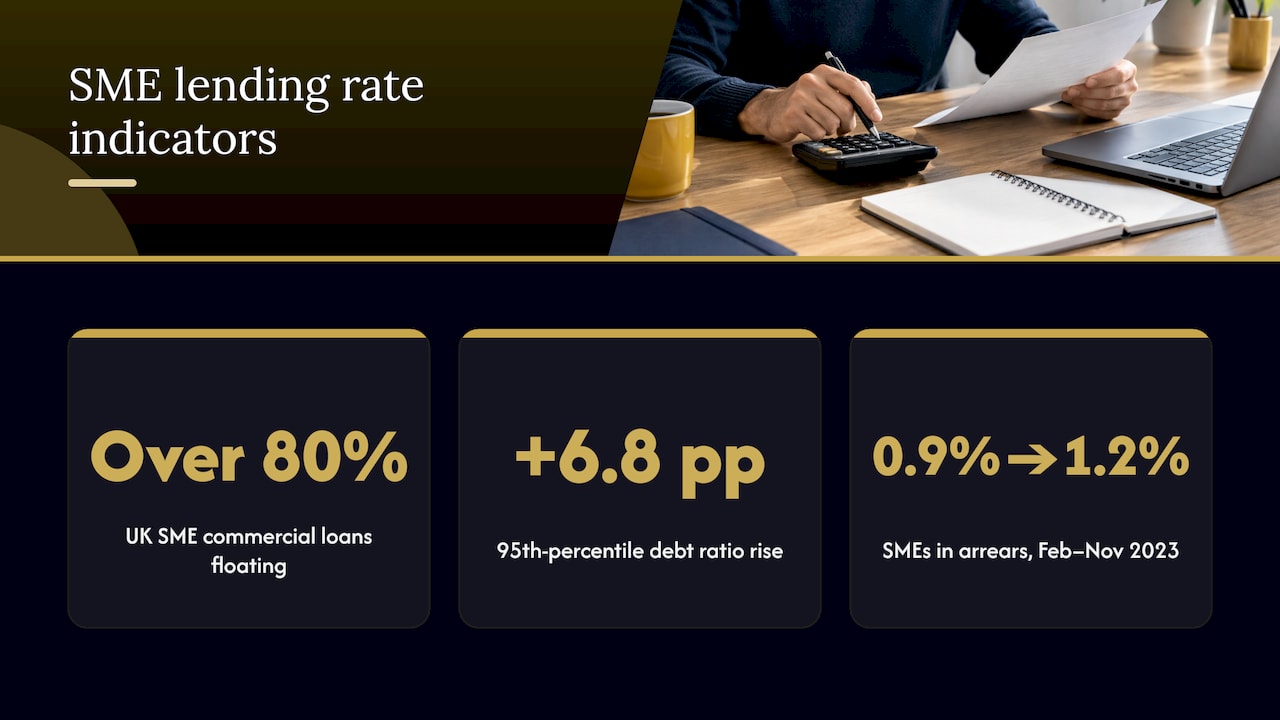
Your debt service is not fixed unless your debt is. The Bank of England found that over 80% of commercial loans to UK SMEs are floating rate, so higher rates had already worked through to repayments. It estimated that the 95th percentile SME debt-servicing ratio rose by around 6.8 percentage points between October 2022 and the period it analysed (Bank of England, April 2024). The same analysis put the share of SMEs in arrears on commercial loans at 1.2% on November 2023 data, up from 0.9% in February 2023.
For your DSCR, this means a ratio that looks comfortable at today’s base rate can tighten when rates move. The trade-offs between fixed versus floating rate debt are worth understanding before you choose a facility, because that choice sets how much of your DSCR is exposed to the next rate decision. Run the ratio at a higher interest rate than today’s before you sign.
Common mistakes when calculating DSCR
Using EBITDA when the lender uses CFADS
As the example shows, EBITDA flatters the ratio. Calculate it both ways, and lead with the definition in the loan documents.
Ignoring bullet repayments
Some loans repay the capital in one go at the end. HMRC’s practical guidance notes that for debt repayable in full at term end, a notional straight-line annual repayment figure may be included in the test. If you leave the balloon out, the ratio looks healthier than a lender’s model will show.
Netting interest income against interest cost
HMRC’s thin capitalisation guidance cautions that netting interest receivable against interest payable can cosmetically improve cover ratios, and can disguise cash building up that a third-party lender might have required to be used to cut debt. What matters is whether the measure tracks the company’s real ability to service its debt.
Testing one period only
A single healthy year does not show seasonality, a late-paying customer or a churn spike. Covenants are typically tested repeatedly, so a rolling forecast of the ratio across the loan term is more useful than a one-off calculation. Our covenant testing examples show worked ratios and where breaches arise.
How to improve your DSCR
There are only two levers: increase the numerator or reduce the denominator. In practice, work through them in this order.
1. Release cash from working capital
Cash trapped in debtors and stock lowers CFADS even when profit is healthy. Tighter invoicing, quicker collection and annual rather than monthly billing for software customers all raise operating cash flow without changing the profit and loss account.
2. Protect recurring revenue
For SaaS companies, churn is a debt metric as well as a growth metric. Lower churn and steadier MRR make forecast cash flow more reliable, and reliable cash flow is what lenders reward with a lower required ratio.
3. Improve margin on the cash you generate
Pricing, supplier terms and cost discipline all flow through EBITDA into CFADS. Be selective: cuts that reduce future revenue, such as slashing sales spend, can leave the ratio worse a year later.
4. Rework the debt, not just the business
Extending a repayment term lowers annual capital repayments, and refinancing expensive borrowing reduces interest. Either shrinks debt service and lifts the ratio immediately. The loan type matters too: our guides on secured versus unsecured loans and asset-based lending explain how security changes pricing and structure.
5. Time capex and distributions
Because CFADS is struck after capital expenditure, deferring non-essential spending in a test year helps the ratio. Likewise, remember HMRC’s point that other calls on cash, such as dividends, are why a bare 1:1 is not a sufficient margin.
6. Stress-test before you commit
Model a revenue drop, a late-paying customer and a rate rise, and see where the ratio lands. Our cash flow scenario analysis guide walks through the method. If a modest downside breaks the covenant, renegotiate the covenant or the structure before signing, not after.
Perspective
Most founders meet DSCR for the first time in a lender’s term sheet, and by then the definition has already been written in the lender’s favour. The better moment is months earlier, when the ratio can still be shaped.
We build the cash flow view the way a lender will: CFADS rather than EBITDA, tested across the loan term and stressed for the downside. That discipline is what we bring from ICAEW chartered accountancy, Big Four standards and investment banking rigour, applied through a fractional engagement rather than a full-time hire.
A growing company rarely needs a permanent CFO to do this. It needs a senior finance mind at the moments that matter: before a debt raise, ahead of a covenant test, when preparing for a sale. Done early, a DSCR conversation costs far less than a breach.
Kishen Patel
Getting a lender-ready DSCR with a fractional CFO
If you are about to borrow, refinance or prepare for a sale, we can build the model a lender or buyer will test. Our debt financing advisory work covers the structure of the facility, and our fractional CFO services give you senior financial leadership without the cost of a full-time hire. For the forecast itself, see our investor-grade financial modelling.
We are led by ICAEW Chartered Accountant Kishen Patel, and engagements are project-based or on a retainer. If you want your ratio, covenant headroom and downside cases set out before you speak to lenders, get in touch through our site.
FAQ
What is a good debt service coverage ratio?
Above 1.0 means you cover your debt service from cash flow, but lenders usually want a margin above that, and the figure varies by lender and loan. HMRC’s guidance says a cash-flow cover covenant should be greater than 1:1 because other calls on cash exist. The number that counts is the covenant in your own facility agreement.
What is the difference between DSCR and EBITDA cover?
EBITDA cover divides EBITDA by debt service. DSCR on a CFADS basis starts from EBITDA and adjusts for working capital, tax and capital expenditure. The British Business Bank notes that banks and investors often prefer CFADS because it accounts for tax and other spending, so it generally gives a more cautious ratio.
Does DSCR include interest and capital repayments?
Yes. Debt service is the interest and the scheduled capital repayments due in the period. Where capital is repaid in one payment at the end of the term, HMRC’s guidance notes a notional straight-line annual figure may be included in the test.
How quickly can I improve my DSCR?
Restructuring the debt, such as extending the term, can change the ratio as soon as the new terms apply. Improvements from collections, pricing and lower churn build through your cash flow over several reporting periods. Most businesses combine both.
Sources
- Bank of England, How are higher borrowing costs affecting debt-servicing pressures for small businesses (April 2024)
- British Business Bank, What is cash flow available for debt servicing (CFADS)?
- Bank of Scotland, A Guide to Viability
- HMRC International Manual INTM516080, Thin capitalisation: practical guidance
- HMRC International Manual INTM516040, Thin capitalisation: practical guidance
Recommended
- UK Covenant Testing Examples: Worked Ratios to Avoid a Breach
- Debt Finance for UK SMEs: What Lenders Actually Check
- Debt Covenants UK Founders Should Test Before Signing | 2026
This article is for general information only and is not professional advice.
Not sure where your business stands right now?
Book a free 30-minute call with Kish. Bring your numbers, your questions, or just your situation. You will leave with a clearer picture than you arrived with.
Book a Free Strategy Call
Over 12 years across Big Four audit, Investment Banking, and corporate advisory. Kish works with SaaS founders, tech companies, and ambitious UK SMEs from £1M to £50M in revenue on fundraising, valuations, exit planning, and financial strategy. ICAEW regulated. Big Four trained. Based in London.