


Financial planning for startups is the structured process of forecasting revenue, budgeting expenses, and managing cash flow to build a business that survives long enough to succeed. Most UK founders treat it as a fundraising exercise. That is the wrong frame. Financial models are operational tools that force you to answer hard questions about hiring, acquisition costs, and cash tightness before those questions become crises. Get the structure right from the start, and you give your business a genuine competitive edge.
What does financial planning for startups actually involve?
Financial planning for a startup business covers four interconnected disciplines: revenue forecasting, expense budgeting, cash flow management, and capital allocation. Each one feeds the others. A revenue forecast with weak assumptions produces a budget that misleads you. A budget that ignores cash timing produces a bank account that hits zero despite a profitable P&L.
The standard financial statements, including your chart of accounts, profit and loss, cash flow statement, and balance sheet, form an interconnected foundation that must be maintained continuously. These are not documents you produce once for an investor deck. They are the operating system of your business. Founders who treat them that way make better decisions at every stage.

Pro Tip: Set up your chart of accounts before you make your first hire. Retrofitting a financial structure onto a growing business is far harder than building it correctly from day one.
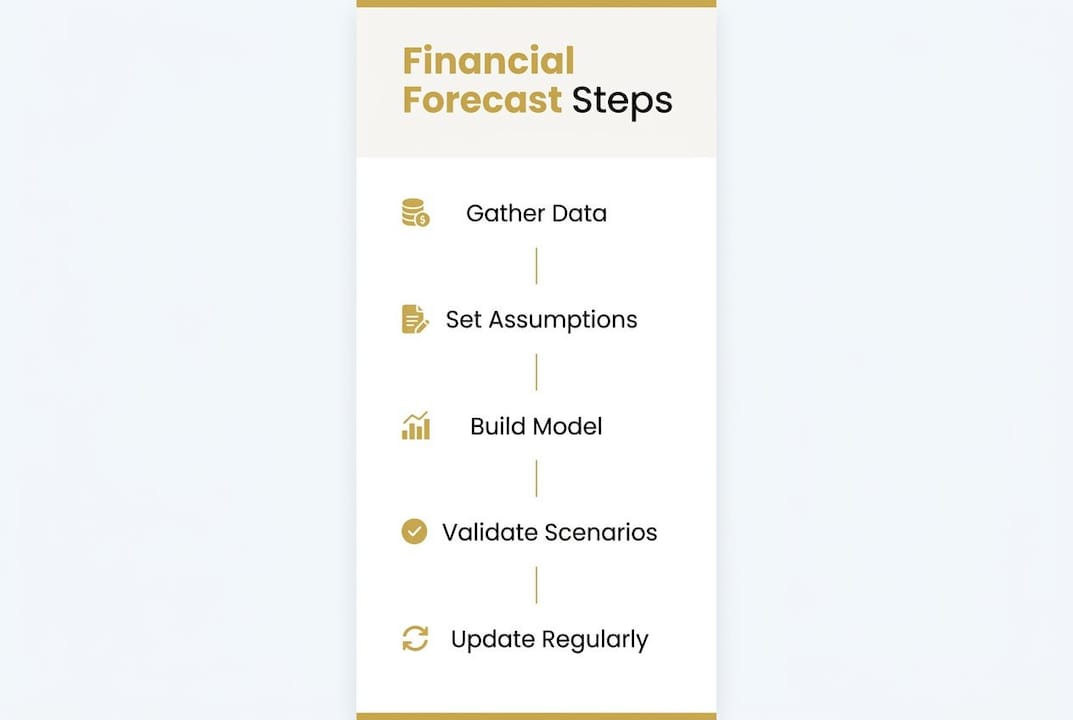
How to build a realistic financial forecast for your startup
A credible financial forecast starts with bottom-up assumptions, not top-down market share estimates. Bottom-up forecasting from granular inputs like lead generation rates, conversion percentages, average contract values, and churn rates is more defensible to investors and more useful to you operationally. Saying “we will capture 1% of a £5 billion market” tells you nothing about what you need to do next week.
Build three scenarios, not one
Every forecast should include a conservative case, a base case, and an optimistic case. The financial scenario planning process for each scenario should share the same structural logic but vary the key drivers independently. Changing just one assumption, such as your customer acquisition cost or monthly churn rate, reveals how sensitive your business model is to that variable. Investors read this sensitivity as evidence that you understand your own business.
The three scenarios serve different purposes:
- Conservative case. This is your survival plan. It shows investors you have thought about what happens when growth is slower than expected.
- Base case. This is your operating plan. It reflects your most likely outcome given current evidence.
- Optimistic case. This is your upside story. It shows what the business looks like if key bets pay off.
Anchor every assumption to a real driver
Pricing, customer acquisition cost, and churn rate are the three levers that most directly determine whether a startup model holds together. Each one should be grounded in real data, whether from your own early sales, comparable businesses, or published industry benchmarks. Unsupported assumptions are the single most common reason investors reject a model before they even reach the revenue line.
Pro Tip: Build your forecast in a spreadsheet that separates the assumptions tab from the calculations. This makes it far easier for an investor or adviser to stress-test your numbers without breaking the model.
Effective budgeting and cash flow management for startups
A budget is only useful if it reflects how money actually moves through your business. Many founders build annual budgets and review them quarterly. That cadence is too slow for an early-stage company where circumstances change monthly.
The 13-week rolling cash flow forecast
The most effective cash management tool for startups is a 13-week rolling forecast updated every week. This approach reveals cash shortages four to six weeks before they hit, giving you time to act rather than react. Monthly reviews miss this window entirely. By the time a monthly report flags a problem, you may have two weeks of runway left.
Key items to track in your weekly cash flow review:
- Receipts. Actual cash collected, not invoices raised.
- Payroll and contractor costs. The largest and most predictable outflow for most startups.
- Supplier payments. Track payment terms actively and negotiate where possible.
- Tax liabilities. VAT, PAYE, and corporation tax all have fixed deadlines that cannot be deferred without penalty.
- Discretionary spend. Software subscriptions, travel, and marketing that can be paused if cash tightens.
Budgeting for tax from day one
Financial best practices recommend allocating 25%–30% of every payment received into a dedicated tax savings account. Lean towards 30% if your business is in a higher tax bracket. This single habit prevents the most common cash crisis that hits profitable early-stage businesses: a large, unexpected tax bill that the founder assumed would be covered by future revenue.
| Budget category | Recommended allocation | Purpose |
|---|---|---|
| Operating costs | Variable by model | Salaries, rent, software, and direct costs |
| Tax reserve | 25%–30% of receipts | VAT, PAYE, and corporation tax liabilities |
| Emergency reserve | Three months of burn | Buffer against revenue shortfalls |
| Growth investment | Remainder after reserves | Marketing, hiring, and product development |
Pro Tip: Open a separate business savings account specifically for tax. Treat it as untouchable. The discipline of keeping it separate removes the temptation to use it for operational spending.
Capital raising and runway planning essentials
Runway planning is not just about knowing how many months of cash you have. It is about knowing when to start your next fundraise and how much to raise. Both questions have answers that most founders get wrong.
Industry guidance recommends raising 1.5 to 2 times your projected burn rate as a safety buffer. The logic is straightforward. Revenue almost always comes in slower than forecast. Costs almost always run higher. A buffer of this size absorbs both without forcing a distressed fundraise at a weak valuation.
On timing, the evidence is clear. Startups need at least 15–18 months of runway when they begin a Series A process. Starting with less than six months of runway puts you in a weak negotiating position and signals poor planning to investors. The fundraising process itself typically takes longer than founders expect.
Three practical steps for runway planning:
- Calculate your true monthly burn. Include all costs, not just the obvious ones. Founder salaries, software licences, and professional fees are frequently underestimated.
- Integrate non-dilutive funding. Cloud credits, Innovate UK grants, and R&D tax credits should be built into your operating model as runway extension, not treated as a bonus. This changes your spending decisions and reduces fundraising pressure.
- Set a fundraising trigger date. Decide in advance at what runway level you will begin the next raise. Twelve months of runway is a sensible trigger for most seed-stage businesses.
How to build an investor-ready financial model
An investor-ready financial model is not a polished spreadsheet. It is a document that can withstand scrutiny from a due diligence team. Investor rejection often stems from models with circular references, weak assumptions, and no scenario logic. These are technical failures that signal to investors that the founder does not understand their own numbers.
What a venture-grade model must include
The strongest models share a consistent structure. Top-performing financial models separate assumptions clearly from calculations, include fully loaded headcount costs, and integrate the cap table with potential dilution impacts. They also include all three financial statements, connected so that a change in one flows correctly through the others.
| Model component | What investors check |
|---|---|
| Revenue drivers | Are unit economics defendable and grounded in real data? |
| Cost model | Are headcount costs fully loaded, including employer NI and benefits? |
| Three statements | Do P&L, cash flow, and balance sheet reconcile correctly? |
| Scenario toggles | Can the model switch between base, upside, and downside with one input? |
| Assumptions tab | Are all inputs documented with sources and logic? |
Transparency in assumptions is not optional. Every number that an investor cannot verify independently must be explained in the model itself. If you cannot defend an assumption in a two-minute conversation, it should not be in your base case.
Pro Tip: Use the five most common modelling mistakes as a checklist before you send your model to any investor. Circular references and hardcoded numbers in formula cells are the two most common errors that kill credibility instantly.
For founders who want to go deeper on model structure, Consult EFC’s guide to investor-grade financial modelling covers the full architecture in detail.
Key takeaways
Effective financial planning for startups requires continuous forecasting, disciplined cash management, and investor-ready models built on defendable assumptions from day one.
| Point | Details |
|---|---|
| Build bottom-up forecasts | Ground every revenue assumption in real drivers like conversion rates and churn, not market share estimates. |
| Use a 13-week cash forecast | Update it weekly to spot cash shortfalls four to six weeks before they hit. |
| Reserve 25%–30% for tax | Set aside a fixed percentage of every receipt into a dedicated tax account from the start. |
| Raise 1.5x to 2x projected burn | Build a capital buffer to absorb slower revenue growth and higher-than-expected costs. |
| Separate assumptions from calculations | A clean model structure lets investors stress-test your numbers without breaking the spreadsheet. |
Why most founders get financial planning backwards
Most founders I work with arrive having built a financial model for their investor deck and nothing else. The model lives in a folder, last updated six months ago, bearing no resemblance to how the business is actually performing. That is not financial planning. That is financial theatre.
The founders who scale well treat their model as a living document. They update it when a key assumption changes. They run a scenario when they are considering a new hire. They check their 13-week cash forecast every Monday morning before they check their email. This is not obsessive. It is the minimum discipline required to run a business where the margin for error is thin.
The uncomfortable truth about reactive finance management is that by the time the problem is visible in your bank account, your options have already narrowed. Proactive planning, specifically scenario planning integrated into everyday decisions, is what keeps options open. It is also what makes you credible to investors, because it shows that you are running the business rather than being run by it.
Non-dilutive funding is another area where I see founders leave money on the table. R&D tax credits, Innovate UK grants, and cloud provider credits are not perks. They are material runway extensions that change what you can afford to build and when you need to raise again. If these are not in your operating model, your model is incomplete.
— Kishen Patel
How Consult EFC supports startup founders
Startup founders who need financial rigour without the cost of a full-time CFO have a practical alternative. Consult EFC provides fractional CFO services for startups that cover financial modelling, cash flow forecasting, and investor readiness, delivered by ICAEW Chartered Accountant Kishen Patel.
The firm builds the kind of models that pass due diligence, not just the kind that look good in a pitch deck. Whether you are preparing for a seed round, managing burn through a growth phase, or planning your first Series A, Consult EFC brings the financial discipline that most early-stage businesses lack internally. You can also explore the full financial forecast for startups guide to understand what investor-ready planning looks like in practice.
FAQ
What is financial planning for a startup business?
Financial planning for a startup business is the process of forecasting revenue, budgeting costs, and managing cash flow to support growth and secure funding. It includes maintaining a profit and loss statement, cash flow forecast, and balance sheet as continuous operational tools.
How often should a startup update its financial forecast?
A startup should update its 13-week rolling cash flow forecast weekly and review its full financial model whenever a key assumption changes, such as pricing, churn rate, or a major hiring decision.
How much capital should a startup raise in each round?
Industry guidance recommends raising 1.5 to 2 times your projected burn rate to provide a buffer for slower-than-expected revenue and higher costs. Begin the fundraising process when you have at least 12–15 months of runway remaining.
What makes a financial model investor-ready?
An investor-ready model separates assumptions from calculations, includes all three financial statements that reconcile correctly, and contains scenario toggles for base, upside, and downside cases. Circular references and unsupported assumptions are the most common reasons investors reject a model.
Do startups need a CFO for financial planning?
Early-stage startups rarely need a full-time CFO, but they do need CFO-level thinking on forecasting, capital allocation, and investor reporting. A fractional CFO provides this expertise at a fraction of the cost, which is why many UK startups use this model during their growth phase.
Recommended
- Financial forecast for startups: the 2026 founder’s guide
- Accounting for Startups 2025: Step-by-Step Guide for UK Founders to Set Up and Grow
- Prepare for a Series A: Founder’s Playbook | Consult EFC
- Business fund raising: your 2026 UK founder’s guide
Not sure where your business stands right now?
Book a free 30-minute call with Kish. Bring your numbers, your questions, or just your situation. You will leave with a clearer picture than you arrived with.
Book a Free Strategy Call
Over 12 years across Big Four audit, Investment Banking, and corporate advisory. Kish works with SaaS founders, tech companies, and ambitious UK SMEs from £1M to £50M in revenue on fundraising, valuations, exit planning, and financial strategy. ICAEW regulated. Big Four trained. Based in London.