

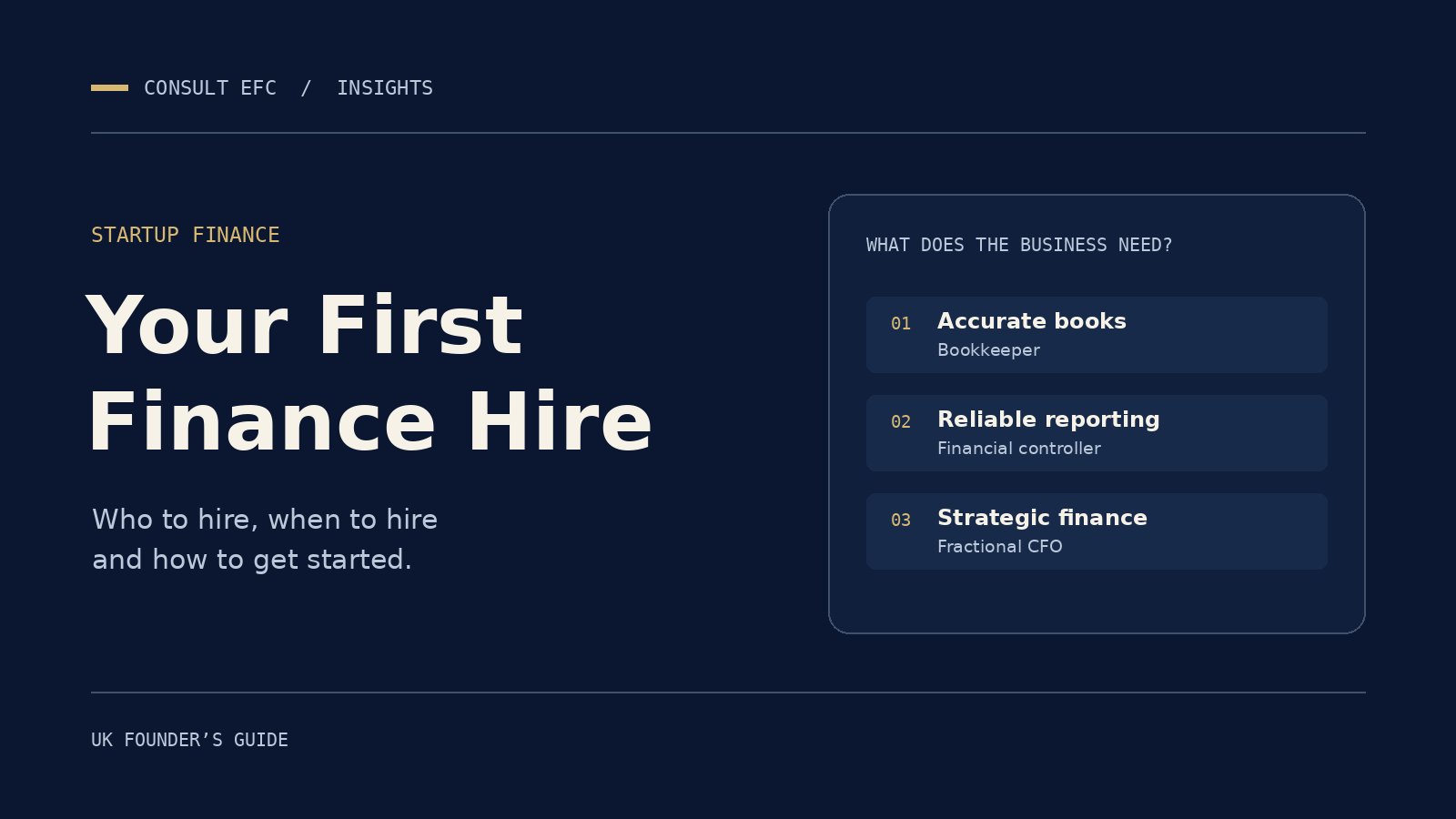
Your first finance hire should match your biggest bottleneck. If the pain is month-end, VAT and payroll, hire or outsource operational control. If it is the model, the board pack and the next raise, you need a Head of Finance or a fractional CFO. Most UK startups between seed and Series A are better served by a senior part-time leader than a full-time salary they cannot yet fill with work. This guide covers when to hire, which level to choose, what it costs, and how to brief and onboard the person.
TL;DR
- Hire when several signals appear together: a raise on the horizon, slow answers on margin, and compliance eating founder time.
- Pick the level by the bottleneck: controller for operations, Head of Finance for model and forecast, CFO for capital structure and investors.
- A full-time Head of Finance at a seed-stage London startup typically starts from £65,000, nearer £80,000 with a raise behind them.
- Below roughly 40 staff and £5m revenue, a fractional CFO is often the better first step.
- Define the role around the next 12 months, then review it as the company changes.
Table of Contents
- When is the right time to make your first finance hire?
- Which level should the first hire be?
- What should your first finance hire actually do?
- How a first finance hire prepares you to raise, grow or sell
- What does a first finance hire cost in the UK?
- Full-time hire, fractional CFO or outsourced support?
- Our perspective
- How to recruit and onboard the hire
- Where Consult EFC fits
- FAQ
- Sources
When is the right time to make your first finance hire?
There is no single revenue number. Suma’s guide for founders says the hire makes sense when more than one signal applies: a Series A expected within nine months, difficulty answering margin questions quickly, compliance consuming founder time, or inventory complexity.
In practice, founders recognise the moment by symptoms rather than headcount:
- You cannot say, without a day’s work, how many months of cash you have under three scenarios.
- Investors or a prospective lender ask for a model and you hand over a spreadsheet only you understand.
- You are the person approving payroll, chasing VAT queries and reconciling Stripe or bank feeds on a Sunday.
- Hiring decisions are made on instinct because nobody has linked headcount to runway.
- Your numbers differ depending on which tool you open.
One of these is normal in a young company. Three of them together mean the cost of waiting is higher than the cost of hiring.
It is also worth separating finance support from a finance hire. Stripe’s guide to building a startup finance team notes that startups can outsource finance from day one, and that outsourced bookkeeping plus FP&A support can be enough early on. One of its contributors even argues for an outsourced partner as soon as the incorporation documents are signed, so the bank accounts and systems are set up properly from the start. The first hire is a different decision: someone who owns finance inside your leadership team.
Which level should the first hire be?
Founders often say “we need a CFO” when they need something narrower. Suma’s guide draws a useful line between three roles:
| Role | What they own | Best when |
|---|---|---|
| Financial Controller | Month-end close, VAT, payroll, audit | Books are messy and compliance is the bottleneck |
| Head of Finance or Finance Director | The model, the forecast, the board pack, compliance | You are heading to a raise and need management insight |
| CFO | Capital structure, investor relations, M&A | You are running multiple rounds or a transaction |
The same guide describes this split and argues that the first hire should match the bottleneck: operational control, management insight or strategic capital leadership. For many seed-stage companies a Head of Finance is the right first full-time role, because they can cover controller work until you can afford both.
Founders Factory adds a practical lens. It says the decision turns on whether you need operational accounting and control or a strategic thought partner, and suggests weighing gaps in the leadership team, fundraising timing, international expansion and new revenue lines. It also stresses finding someone who is comfortable with startup uncertainty, because the job will change every six months.
The common mistake: hiring for the company you hope to be
A full-time CFO at the very early stage is often overkill, as the Stripe guide puts it. A CFO who has run an IPO process will be frustrated reconciling payment processors, and you will be paying for capability you cannot use for two years. Hire for the next 12 months of real work, not the ambitious slide in your pitch deck.
What should your first finance hire actually do?
Write the role as outcomes, not a list of tasks. The research points to a consistent picture.
Suma says that in year one the hire should own the financial model and scenarios, cash and runway tracking, the board pack, VAT, R&D claims and payroll, and prepare a clean data room for the next raise.
Mercury’s guide says the first finance hire should establish controls, organise the books, create audience-specific reporting and move the company towards bottom-up planning and unit-economics analysis. “Audience-specific” matters: your board wants a different view from your investors, your lender and your team leads.
Translated into a UK startup context, a sensible first-year scope looks like this:
- Foundations. Chart of accounts, month-end close routine, approvals, expense and payroll controls.
- Cash. A weekly cash review and a rolling 13-week forecast, tied to a runway figure the whole leadership team uses.
- Model. A bottom-up operating model driven by real inputs: pipeline, pricing, hiring plan, marketing spend, not a top-down percentage.
- Reporting. A monthly management pack and a quarterly board pack with the same definitions each time.
- Compliance. VAT, payroll, and any R&D tax relief claims handled on time with clean support.
- Investor readiness. A tidy data room, a cap table that reconciles, and answers ready for diligence questions.
For subscription businesses, add revenue recognition, MRR and churn definitions, and cohort reporting to that list. These are the numbers investors test first, and a messy definition of churn can cost you credibility in the first meeting.
How a first finance hire prepares you to raise, grow or sell
Mercury describes the first finance leader as creating leverage by connecting accounting, operating metrics, hiring and investment decisions in one forward-looking model. Another of its guides recommends the first full-time finance lead begin with a health teardown covering acquisition, unit economics and runway, then build an integrated forecast from growth metrics, historical financials, hiring plans and marketing budgets.
That teardown is worth copying whoever you hire. It forces three honest questions:
- What does it cost to acquire a customer, and how long until that cost is repaid?
- Which customers or products actually make money after delivery costs?
- How many months of runway do we have if growth is slower than planned?
The same groundwork serves three later events. In a fundraise, investors ask for the model, historic management accounts and KPIs, and consistency across all three builds trust. In a debt raise, lenders look at cash visibility and covenants. In a sale, a buyer’s financial due diligence tests whether your reported profit holds up. Companies that built a clean finance function early usually find those processes shorter and less distracting for the founders. If you are weighing the routes, our guide to debt versus equity funding sets out how each looks to the other side of the table.
What does a first finance hire cost in the UK?
Salary data for startup finance roles varies by city, sector and stage, so treat figures as a starting point. Suma says a full-time Head of Finance at a seed-stage London consumer startup will usually start from £65,000, and expect to pay closer to £80,000 for someone who has already completed a funding round. It also notes that equity depends on how early the person joins and how much responsibility they take on, and that a below-market salary for someone building the function from scratch should be balanced in the overall package.
Salary is only part of the cost. Budget for:
- Employer National Insurance and pension contributions on top of salary.
- Recruitment fees if you use an agency.
- Software the hire will want: accounting, expenses, planning and reporting tools.
- Equity dilution, which is permanent in a way salary is not.
- Management time, since a senior hire still needs a clear brief and a regular rhythm with you.
The point is not that the hire is too expensive. It is that the full-time route commits you to the whole package before you know whether you have a full week of senior work.
Full-time hire, fractional CFO or outsourced support?
This is the real decision for most seed to Series A companies. The three options solve different problems.
| Option | Strength | Typical fit |
|---|---|---|
| Outsourced bookkeeping and accounts | Accurate records, filings on time | Pre-seed and seed, simple operations |
| Fractional CFO | Senior judgement, model, board and investor work at a share of the cost | Between seed and Series A |
| Full-time Head of Finance or CFO | Daily presence, team building, deep operational ownership | When there is enough scope for a full week, every week |
Stripe’s guide suggests a fractional CFO may suit companies between seed and Series A. HSBC Innovation Banking goes further for UK companies: it says those with fewer than 40 employees and below £5m revenue should consider whether a fractional CFO is more appropriate than a full-time finance leader. It adds that an experienced fractional leader can repair processes and lay groundwork for a later full-time CFO while limiting early salary and equity commitment.
That last point is the one founders underrate. A fractional CFO is not a lesser version of a full-time CFO. It is a way to buy exactly the senior work you need now, and to hand over a working finance function to the permanent hire when the time comes. If you want to see how the model works in the UK, read our explainer on what a fractional CFO is, or our guide to when to hire a fractional CFO.
A simple decision rule
- Your books are late or wrong: fix operations first, with a controller or outsourced accountant.
- Your books are fine, but you cannot answer investor questions: bring in a fractional CFO or Head of Finance.
- You have a team, several entities, or constant transaction work: a full-time hire starts to pay for itself.
Our perspective
We meet founders at the point where the finance function has quietly become the constraint. The books are usually reasonable. What is missing is someone senior who owns the numbers: the model, the cash view, the story an investor or buyer will test.
Our view is that the first finance hire does not have to be a full-time employee. A fractional CFO gives you ICAEW Chartered Accountant-led judgement, Big Four consultancy standards and investment banking rigour, applied to your business for the days you need. That is how a seed or Series A company gets investor-ready metrics without carrying a senior salary before the workload justifies it.
The best engagements start with a plain brief: what decision are you trying to make in the next 12 months? Raise, stabilise MRR and churn, prepare for a sale in one to three years? We build the finance function around that answer and leave you with systems your next hire can inherit.
Kishen Patel
How to recruit and onboard the hire
Founders Factory recommends a clear sequence: define the finance function against the plan for the next 12 months, validate the seniority against the market, recruit through networks and agencies, and onboard flexibly as needs change. It specifically suggests scoping the role around the next 12 months rather than two years, then testing the job description against real candidates and platforms.

Interview for fit as well as CV
HSBC Innovation Banking advises testing relevant experience, appetite for the long haul, candour about the scope of the role and cultural fit with the leadership team. Useful questions in practice:
- Tell me about the messiest set of books you inherited and what you did in the first month.
- Which metrics did you put in front of the board, and which did you stop reporting?
- What have you handled personally, not supervised: VAT, payroll, R&D claims?
- How do you explain a miss in the forecast to a non-finance founder?
Look for ICAEW or equivalent chartered qualifications if your investors will expect them, but weigh startup experience as heavily. The person who thrives is willing to do the small stuff and the strategic work in the same week.
The first 90 days
Mercury’s guide lays out what the opening quarter should include: reviewing accounting systems and outsourced providers, mapping revenue and billing, identifying revenue-recognition issues, building a bottom-up operating model, and establishing a weekly cash review, monthly close and quarterly board reporting.
A workable shape:
- Days 1 to 30: audit systems and providers, map how money enters and leaves, agree KPI definitions with you.
- Days 31 to 60: stabilise the monthly close, build the first version of the operating model, set the cash review rhythm.
- Days 61 to 90: deliver the first full board pack, a scenario set for runway, and a list of diligence gaps to close before any raise.
Agree the 90-day deliverables in writing. It protects you both and makes the hire’s first review a conversation about evidence, not impressions.
Where Consult EFC fits
If you are raising soon, or the finance function has outgrown you but a full-time salary is premature, our fractional CFO services are designed for that gap. We work with high-growth SaaS companies and UK SMEs on financial leadership, reporting, fundraising and exit preparation, led by ICAEW Chartered Accountant Kishen Patel.
Typical starting points are investor-grade financial modelling, FP&A to put forecasting and reporting on a regular rhythm, and, for SaaS founders, our SaaS fractional CFO work on MRR, churn and Series A readiness. If a sale is in your one to three year plan, our exit planning work begins with the same clean numbers. To discuss your situation, start at consultefc.com.
FAQ
Should my first finance hire be a CFO?
Usually not. A CFO focuses on capital structure, investor relations and M&A, which most seed-stage companies cannot yet use full time. A Head of Finance or a fractional CFO normally covers the model, forecast and board pack at a lower commitment.
Can I wait until after my Series A to hire someone?
You can, but it is risky. Investors will test your numbers during the raise, and fixing the books and model while you are fundraising is hard. Suma’s signal of a Series A expected within nine months is a sensible trigger to start looking, or to bring in fractional support.
Is a fractional CFO cheaper than a full-time hire?
It costs less in the early stage because you pay for the days of senior time you need, with no equity package or employment overheads. As your workload grows to a full week, a full-time hire may become the better value, and a fractional CFO can help you make that transition.
What is the difference between a bookkeeper and a first finance hire?
A bookkeeper or accountant records and files: transactions, VAT, accounts. A first finance hire interprets and plans: cash runway, unit economics, the operating model and investor reporting. Most startups need both, in that order.
Sources
- When does a startup need its first finance hire? A founder’s guide, Suma
- Making the first finance hire for your startup, Mercury
- How to build a strong financial foundation as a startup’s first finance hire, Mercury
- Building out your finance team, Founders Factory
- Hiring your first CFO, HSBC Innovation Banking
- Building your startup’s finance team, Stripe
Recommended
- Startup Fractional CFO: 4 Signs You Need One
- Fractional CFO: Your First 30-Day Roadmap
- Financial planning for startups: the 2026 founder’s guide
This article is for general information only and is not professional advice.
Not sure where your business stands right now?
Book a free 30-minute call with Kish. Bring your numbers, your questions, or just your situation. You will leave with a clearer picture than you arrived with.
Book a Free Strategy Call
Over 12 years across Big Four audit, Investment Banking, and corporate advisory. Kish works with SaaS founders, tech companies, and ambitious UK SMEs from £1M to £50M in revenue on fundraising, valuations, exit planning, and financial strategy. ICAEW regulated. Big Four trained. Based in London.