

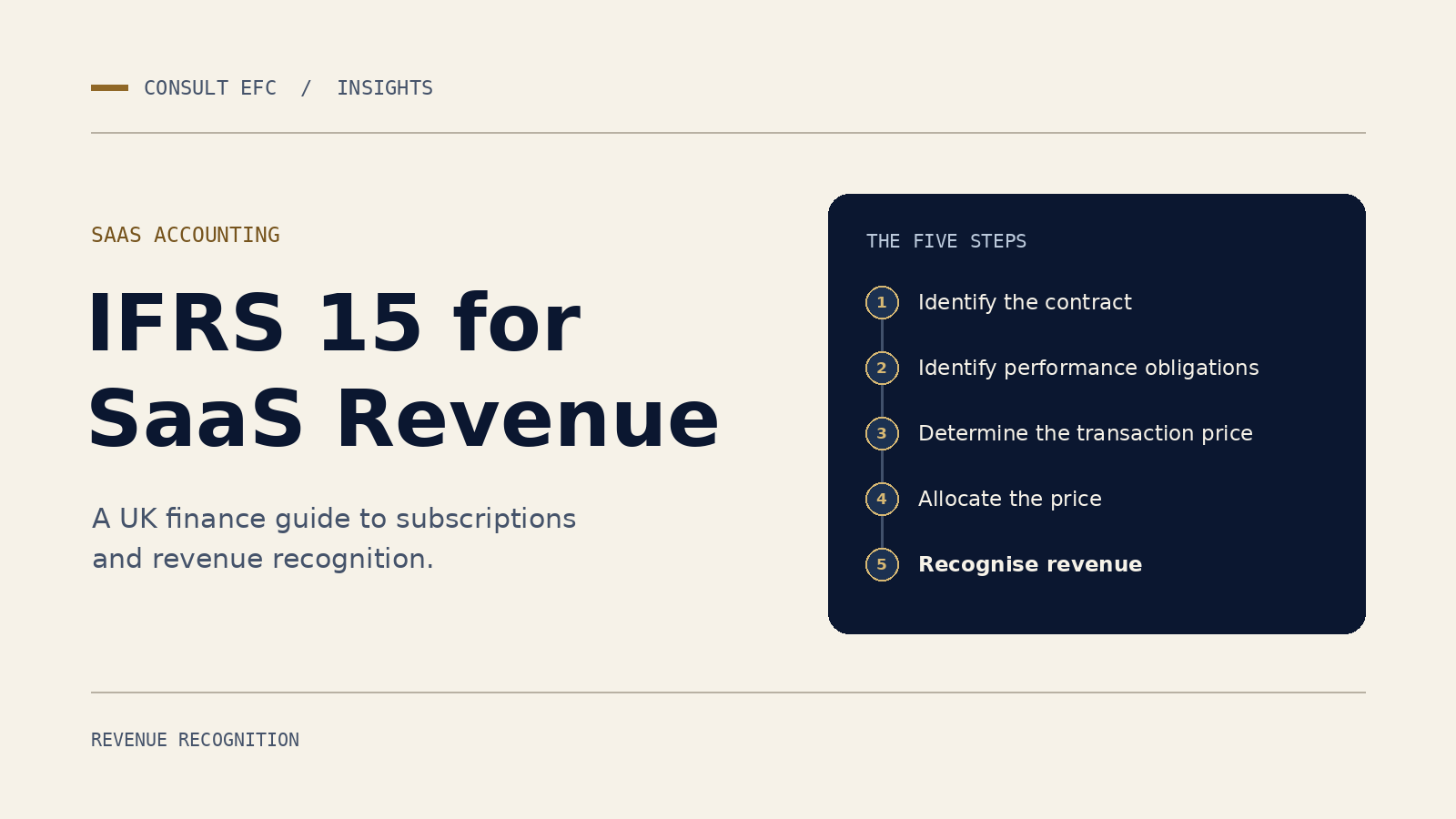
Under IFRS 15, a SaaS business recognises subscription revenue as it delivers the service, not when it invoices or collects cash. In most cases that means spreading each subscription evenly across the contract term. The judgement sits in the details: setup fees, discounts, usage charges, upgrades and renewals. This guide takes you through each one in the order a UK finance team meets them.
TL;DR
- IFRS 15 asks you to apply a five-step model: identify the contract, identify the performance obligations, set the transaction price, allocate it, then recognise revenue as each obligation is satisfied.
- Standard SaaS access is delivered continuously, so revenue is normally recognised over time. A £12,000 annual invoice becomes £1,000 of revenue a month, with the rest held as deferred revenue.
- Setup and onboarding fees depend on one question: is the work a distinct service, or just a step towards giving the customer access?
- MRR and ARR are management metrics. Revenue under IFRS 15 is what you have delivered in the period. The two will differ, and investors will ask you to reconcile them.
- Keep contract-level records and a written note of your judgements. Both your auditor and a buyer’s diligence team will want them.
Table of Contents
- What IFRS 15 asks of a SaaS company
- The five-step model applied to a subscription
- Annual and upfront subscriptions: a worked example
- Setup, onboarding and implementation fees
- Discounts, usage charges and variable consideration
- Upgrades, downgrades and renewals
- MRR, ARR, billings and revenue: how they relate
- Disclosures and records that support your numbers
- Common mistakes we see in SaaS revenue policies
- Our perspective
- Getting revenue recognition investor-ready
- FAQ
- Sources
What IFRS 15 asks of a SaaS company
The core principle is that you recognise revenue to show the transfer of promised goods or services to the customer, in an amount that reflects what you expect to be paid for them. The wording is in the UK-published text of the standard, which covers the nature, amount, timing and uncertainty of revenue and cash flows.
For a SaaS business, this has one big consequence. Billing is not the trigger. Delivery is. You can invoice a customer for three years on day one, but you have only earned the part of that fee that matches the service you have provided so far.
Which framework applies to you depends on how your company reports. Some UK companies use UK-adopted IFRS, others use UK GAAP. Confirm yours with your accountant before you design any policy. The IFRS 15 logic below is also a useful reference for management reporting, because investors and acquirers tend to think in these terms.
The five-step model applied to a subscription
The five steps work like this for a typical SaaS contract.
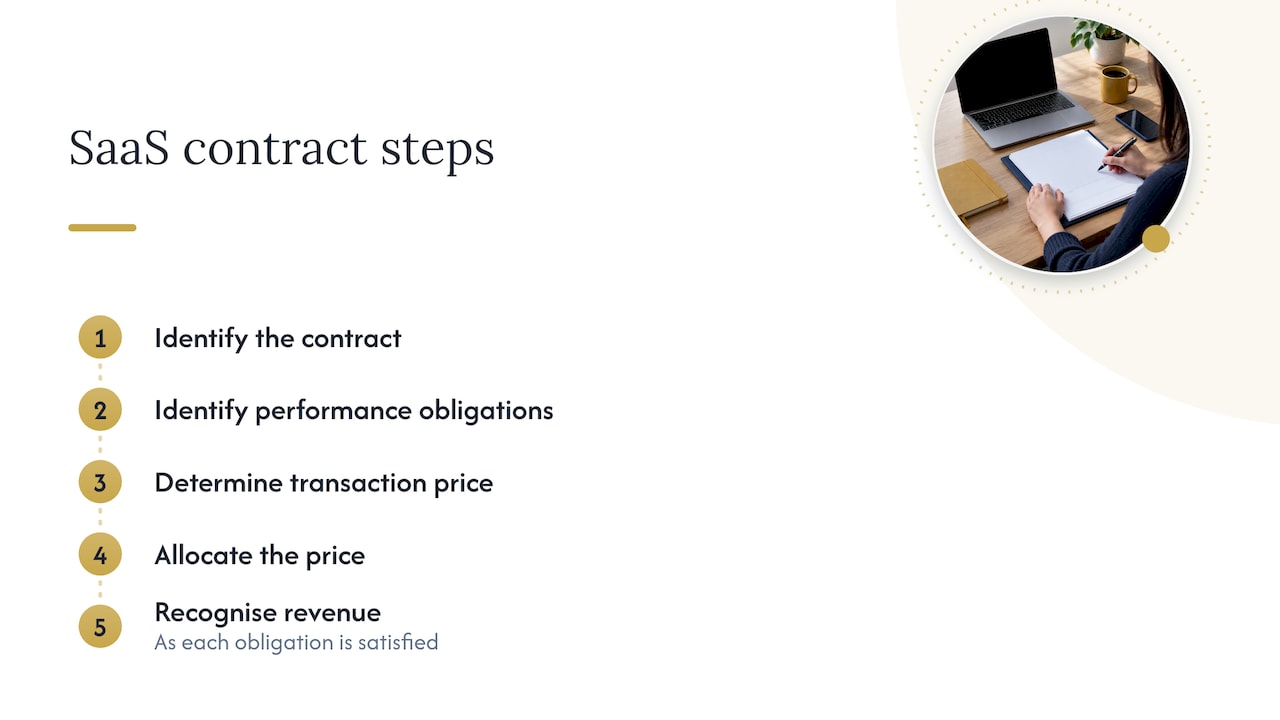
Step 1: identify the contract
A contract exists when the parties have approved it and are committed to perform. Each party’s rights and the payment terms must be identifiable. The contract must have commercial substance, and it must be probable that you will collect the consideration. Contracts can be written, oral or implied by customary business practice, according to the standard itself.
In practice, that matters for the following situations:
- Order forms accepted by click-through rather than signature.
- Pilots that convert to paid plans without new paperwork.
- Customers with a real chance of non-payment, where the collectability test may not be met.
Step 2: identify the performance obligations
List what you have promised. A SaaS contract might include platform access, support, hosting, onboarding, training, API credits and a data migration. Each promise that is distinct becomes its own performance obligation. Promises that are not distinct are bundled.
The standard is explicit that routine administrative setup activities are not a performance obligation unless they transfer a good or service to the customer. That point decides most of the setup-fee debates covered below.
Step 3: determine the transaction price
This is the amount you expect to be entitled to. It can include fixed fees and variable elements such as usage charges, volume discounts, credits and refunds. We cover those further down.
Step 4: allocate the price
If you have more than one performance obligation, you split the price between them using relative standalone selling prices. Where you sell an item on its own, that price is the best evidence. Where you do not, you estimate it, and you need to be able to explain how.
Step 5: recognise revenue as you satisfy each obligation
For platform access, that is over time. The standard says revenue is recognised over time when the customer simultaneously receives and consumes the benefit as you perform. A customer using your software each day is the textbook example.
Annual and upfront subscriptions: a worked example
Take a UK SaaS company that signs a customer to a 12-month plan at £12,000, invoiced and paid in full on 1 January. This is an illustration, not a client case.
| Month | Cash received | Revenue recognised | Deferred revenue at month end |
|---|---|---|---|
| January | £12,000 | £1,000 | £11,000 |
| February | £0 | £1,000 | £10,000 |
| June | £0 | £1,000 | £6,000 |
| December | £0 | £1,000 | £0 |
The cash arrives in month one, but revenue is £1,000 a month. The unearned portion sits on the balance sheet as a contract liability, usually shown as deferred revenue, and is released as the service is delivered.
Two practical points follow:
- Start date matters. If the service starts on 15 January, you recognise a part month. Many finance teams use daily recognition to avoid arguments over rounding.
- Straight-line is a result, not a rule. It works because the service is a series of substantially similar daily or monthly services. If delivery is uneven, for example a fixed number of licences activated in stages, the pattern should follow the delivery.
Monthly billing is simpler. You invoice £1,000 and recognise £1,000, so revenue and billing line up. The complexity comes from annual or multi-year prepayments, free months and ramped pricing.
Setup, onboarding and implementation fees
This is where SaaS revenue policies most often go wrong. The question to ask is whether the setup work gives the customer something of value on its own, or whether it only prepares the account so they can use the subscription.
When the fee is combined with the subscription
If onboarding is mandatory and customers cannot use the software without it, and the customer cannot benefit from it separately, it is generally not distinct. The fee is then added to the subscription and recognised over the service period.
Illustration: a £12,000 annual subscription plus a £3,000 mandatory configuration fee. If the configuration is not distinct, the total of £15,000 is recognised at £1,250 a month for 12 months. Taking the £3,000 up front would bring revenue forward and could overstate the first quarter.
When the fee is a separate performance obligation
Training delivered by your team, a data migration a third party could also perform, or a bespoke integration the customer owns can be distinct. You allocate part of the price to that service and recognise it when it is delivered. The subscription is still recognised over the term.
To make the call, ask:
- Could the customer buy this service from someone else and still use your platform?
- Do you sell it separately, at a visible price?
- Does it significantly modify or customise the software, or is it standard configuration?
- Is it a one-time deliverable the customer keeps, or part of getting the account live?
Write down the answers. A one-paragraph policy memo per fee type is enough, and it is the first thing a reviewer will ask for.
Discounts, usage charges and variable consideration
The transaction price is not always a single fixed figure. It can include variable amounts, and IFRS 15 asks you to include them only to the extent that a significant reversal is highly improbable once the uncertainty is resolved.
Common SaaS examples:
- Usage-based fees. If the customer pays per API call or per seat above a threshold, the variable portion is often recognised as the usage occurs, provided it relates to that period’s service. Check how the pricing is structured before assuming.
- Volume discounts and rebates. Estimate the likely discount and reflect it from the start instead of booking full price and reversing later.
- Service credits and refunds. If your SLA offers credits for downtime, consider the likelihood of paying them and whether that makes part of the price variable.
- Free months or ramped pricing. A contract with two free months and ten paid months is still, in substance, a 12-month service. The total price is normally spread across the term rather than recognised only in the paid months.
Financing is another trap in multi-year deals. If a customer pays several years in advance, or you let them pay much later, the contract may contain a significant financing component. The standard lists this as part of transaction price measurement, so test it on large prepayments.
Upgrades, downgrades and renewals
A contract modification is an approved change in scope or price. The accounting turns on two questions: are the added services distinct, and are they priced at their standalone selling price?
- Added distinct services at standalone price. Treat the change as a separate contract. The original deal carries on untouched.
- Added services not at standalone price, remaining services distinct. Treat it as ending the old contract and starting a new one. The remaining price is reallocated and recognised going forward.
- Remaining services not distinct. Adjust cumulatively, which is rarer in SaaS.
A typical case is a blend-and-extend. A customer with eight months left on a £12,000 plan signs a new three-year deal at a lower monthly rate. The new rate is not the standalone price, so you generally look at the combined remaining consideration and spread it over the new remaining term. You should document that treatment rather than leave it to the billing system’s default.
Simple renewals at the same price are new contracts from the renewal date. The sales-commission side needs attention too: certain costs of obtaining a contract can be capitalised and amortised, and the disclosure requirements cover contract-cost assets.
MRR, ARR, billings and revenue: how they relate
Founders often treat these as interchangeable. They are not.
| Measure | What it tells you | Where it comes from |
|---|---|---|
| MRR | Monthly recurring subscription value at a point in time | Management reporting |
| ARR | MRR annualised | Management reporting |
| Billings | What you invoiced in the period | Sales ledger |
| Cash receipts | What customers paid | Bank |
| Revenue | The service delivered in the period | IFRS 15 accounting |
| Deferred revenue | Cash or invoices ahead of delivery | Balance sheet |
A business that signs a lot of annual-upfront deals in December will show strong billings and cash, but revenue only builds gradually. The reverse happens when growth slows: revenue keeps flowing from earlier prepayments while billings fall away. Revenue lags the underlying commercial position, which is one reason investors read billings and deferred revenue movements alongside the income statement.
A reconciliation from ARR to recognised revenue is one of the most useful schedules you can build. Start with opening ARR, add new and expansion, subtract churn and contraction, then bridge to the revenue in the accounts, with deferred revenue as the connector. Our guide to investor-ready SaaS metrics shows how founders present these figures, and the revenue engine section of our model guide explains how MRR and ARR feed a bottom-up forecast.
Disclosures and records that support your numbers
IFRS 15 requires you to disclose the nature, amount, timing and uncertainty of revenue and cash flows. That covers information on contracts, significant judgements and contract-cost assets. Revenue must also be split into categories showing how economic factors affect it. For SaaS, sensible splits are:
- Subscription versus professional services.
- Geography.
- Customer segment, such as SME versus enterprise.
- Contract length, such as monthly versus annual.
The Norwegian financial regulator’s review of IFRS 15 disclosures is a useful guide to what scrutiny looks like. It stresses that contract-balance disclosures should explain the movements and why payment timing differs from performance timing. A bare table of opening and closing deferred revenue is not enough.
A practical record set:
- A contract register with start and end dates, price, billing terms and any non-standard clauses.
- A revenue schedule that ties to the ledger each month.
- A deferred revenue roll-forward: opening balance, billings, revenue released, closing balance.
- A policy memo for each judgement: setup fees, SSP estimates, modifications, usage pricing.
- A log of manual adjustments, with who approved them and why.
If you are heading for funding or a sale, this pack does double duty. Diligence teams routinely test revenue first, and our guide to revenue recognition for UK startups covers the traps that surface there.
Common mistakes we see in SaaS revenue policies
- Recognising annual invoices in the month of billing. It flatters revenue and leaves a restatement waiting.
- Treating all setup fees as immediate revenue. Test distinctness first.
- Ignoring contract changes. Upgrades handled only in the billing tool often miss the accounting consequence.
- Using ARR as a proxy for revenue in the model. The two need an explicit bridge.
- Spreadsheets with no controls. A formula overwritten once can undo months of work. This is where automation and a tidy close process pay back.
Our perspective
Most SaaS founders we meet do not have a revenue recognition problem. They have a translation problem. The sales team talks in ARR, the investor talks in net revenue retention, and the accounts show something different again.
Our view is that IFRS 15 should be treated as part of the commercial story, not a year-end exercise. A clear policy, a deferred revenue roll-forward and an ARR-to-revenue bridge let you walk into an investor meeting or a buyer’s data room and answer the revenue questions before they are asked.
This is the kind of work a fractional CFO is designed for. You get senior, ICAEW-qualified judgement on the policy calls, the rigour of a large-firm approach to the schedules, and none of the cost of a permanent hire. We would rather help you set the policy early than rebuild it under diligence pressure.
Kishen Patel
Getting revenue recognition investor-ready
If you are preparing for a raise or a sale, we can help turn your revenue policy into numbers that stand up. Our fractional CFO service covers policy decisions, month-end discipline and board reporting, and our FP&A team builds the schedules that tie MRR, billings and revenue together.
Where the numbers feed a forecast, our investor-grade financial modelling links the revenue engine to cash flow and runway. If a transaction is on the horizon, our due diligence preparation work tests your revenue pack before a buyer does. You can see the full range on the Consult EFC site.
FAQ
Is SaaS revenue recognised over time or at a point in time?
For standard subscription access it is recognised over time. The customer receives and uses the benefit as you provide it, which meets the over-time criterion in IFRS 15. Separate distinct deliverables, such as a one-off training session, may be recognised when delivered.
How do I treat an annual subscription paid upfront?
Record the cash and a matching deferred revenue liability, then release it to revenue evenly over the term. A £12,000 annual plan gives £1,000 of revenue a month. Adjust for part months if the start date is mid-month.
Are setup fees recognised immediately?
Only if the setup is a distinct service that the customer can benefit from separately. Routine administrative setup is not a performance obligation by itself. If the work is integral to getting the platform running, the fee is combined with the subscription and recognised over the service period.
Is ARR the same as revenue?
No. ARR is an annualised management metric of recurring subscription value. Revenue is the amount earned for service delivered in the period. Deferred revenue, discounts, usage charges and timing of start dates all create differences, so build a reconciliation.
Sources
- IFRS 15 Revenue from Contracts with Customers (IFRS Foundation)
- IFRS 15 Revenue from contracts with customers (GOV.UK)
- IFRS 15 disclosures and presentation in annual financial statements (Finanstilsynet)
Recommended
- SaaS Financial Due Diligence in the UK: The Ultimate Guide
- Revenue Recognition for UK Startups, Traps Guide 2025
- SaaS Valuation 2026, UK Guide to ARR Multiples
- How to Prepare a SaaS Business for Sale in the UK (2026 Guide)
This article is for general information only and is not professional advice.
Not sure where your business stands right now?
Book a free 30-minute call with Kish. Bring your numbers, your questions, or just your situation. You will leave with a clearer picture than you arrived with.
Book a Free Strategy Call
Over 12 years across Big Four audit, Investment Banking, and corporate advisory. Kish works with SaaS founders, tech companies, and ambitious UK SMEs from £1M to £50M in revenue on fundraising, valuations, exit planning, and financial strategy. ICAEW regulated. Big Four trained. Based in London.