

An independent company valuation is a formal, impartial assessment of a business’s worth conducted by a credentialed appraiser who holds no financial stake in the outcome. The process produces a defensible value range grounded in recognised methods and governed by HMRC Valuation Standards, ICAEW Standards, and International Valuation Standards (IVS). For UK business owners preparing for a sale, shareholder dispute, funding round, or tax event, this type of third-party company appraisal is not optional. It is the difference between a figure that holds up under scrutiny and one that does not.
What is an independent company valuation and why is it necessary?
An independent company valuation is defined by one structural requirement: the appraiser must have no financial interest in the result. That means fees must be fixed or hourly, never contingent on the value concluded. The moment a valuer’s pay depends on the outcome, independence is invalidated and the report loses credibility with courts, HMRC, and investors alike.
The scenarios that legally require this level of impartiality are specific. They include estate and gift tax filings, divorce proceedings, shareholder buyouts, employee share ownership plans (ESOPs), and commercial litigation. Each of these contexts involves a counterparty, a regulator, or a court that will scrutinise the figure. A credible, independent report is the only document that survives that scrutiny.
Broker opinions and owner estimates are not independent valuations. Broker opinions tend to be optimistic because brokers benefit from a higher listing price. Owner estimates skew high for obvious reasons. Buyer offers skew low. None of these carry weight in a legal or tax context. Only a report prepared by a credentialed, disinterested appraiser qualifies as a genuine third-party company appraisal.
Pro Tip: If you are unsure whether a valuation you have received qualifies as independent, check the fee structure first. Contingency fees disqualify a report immediately under ICAEW Standards.
What are the recognised methods of independent company valuation?
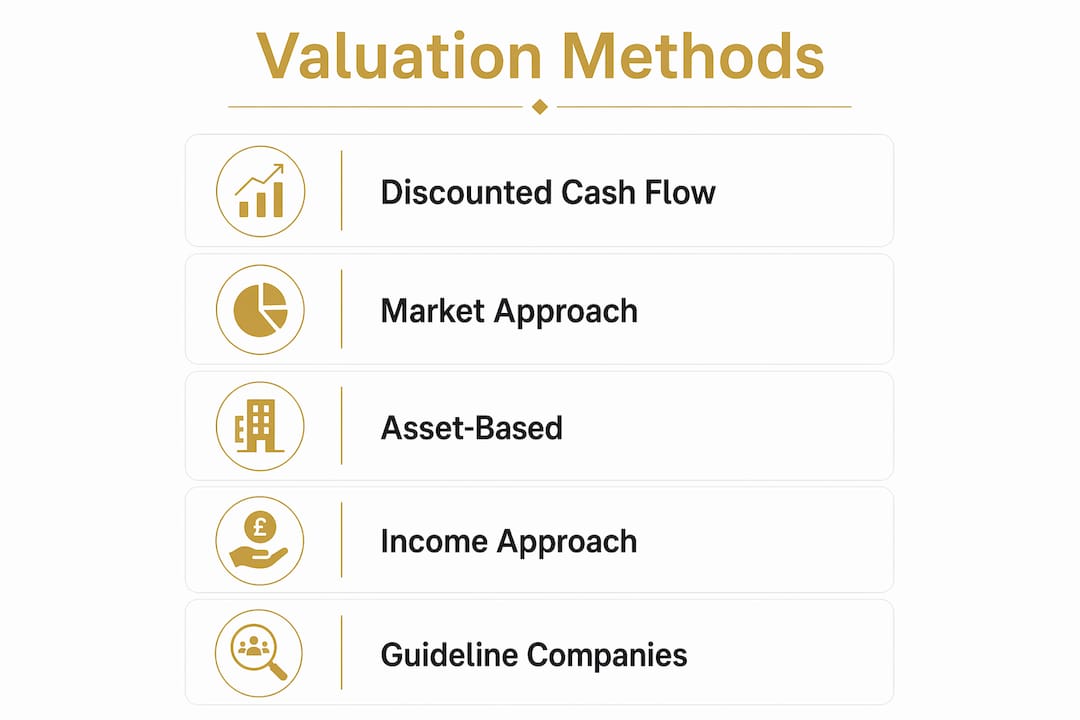
Three main approaches govern independent valuation methods under both ICAEW Standards and International Valuation Standards: the income approach, the market approach, and the asset approach. Standards require valuers to consider all three approaches and reconcile any divergence in the results. Selecting only one method without justification is a common deficiency that weakens a report’s defensibility.
Each approach contains specific methods suited to different business types and financial conditions.

| Method | Approach | Data required | Best suited for |
|---|---|---|---|
| Discounted cash flow (DCF) | Income | Projected cash flows, discount rate | Growth businesses with predictable revenue |
| Capitalisation of earnings | Income | Normalised earnings, cap rate | Stable, mature businesses |
| Guideline public company | Market | Comparable listed company multiples | Businesses with public market comparables |
| Guideline transaction | Market | Comparable M&A deal data | Businesses approaching a sale |
| Net asset value | Asset | Balance sheet, fair market asset values | Asset-heavy or holding companies |
| Liquidation value | Asset | Forced-sale asset realisations | Distressed or winding-down businesses |
The discounted cash flow method is the most analytically demanding. It requires detailed revenue projections and a defensible discount rate, typically derived from the weighted average cost of capital. The capitalisation of earnings method suits businesses with stable, recurring profits where a single normalised earnings figure can be divided by a capitalisation rate to produce a value.
Market-based methods depend on the availability of comparable data. The guideline public company method uses trading multiples from listed peers. The guideline transaction method draws on completed M&A deals in the same sector. Both require careful adjustment for size, liquidity, and control premiums.
A valuation report for businesses prepared under IVS or ICAEW Standards must include methodology explanations, key assumptions, and a reconciled value conclusion. That reconciliation is what makes the report defensible.
Pro Tip: Ask any prospective valuer which methods they intend to apply and why. A credible appraiser will explain the rationale before they begin, not after.
How much does an independent company valuation typically cost?
Cost depends primarily on scope and complexity. Calculation engagements, which apply agreed methods without full independence procedures, cost approximately £1,200–£6,500 for most UK SMEs. Full independent valuations, which include comprehensive analysis and a defensible written report, typically range from £4,000 to £12,000 or more.
Litigation and expert witness engagements sit in a different category entirely. When a valuer must provide depositions or appear as an expert witness, fees rise substantially due to the additional time required for testimony preparation and court attendance. All-in costs for contested matters can exceed these standard ranges by a significant margin.
Several factors drive the final fee upward:
- Business size and revenue. Larger businesses require more data analysis and a wider range of comparables.
- Industry sector. Regulated industries such as financial services or healthcare require specialist knowledge and additional research.
- Number of legal entities. Group structures with multiple subsidiaries require separate analysis at each level.
- Data quality. Poorly maintained management accounts increase the time needed to normalise financials before analysis begins.
- Urgency. Compressed timelines for litigation or a pending transaction typically attract a premium.
Fee structures must always be fixed or hourly to preserve independence. A valuer who proposes a fee tied to the concluded value cannot produce an independent report, regardless of their credentials.
How can business owners use independent valuations beyond compliance?
The most underused application of a formal business appraisal is ongoing strategic planning. Baseline valuations are valuable long before a sale or dispute arises. They identify which value drivers, such as recurring revenue, customer concentration, or EBITDA margin, have the greatest impact on the concluded figure. That knowledge shapes operational decisions years in advance of any exit.
Succession planning is a specific area where early valuation pays dividends. Business owners who know their company’s current value can structure ownership transfers, gift shares to family members, or establish employee share schemes with accurate tax compliance built in from the start. For employee equity compensation, qualified independent valuations are required to comply with UK tax rules, in the same way that US Section 409A requires a formal appraisal for stock option pricing.
Investors also respond differently to founders who arrive with a credible, independently prepared valuation report. It signals financial discipline and removes a common point of friction in due diligence. For businesses seeking to answer tough investor questions about equity value, an independent report provides the factual foundation that a pitch deck alone cannot.
A professional valuer produces a value range, not a single definitive figure. That range reflects genuine uncertainty in the inputs and comparables. Understanding the range, and what would need to change to move toward the upper end, is the most practical output a business owner can take from the process.
- Review the report annually. Value drivers change. An annual review against the baseline shows whether the business is moving in the right direction.
- Use the report in board discussions. Sharing valuation findings with directors and senior managers aligns the team around the metrics that matter most.
- Prepare for the next event. Whether the next trigger is a funding round, a shareholder exit, or a sale, a current baseline valuation reduces preparation time and cost significantly.
Pro Tip: When you receive a valuation report, focus on the assumptions section first. The assumptions reveal which inputs the valuer weighted most heavily, and those are the levers you can actually pull.
What standards and regulations govern independent company valuations in the UK?
Three frameworks set the quality standard for independent valuations in the UK. Understanding them helps business owners assess whether a report they receive is genuinely credible.
The HMRC Valuation Manual governs tax-related valuations, including those for inheritance tax, capital gains tax, and share scheme compliance. HMRC expects valuations to follow recognised methodologies and to be prepared by appropriately qualified professionals. A report that does not meet this standard can be challenged, leading to reassessment and penalties.
ICAEW Standards apply to valuations prepared by members of the Institute of Chartered Accountants in England and Wales. These standards require credentialed appraisers to follow rigorous professional methodologies, maintain independence, and document their reasoning transparently. ICAEW membership is a reliable indicator of professional accountability in the UK context.
International Valuation Standards, published by the International Valuation Standards Council, provide the global framework that underpins cross-border transactions and investor-facing reports. IVS aligns with ICAEW Standards on the core requirements of independence, methodology, and disclosure.
Credentials matter because standards are only as strong as the professionals applying them. Recognised designations include the ASA (Accredited Senior Appraiser), CVA (Certified Valuation Analyst), ABV (Accredited in Business Valuation), and CBA (Certified Business Appraiser). A credentialed appraiser following IVS or ICAEW Standards produces a report that is defensible against HMRC, courts, and institutional investors.
Understanding the types of financial reports that underpin sound financial decision-making helps business owners contextualise where a valuation report fits within their broader financial governance.
Key takeaways
An independent company valuation is only credible when the appraiser holds no financial stake, applies recognised methods under HMRC, ICAEW, and IVS Standards, and produces a reconciled, written report.
| Point | Details |
|---|---|
| Independence is structural | Fees must be fixed or hourly. Contingent fees invalidate a report’s credibility immediately. |
| Three approaches are required | Income, market, and asset methods must all be considered and reconciled under ICAEW and IVS Standards. |
| Costs vary by scope | UK calculation engagements typically cost £1,200–£6,500; full independent valuations run £4,000–£12,000 or more. |
| Strategic use starts early | Baseline valuations identify key value drivers years before a sale, funding round, or succession event. |
| Credentials determine defensibility | Appraisers holding ASA, CVA, ABV, or CBA designations produce reports that hold up against HMRC and courts. |
Why most business owners misread their own valuation
The most common mistake I see is business owners treating an independent valuation as a one-time compliance exercise. They commission a report for a shareholder dispute or a tax filing, file it away, and never look at it again. That is a significant missed opportunity.
A valuation report tells you, in precise financial terms, what the market currently thinks your business is worth and why. The assumptions section reveals which factors drive that conclusion. In my experience working with UK SMEs and high-growth SaaS businesses, the owners who extract the most value from the process are those who use the report as a management tool, not a legal document.
The second misunderstanding concerns method selection. Owners often assume the income approach will produce the highest figure, so they push for DCF. That is not always true. For asset-heavy businesses or those with volatile cash flows, the asset or market approach may produce a more favourable and more defensible result. The right method depends on the business, not on what sounds most impressive.
My practical advice: before you engage a valuer, get clarity on when to commission a valuation relative to your specific event. Timing matters. A valuation prepared six months before a funding round gives you time to address weaknesses the report identifies. One prepared the week before a transaction does not.
Finally, do not conflate a market valuation with a formal independent appraisal. A quick multiple-of-revenue estimate from an adviser is useful context. It is not a valuation report. Courts, HMRC, and institutional investors will not accept it as one.
— Kishen Patel
How Consult EFC supports your valuation readiness
Understanding a valuation report is one thing. Knowing what to do with it is another. Consult EFC works with UK SMEs and high-growth SaaS businesses to build the financial foundations that make valuations credible and useful, from clean management accounts to investor-ready metrics.
Kishen Patel and the Consult EFC team bring ICAEW-level rigour to every engagement. Whether you are preparing for a funding round, a shareholder exit, or a formal appraisal, the firm’s fractional CFO services give you the financial leadership to act on what your valuation reveals. For businesses at an earlier stage, the fractional CFO guide for UK businesses explains exactly how this model works and what it delivers.
FAQ
What makes a company valuation truly independent?
A valuation is independent when the appraiser has no financial stake in the outcome and charges fixed or hourly fees, never a percentage of the concluded value. Any contingent fee arrangement invalidates independence under ICAEW Standards.
Which valuation method is most commonly used in the UK?
No single method is universally preferred. ICAEW Standards and IVS require valuers to consider income, market, and asset approaches and reconcile the results. The most appropriate method depends on the business’s financial profile and the purpose of the valuation.
How long does an independent valuation take?
A full independent valuation for a UK SME typically takes four to eight weeks from engagement to final report, depending on data availability and complexity. Litigation engagements take longer due to additional procedural requirements.
Do I need an independent valuation to set up an employee share scheme?
Yes. UK tax rules require a qualified independent valuation to establish the fair market value of shares for employee equity compensation schemes. This ensures correct tax treatment for both the business and the employees receiving shares.
How often should a business owner commission a valuation?
A baseline valuation every two to three years is a sound practice for most SMEs, with updates triggered by material events such as a funding round, a shareholder change, or a significant shift in revenue. Annual reviews against the baseline are useful for tracking value driver progress.
Recommended
- Small Business Valuations: What is Your UK Company Worth?
- The 2026 UK Business Valuation Gap: Why Your Exit Offer Might Be Lower
- Business Valuation for UK Founders: Raise, Sell, or Wait?
- Business Valuation Services | Consult EFC
Not sure where your business stands right now?
Book a free 30-minute call with Kish. Bring your numbers, your questions, or just your situation. You will leave with a clearer picture than you arrived with.
Book a Free Strategy Call
Over 12 years across Big Four audit, Investment Banking, and corporate advisory. Kish works with SaaS founders, tech companies, and ambitious UK SMEs from £1M to £50M in revenue on fundraising, valuations, exit planning, and financial strategy. ICAEW regulated. Big Four trained. Based in London.