


By Kishen Patel ACA, Lead Partner at Consult EFC.
Profit vs cash flow in a business sale comes down to two questions. How much cash does the business generate from its earnings, and how much will shareholders receive under the deal terms? A business can trade profitably while invoices, stock and capital spending absorb cash. On completion, the agreed treatment of cash, debt and working capital can also change what shareholders receive.
On this page
Profit vs cash flow in a business sale: a worked example
A fictional manufacturer reports £300,000 of operating profit after £40,000 of depreciation. In the same period, trade receivables rise by £90,000, stock rises by £70,000 and trade payables rise by £20,000. The business also spends £80,000 on equipment. Assume no other operating adjustments.
| Line item | Amount |
|---|---|
| Operating profit | £300,000 |
| Add back depreciation | +£40,000 |
| Increase in trade receivables | −£90,000 |
| Increase in stock | −£70,000 |
| Increase in trade payables | +£20,000 |
| Operating cash before tax and interest | £200,000 |
| Capital expenditure | −£80,000 |
| Cash after capital expenditure, before tax, interest and financing | £120,000 |
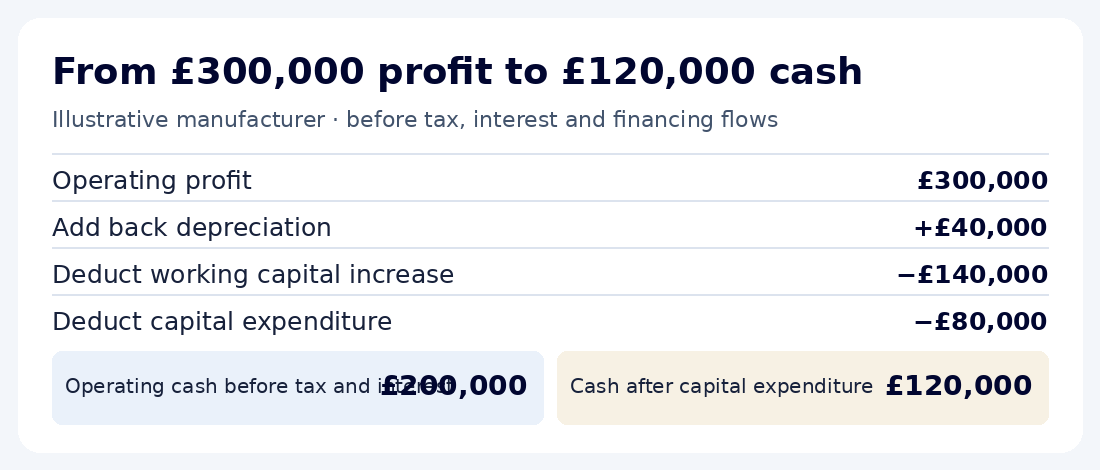
The buyer’s next question is whether these movements will recur. A stock build for confirmed orders may unwind. An increase in overdue invoices or an equipment replacement programme may signal a continuing need for cash. If you’re assessing liquidity outside a deal, see why a profitable business can run out of cash.
This example can produce several cash conversion percentages, depending on the definition. Operating cash before tax and interest is 67% of operating profit (£200,000 divided by £300,000). Cash after capital expenditure is 40% on the same denominator. If a buyer quotes cash conversion as a percentage of EBITDA, reconcile the denominator too. Here illustrative EBITDA is £340,000, assuming depreciation is the only add-back.
Five checks buyers make when reviewing cash conversion
1. Do recorded sales turn into customer receipts?
Profit includes revenue when it is recognised. Cash arrives when the customer pays. Compare the aged receivables report with receipts after month-end. Investigate old invoices, disputes, credit notes and customer concentrations. The buyer wants to understand both the recoverability of existing balances and how quickly new sales typically convert to cash.
2. Does stock support normal trading?
Break stock down into fast-moving items, seasonal stock and old or obsolete items. Use counts, sales history and confirmed orders to show which balances are supported by demand. Buying stock ties up cash before sale, and stock with limited resale prospects can reduce the value of the inventory that the parties agree to include in working capital.
3. Is the seller using agreed supplier terms?
Higher trade payables can support current-period cash, especially if purchasing has increased or suppliers have agreed longer terms. Check for overdue balances, disputed bills and suppliers tightening credit. A buyer may ask how much cash it will take to bring suppliers current and restore normal purchasing terms after completion.
4. What capital expenditure keeps the business operating?
Depreciation reduces profit without requiring a current-period cash payment. Buyers still need to fund equipment replacements and other investment. Show historic capital expenditure, work already committed and any backlog of essential projects. Separate spending needed to keep trading from investment that adds capacity so the buyer can see the cash demands of each.
5. How will the deal classify working capital, cash and debt?
A profit-to-cash bridge explains movements over a trading period. A completion adjustment compares agreed balance sheet items at the relevant date with the target or other terms in the sale agreement. Ask which receivables, stock, payables and accrued items are included and how the parties intend to treat deposits and deferred income. Check that each balance appears once in the price calculation. See ICAEW’s guidance on completion mechanisms.
How buyers assess normalised cash conversion
Reconcile reported EBITDA and test adjustments
Start with monthly management accounts and reconcile reported earnings to any adjusted EBITDA used in the offer. For every adjustment, record the accounting period, the amount, the reason and the supporting evidence. A one-off expense can affect price twice if it is added back to earnings and the associated unpaid liability is later deducted from equity value. That treatment may reflect the deal’s economics. Track the profit adjustment and the liability separately, then check how the agreement treats the liability.
Review working capital on consistent month-end definitions. A year-end snapshot may understate the amount of cash the buyer needs if stock is usually bought in the months before the peak sales period. Plot monthly receivables, stock and payables and mark changes in pricing, terms or operating scale. Ask what a buyer would inherit if completion falls before the peak and which month or period supports a representative target.
Separate cash released once from recurring trading cash
Suppose the manufacturer collects £60,000 of overdue invoices and sells £40,000 of surplus stock for cash. It releases £100,000 once, assuming no other cash costs. The recurring benefit depends on whether it can keep invoices current and buy closer to demand. Compare the next few months’ overdue debt and stock days with the previous baseline to see whether the operating improvement lasts.
Stress-test cash using the timing of receipts and payments. If a £120,000 customer payment moves two weeks later, check whether payroll, suppliers or an equipment deposit fall into the gap. A forecast can show an operating cash surplus over a month alongside a funding shortfall during one week.
Check whether the cash flow supports the buyer’s investment case
Maintenance capital expenditure can sit outside EBITDA while using cash every year. A buyer can compare the age of equipment, repair history and supplier quotes with the replacement plan to estimate when spending is likely to fall. If the seller has deferred a recurring project, show the likely catch-up cost and expected timing. If expenditure is for expansion, explain what capacity it adds and whether the profit forecast relies on that capacity.
Also show how sales terms and order timing affect cash needs. A three-year service contract may look attractive in the order book even if the team must hire before the first invoice is due. A manufacturer with a larger order may need to commit cash to materials earlier than usual. Match the order schedule to billing milestones, cash receipts and the commitments it triggers to explain the short-term cash demand.
Check that the quality of earnings and cash schedules use the same period. If adjusted EBITDA covers the last twelve months, use the same twelve months for the comparable cash bridge and explain any differences in scope. For example, if the offer assumes a recently acquired subsidiary was owned for the full year, the cash analysis needs to distinguish its actual contribution from any pro forma estimate. Show both where available and identify which figures come from management accounts. A buyer can then test the offer assumptions without confusing the effects of acquisition timing with changes in cash conversion from ordinary trading.
Worked example: how a £3 million offer becomes £2.64 million in equity value
Suppose a buyer offers £3 million of enterprise value in a UK share sale with completion accounts. The parties agree £120,000 of qualifying cash, £400,000 of debt and a £500,000 working capital target. At completion, eligible working capital is £420,000 and the agreement applies a pound-for-pound adjustment.
| Deal calculation | Amount |
|---|---|
| Headline enterprise value | £3,000,000 |
| Add qualifying cash | +£120,000 |
| Deduct agreed debt | −£400,000 |
| Deduct working capital shortfall (£420,000 less £500,000) | −£80,000 |
| Illustrative equity value | £2,640,000 |
The £2.64 million is the illustrative equity value before seller taxes, fees or other terms. Check the consideration schedule separately for any amount paid at completion, retained in escrow, deferred or contingent on later performance. For the pricing assumptions, see our guides to business valuation for exit and the working capital peg.
From equity value to cash paid at completion
Continue the example by assuming £250,000 of the £2.64 million equity value is deferred and £150,000 is paid into escrow. Ignoring fees and other deductions, £2.24 million is available to shareholders at completion. The deferred £250,000 follows the agreed payment terms. Access to the £150,000 depends on the escrow release terms and any valid claims. Show any performance-based earn-out separately and state whether it is included in the headline figure.
Next, model the impact of an updated completion balance sheet before agreeing the terms. If working capital at completion is £470,000 instead of £420,000, the shortfall against the £500,000 target becomes £30,000. With all other inputs held constant, illustrative equity value rises by £50,000 to £2.69 million. That scenario isolates the adjustment. If the movement comes from collecting receivables or delaying payables, test the related movement in qualifying cash and any reclassification under the agreement.
Agree the definitions before modelling the price
For a cash-free, debt-free transaction, build the schedule in the same order as the draft sale agreement. Tag every balance as cash, debt, debt-like, working capital or excluded. For contested balances, model both positions. Invoices received after completion, unpaid transaction costs and customer deposits are examples where the agreement’s definitions and the accounting cut-off can materially affect the calculation.
Use a worked example in the deal documents where appropriate. Ask who prepares the estimated figures, when the final numbers are due, how the parties raise a dispute and what accounting rules apply if the agreement and historical accounts produce different classifications. A sample completion statement gives buyers and sellers a common calculation to test before signing.
Model the working capital target against the completion date
Suppose comparable months show operating working capital typically between £450,000 and £550,000, but the business needs £600,000 for the pre-season stock build. A single average can hide that difference. Decide with advisers whether the deal should use a single target, a seasonal approach or another agreed mechanism. Then model how both sides’ proposals affect the price using the same account definitions.
Rework historical month-end balances if the draft agreement excludes balances that the management accounts historically put in working capital. Compare the target and the completion figure on the same footing. If a creditor moves to the debt-like schedule for the completion calculation, review its historical treatment in the target calculation as well. This is particularly important in a business that has changed billing policy, moved to annual contracts or introduced a new inventory provision.
Review the price model with a simple three-column check. Show the source balance, the proposed classification and its signed contribution to equity value. Tie the total back to the accounts and compare it with the estimated price statement. This gives the lawyers and accountants a shared record of which line items remain open.
What sellers should prepare before financial due diligence
- Monthly profit-to-cash bridge. Reconcile management accounts to cash movements and explain material changes in receivables, stock, payables and non-cash charges. Include enough periods to show the seasonal pattern.
- Evidence behind balances. Provide aged receivables and later receipts, aged stock and stock counts, supplier statements and schedules for customer deposits or deferred income. Identify disputed or unusual items.
- Forecast and investment plan. Use a 13-week cash flow forecast to show expected operating receipts and payments, then list planned capital spending by timing and purpose.
- Draft price bridge. Map cash, debt, debt-like items and working capital to the trial balance. Agree who will prepare and review the completion accounts, and log items whose classification is still open.
Keep a short explanation alongside each material balance. For example, a £90,000 increase in receivables calls for different buyer questions if £70,000 was collected shortly after month-end than if the same £70,000 is still disputed. Give the date of the later receipts, identify the invoices and reconcile the total to the ledger so a reviewer can reproduce the conclusion.
Use the evidence to improve trading processes before a buyer asks. Resolve repeated invoice disputes and separate stock bought for confirmed orders from old stock with no clear route to sale. See the working capital improvement levers for steps to release cash from day-to-day operations.
Assemble a cash evidence pack a buyer can reproduce
Choose one recent month and take a reviewer through the accounts, bank reconciliations and ageing reports. If month-end and bank dates differ, identify the payments in transit and how they cleared. Record the dates of subsequent receipts and payments so a reviewer using a later export can reproduce the same result.
Add an explanation for each material swing and name the person who can explain the operational cause. For example, an increase in stock might reflect a specific purchase order, a larger minimum order quantity or a delay delivering to a customer. Each explanation points to different evidence and a different expectation for future cash flow.
Before marketing the business, run a trial request for the cash conversion schedule, supporting bank reconciliations and price bridge. Record how long it takes to recreate the figures and where the team relies on a single person or spreadsheet. The exercise shows which numbers need a clearer audit trail before a buyer starts asking for explanations.
Common questions about cash flow and sale proceeds
Is EBITDA the same as cash flow?
EBITDA measures earnings before interest, tax, depreciation and amortisation. To estimate operating cash from it, account for working capital changes and other cash and non-cash items separately. Then consider capital expenditure, tax, interest and financing flows according to the cash measure you need.
Do all UK business sales use completion accounts?
Some use completion accounts to adjust the final price using agreed balances at completion. A locked box generally fixes equity value using an earlier set of accounts and relies on agreed protections against leakage between that date and completion. Read the comparison of completion accounts and locked box for when each can fit.
How do customer deposits affect the price?
Receiving a deposit raises cash and can leave the business with an obligation to deliver after completion. The sale agreement determines how the parties classify the cash and the associated liability. Trace both through the enterprise-to-equity bridge to see where they affect the price.
Does collecting an invoice before completion increase the purchase price?
It depends on how the agreement handles cash and working capital. If £50,000 of included receivables becomes £50,000 of qualifying cash, an increase in the cash adjustment can be offset by a lower working capital adjustment. The impact may differ where the deal excludes cash, treats the receivable differently or uses a different pricing mechanism. Run both entries through the same price bridge to test the effect.
How is a business with negative working capital treated?
A business that collects upfront or pays suppliers after it receives customer cash may trade normally with negative working capital. A completion accounts mechanism can still compare that position with an agreed negative target. Check which balances create the negative position and whether they reflect sustainable terms or unusual timing. The agreement determines how the resulting difference feeds into the price.
Preparing your business for sale?
Consult EFC helps UK business owners explain cash conversion, working capital and the figures that affect sale proceeds. Explore seller due diligence preparation or discuss your sale timetable.
Not sure where your business stands right now?
Book a free 30-minute call with Kish. Bring your numbers, your questions, or just your situation. You will leave with a clearer picture than you arrived with.
Book a Free Strategy Call
Over 12 years across Big Four audit, Investment Banking, and corporate advisory. Kish works with SaaS founders, tech companies, and ambitious UK SMEs from £1M to £50M in revenue on fundraising, valuations, exit planning, and financial strategy. ICAEW regulated. Big Four trained. Based in London.