

Some of the fastest-growing businesses I meet are also the hungriest for cash. Not because they are failing, but because the way they charge customers forces them to fund the customer’s asset.
The clearest example right now is robotics. Companies with real, paying customers are still raising enormous rounds. The reason is not hype. It is the revenue model. When you rent a machine instead of selling it, you pay for it today and get paid for it over years.
That is not a robotics problem. It is a financing problem that shows up in any business that delivers value upfront and collects it over time. If your growth plan depends on that model, your funding plan has to be designed around it from day one.
The robotics lesson: rent the robot, carry the risk
In February 2026, Toyota Motor Manufacturing Canada moved from a pilot to a paid Robots-as-a-Service agreement with Agility Robotics. Under that model, Toyota pays for results rather than upfront hardware, with maintenance and software included.
That is a great deal for the customer. Look at it from the vendor’s side instead. Agility must build the robots, install them, maintain them and stand behind their uptime. The cash goes out at the start. It comes back monthly, over the life of the contract.
Industry analysts now describe robotics-as-a-service as much a financing model as a software one. That framing is the key insight. The bigger the order book, the bigger the funding requirement.
This is not just a robotics problem
The same shape appears in many UK businesses I work with. The common thread is simple: you spend first and collect later, and growth widens the gap.
- Equipment-as-a-service. Coffee machines, EV chargers, medical devices, catering kit or security systems supplied for a monthly fee.
- Hardware plus subscription. Telematics, smart meters, IoT sensors or point-of-sale terminals where the device is subsidised or free.
- Managed services with upfront set-up. IT MSPs, facilities management and fire and security firms that install before they bill.
- Fleet and rental businesses. Vehicles, plant, scaffolding or modular buildings bought outright and hired out.
- Long contracts with back-ended billing. Engineering projects, software implementations or construction work paid on milestones or retention.
- Inventory-heavy subscriptions. Subscription boxes and rental fashion, where stock is bought months ahead of revenue.
If your business is on that list, profit and cash will tell two very different stories. Most founders only notice when the bank balance does.
A worked example: same product, two revenue models
Imagine a business whose product costs £35,000 per unit to build and install. It can sell each unit for £50,000. Or it can rent it for £1,500 a month on a 48-month contract, leaving about £1,200 a month after servicing.
On paper, renting wins. Over the contract, each rented unit earns about £22,600 of profit against £15,000 from a sale. Now grow at 10 units a month for a year.
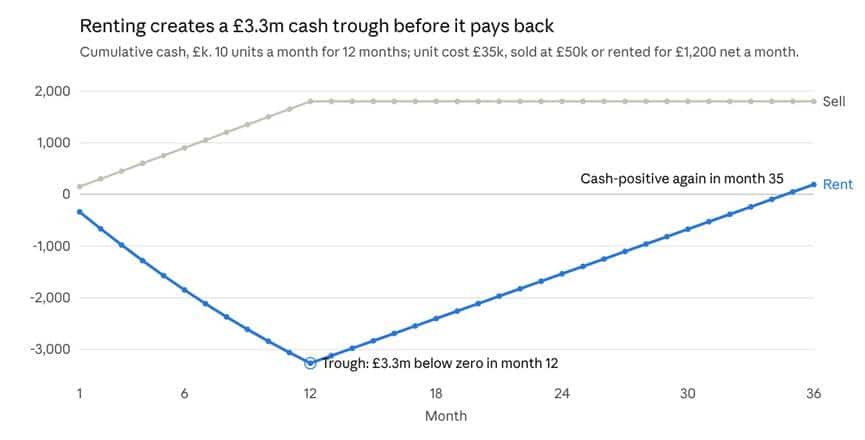
Illustrative example · Consult EFC calculation · 10 units a month for 12 months, 48-month contracts
After 12 months, selling leaves the business £1.8m better off. Renting the same 120 units ties up £4.2m and leaves cash £3.3m below where it started. The rental model only turns cash-positive in month 35, and only overtakes the sales model around month 48.
That is the trap. The rental business is the more valuable one. Without a funding plan for that £3.3m trough, it never reaches month 35. And the faster it grows, the deeper the trough gets.
Why your P&L will not warn you
When you rent out an asset, it sits on your balance sheet and is depreciated over its useful life. Revenue arrives monthly. So each month the P&L shows a small, steady profit per unit, while the full purchase cost left the bank on day one.
EBITDA makes this worse, not better. It strips out depreciation, so a fast-growing rental business can report strong, rising EBITDA while burning cash. It is entirely possible for the management accounts to look excellent while the 13-week cash forecast shows a covenant breach within two months.
The fix is not complicated. Track cash payback per unit, capital deployed and the cash trough alongside the P&L, every month. If the board only sees profit, it is flying blind.
Match the funding to the asset
The most expensive mistake is funding rental units with equity. Equity is the costliest money you will ever raise. Using it to buy machines that generate predictable monthly income gives away ownership for something a lender would happily finance.
A better approach splits the funding by what it pays for:
| What you are funding | Better-matched funding | What the funder looks at |
| Product development, team, go-to-market | Equity (VC, angels, EIS/SEIS) | Market size, growth, team |
| The units you deploy to customers | Asset finance or hire purchase | Asset value, resale market, contract terms |
| Contracted future income | Receivables or contract-backed lending | Customer credit quality, churn, contract length |
| A growing fleet at scale | A dedicated fleet facility, sometimes in a separate vehicle | Utilisation, residual values, performance history |
| Short-term timing gaps | Revolving credit facility or invoice finance | Debtor book, cash forecast |
There are also commercial levers that reduce the problem before you borrow. Charge an upfront installation or onboarding fee. Ask for deposits or annual billing in advance. Offer a hybrid model where larger customers buy the hardware and pay a subscription for the service. Negotiate longer payment terms with your own suppliers.
Each of these shortens the cash payback per unit. That is often worth more than any funding round. For more on secured lending, see our guide to asset-based lending in the UK, and check the covenants before you sign.
What lenders and investors will want to see
Asset-backed funders lend against evidence, not ambition. Before you approach one, make sure you can show these numbers cleanly and trace each one to source data:
- Fully loaded cost per unit: hardware, delivery, installation and the cost of the capital tied up.
- Net monthly cash per unit: subscription income minus servicing, support and consumables.
- Cash payback period: how many months before each unit has repaid its cost.
- Contract terms: length, break clauses, price escalators and who owns the asset at the end.
- Churn and early termination: how often customers leave, and what you recover when they do.
- Utilisation and uptime: how much of the fleet is actually earning.
- Residual value: what a returned unit is worth, backed by real resale or redeployment evidence.
- The cash trough: a monthly forecast showing the lowest point of cash under your growth plan, and how it is funded.
The robotics sector is a useful warning here. Many companies announce pilots and partnerships but rarely disclose fleet size, uptime or cost per task. Those are exactly the figures that decide whether a deployment model is economically viable. The same is true for your business.
Five questions to ask at your next board meeting
- If we hit our sales target, what is our lowest cash balance over the next 24 months, and in which month?
- How many months does it take each unit or contract to pay back its cash cost?
- Are we using equity to fund assets that a lender would finance more cheaply?
- What happens to the cash trough if growth is 50% faster than planned? What if churn doubles?
- Which lenders would fund our fleet today, and what data would they need from us?
If any of these takes more than a minute to answer, that is the gap to close first.
Growth should not be the thing that breaks you
Service-based revenue models are often more valuable. Recurring income, longer customer relationships and better lifetime margins all support a higher exit multiple. But that value only arrives if you can fund the journey to get there.
The businesses that win treat their revenue model and their funding model as one decision. They know their payback per unit, they forecast the trough, and they put the right money against the right asset.
At Consult EFC, we help founders build investor-grade financial models that show the real cash profile of the business, and we structure and negotiate debt facilities that fit it. If your growth plan is starting to feel like a cash problem, book a free 30-minute strategy call with Kish.
Not sure where your business stands right now?
Book a free 30-minute call with Kish. Bring your numbers, your questions, or just your situation. You will leave with a clearer picture than you arrived with.
Book a Free Strategy Call
Over 12 years across Big Four audit, Investment Banking, and corporate advisory. Kish works with SaaS founders, tech companies, and ambitious UK SMEs from £1M to £50M in revenue on fundraising, valuations, exit planning, and financial strategy. ICAEW regulated. Big Four trained. Based in London.