

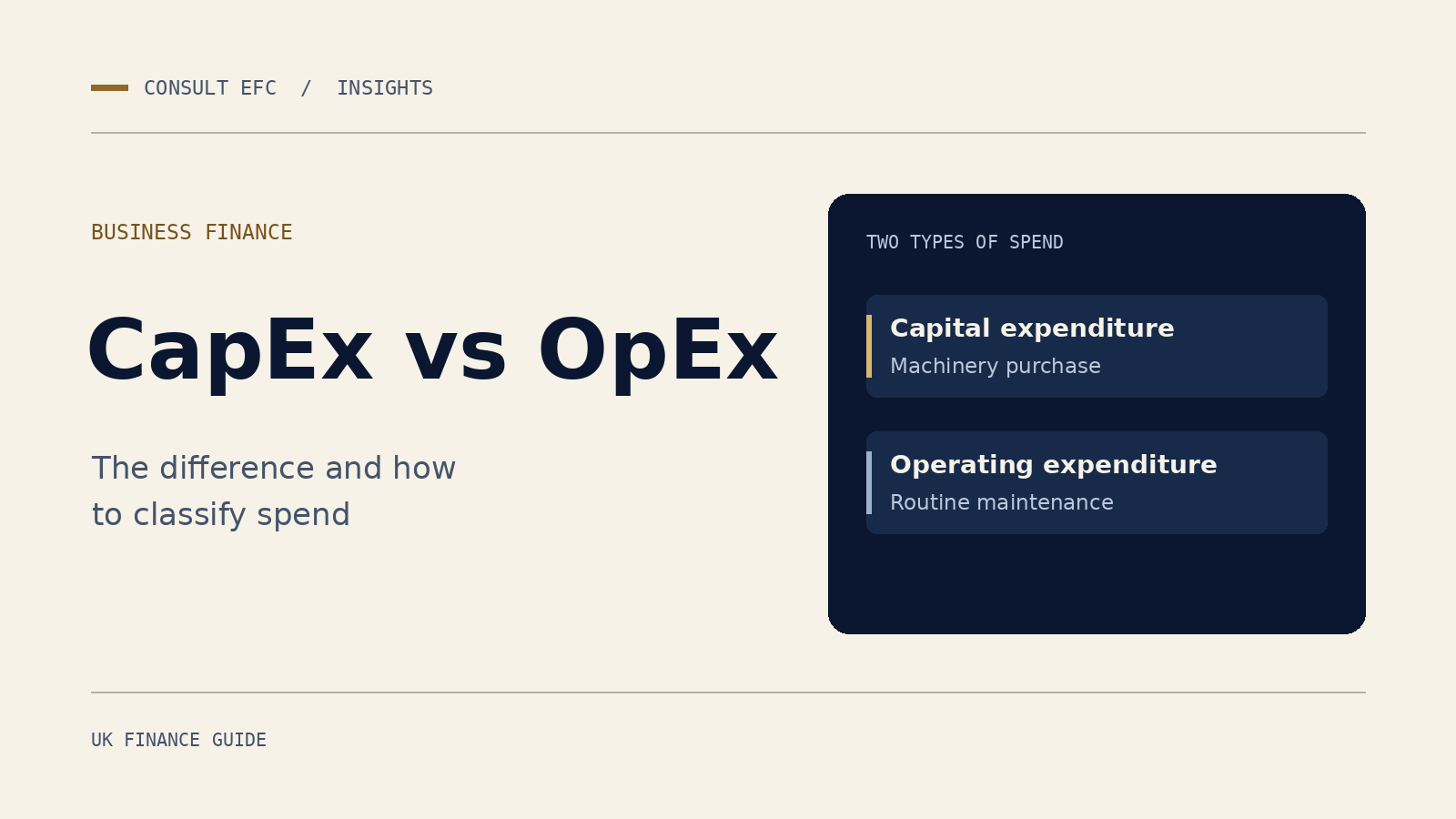
Capex (capital expenditure) is money spent on assets that will serve your business for more than a year, such as equipment, vehicles or major software builds. Opex (operating expenditure) is the cost of running the business day to day, such as rent, salaries and subscriptions. Capex goes on the balance sheet and is written off gradually. Opex hits the profit and loss account in the period you incur it. That one difference changes your reported profit, your cash position, your tax bill and, eventually, the story you tell investors or a buyer.
This guide sets out the definitions, worked examples, the UK accounting and tax treatment, and a practical way to classify the grey areas.
TL;DR
- Capex buys long-term assets (benefit beyond one year). It is capitalised, then depreciated or amortised over its useful life.
- Opex covers ongoing running costs. It is expensed in full in the period and reduces profit straight away.
- In the UK, depreciation is not tax-deductible. Relief comes through capital allowances instead, so accounting profit and taxable profit differ.
- The classification is not a free choice: repairs are generally opex, improvements that give an enduring benefit are generally capex, and your capitalisation policy sets the floor.
- Capex and opex both matter for cash flow, EBITDA and valuation, so forecast them separately.
Table of Contents
- What is capex and what is opex?
- Capex vs opex at a glance
- Examples of capex and opex
- Software and cloud: where the line has moved
- How to decide when the classification is unclear
- How capex and opex appear in UK accounts
- UK tax: capital allowances vs deductible expenses
- What the choice does to cash flow, EBITDA and valuation
- Choosing between buying and renting
- Our perspective
- Getting capex and opex right in your model
- FAQ
- Sources
What is capex and what is opex?
The core distinction is time. Capital expenditures are a company’s major, long-term expenses, while operating expenses are day-to-day expenses. Capex items tend to give benefit for longer than a year, whereas opex items often have a useful life of a year or less.
The same source notes that operating expenses are typically deductible for tax purposes, while capital expenditures must be capitalised and depreciated over time. We cover the UK version of that rule below, because it works differently from the US description.
A simple way to hold it in your head:
- Capex answers: “What did we buy that will still be working for us in a few years?”
- Opex answers: “What did it cost to keep the business running this period?”
Capex also has two flavours. Maintenance capex keeps current operations running, such as replacing a broken refrigerator or an ageing computer system, while growth capex expands or improves the business, for example extra equipment, a new location or a major software platform. Investors read the split closely, because growth capex signals ambition and maintenance capex signals the cost of standing still.
Capex vs opex at a glance
| Capex | Opex | |
|---|---|---|
| What it buys | Long-term assets | Day-to-day running of the business |
| Typical benefit period | More than one year | One year or less |
| Balance sheet | Recorded as a fixed asset | Not recorded as an asset |
| Profit and loss | Depreciation or amortisation over useful life | Full cost in the period incurred |
| Cash flow statement | Investing activities | Operating activities |
| UK tax relief | Capital allowances | Deducted as a trading expense, if wholly and exclusively for the business |
| Typical examples | Machinery, vehicles, premises, bought software, major fit-outs | Rent, salaries, utilities, repairs, SaaS subscriptions |
Examples of capex and opex
Capex examples
- Machinery, tools and production equipment
- Computers and servers you buy outright
- Vehicles for the business
- Building work that improves or extends a property
- Purchased software used without customisation, recorded on the balance sheet as a capital expenditure
- Internally developed software or platforms, where they meet the capitalisation criteria in your accounting framework
Opex examples
- Rent, utilities and insurance
- Salaries and wages
- Office supplies and marketing
- Ordinary repairs. Repair and maintenance that keeps an asset in working order without substantially improving it or extending its life is revenue expenditure, and it recurs, unlike most capital purchases.
- SaaS subscriptions, cloud hosting and managed IT services
A worked example: buy or rent the same asset
The cleanest illustration comes from a delivery truck. Buy a $50,000 truck and you might reduce income by $10,000 a year for five years as it loses value (capex). Rent the same truck for a year and the full $50,000 hits the income statement that year (opex).
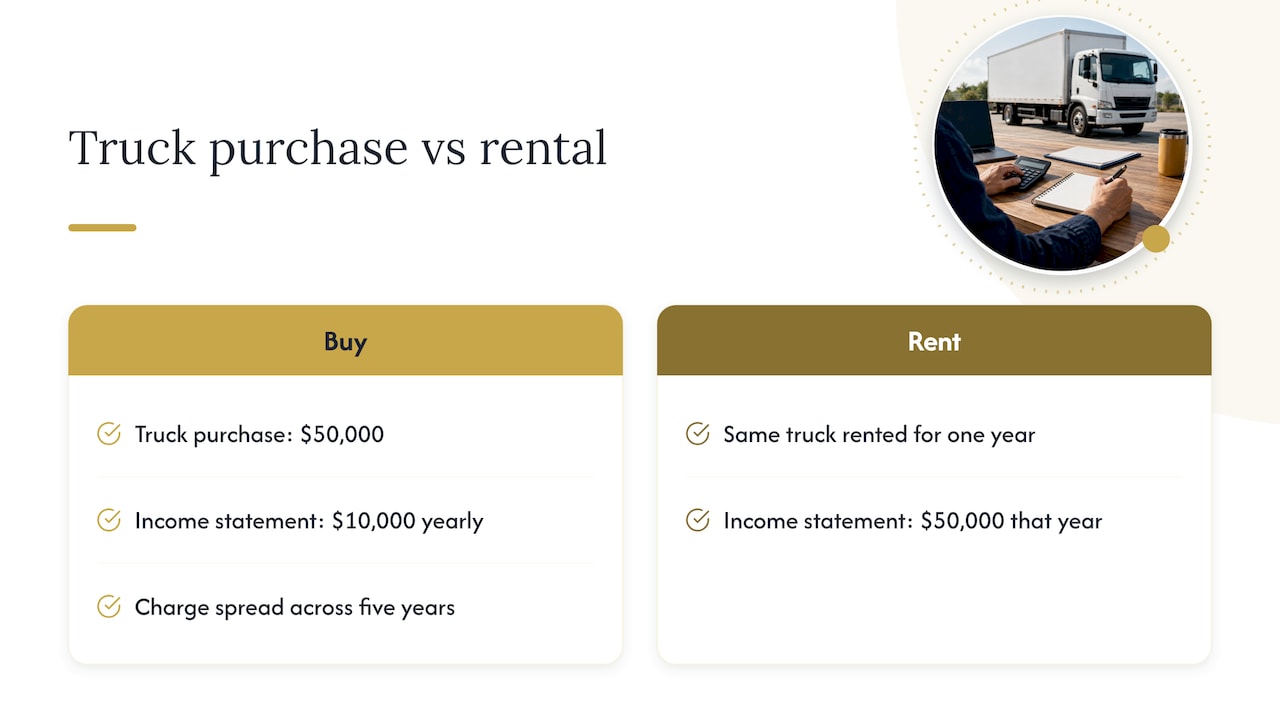
The UK equivalent is a van. Buying a van outright reduces cash in the bank, while leasing at £400 a month preserves £4,600 for flexibility. The same source notes that rent is deducted from revenue in the year it is paid, which directly reduces reported profit and can lower that period’s tax bill.
Notice what changes and what does not. Over the full life of the asset the total cost is similar. What shifts is timing: when the cost reaches your profit, when the cash leaves the bank, and which line of your accounts carries it.
Software and cloud: where the line has moved
For SaaS companies and any business running on cloud tools, this is the section that matters most. Cloud computing and as-a-service offerings have made many IT products easier to treat as opex rather than capex, including SaaS, platform and infrastructure services, data storage and managed IT.
Two practical points:
- Subscriptions are generally opex. Subscription costs for SaaS agreements are typically expensed over the contract term rather than capitalised, although that source notes some implementation costs for cloud arrangements can be capitalised under US rules. Under UK GAAP, check your own framework and speak to your accountant.
- Prepaid commitments can blur the line. Public cloud usage is typically an opex budget item, but reserved capacity paid in advance on one or three-year terms can be treated as capex, whereas pay-as-you-go subscriptions remain opex.
If you sell usage-based software, the cost side of your model shifts with it. Our guide to usage-based pricing and SaaS metrics shows how consumption models change the numbers investors look at.
How to decide when the classification is unclear
Most real-world debate is not about buying a lorry. It is about repairs, upgrades and internal projects. UK businesses have an official starting point.
HMRC’s capital versus revenue expenditure toolkit explains that a repair restores an asset to what it originally had and is normally an allowable revenue expense. Alterations that improve or change an asset and give an enduring benefit are normally capital. HMRC’s own manual gives a memorable example: knocking down a run-down garage and building a new one is a replacement, so it is capital, not a repair, even if it is the cheapest option.
A practical four-question test:
- Does it create a new asset? If yes, lean towards capex.
- Does it extend the asset’s life, increase capacity or improve performance? If yes, lean towards capex. SAP’s guidance lists the same triggers.
- Is it routine? Rent, utilities, regular maintenance, supplies and salaries are typically opex.
- Does it clear your capitalisation threshold? Most companies set a minimum value for capitalisation. An item that passes the tests above may still be expensed if it falls below your policy threshold.
If a transaction still feels unclear, take it to your accountant before the figures go into a tax return or a data room. That is cheaper than unpicking a classification later.
Does opex include capex, and can you choose?
No. Opex and capex are separate categories. Opex is not a bigger bucket that contains capex. What can overlap is the same underlying need, such as having vehicles, which you can meet either through capex (buy) or opex (lease or rent). That is a genuine commercial choice.
The accounting classification of a specific cost is different. It follows the nature of the spending, your accounting framework and your documented policy, not your preference for a better-looking profit. Capitalising a recurring cost to lift profit is the sort of thing that analysts look for when they compare capital expenditure with depreciation. Consistency and a written policy protect you in an audit, a funding round and a sale.
How capex and opex appear in UK accounts
Under UK GAAP, FRS 102 requires capital expenditure to be recorded as a fixed asset on the balance sheet, with its cost allocated systematically over its useful life. Tangible assets are depreciated and intangible assets are amortised, and the charge is recognised in profit or loss each period (sections 17 and 18). Operating expenditure is expensed in full in the period incurred.
In practice that means:
- Balance sheet: Capex sits under property, plant and equipment (or intangible assets for things like capitalised software).
- Profit and loss: capex appears as a depreciation or amortisation charge. Opex appears as the full cost.
- Cash flow statement: capex outflows appear under investing activities, while day-to-day trading cash sits in operating activities.
FRS 102 also lets an entity adopt a revaluation policy for a class of fixed assets, otherwise assets are held at cost less depreciation and impairment. Which approach your business uses is a decision for you and your accountant.
Estimating capex from the accounts
When you are analysing a company and the notes do not show gross additions, a widely used estimate is: closing net fixed assets, minus opening net fixed assets, plus the period’s depreciation, adjusted for the net book value of disposals. It is an estimate, but it is useful for sense-checking a target company or a competitor’s investment level.
UK tax: capital allowances vs deductible expenses
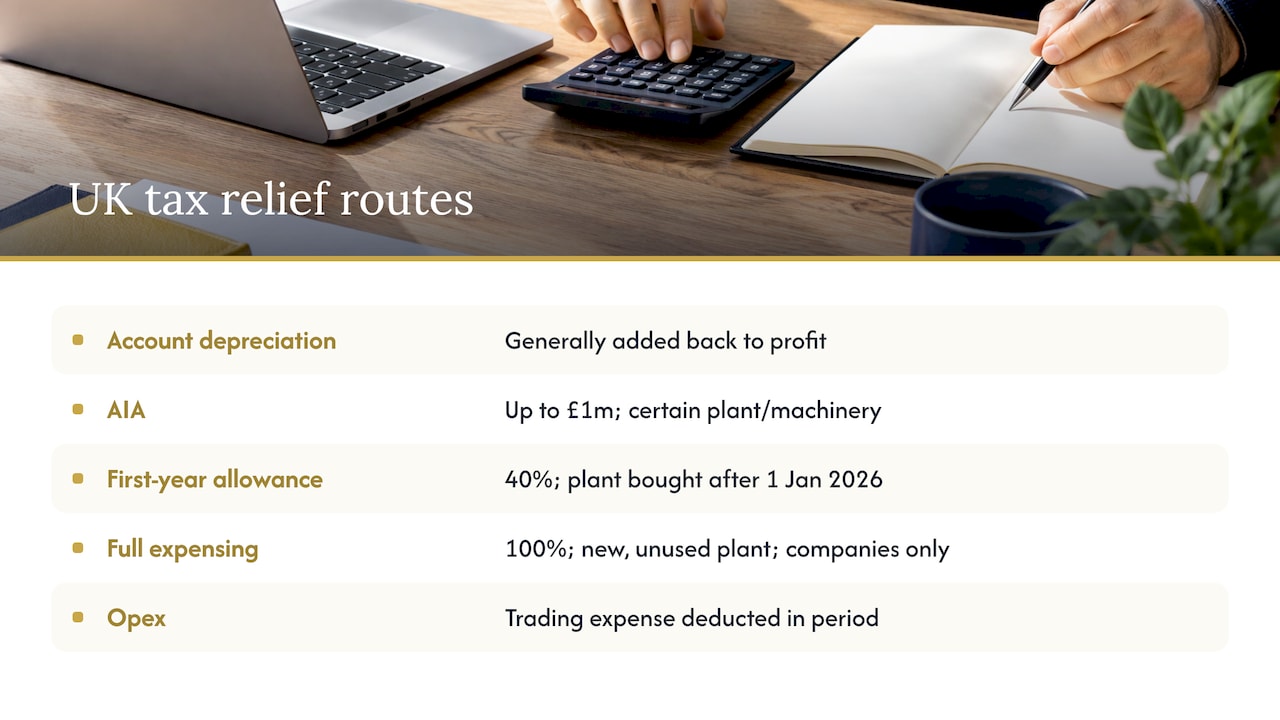
Here the UK differs from the simple US summary. Depreciation in your accounts is generally not an allowable deduction, so it is added back to profit in the tax computation. Relief for capex comes instead through capital allowances.
According to GOV.UK, capital allowances let you deduct some or all of an item’s value from profits before tax. The Annual Investment Allowance (AIA) is up to £1 million on certain plant and machinery, and the same page describes a 40% first-year allowance for qualifying plant and machinery bought after 1 January 2026.
For companies, there is a further route: full expensing lets a company deduct 100% of the cost of qualifying plant and machinery from profits in the year it was bought. The asset must be new and unused, bought from 1 April 2023, and not a car. Only companies can claim, and you cannot claim both full expensing and the 50% first-year allowance on the same spend.
The result is a timing difference. Your accounts may spread the cost over five years while your tax computation takes the deduction up front. That gap flows into deferred tax and into your cash tax forecast. Rates and thresholds change, so confirm the current position on GOV.UK or with your adviser before committing to a purchase.
Opex, by contrast, is generally deducted as a trading expense in the period, provided it is incurred wholly and exclusively for the business.
What the choice does to cash flow, EBITDA and valuation
Cash flow
The cash impact of capex lands in full on the day you pay, however it is depreciated in the P&L. That is why capex should be forecast separately from opex, with a schedule of each planned purchase, its cost, payment date and depreciation period. The same source warns that many SMEs underestimate replacement needs and get caught short, and recommends a rolling capex forecast that tracks asset ages.
A business can be profitable on paper and still run short of cash because of a large capex payment. If that sounds familiar, read our piece on being profitable but running out of cash, and build a 13-week cash flow forecast so big purchases never arrive as a surprise.
EBITDA and profit
Because depreciation and amortisation are added back to reach EBITDA, a capex-heavy business usually shows a higher EBITDA than an otherwise identical opex-heavy one. Leasing instead of buying moves cost above the EBITDA line. A buyer or investor who values on an EBITDA multiple will look past this and examine capex, free cash flow and the consistency of your classification. That is why a clean capitalisation policy matters long before a sale.
Investor and buyer view
Investors tend to want to know:
- How much of your capex is maintenance and how much is growth
- Whether recurring costs have been capitalised to flatter profit
- How capex ties to your cash runway and your forecast
- Whether the buy-or-lease decision was a deliberate one
A procurement view adds a useful framing. Capex involves a large up-front outlay, board-level approval and longer cycles, with obsolescence and under-use as the main risks. Opex involves predictable recurring payments that preserve cash, with vendor lock-in and cost escalation as the main risks.
Choosing between buying and renting
When you have a genuine choice, weigh it on the criteria that matter to your business:
| Criterion | Leans towards capex (buy) | Leans towards opex (lease, rent, subscribe) |
|---|---|---|
| Cash available | Strong balance sheet | Cash needs preserving for growth |
| Asset life | Long and stable | Short, or fast-changing technology |
| Flexibility | Low need to scale up or down | High need to scale up or down |
| Tax position | Can use capital allowances efficiently | Prefer a steady deduction each period |
| Investor story | Building a durable asset base | Showing capital efficiency |
| Financing | Asset can support borrowing | Lease or subscription fits the plan |
There is no universal winner. Fast-growing SaaS businesses often favour opex to protect runway, while a business with predictable demand and long-lived equipment may be better off owning. Our cash runway stress test is a good way to see how each choice behaves if sales come in below plan.
Our perspective
Most founders meet capex and opex as an accounting label. We see them as a decision about how you finance growth and how you present it.
The mistakes we see are rarely exotic. A recurring cost gets capitalised without a written policy. Capex is left out of the cash forecast because the P&L looks healthy. A lease-or-buy decision is made on the monthly price alone. Each one is small in the moment and expensive when a funder or buyer starts asking questions.
Our approach, as a firm led by an ICAEW Chartered Accountant, is to treat the classification as part of your financial model from the start. We separate maintenance from growth capex, tie both to the cash forecast, and make sure the policy is documented and consistent. That is the rigour a Big Four-style review would expect, delivered through a fractional engagement rather than a full-time hire.
If you plan to raise or sell, do this early. Clean numbers shorten diligence and make your story easier to believe.
Kishen Patel
Getting capex and opex right in your model
If you are preparing for a raise, a debt facility or a sale, the classification of your spend feeds directly into the metrics a counterparty will test. Consult EFC provides fractional CFO support for UK SMEs and SaaS businesses: financial modelling, FP&A, valuations, due diligence preparation and exit planning, led by ICAEW Chartered Accountant Kishen Patel.
A good place to begin is our fractional CFO services, or our investor-grade financial modelling if you need a model that separates capex and opex cleanly. If you need a defensible figure for your business, our business valuation service starts from £2,500 one-off. For SaaS founders, our SaaS forecasting guide shows how spend, cash and runway connect.
FAQ
Is software capex or opex?
It depends on how you get it. Software you buy and use as is can be capitalised as an asset, while SaaS subscriptions are generally expensed as opex over the contract term. Internally developed software can be capitalised only where it meets the recognition criteria in your accounting framework, so agree the treatment with your accountant.
Do operating expenses include capex?
No. Operating expenses cover the costs of running the business in the period, while capex covers long-term assets that are capitalised and then depreciated or amortised. Depreciation, the annual charge from capex, does appear in the P&L, but the purchase itself does not.
Is a repair capex or opex?
A repair that restores an asset to its original condition is normally opex and an allowable revenue expense. An upgrade that improves the asset or gives an enduring benefit is normally capex. HMRC’s toolkit sets out the test, and your accountant can confirm borderline cases.
Does leasing count as capex or opex?
A simple rental or pay-as-you-go arrangement is normally opex, as the full payment hits the P&L when incurred. Longer prepaid commitments can be treated differently, and some lease arrangements have their own accounting rules under your framework, so check the terms with your accountant.
How do capex and opex affect business valuation?
They change EBITDA, free cash flow and the quality of earnings a buyer sees. A consistent policy, a clear split between maintenance and growth capex and a capex schedule in your forecast all make your numbers easier to rely on in diligence.
Recommended
- Usage-Based Pricing and SaaS Metrics: A UK Founder’s Guide
- SaaS Unit Economics Guide: CAC, LTV & Burn Multiple
- Financial Planning and Analysis
- Fractional CFO for Startups: Scale Unit Economics
This article is for general information only and is not professional advice.
Not sure where your business stands right now?
Book a free 30-minute call with Kish. Bring your numbers, your questions, or just your situation. You will leave with a clearer picture than you arrived with.
Book a Free Strategy Call
Over 12 years across Big Four audit, Investment Banking, and corporate advisory. Kish works with SaaS founders, tech companies, and ambitious UK SMEs from £1M to £50M in revenue on fundraising, valuations, exit planning, and financial strategy. ICAEW regulated. Big Four trained. Based in London.