

A fractional FD is an experienced finance director who works for your company part-time, for a set number of days a month, instead of being a full-time employee. You get senior ownership of the numbers, the controls and the management accounts without a six-figure salary on the payroll. This guide covers what the role involves, how it differs from a fractional CFO, what the full-time alternative costs in the UK, and how to decide whether the time has come.
TL;DR
- A fractional FD is a part-time finance director. The remit is usually hands-on: month-end, management accounts, controls, cash and reporting to the board.
- A fractional CFO leans towards strategy: fundraising, modelling, investor relations and exit. Many growing businesses need the FD first, then the CFO.
- A full-time FD in the UK costs roughly £95,000 to £150,000 in base salary at SME level, before employer costs. That is the benchmark a fractional arrangement is measured against.
- Hire when decisions are outrunning your data: a raise, a sale, a lender, or monthly accounts that arrive too late to act on.
- Legal responsibility for the accounts stays with your directors, whoever prepares them.
Table of Contents
- What a fractional FD actually does
- Fractional FD vs fractional CFO
- What a full-time FD costs in the UK
- Signs you need one now
- A realistic first 90 days
- The board’s duties do not move
- Our view
- How Consult EFC can help
- How to choose the right person
- FAQ
- Sources
What a fractional FD actually does
The title is borrowed from the traditional UK finance director, the person who owns the finance function and sits next to the managing director. “Fractional” only describes the time commitment: perhaps two days a week for a fast-growing company, or two days a month for a steadier one.
In practice, the work falls into four buckets.
1. Reporting you can trust. Timely, accurate management accounts, signed off by someone senior, with a view of margin, cash and (for SaaS) recurring revenue and churn. This is the foundation for everything else.
2. Control and compliance. Approval limits, payroll and VAT processes, statutory accounts, the relationship with your external accountant, and tidy records. Our guidance on financial controls and governance sits here.
3. Cash and forecasting. A rolling forecast that tells you when cash gets tight, not after. ICAEW notes that rolling forecasts, typically updated monthly and looking three to 12 months ahead, help entrepreneurs adapt as new information arrives and spot future cash shortfalls early.
4. Challenge in the room. The least visible and often most valuable part. A good fractional FD questions pricing, hiring plans and acquisition ideas before money is committed. ICAEW’s piece on portfolio CFOs describes how a part-time finance leader can act as a stand-in for the board while a business is too small to justify a full-time senior hire, and help the founder become more financially literate along the way.
Fractional FD vs fractional CFO
The two titles overlap, and some firms use them interchangeably. The useful distinction is where the person spends their time.
| Fractional FD | Fractional CFO | |
|---|---|---|
| Main focus | Running the finance function well | Using finance to shape strategy and funding |
| Typical tasks | Month-end, management accounts, controls, team oversight, cash | Fundraising, investor reporting, modelling, M&A, exit planning |
| Style | Hands-on, process-led | Strategic, external-facing |
| Best fit | Messy or slow reporting, no senior finance owner | A raise, a sale, a lender, board-level planning |
The split is not rigid. Practitioners quoted by ICAEW describe the FD as more of a “doer” with team leadership and sign-off of management accounts, and the CFO as more of a strategist, with many fast-scaling SaaS companies moving from one need to the other as they mature.
The market is moving in the same direction. A 2026 remuneration study of 373 UK finance professionals found 63% of respondents reporting a more strategic remit than 12 months earlier. Even if you hire an FD for the hands-on work, expect to be asked for forward-looking judgement too.
So which title should you search for? Ignore the label and write down the problems you need solved. If most are “our numbers are late and I do not trust them”, you want an FD. If most are “we need a model for investors in three months”, you want a CFO. Our page on fractional FD and part-time finance director support and our fractional CFO services cover both ends, and a single engagement can start with one and shift to the other.
What a full-time FD costs in the UK
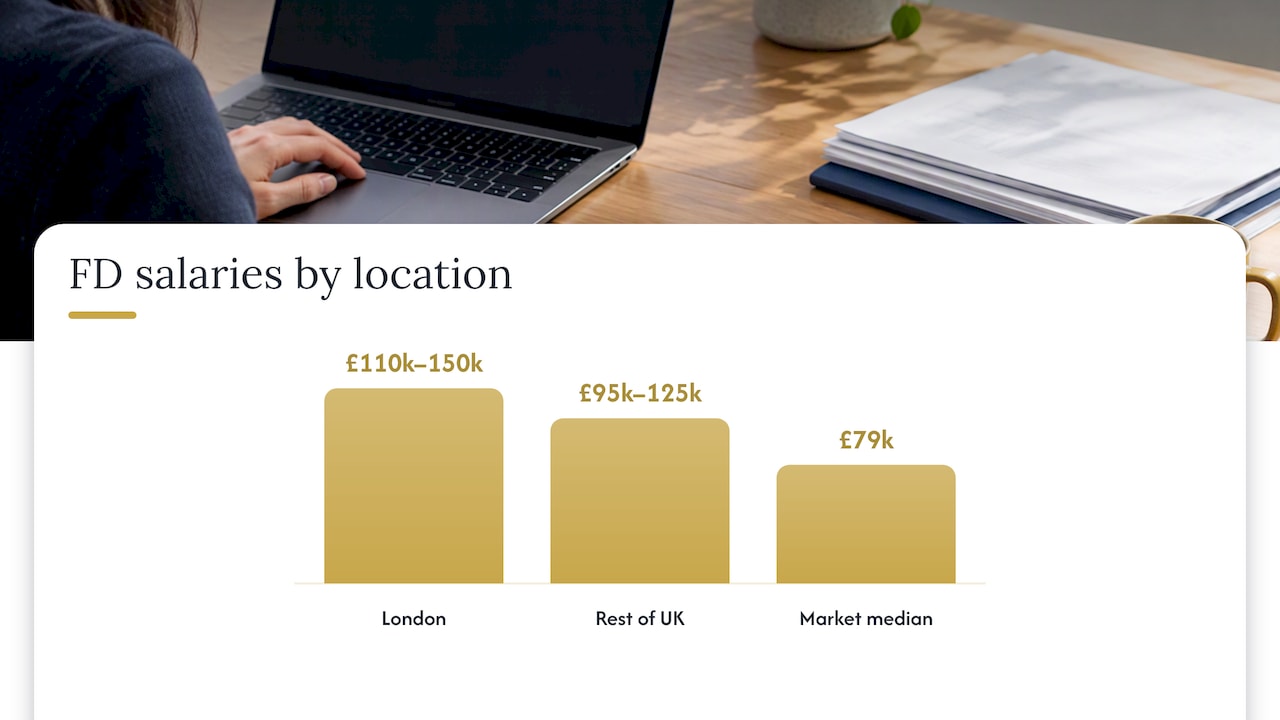
A fractional arrangement only makes sense against the alternative. Accountancy Capital’s 2026 benchmarks put base salary for an FD at an SME with £10m to £40m turnover at £110,000 to £150,000 in London and £95,000 to £125,000 elsewhere in the UK. The same source reports a median across the market of around £79,000, and notes that PE-backed roles often carry a premium of 15% to 25%.
Those are base figures. Add employer National Insurance, pension, benefits, bonus, recruitment fees and the time a search takes, and the real annual cost is meaningfully higher. For a company turning over £3m to £10m, a full-time FD is often more finance leadership than the business can use on a Tuesday, yet the business still needs that judgement on the days it matters.
That gap is what the fractional model fills: senior ownership for the days you need it. We do not publish a standard fractional rate, because scope varies widely, from a few days a month of oversight to a heavy fundraising quarter. We scope each engagement against what you need to achieve. You can talk to us about your situation and get a clear scope rather than a generic day rate.
Signs you need one now
Most founders hire too late. These are the triggers we see most often in UK SaaS and SME businesses.
- Monthly accounts arrive after the month has already been lived. If you learn about a cash problem three weeks after it began, you have a reporting problem, not a bad month.
- You are about to raise. Investors and lenders want current numbers. The British Business Bank’s guidance on getting your business ready for finance stresses cash flow, up-to-date management information and a clear grasp of your position. A flawless five-year spreadsheet on top of messy books is a common trap.
- You plan to sell within one to three years. Buyers’ due diligence tests whether your reported numbers are reliable. Cleaning up is far easier eighteen months out than eight weeks out.
- Your MRR and churn figures change depending on who calculates them. Definitions need an owner.
- The founder is still the finance function. If you approve payments, chase invoices and build the board pack, you are spending the most expensive time in the company on the cheapest work.
- Your external accountant does compliance but nobody does decisions. Year-end accounts look backwards. Someone has to look forwards.
A realistic first 90 days
Every business differs, but a sensible engagement tends to follow this shape.
- Weeks 1 to 2: diagnose. Review the ledger, bank reconciliations, revenue recognition, payroll and VAT, and the current reporting pack. Agree what “good” looks like.
- Weeks 3 to 6: stabilise. Fix the close process, set a reporting calendar, and settle definitions for the metrics the board and investors will ask about. For SaaS, that means MRR, churn, net revenue retention, CAC and payback.
- Weeks 7 to 10: forecast. Build a rolling cash forecast with a base case and a downside. ICAEW’s reporting on financial planning for scale-ups quotes a fractional CFO describing the plan as a reflective exercise, and a downside scenario with named actions, such as a hiring freeze or deferred marketing spend, is where it earns its keep.
- Weeks 11 to 13: embed. Present to the board, hand over a rhythm of monthly reviews, and decide whether the next stage is more FD time, a CFO-style project, or a step back to lighter oversight.
The tooling matters less than the discipline, but it helps. If your books are still in spreadsheets, bookkeeping software for small businesses that automates transaction categorisation and connects to Xero can shorten the close, leaving the senior time for judgement rather than data entry.
The board’s duties do not move
Hiring a fractional FD does not transfer legal responsibility. Under the Companies Act 2006, directors remain responsible for the company’s records and accounts, and for filing information with Companies House on time, even when professionals do the work. The same guidance sets out the general duties, including exercising reasonable care, skill and diligence, with a higher standard expected of directors who are qualified accountants or have relevant experience.
The practical point: use a fractional FD to improve the quality of what you sign, not to avoid reading it. If you are unsure about a specific director’s duty or a filing deadline, ask your accountant or a solicitor before acting.
Our view
We see the same pattern repeatedly. A founder asks for a financial model for investors. When we look, the model is not the problem. The monthly numbers underneath it are slow, inconsistent or both. Lenders and investors give more weight to current management accounts than to a long-range forecast, and diligence tests precisely that. So we start with reporting hygiene, then the forecast, and only then the pitch material.

We also think the FD versus CFO debate is slightly overplayed. Both roles are about accountability: someone senior who owns the numbers, tells you when a plan does not add up, and is still there next month to see whether it did. What changes over time is the mix. Early on, expect more control and reporting. Ahead of a raise or sale, expect more modelling, valuation and transaction support. Our team is led by an ICAEW Chartered Accountant, and our aim is to bring Big Four-style rigour to growing businesses without the full-time cost.
The best sign a fractional relationship is working is that you need it a little less each quarter, because your team and your own financial literacy have grown.
— Kishen Patel
How Consult EFC can help
We provide fractional finance leadership for UK SaaS companies and ambitious SMEs, from part-time FD oversight to full CFO-level support on fundraising and exit. Related work includes investor-grade financial modelling, FP&A services, financial due diligence and exit planning. If you need a defensible figure for a deal or an HMRC matter, our business valuation service starts from £2,500 as a one-off fee.
If you are unsure which role fits, start with our fractional FD page and tell us what is keeping you up at night. We will say honestly whether you need us, and for how many days.
How to choose the right person
Whoever you speak to, test them on these points.
- Qualification and standing. A recognised accounting qualification, such as ICAEW chartered status, gives you a professional body and ethical standards behind the individual.
- Relevant stage. Someone who has scaled a SaaS company knows churn and deferred revenue. Someone from a manufacturing background may not.
- Deliverables, not hours. Ask what will be different at day 90 and how you will measure it.
- Continuity. Who covers holidays and illness? Will the person you meet be the person who works with you?
- Independence. You want someone who will tell you a plan does not work, not someone who polishes it.
- Exit terms. Rolling monthly notice after an initial period is reasonable. Long lock-ins are a red flag.
FAQ
Is a fractional FD the same as a fractional CFO?
Not quite, though the roles overlap. A fractional FD usually owns the finance function: reporting, controls, cash and team oversight. A fractional CFO tends to focus on strategy, fundraising, modelling and exit. Many businesses start with one and add the other as they grow.
Is a finance director higher than a CFO?
In the UK, the titles are often used for roles of similar seniority, and the difference is largely about scope and company size rather than rank. A CFO title tends to appear in larger, investor-backed or international businesses. In a smaller company, the FD may be the most senior finance person and sit on the board.
How much does a full-time finance director earn in the UK?
Accountancy Capital’s 2026 benchmarks put SME finance director base salaries at £110,000 to £150,000 in London and £95,000 to £125,000 elsewhere, with a market median of about £79,000. Those figures exclude employer costs and bonuses, which is why many smaller companies look at a fractional arrangement.
How many days a month does a fractional FD work?
It depends on your size and what is going on. A steady business might need a few days a month, a company in the middle of a raise or sale may need one or two days a week for a short period. We agree the scope with you up front and review it as your needs change.
Recommended
- Fractional FD & Part-Time Finance Director UK
- When to Hire a Fractional CFO: A Guide for UK SMEs
- What is a fractional CFO? A guide for UK businesses
- Fractional CFO Services for UK SMEs
This article is for general information only and is not professional advice.
Not sure where your business stands right now?
Book a free 30-minute call with Kish. Bring your numbers, your questions, or just your situation. You will leave with a clearer picture than you arrived with.
Book a Free Strategy Call
Over 12 years across Big Four audit, Investment Banking, and corporate advisory. Kish works with SaaS founders, tech companies, and ambitious UK SMEs from £1M to £50M in revenue on fundraising, valuations, exit planning, and financial strategy. ICAEW regulated. Big Four trained. Based in London.