

By Consult EFC
The articles of association for growth shares define what the share class can receive, when it can receive it and where it ranks when sale proceeds are paid out. Before issuing growth shares in a UK company, check the hurdle and payment order against the cap table, shareholder agreement and award terms. A 10% entitlement above a £5 million hurdle can pay £500,000 or £300,000 on the same £10 million exit, depending on those rights.
On this page
Growth shares: articles of association provisions to check
Start with the clause that divides the proceeds on a sale or other exit. Ask the solicitor and valuer to trace the same example from the total equity proceeds to the amount received by the growth class and then by a single holder. A mismatch usually points to a definition, payment priority or assumption that needs checking.
1. Define the hurdle and what it is measured against
The hurdle is the threshold above which the growth class can participate under its terms. Ask whether it applies to total equity proceeds, what remains after paying senior shareholders, or another defined amount. Confirm whether it is fixed or can change after a funding round or another event. A hurdle expressed as a whole-company enterprise value needs a clear link to the equity proceeds used in the payout.
2. Check preference payments and conversion rights
List each share class in payment order. For a preference class, confirm the amount payable first, whether the investor also shares in the balance and whether it can convert to ordinary shares instead. If conversion is permitted, test the proceeds at which conversion would be more attractive than taking the preference. The growth class’s share can change at that point.
3. Separate the class percentage from the holder’s percentage
If the growth class receives 10% of proceeds above the hurdle and an employee owns 25% of that class, their share is 25% of the amount allocated to the class. Check whether options or convertible securities can change the split and which instruments the payout calculation assumes are exercised or converted. Reconcile that assumption to the cap table.
4. Trace vesting and leaver provisions
Check what happens when an employee leaves before an exit. Ask whether vested and unvested shares are treated differently, whether a transfer can be required and how its price is set. Establish which document governs the result if an award letter and the articles use different wording.
5. Review dividends, transfers and voting rights
An exit waterfall shows who receives sale proceeds. The valuer also needs to know whether the class can receive dividends before a sale, sell or transfer shares, vote or exercise other rights. Check the conditions attached to those rights and any consent requirements. HMRC’s restricted securities guidance explains how restrictions that affect market value can be relevant for employment-related shares.
How to test growth share rights before adopting the articles
Check what the articles treat as an exit
Ask which events trigger the payout calculation. A sale of the shareholders’ shares, a sale of the company’s assets and a winding-up can produce different amounts and payment routes. In an asset sale, the selling company receives the proceeds first. Any later distribution to shareholders depends on what remains in the company and the legal route used to distribute it. Model the event the board expects and ask the solicitor how the documents deal with other routes.
Review deferred consideration and non-cash proceeds as well. If the buyer pays part of the price a year later, identify whether the hurdle is tested once against the total or separately when amounts are received, subject to the wording. If shareholders take buyer shares, ask how those shares are valued for the waterfall and when each class is entitled to receive its allocation.
Run the waterfall with future funding and a leaver
Start with the current cap table and then run a second version after a plausible funding round. Show separately what changes because new investors receive priority and what changes because the holder’s share of the relevant class or pool falls. A headline percentage on an award can be accurate on the day of issue and still give a poor indication of what the holder will receive after a round.
Run a separate case for a holder who leaves before the proposed exit. Record the number of shares retained, transferred or otherwise affected and the price that applies at that point. Use the rights and award terms that apply to the same person and date. A simple audit check is to tie the total allocated to all classes back to the proceeds available in each scenario.
Reconcile the articles, shareholders’ agreement and award terms
Use the articles to identify the rights the company proposes to attach to each share class. Review the shareholders’ agreement for contractual rights, such as investor consents and obligations that apply on a sale. Read the award or subscription documents for the individual’s issue price and the conditions that apply to their holding. The solicitor should confirm how the documents interact and how any inconsistency should be resolved.
For each question the model needs to answer, write down the source clause and the version of the document it came from. If the articles say a holder can be compelled to transfer on leaving and the award terms specify a good-leaver price, identify the mechanism that connects the two. Give the valuer the full terms and ask them to record any legal interpretation the company’s solicitor has confirmed.
Look at transfer and sale provisions together. A drag-along provision can require a holder to sell as part of a qualifying deal. A tag-along provision can give a holder a right to take part in a sale by another shareholder. Ask which classes are covered, whether the terms differ by deal structure and how any class preferences still apply when those provisions are used.
Worked example: how a £2 million preference changes the payout
Assume the growth class receives 10% above a £5 million hurdle. The starting point is equity proceeds available for distribution after any relevant debt and transaction cost adjustments. In the second scenario, a £2 million non-participating preference is paid first where proceeds permit, the investor takes the preference at all three exit values and the hurdle applies to what remains.
| Equity sale proceeds | No senior preference | £2m preference paid first |
|---|---|---|
| £4 million | £0 | £0 |
| £6 million | £100,000 | £0 |
| £10 million | £500,000 | £300,000 |
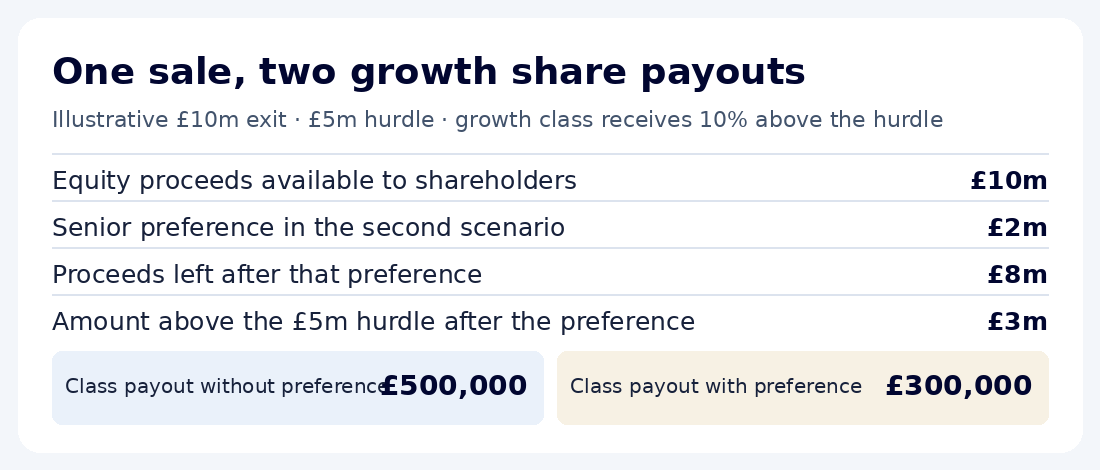
At the £10 million exit with the preference, £8 million remains. Subtract the £5 million hurdle and apply 10% to the £3 million excess. The class gets £300,000. A holder with a quarter of that class receives £75,000 before any personal tax or other individual adjustments.
For an issue-date valuation, the valuer looks at the rights in force at the valuation date and the range, timing and likelihood of future outcomes. A below-hurdle business value today can coexist with a positive value for the growth class if there is a credible chance of participating later. Our guide to valuing growth shares explains how the waterfall feeds into the valuation.
The wording can shift the point at which the class first receives cash. With the hurdle applied after the fixed £2 million preference, the growth class starts to participate above £7 million of proceeds in this example. If the hurdle were measured against total equity proceeds, the threshold test would instead start above £5 million, with the actual distribution still governed by the full payment order in the articles.
A second sensitivity is the holder’s share of the class. At the same £10 million exit with the preference, a holder whose share of the class falls from 25% to 20% would receive £60,000 instead of £75,000, assuming the class still receives £300,000. That isolates the effect of dilution within the class. A funding round that also changes preference terms needs a new calculation of the class payout.
What to give your growth share valuer before issue
- Articles and cap table. Send the current and proposed articles, with share classes, holdings, options and instruments that can convert into equity.
- Shareholder and funding documents. Include preference, conversion and dilution provisions, plus side letters that change the rights or payment order.
- Award terms. Include the proposed number and price of shares, issue date and any vesting, leaver or transfer conditions.
- Company evidence. Include current management accounts, forecasts and details of recent funding or share transfers.
- Purpose and approvals timetable. Confirm why the valuation is needed, who will rely on it and when the board expects to approve the issue.
A useful check before sign-off is to ask someone who did not build the model to reproduce one scenario using only the terms and cap table. Have them identify the starting proceeds, each senior payment, the hurdle calculation and the holder’s share. If they need an undocumented assumption, record it and ask the solicitor to confirm whether the documents support it.
Give the solicitor, valuer and tax adviser the same dated draft. If the board changes the hurdle, payment order or award terms before issue, send the revision back to the advisers and ask which conclusions need revisiting. Use our growth share scheme checklist to plan that sequence.
How UK companies amend and file growth share articles
First, ask the company solicitor to check whether the existing articles already provide for the proposed class and its rights. If the company needs to amend its articles, section 21 of the Companies Act 2006 provides for amendment by special resolution. Check any separate investor consent, allotment authority and pre-emption requirements for the proposed issue. A change to existing class rights can also trigger its own consent process. See the Companies Act provision on amending articles.
Build the filing dates into the issue timetable. Companies House requires the special resolution within 15 days of it being passed and a copy of the amended articles within 15 days of the amendment taking effect. If the company allots new shares, the return of allotment, usually form SH01, is due within one month of allotment. Confirm the required documents for the specific changes with the company’s adviser. See the Companies House guidance on company changes and allotments.
Use the signed terms to reconcile the filings, the company’s share records and the post-issue cap table. Keep a dated copy of the valuation and the terms it relied on. If award documents refer to an earlier draft of the articles, resolve and document the discrepancy before the issue is completed.
Confirm the position for employment-related growth shares
Where the shares are employment-related securities, ask the tax adviser to identify the acquisition date, the relevant market value basis and any potential tax, payroll and reporting obligations. Where a section 431 election applies and the parties decide to make it, employer and employee make the election jointly within 14 days of acquisition. Build that decision into the timetable before allotment. See HMRC’s guidance on elections for restricted securities.
Check the issue-date value separately from the exit payout
The payout examples show amounts at a hypothetical exit. An issue-date valuation asks what the proposed shares are worth at a particular date with the rights then in force. It can require estimates of future sale values, the timing of an exit and the likelihood of receiving anything above the hurdle. A third-party investment round can give a valuer evidence about the company, but the price of a senior share class may reflect protection that growth shareholders lack.
Where funding is under discussion, provide the latest terms and explain which ones are agreed, proposed or still being negotiated. Include any material events between the accounts date and the valuation date. A forecast based on one version of the funding plan and a cap table based on another can distort the model even if both documents are individually accurate.
Before directors approve the proposed issue, reconcile the number of shares, class, issue price and dates across the board papers, award documents and cap table. If the transaction slips or terms change, ask the valuer and advisers whether the existing work still applies. Maintain a record of each decision so that a buyer doing diligence later can see how the company arrived at the final terms.
Growth share approvals, tax and common questions
Who checks whether existing shareholders need to consent?
Ask the company solicitor to check the articles, shareholder agreement and any investor consent provisions. If the proposal varies rights attached to an existing class, section 630 of the Companies Act 2006 sets out how such rights can be varied, including the default class consent requirements where the articles contain no provision for the variation.
Which market value do we need for employee growth shares?
Ask the tax adviser to confirm the relevant valuation basis and whether restricted securities rules, an election or reporting obligations apply. The answer depends on the terms of the award and the purpose of the valuation. HMRC’s valuation guidance discusses how restrictions can affect the basis used.
Can we brief the valuer while the articles are still in draft?
Yes. A draft lets the valuer identify unclear terms and test how alternative wording changes payouts. Before relying on the report for issue, confirm that the valuation uses the rights and award terms the company will adopt.
What if the company is sold for less than the hurdle?
If the agreed base for the hurdle falls below the threshold, the growth class receives no payout under that hurdle formula. Read the other terms to see whether dividends, a minimum entitlement, conversion or another class right could apply. In the worked example, the base is either total equity proceeds or the balance after paying a senior preference, depending on the scenario.
What happens if an investor converts preference shares on sale?
Rebuild the waterfall for the conversion case. The investor may participate alongside ordinary shareholders and the senior preference may fall away, depending on the terms. Recompute how much is available to the growth class and which instruments count in the denominator. Compare investors’ outcomes on both bases if they have a choice.
When should we revisit the growth share model?
Revisit the assumptions when the company changes the share rights, raises new capital, issues significant options or changes the anticipated timing or structure of an exit. Keep the previous model and document the change that led to the new result. This helps explain movements in expected payouts and lets advisers assess whether an updated issue-date valuation is needed for any new award.
Preparing to issue growth shares?
Share the latest draft rights, cap table and proposed issue date. Consult EFC can help you scope the UK growth share valuation and identify questions to take back to your advisers. You can also book a free 30-minute consultation.
Not sure where your business stands right now?
Book a free 30-minute call with Kish. Bring your numbers, your questions, or just your situation. You will leave with a clearer picture than you arrived with.
Book a Free Strategy Call
Over 12 years across Big Four audit, Investment Banking, and corporate advisory. Kish works with SaaS founders, tech companies, and ambitious UK SMEs from £1M to £50M in revenue on fundraising, valuations, exit planning, and financial strategy. ICAEW regulated. Big Four trained. Based in London.