

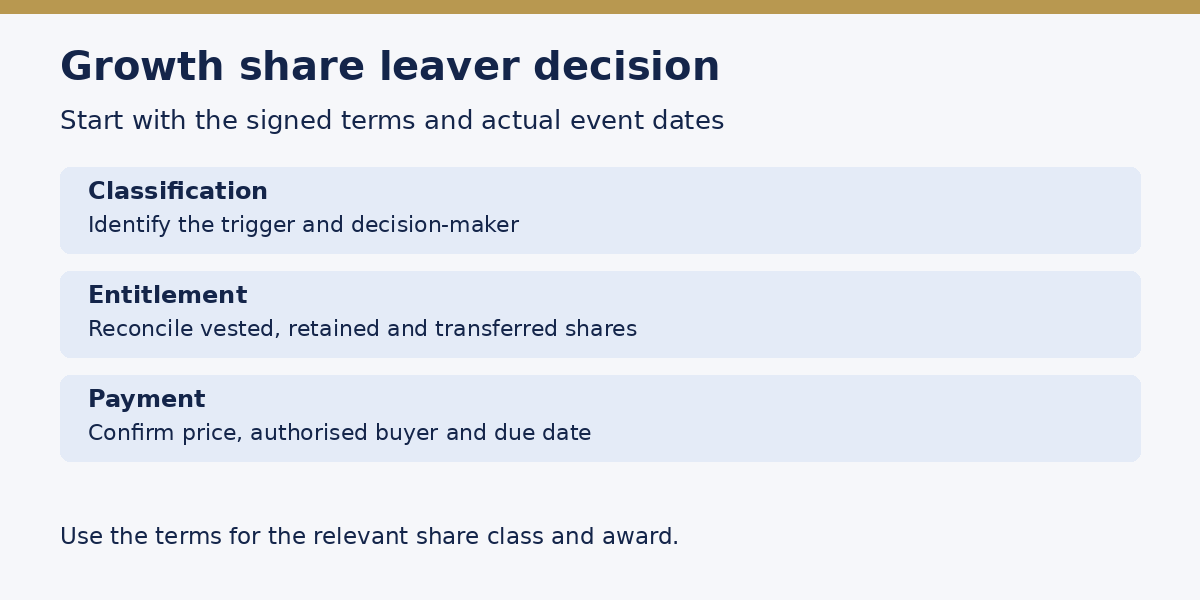
When an employee leaves with growth shares, read the adopted documents for four answers: how the departure is classified, which shares can be retained or transferred, what price applies and when payment is due. Growing company value and vested status can matter, but the transfer price depends on the actual growth shares good leaver and bad leaver terms. Record the transfer price formula and the valuation date for each award.
On this page
1. Read the definition and trigger before classifying the leaver
Start with the exact departure event. A role can end through resignation, redundancy, retirement, incapacity, dismissal or a negotiated departure. The growth shares good leaver and bad leaver definitions may use different categories from HR or include an intermediate outcome. Have the solicitor identify the rule that applies and who is entitled to decide. A board should record the facts and the terms it relied on.
Find which documents govern the shares. The articles may establish a transfer mechanism while the award agreement sets out individual conditions. An employment agreement might refer to different timing. Supply the solicitor with signed versions, amendments and any records of consent. Ask them to explain how the documents interact before the finance team prepares a price.
Check which date triggers the process. Some terms may refer to notice, the end of employment, a decision or a transfer notice. Record the date provided by the solicitor and which other dates matter for valuation or payment. Save the evidence so someone reviewing the cap table later can understand when the outcome took effect.
Ask who has discretion and whether any approval, notice or procedure applies before relying on a classification. Keep the financial scenario separate from the decision on the facts. Finance can compare the value under each route while the team responsible for the decision confirms what the signed documents and circumstances support.
2. Separate vested shares, unvested shares and retained rights
For each grant, reconcile the original issuance to the current holding. Check share certificates or records, the register, any earlier transfers and the vesting schedule. The cap table should show which shares were issued and what terms affect them. Ask whether vesting changes ownership, retention or price under the actual terms. Those consequences need their own columns in the working schedule.
A person might be entitled to keep vested growth shares, required to sell them, or allowed to keep only a defined portion. Share rights could vary by grant or issue date. Review any acceleration, performance measure, exercise or conversion provisions with the relevant advisers. Do not apply one award’s terms to every share held by the same employee.
Model a departure before and after the next vesting event. If 600 of 1,000 issued shares are vested and 100 more would vest one month later, calculate both outcomes under the applicable clauses. In a simple compulsory-transfer scenario with a £4 price for vested shares and £1 for unvested shares, the first transfer gives £2,800. With 700 vested, it gives £3,100, assuming the prices remain the same. Keep the transfer price, the value on a later sale and the number of retained shares in different columns.
Show any shares that the employee keeps separately from cash paid on a transfer. They may still have voting, information, dividend or exit rights depending on the class. Keep the post-departure cap table aligned with the instructions given to anyone negotiating the next funding round or sale.
3. Identify the transfer price formula and who sets it
The documents may prescribe a fixed amount, the original subscription cost, an agreed market value definition or a formula based on the lower of two figures. Use the exact definition and avoid substituting a convenient market value measure. If the terms require an independent expert, ask the solicitor to confirm appointment, access to information, scope and dispute procedure.
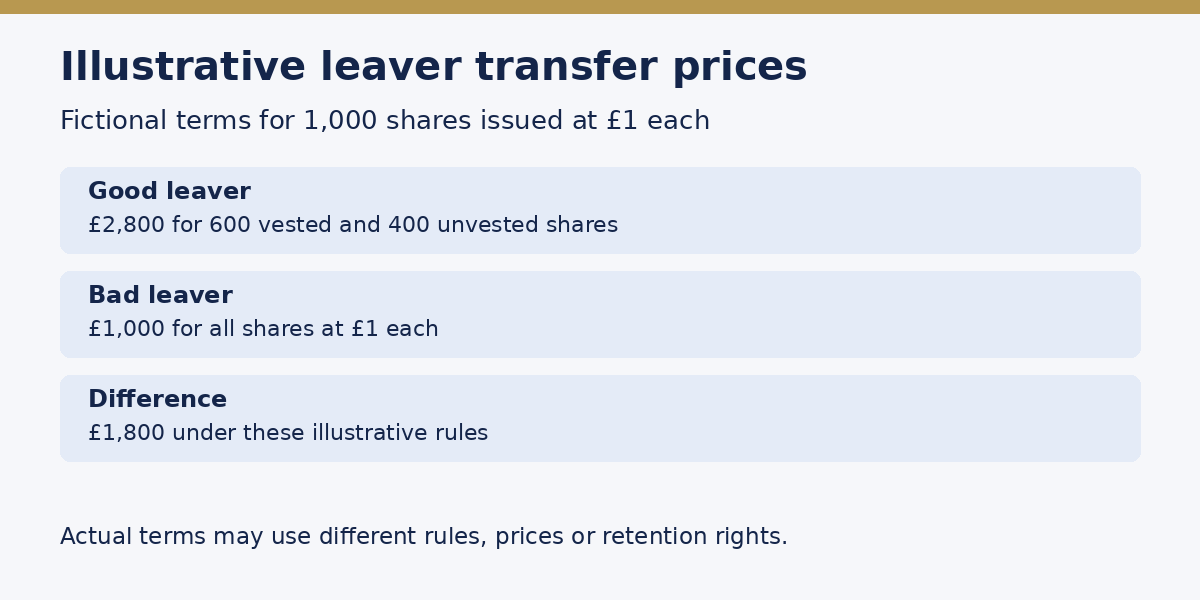
For an illustrative growth shares good leaver and bad leaver comparison, assume the company issues 1,000 shares at £1 each. In one fictional set of terms, a good leaver transfers 600 vested shares at £4 each and 400 unvested shares at £1 each. That produces £2,800. The bad leaver terms in this example require all 1,000 shares to transfer at £1 each, producing £1,000. The £1,800 difference is entirely due to the stipulated rules. It is neither a market benchmark nor a recommendation for either category.
Do not infer a payout from a percentage alone. A different clause might allow the good leaver to retain the 600 shares and receive £400 for the remainder. In that case, £400 is the immediate cash under those assumptions, and the 600 shares remain exposed to the future business outcome. A reader needs to see cash today and continuing entitlement separately.
Check whether the price is inclusive of a particular adjustment, whether any fraction can arise, and how payment is funded. Have the solicitor check the resulting notices and the tax adviser consider the treatment before giving anyone a final amount.
| Assumed terms | Cash on transfer | Shares kept |
|---|---|---|
| Good leaver, transfer of all shares | £2,800 | None |
| Bad leaver, transfer at subscription cost | £1,000 | None |
| Alternative, keep vested shares | £400 | 600 |
4. Confirm which valuation date and evidence are relevant
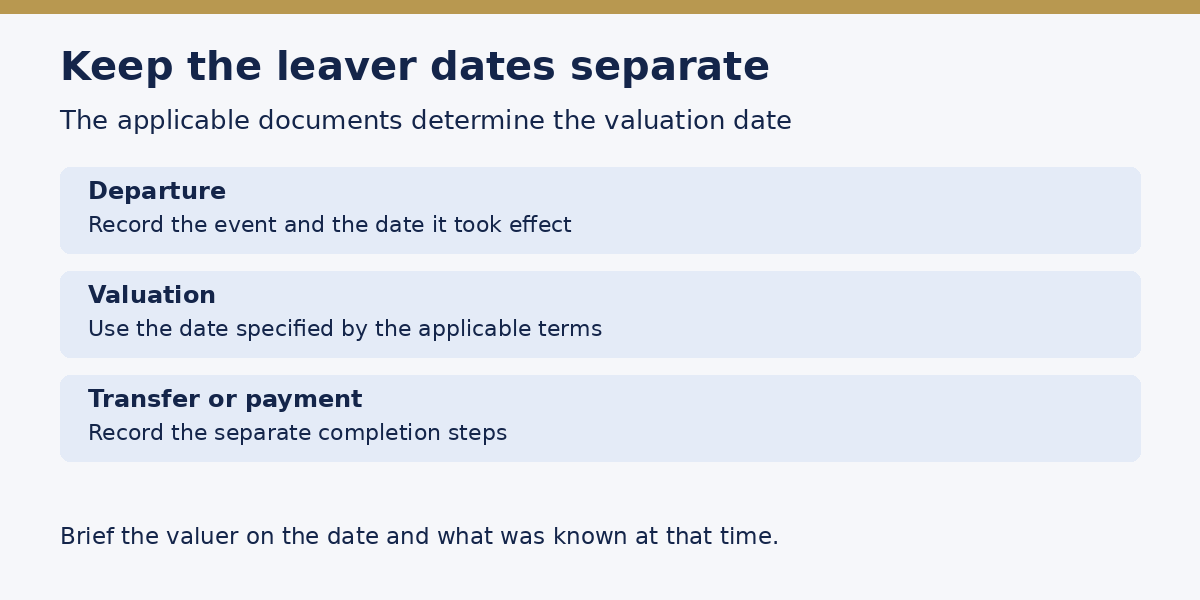
A leaver valuation may require information as at a contractual date. Ask the solicitor to confirm what the expert is being asked to assess, the basis for the price and how the date is fixed. The valuation date, legal transfer date and payment date can be different. A report that answers a different date can change the result even if its methodology is sound.
Provide the valuer with the cap table, class rights, hurdle, priority payments, conversion terms, recent financial information and relevant transaction or funding materials. Include what was known and supportable at the required date. If a later offer becomes available, ask the valuer and solicitor what bearing it has under the applicable basis. Avoid simply carrying the sale price back to an earlier date.
For example, suppose the adopted price definition requires valuing the share class at the departure date, while a buyer signs heads of terms two months later. Keep both events in the chronology and record what negotiations were actually known at departure. The weight of later information depends on the engagement and instructions. The business should provide the evidence and let the appointed adviser make that assessment. Ask the adviser to say which assumptions need to be confirmed before the leaver valuation is used to agree the transfer price.
Confirm whether the transfer price basis also supplies any value the tax adviser needs. A contractual price and a statutory value can answer different questions. HMRC describes how restrictions that affect market value can be relevant to employment-related securities in its restricted securities guidance.
Consult EFC specialises in growth share valuations. For a leaver valuation, bring the signed terms, the departure timeline and the price basis your solicitor has confirmed, so we can scope the valuation against the right date and rights.
5. Check who can acquire the shares and when cash is due
The permitted buyer may be another shareholder, a nominee or the company itself, depending on the documents and legal requirements. Ask the solicitor to identify the permitted mechanism and approvals, then ask finance to show who pays and when funds are available. A signed transfer process and ability to fund the payment are separate questions.
A purchase by the company is subject to the Companies Act rules on purchasing its own shares. Legal and tax advisers should confirm the permitted route, funding and reporting. See the Companies Act provisions on purchase of own shares and the Companies House guidance on form SH03. A transfer to an existing shareholder can follow a different route and have different tax and filing considerations.
Add the payment to the cash forecast. If the company is permitted to pay and expects several leavers in a short period, model the aggregate requirement and compare it with payroll, tax and supplier payments. Ask for the timetable in writing rather than relying on an estimate that assumes payment can be delayed.
Agree who will update the share records once the solicitor confirms completion. Retain the valuation, price reconciliation and evidence of payment with the underlying terms. If the transaction has not completed, show it as pending in the working cap table so a prospective investor does not confuse an expected transfer with the registered position.
6. Model a departure shortly before a company sale
Compare the dates and rights in a late-stage sale. Ask whether the leaver could retain the shares, lose entitlement on an earlier trigger, receive a price based on a later event or qualify for a formula adjustment. Ask legal advisers to check the terms for a sale that is agreed, signed or completed at different moments. Avoid relying on an informal assurance about what the employee will receive.
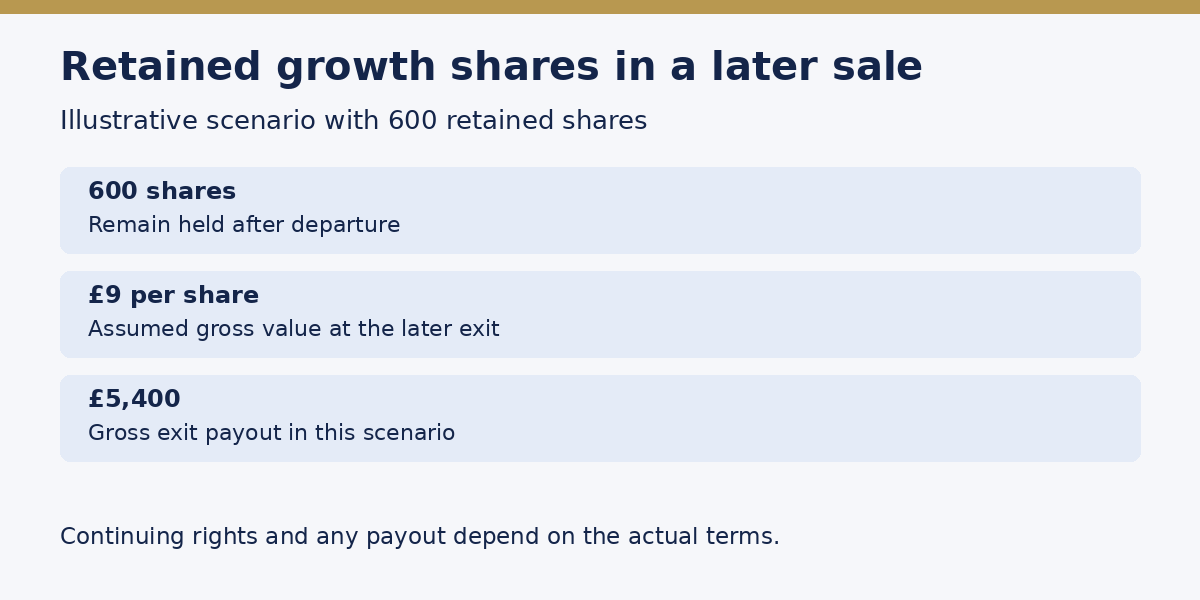
Continue the fictional case. If the employee keeps 600 shares and a later exit returns £9 per retained share under the agreed waterfall, the example gives a gross £5,400 at that exit, subject to the terms. That is distinct from the £2,800 immediate compulsory-transfer case. Do not add the figures together if the two scenarios are alternatives. A person who transferred all shares has no continuing payment in this example. A well-documented transfer price lets a later reviewer trace the result to the right clause and share count.
Run the same exercise for a sale below the hurdle and for a sale with deferred or contingent consideration. Explain which assumptions create or remove payment and when cash would be received. A leaver may see a large illustrative number, so label gross, before-tax amounts and identify which conditions must be met.
In a sale process, reconcile the holder list with all outstanding notices and the sale waterfall. Make sure the legal team knows about disputes or incomplete transfers that could affect who signs or who receives consideration. A board-approved forecast does not settle those legal questions. Keep them on the completion issues list until resolved.
7. Keep a clear finance file and explain the outcome
Put the departure timeline, classification advice, cap table, relevant clauses, valuation and price calculation into one working file. Record what is agreed, who approved it and open questions. A short reconciliation should show the starting share count, which shares stay or transfer, who pays, and when the cap table can be updated. This helps HR and finance explain the same outcome.
Where employees are given a summary, distinguish confirmed terms from illustrations and say who can answer questions about the award. Be precise about the date and price basis. If two parties still disagree about what the clauses say, refer the point to the relevant adviser. Financial modelling can quantify the options while the company identifies the correct legal and tax treatment.
If you’re designing new terms, repeat the exercise for resignation, redundancy and a departure shortly before sale. Ask the team to reproduce the outcome using the documents alone. Where the process depends on discretion, identify who exercises it and how the result is communicated. That can reveal an unclear definition before the first real departure.
For related work, see the growth share articles checklist. Consult EFC can help scope a growth share valuation once the solicitor has confirmed the date, rights and price basis. Give the specialists the same version of the terms and timeline before commissioning the report.
| Record | Who checks it | Question it answers |
|---|---|---|
| Signed award and articles | Solicitor | Which terms and transfer route apply? |
| Register and vesting schedule | Finance with legal confirmation | How many shares can move or be kept? |
| Dated valuation and price formula | Valuer and solicitor | What amount follows on the agreed basis? |
| Tax and payroll instructions | Tax adviser and payroll | Which reporting or deductions apply? |
| Payment evidence and updated cap table | Finance | Does the actual transfer match the final record? |
Document who makes each decision and what they need
Assign the ownership of each step before you commission a valuation. HR should confirm the employment timeline and documents it holds. The solicitor should identify the applicable rules, decision-maker, permitted transfer and valuation instructions. The finance team should reconcile the share count, build the payment schedule and preserve the evidence. The tax adviser can then review whether the same or another measure is needed for tax purposes.
Keep alternative outcomes clearly labelled while the classification remains under review. If a fictional award has 600 vested shares, finance can provide both the £2,800 transfer case and the £400 plus retained shares case. Each case should state why it exists and which clause or legal conclusion would make it applicable. The employee can then be told the confirmed outcome once it has been determined.
If an external expert is appointed, check what information is available to each party and how corrections are handled. Give the expert a dated set of accounts, relevant forecasts and a copy of any known transaction evidence required by the scope. Keep a record of new information supplied after the initial brief. The expert can assess its relevance against the specified valuation date and basis.
Ask whether the company is about to announce another financing, grant a new incentive or begin negotiations with a buyer. Model the cap table with the leaver transfer pending and with it completed. A difference in voting or proceeds can change the picture even if the payment itself is small. Share the current record with the appropriate deal team and mark open approvals or notices.
After completion, compare the final transfer record with the amounts paid and the updated cap table. Keep the reconciliation and the source documents in the file the business uses for future shareholder questions. If the award was employment-related, ask the tax adviser to confirm whether any reporting follows the departure or transfer. The recorded owner, rights and cash payment should all tell the same story.
See how UK growth shares work and the growth share valuation mistakes guide for other questions to flag before commissioning work.
Frequently asked questions
Does a good leaver automatically keep vested growth shares?
No. The signed terms may allow retention, require a transfer or provide another outcome. Check the vesting rules, transfer notice and price formula together.
Can vested growth shares be subject to a compulsory transfer?
Yes, where an enforceable provision applies. Ask your solicitor to identify the triggering event, notice requirements, affected shares and transfer price.
Which date should be used for a leaver valuation?
Use the date specified by the applicable documents as confirmed by the solicitor. It might differ from the last day of work or payment date. Brief the valuer on the correct date and evidence available at that date.
Is a company buyback the same as transferring shares to another shareholder?
No. A purchase by the company is subject to its own statutory, funding and filing requirements. Ask legal and tax advisers to confirm the permitted route and who pays.
Can a sale shortly after departure change the leaver’s payout?
It can if the applicable terms provide for retention, an adjustment, a relevant valuation date or another entitlement. Ask your advisers to check the timing and before-and-after scenarios.
Not sure where your business stands right now?
Book a free 30-minute call with Kish. Bring your numbers, your questions, or just your situation. You will leave with a clearer picture than you arrived with.
Book a Free Strategy Call
Over 12 years across Big Four audit, Investment Banking, and corporate advisory. Kish works with SaaS founders, tech companies, and ambitious UK SMEs from £1M to £50M in revenue on fundraising, valuations, exit planning, and financial strategy. ICAEW regulated. Big Four trained. Based in London.