



What are growth shares?
Growth shares are a class of shares that typically lets the holder share in the increase in a UK company’s equity value above an agreed threshold, called a hurdle. The share rights determine what the holder receives on a sale or other distribution. A class can have market value today even when it would receive nothing on a sale at today’s equity value, because it may receive a payout in the future.
Growth shares can be considered by UK technology, AI and data companies, professional-services firms, family businesses and other SMEs. The relevant question is not whether the company looks like a startup. It is whether a separate right to future growth answers a clear commercial need, and whether the cost, rights and administration are proportionate.
- Shares participate only in value above the hurdle, not in historic company value
- The subscription price needs support from the value of the actual shares and the acquisition circumstances.
- A disposal may be within CGT, subject to the employment-related securities and other relevant rules.
- Issued shares and options have different legal mechanics; check the actual rights and current EMI exercise rules.
- Available to employees, directors, consultants, family members, and trusts
- Require amendments to the company’s articles of association to create a new share class
How do growth shares work?
A growth shares example with two possible exits
Assume the growth class gets 10% of equity sale proceeds above a £5 million hurdle, with no senior preference or other adjustments. At a £4 million sale the class gets £0. At an £8 million sale it gets £300,000, calculated as 10% of the £3 million above the hurdle. That is the amount for the whole class. An employee’s own payout depends on how much of the class they hold and their award terms.
Before quoting a payout, ask who is paid first and whether the hurdle applies before or after that payment. See what to check in the growth share articles of association for a comparison with preference shares, or read how investors value growth shares.
The hurdle is a contractual participation threshold. Its relationship to current company equity value must be supported, but there is no universal requirement to add a fixed percentage premium. A company with £10 million of current equity value and a £12 million hurdle may produce no immediate payout to growth holders. That does not establish that their future participation is worth nothing today.
“Hope value” describes the value of possible future participation; it is not simply the arithmetic gap between the hurdle and the current company value. The issue price must be supported for the particular shares and acquisition date. A nominal price, however convenient for the recipient, is not evidence of market value.
Illustrative example: suppose distributable equity proceeds are £20 million, the hurdle is £12 million and the entire growth class receives 10% of the £8 million excess. The class receives £800,000. Someone holding 1% of that class receives £8,000. Someone separately entitled to 1% of the excess would receive £80,000. Those rights are different. Tax and other omitted adjustments require separate assessment. A low exit can produce no payout without the shares automatically lapsing; the documents govern what happens.
Voting, dividend, conversion, leaver and sale rights depend on the documents. Some growth classes restrict them; the label does not remove shareholder rights automatically. Allocation usually concerns equity entitlements after relevant adjustments and preferences, rather than a simple option on unadjusted enterprise value.
Before finalising the hurdle, compare the current equity evidence with realistic future outcomes. Explain what the proposed participation would deliver in each outcome and whether the recipient regards that as a meaningful incentive.
Key mechanics to understand:
- The hurdle is expressed as a cash amount, sometimes with an annual coupon that increases it over time
- Participation above the hurdle is defined by a ratio versus ordinary shares, agreed at issue
- Dividend rights are usually absent or minimal, to keep day-one value low
- Voting rights are typically excluded to preserve founder control
- Good leaver and bad leaver provisions govern what happens to shares if an employee departs
- Tag-along and drag-along rights protect growth shareholders in a sale
Why growth shares benefit both companies and employees
A growth class can reserve a defined first slice of future proceeds for existing holders while sharing subsequent growth. That does not make the new rights costless. Their future participation can have present value, and a new issue changes ownership. Explain both the issued cap table and the economic waterfall instead of claiming that growth shares create no dilution.

For employees, the attraction is real ownership rather than a promise. Unlike options, which are a contractual right to buy shares later, growth shares are actual shares held from day one. That status creates a genuine psychological stake in the company’s success, and it comes with legal protections that options do not automatically carry. Actual share ownership can be used to enforce retention through forfeiture provisions, meaning a departing employee loses unvested shares rather than simply walking away.
Tax is an important part of the decision, but a small acquisition charge and capital treatment on exit should not be promised. Relevant value, price paid, restrictions, elections, employment-related securities rules and later events need assessment. Eligibility for any capital gains relief is a separate question and cannot be inferred from the growth-share label.
Growth shares may be considered for a broader range of recipients than an employee-only option plan, including some consultant or family arrangements. Each relationship raises its own legal and tax questions. Issued shares are not options with a standard exercise deadline, but their terms may provide for vesting, compulsory transfer or other conditions. Compare the actual documents and current EMI rules rather than an assumed ten-year deadline.
Benefits at a glance:
- An acquisition cost based on the rights and relevant value, rather than an assumed nominal price.
- Potential capital treatment on disposal, requiring assessment of the facts and applicable rules.
- Defined participation can reserve an initial slice of proceeds for existing holders, subject to the rights.
- No standard option-exercise deadline for issued shares; actual leaver and transfer terms still matter.
- Suitable for non-employee participants including consultants and family trusts
- Retention enforced through leaver provisions and forfeiture clauses
- Aligns employee incentives directly with company growth above the hurdle
Tax treatment of growth shares in the UK
Start the acquisition tax analysis with the relevant value of the shares and the consideration actually provided. A genuine commercial hurdle can affect that value but does not make it automatically nil. The correct treatment of restrictions, employment connection, payment terms and any election needs advice before acquisition; company value less hurdle is not an acquisition-tax calculation.
An employment-related acquisition below the relevant value can create an income-tax charge. PAYE and National Insurance depend on the applicable rules, including whether the securities are readily convertible assets. Identify who will assess and operate payroll obligations. A report should support its assumptions, but no report by itself guarantees the tax result.

A disposal may create a capital gain, but the allowable cost and interaction with employment-related charges require analysis. Restricted-securities and other provisions can matter at later events. Ask the tax adviser to assess relief eligibility and the employer’s deduction position on the actual arrangement; neither a universal deduction nor a universal denial follows merely from calling the shares growth shares.
A section 431 election is a joint employer-and-employee decision where the restricted-securities rules make it relevant. Under HMRC guidance, it must be made in an approved form within 14 days of acquisition. It can increase the acquisition charge and address specified later restricted-securities charges, rather than guarantee capital treatment for every subsequent gain. Keep signed evidence and agree responsibility before issue. Making the election is separate from submitting the annual ERS return.
Assess whether the arrangement and acquisition are reportable under the employment-related securities rules. Registered schemes require an annual ERS return, including a nil return where applicable, by 6 July after the tax year. Identify the person responsible for registration, records, submission and any final return; a valuation report does not perform those tasks.
Key tax points:
- Assess acquisition value, payment, restrictions and applicable employment-related charges.
- Discounted issue triggers income tax and potentially employer NICs on the discount
- Disposal gains and any employment-related charges require assessment; subscription price alone does not determine the full tax calculation.
- BADR may be available subject to standard qualifying conditions
- Consider any appropriate section 431 election before acquisition and make it within the required period.
- Annual ERS return is mandatory; missing it carries penalties
- Do not assume an ordinary growth-share acquisition uses the EMI VAL231 agreement route.
Growth shares vs EMI options: which should you choose?
EMI deserves consideration where both company and participants qualify, but it is not automatically the best answer. Compare ownership timing, exercise cost, commercial rights, liquidity, tax conditions and ongoing administration. HMRC valuation agreement is a voluntary service, not a general approval of the entire incentive arrangement.
Check the current EMI rules and the grant date. For most eligible companies, changes from 6 April 2026 increased the gross-assets limit to £120 million and the employee limit to fewer than 500, with exceptions for specified Northern Ireland companies. Other company, trade and employee conditions remain relevant. See HMRC’s limits and exercise-period guidance. Do not reject EMI using the old £30 million and 250-employee limits without checking which rules apply.
For a detailed look at how valuations differ across these instruments, the Consult EFC guide on ordinary shares and EMI options covers the mechanics in depth.
| Feature | EMI options | Growth shares |
|---|---|---|
| Eligible holders | Employees only | Employees, directors, consultants, family, trusts |
| Company eligibility | Qualifying company and employee conditions; check current limits, grant date and exceptions. | Any company |
| Tax at grant or issue | None | Acquisition treatment depends on relevant value, price paid and restrictions. |
| Tax on exit | Tax treatment and relief eligibility depend on the relevant conditions. | Disposal and employment-related tax rules require separate analysis. |
| Day-one cost to holder | Nil (option, no upfront payment) | Subscription at market value (low but positive) |
| Valuation | EMI valuation agreement can be requested voluntarily using the relevant HMRC route. | Independent valuation, no HMRC pre-clearance |
| Expiry | Check the applicable grant-date rules, option terms and any permitted extension. | No expiry |
| Annual ERS reporting | Required | Required |
| Dilution timing | On exercise | On issue |
Practical scenarios where growth shares win:
- Company has exceeded the EMI gross assets or employee headcount limits
- Non-employee participants (advisers, family members, trusts) need to be included
- The ordinary share price is so high that meaningful EMI grants would breach the £250,000 individual limit
- The actual option exercise window or share terms do not fit the commercial plan, after checking the current rules.
- Succession or estate planning requires ringfencing existing value for family members
For a broader perspective on how growth-oriented equity thinking applies to investment strategy, the Finblog guide on growth vs value investing is a useful reference point.
Who can use growth shares and how they are typically structured
Growth shares may be considered for employees, directors and some non-employee recipients, but no category is automatically free of legal or tax consequences. Family transfers, trusts, reorganisations and non-resident recipients need their own analysis. An arrangement should be driven by the commercial objective rather than an assumption that it avoids employment or inheritance taxes.
Common commercial uses include:
- Incentivising senior employees or management teams in companies that have outgrown EMI
- Including non-employee advisers and consultants in equity arrangements
- Succession planning in family businesses, where growth shares pass future value to the next generation
- Succession planning where the relevant inheritance-tax, capital-gains and trust issues have been separately assessed.
- Complementing an existing EMI scheme where individual limits have been reached
Structuring the shares requires careful thought on several fronts. Vesting schedules, leaver provisions, and shareholders’ agreements must be designed to protect both the company and its existing shareholders. A typical arrangement includes time-based vesting over three to four years, with a cliff at year one, and clear good leaver and bad leaver definitions that determine whether departing employees keep their shares at fair value or forfeit them at par.
The articles of association must be amended to create the new share class, and shareholders must approve the amendment. A growth share subscription agreement is then entered into with each participant, setting out the hurdle, the participation ratio, the leaver provisions, and any other rights. Dividend rights are usually excluded or kept minimal to avoid creating taxable income before exit. Voting rights are typically excluded to preserve founder and investor control.
Pro Tip: Draft the leaver provisions before you issue a single share. Ambiguous good leaver and bad leaver definitions are the most common source of shareholder disputes on exit, and they are far harder to fix after the fact.
Growth share valuation: getting the hurdle right
Separate the commercial hurdle decision from valuation of the actual shares. A low hurdle may create more valuable rights; a high hurdle may make the reward commercially weak. There is no universal 10% to 40% premium. Test the proposed rights against supported company equity value and realistic outcomes, then assess their present value using an appropriate approach.
Do not assume the EMI VAL231 agreement route applies to an ordinary growth-share acquisition. The relevant tax purpose and available HMRC route need assessment. Preserve the evidence, financial model and rights used. Scenario analysis or an option-pricing approach may be appropriate, but no one model is mandatory for every structure. The method must match the rights and valuation basis.
Review the relevant evidence before a later issue, transfer or other valuation event. A funding round, changed rights, material trading change or credible sale process can make an older report unsuitable for a new date. That does not automatically reset an existing contractual hurdle. Altering issued rights can itself require legal, commercial and tax advice.
Consult EFC provides growth share valuation support for a defined purpose and date, including company analysis, share-class allocation and explained conclusions as agreed. Legal drafting, tax design and reporting responsibilities are separately scoped with the relevant advisers.
Common valuation mistakes to avoid:
- Setting the hurdle below current market value, creating an immediate income tax event
- Using a Black-Scholes model with an unsupported or generic volatility assumption
- Failing to update the valuation after a funding round or material corporate event
- Issuing growth shares immediately before a known sale, when the day-one value approaches the exit price
- Skipping the annual ERS return, which weakens the evidential record
- Drafting participation rights ambiguously, leading to disputes over the exit waterfall
Choose a valuer who can explain the company evidence, rights, allocation method and limitations. Ask what the report covers, who can rely on it and what specialist legal or tax work remains. The quality of the analysis matters more than an unsupported assurance that a report is “HMRC approved”.
How long does it take to set up a growth share scheme?
Agree a timetable after reviewing the records, proposed rights, approvals and adviser availability. A straightforward valuation and a multi-class arrangement with unresolved legal terms are different engagements. Work back from the intended acquisition date and allow time to resolve inconsistencies before documents are signed.
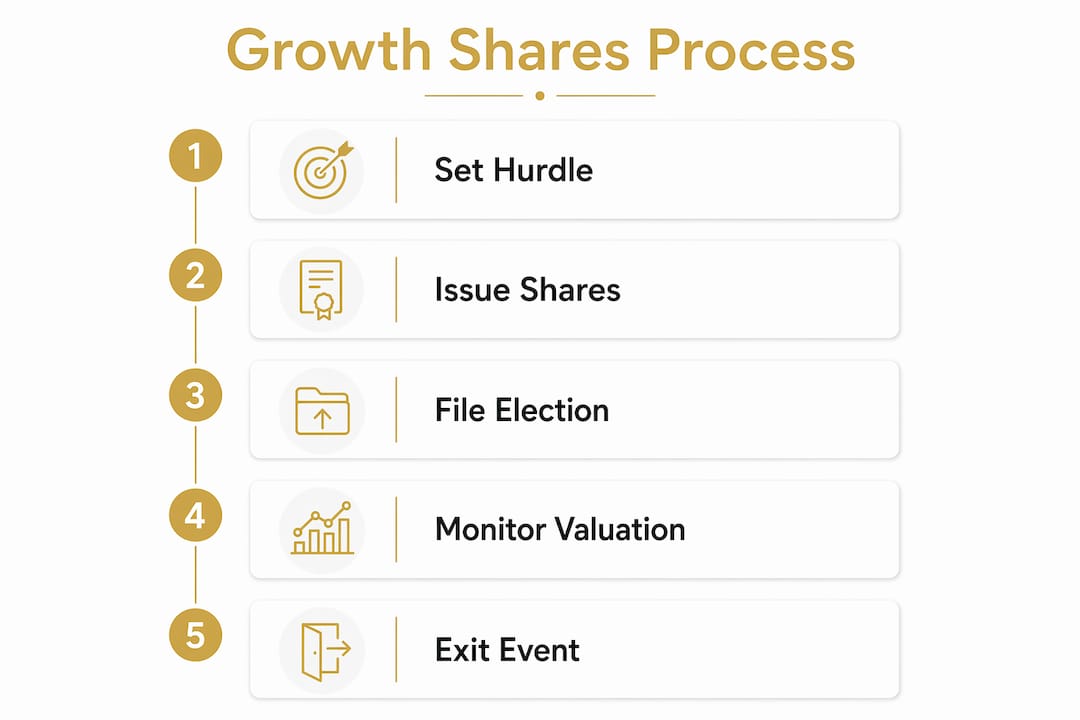
The working sequence is to agree the commercial objective, review company value, develop the proposed rights with legal and tax advisers, analyse the resulting share value, obtain approvals and complete the acquisition. Keep a controlled final document set. Address any appropriate election within its statutory window and complete the separate company and ERS reporting. Some steps can run in parallel, but valuation assumptions must match the final rights.
The valuation is usually the longest single step, particularly if the company has a complex capital structure or has recently completed a funding round that needs to be reflected in the methodology. Founders who try to compress this step by using a rough internal estimate rather than a documented independent valuation create a significant HMRC risk that can surface years later on exit.
For companies that want to understand the full valuation process before committing to a scheme, the Consult EFC guide on valuation before issuing equity covers the methodology and documentation requirements in detail.
Legal and administrative requirements for issuing growth shares
The legal requirements for growth shares are more demanding than for EMI options, partly because there is no universal template to follow. Every scheme is bespoke, and the documentation must be watertight.
Legal advisers should confirm whether new articles, resolutions, class consents or allotment authority are required. Filing an SH01 return of allotment is a separate task from filing resolutions or amended articles. Companies House guidance specifies the allotment reporting requirements. Do not treat one form as completing every legal change.
A shareholders’ agreement or deed of adherence should also be updated to bring growth shareholders into the governance framework. This covers tag-along and drag-along rights, information rights, and any restrictions on transfer. Growth shareholders who are not party to the shareholders’ agreement can create complications on exit if a buyer requires all shareholders to sign the sale documents.
Complete the required acquisition documents and record the consideration actually paid. Agree who will prepare any appropriate joint election, preserve signed copies and handle the relevant Companies House, payroll and ERS tasks. These responsibilities should be explicit, rather than assumed to sit with the valuer.
Administrative requirements at a glance:
- Amend articles of association by special resolution and file at Companies House
- File Form SH01 with Companies House to record the allotment
- Commission and document an independent valuation
- Draft and execute growth share plan rules and subscription agreements
- Make and retain any appropriate section 431 election within its statutory period.
- Report on annual ERS return by 6 July each year
- Update the shareholders’ agreement or deed of adherence for new participants
Risks and challenges founders should not underestimate
Growth shares carry real risks for both companies and employees, and the most dangerous ones are the ones that surface years after the shares are issued.
Unexpected tax can arise from an undervalued acquisition, restrictions, later events or other employment-related securities provisions. A missed relevant election can matter, but it is inaccurate to state that every exit gain automatically becomes income. Preserve the actual records and seek advice on the specific facts; never backdate an election or assume a later valuation cures a missed statutory step.
For companies, the risks are primarily governance and administrative. Growth shareholders are real shareholders with legal rights, and they must be managed accordingly. A disgruntled growth shareholder who believes their participation rights were misrepresented can disrupt a sale process at the worst possible moment. Poorly drafted leaver provisions create disputes when a key employee departs before exit. Missing the annual ERS return filing creates penalties and, more seriously, weakens the company’s evidential position if HMRC later challenges the valuation.
There is also a risk that the tax treatment changes. CGT rates and BADR rules are subject to legislative change, and employees should be informed that the tax efficiency of growth shares depends on the current regime remaining in place. The Autumn 2024 Budget made changes to BADR rates, and further changes cannot be ruled out.
Key risks to manage:
- Missing a relevant section 431 election window; obtain advice promptly and preserve the records.
- HMRC challenging an underdocumented or stale valuation
- Ambiguous participation rights creating exit waterfall disputes
- Leaver provisions that are too vague to enforce cleanly
- Issuing shares immediately before a known exit, when the tax risk is highest
- Failing to update the valuation after a funding round or material corporate event
- Changes to CGT rates or BADR rules altering the expected tax outcome
How Consult EFC helps you structure growth shares correctly
Growth shares are one of the most flexible equity incentive tools available to UK founders, but they are also one of the easiest to get wrong. A missed section 431 election, a stale valuation, or ambiguous articles can turn a well-intentioned incentive into a tax liability that surfaces at the worst possible moment: on exit.
Consult EFC is led by Kishen Patel, ICAEW Chartered Accountant, and supports UK businesses across sectors. The growth-share engagement focuses on the agreed valuation purpose, company evidence, rights and allocation. We coordinate information with the client’s legal and tax advisers and identify separately scoped work. Request a fixed-fee valuation proposal with your intended issue date and proposed rights.
Key takeaways
Growth shares can align reward with defined future participation, but their value and tax treatment depend on the facts. Separate company value, the hurdle and current share value. Agree legal, tax, valuation and reporting responsibilities before acquisition, and explain outcomes to recipients without promising liquidity or a tax result.
| Point | Details |
|---|---|
| Hurdle pricing is the foundation | The hurdle defines participation, while future rights can have present value below that threshold. |
| Section 431 election requires advice | Where appropriate, make a joint election within 14 days of acquisition; it does not guarantee all future tax treatment. |
| Valuation must be supported and documented | Keep a supportable valuation and assess the relevant route; do not assume the EMI process applies. |
| Growth shares suit wider participants than EMI | Unlike EMI options, growth shares can be issued to consultants, family members, and trusts, with no company size limits. |
| Leaver provisions must be precise | Ambiguous good leaver and bad leaver definitions are the most common source of exit disputes in growth share schemes. |
Recommended
- Growth Shares for UK Startups: Complete Founder Guide | Consult EFC
- Growth shares valuation: a guide for businesses
- Growth Share Valuation: Why Founders Need It Before Issuing Equity
- Growth Shares Valuation Mistakes That Hurt Tax & Trust
A board decision pack for a growth-share issue
Separate the investment decision from the administration. The board should understand the commercial objective, who is receiving rights, the expected reward under several outcomes and the costs of maintaining the arrangement. A statement that the shares are “tax efficient” is not enough to explain why this structure is appropriate.
| Decision | Evidence to review | Owner to agree |
|---|---|---|
| Commercial objective | Role, contribution, retention goal and realistic liquidity routes | Management and board |
| Participation | Final rights and worked equity-proceeds waterfall | Legal adviser and management |
| Valuation | Company evidence, acquisition date, class allocation and sensitivities | Valuation adviser |
| Tax treatment | Recipient circumstances, restrictions and applicable charges | Tax adviser |
| Completion and reporting | Approvals, documents, payment, elections and filing timetable | Named legal, tax and company contacts |
Record the final rights and the date used in the valuation. If a last-minute legal change alters participation, do not treat it as a cosmetic revision. Ask whether it affects the financial analysis or tax advice. Equally, do not rewrite an existing hurdle just because company value has changed; existing holders may have rights that need to be respected.
Explain the downside to participants
Give a simple schedule covering an exit below the hurdle, a moderate outcome and a stronger outcome. Identify whether amounts are before tax, whether the recipient must pay cash at acquisition, and what happens on leaving. A person can be a shareholder without having a practical market for their shares. An incentive should not depend on their mistaking paper value for available cash.
Where an employee is choosing between cash remuneration and shares, explain that the risks differ. Future company performance, timing, dilution and the legal terms may all change the result. The commercial explanation should be consistent with the valuation assumptions and the documents, with questions directed to the right adviser.
Frequently asked questions
What are growth shares?
They are shares whose participation is defined by the company documents, commonly giving a right to value above a hurdle. The exact rights govern the result.
Does a section 431 election guarantee capital gains tax treatment?
No. It addresses specified restricted-securities rules and may increase the acquisition charge. Other tax rules and the actual facts still matter.
When is a section 431 election made?
Where appropriate, the employer and employee make it jointly in an HMRC-approved form within the statutory 14-day period following acquisition. They should retain the signed evidence; it is separate from the annual ERS return.
Are growth shares automatically better than EMI?
No. Compare participant eligibility, commercial rights, acquisition cost, liquidity, valuation and administration. EMI eligibility and the relevant grant-date rules need checking.
Is an ERS return the same as the valuation?
No. Reporting, valuation, legal documents and any election are separate workstreams with named responsibilities.
Not sure where your business stands right now?
Book a free 30-minute call with Kish. Bring your numbers, your questions, or just your situation. You will leave with a clearer picture than you arrived with.
Book a Free Strategy Call
Over 12 years across Big Four audit, Investment Banking, and corporate advisory. Kish works with SaaS founders, tech companies, and ambitious UK SMEs from £1M to £50M in revenue on fundraising, valuations, exit planning, and financial strategy. ICAEW regulated. Big Four trained. Based in London.