

A growth shares section 431 election can change which restrictions are ignored for UK employment tax purposes when an employee acquires restricted shares. If it is appropriate, the employer and employee must make it jointly, in an HMRC-approved form, no later than 14 days after acquisition. Ask your tax adviser which restrictions and valuation basis apply, and have the signed terms and evidence ready before the award date. The groundwork for a section 431 election begins before the acquisition date.
On this page
1. Confirm that the growth shares are employment-related
Start with the event. Are employees acquiring shares now, or are they receiving an option or another right that could lead to a share acquisition later? The answer affects which date and which rules need reviewing. Get the solicitor to confirm the recipient, class, consideration and when the person actually acquires the securities. A board approval, payroll date, share certificate and share acquisition may occur on different days.
Map which parties are involved. The issuer might be a group holding company while the employment is with a subsidiary. Identify the relevant employer and employee for the joint election and confirm who may sign for the employer. If a nominee or a family member acquires the shares, take advice on who must make the election. HMRC discusses these cases in its restricted securities election guidance.
Read the provisions that can affect value. These may restrict transfer, prescribe what happens on leaving, or make continued ownership conditional. The presence of a hurdle does not by itself decide whether a given provision is a statutory restriction. Ask the advisers to distinguish the rights that define the class from any restrictions that the legislation requires the team to consider.
Prepare a one-page award summary before the issue meeting. Include the intended acquisition date, employer, employee, issuer, share count, subscription price and any documents that govern the restrictions. This gives payroll, the solicitor and the valuer the same starting information and makes later changes easier to spot.
2. Agree the actual and unrestricted market value brief
Actual market value (AMV) generally reflects relevant restrictions on the shares. Unrestricted market value (UMV) is determined on the statutory basis with the relevant restrictions disregarded. A growth shares section 431 election uses that distinction. It does not by itself remove restrictions from the employee’s contract or rewrite the articles. Ask the tax adviser for the specific valuation instructions and have the report explain what was included on each basis.
The nominal value, subscription price and valuation are separate figures. Nominal value can be useful for recording share capital. The price is what the employee agrees to pay. Market value is an opinion supported by the specific rights and current evidence. A newly issued class may have low value, but a model still needs to consider possible future payouts and the risks and restrictions that affect what someone would pay.
Send the valuer the signed or near-final articles, shareholders’ agreement, award terms, cap table and relevant funding information. Include the economic hurdle, the cash or equity measure it uses, priority payments, conversion rights and the employee’s slice of the class. Identify any rights affected by departure from employment and supply enough financial information to test the likelihood and timing of a payout. Make the restricted securities analysis and section 431 election decision part of the same award file.
If the company changes the hurdle, share count, vesting or transfer provisions between drafting and acquisition, send the change to the valuer before relying on the report. Ask the adviser to record the version assessed and whether the change affects the value. HMRC’s employment-related securities valuation guidance provides background on the different market value bases.
Consult EFC specialises in growth share valuations for UK companies. Before you issue the shares, we can scope a report for the valuation basis your tax adviser identifies and agree how the final share rights and acquisition date should be reflected.
3. Compare the tax timing before choosing an election
A full section 431 election under subsection (1) disregards the restrictions for the relevant acquisition tax treatment and disapplies the later Chapter 2 restricted-securities charges covered by the legislation. A partial election under subsection (2) addresses specified restrictions. Ask the tax adviser to compare the acquisition position, any later restricted-securities charge and which other employment tax or capital gains rules still need checking in your circumstances.
Focus on the cash. The employee could face a bill on acquisition even though the company is private and there is no ready market for the shares. Check the price the employee must pay, how it will be collected, whether any tax needs payroll treatment and who will fund any employer costs. HMRC recognises that tax and National Insurance outcomes depend on the relevant rules and circumstances. Ask payroll and the tax adviser to agree the treatment before the company issues the shares.
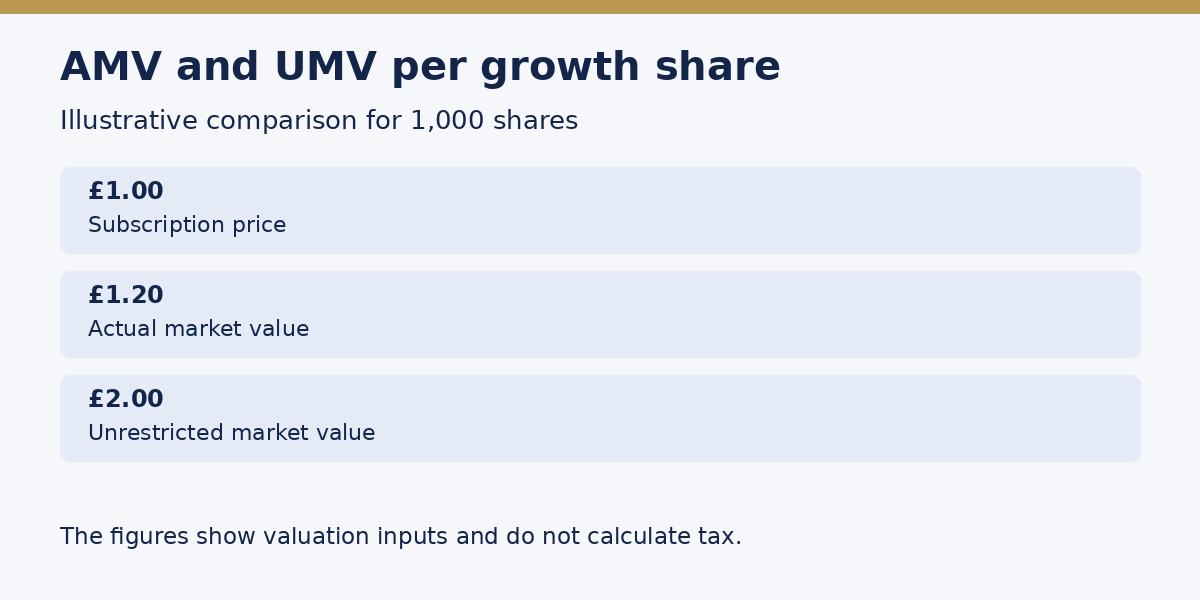
Suppose 1,000 shares are acquired for £1 each. An illustrative valuation gives AMV of £1.20 per share and UMV of £2 per share. The amount paid is £1,000. The difference to AMV is £200 and the difference to UMV is £1,000. These are arithmetic differences to show why the required valuation basis matters. They are neither a tax calculation nor a prediction of the amount due. The actual acquisition rules and any election determine the analysis.
Model what could happen after acquisition. If restrictions are lifted on a later date, the valuation and facts at that point may be relevant. Ask for a comparison of the likely later events, including a leaver transfer or sale, and the cash implications under the alternatives. Read section 431 of ITEPA 2003 alongside the guidance for the scope of the election.
| Input | Per share | 1,000 shares |
|---|---|---|
| Subscription price | £1.00 | £1,000 |
| Actual market value | £1.20 | £1,200 |
| Unrestricted market value | £2.00 | £2,000 |
4. Record the acquisition date and count the 14 days
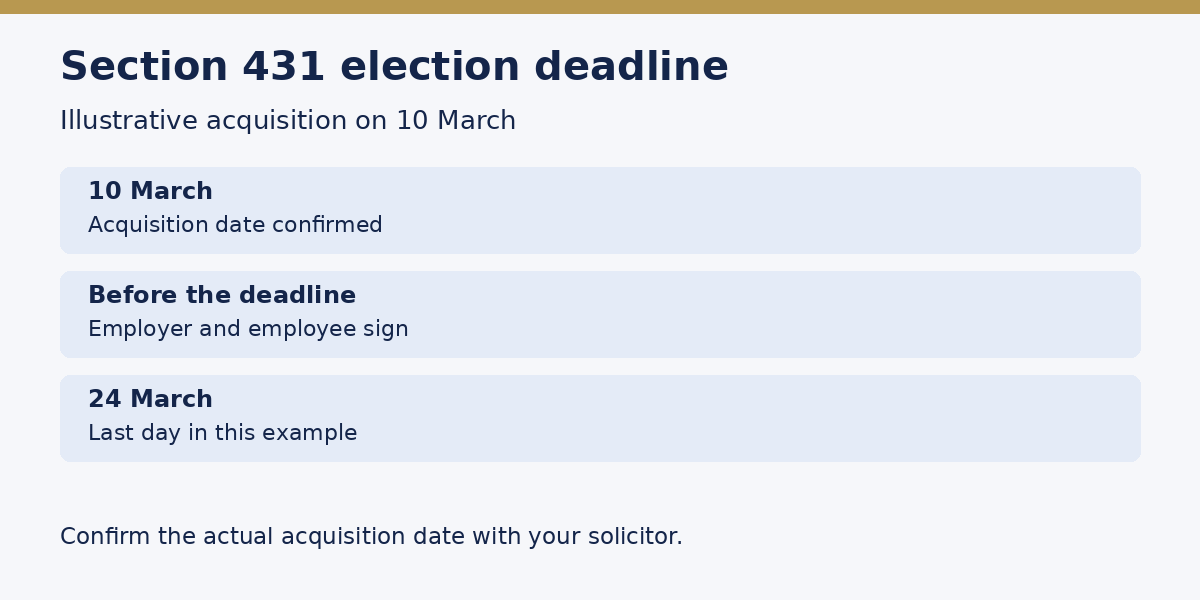
The growth shares section 431 election deadline runs from acquisition of the restricted securities. HMRC explains that acquisition is day one and the period ends at midnight on day 15. For example, if the adviser confirms acquisition on 10 March, the last day under that count is 24 March. Agree an internal deadline earlier than that so there is time to correct a missing signature or document mismatch.
HMRC says an election can also be made in advance if the requirements are met. If the award timetable slips, check whether the agreement still clearly applies to the securities actually acquired. A copied date from the board pack is a poor substitute for confirming when the legal acquisition occurs. Give one person responsibility for obtaining that confirmation and circulating it to everyone who needs it.
Where awards are staggered across multiple employees or dates, track each award in a separate row. Record the employer, recipient, share class, acquisition date, value evidence and signing status. Ask advisers to check whether the election used covers each acquisition. The point of the register is to identify an unsigned or changed award while someone can act on it. Record the section 431 election deadline and the employment related securities reporting date separately.
If the team discovers a missed deadline, escalate it to the tax adviser promptly. Preserve the actual evidence and do not backdate documents. The adviser will need the share terms, records of acquisition and any genuine correspondence about the election to assess the position. HMRC’s further guidance explains the count and its approach to verifiable electronic signatures.
| Event | Example date | Evidence to retain |
|---|---|---|
| Acquisition | 10 March | Solicitor’s confirmation and signed terms |
| Internal deadline | For example, 17 March | Signed election and award reference |
| Statutory last day on these facts | 24 March | Verifiable signatures in the approved form |
| ERS reporting, if required | 6 July after the tax year | Return receipt and final award data |
5. Check the approved form and retain signing evidence
Ask the tax adviser to identify the appropriate HMRC-approved form and confirm whether the election covers all relevant restrictions or specified restrictions. Compare the form to the final award. The names, employer, securities and description should identify the intended acquisition. A generic signed form that cannot be connected to the right award may be difficult to rely on later.
For an electronic workflow, verify that signatures can be traced and stored satisfactorily, in line with HMRC’s guidance. Save the executed version and its signing evidence with the underlying share documents. Do not rely on a temporary signing link or presume someone will be able to retrieve the email after leaving the company. Confirm both parties have an appropriate record.
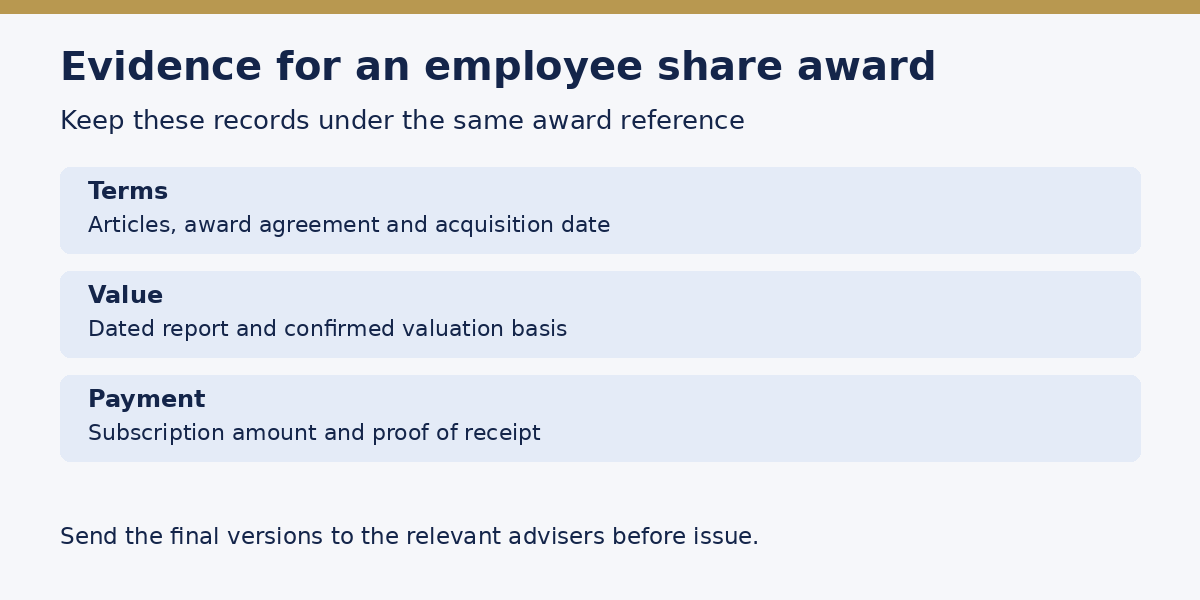
Use a closing checklist with a dated entry for each completed step. Capture the source document that confirms acquisition and retain the final valuation report, cap table, evidence of subscription monies and decision record. If someone later asks why a certain basis or date was used, the answer should be recoverable from the file without reconstructing the entire transaction.
Make ownership of the file clear across finance and HR while protecting access. Keep only the relevant records in the working folder and agree which adviser receives them. A short summary can be shared internally while the underlying personal records stay with the people responsible for the award.
6. Give payroll and the ERS return owner separate instructions
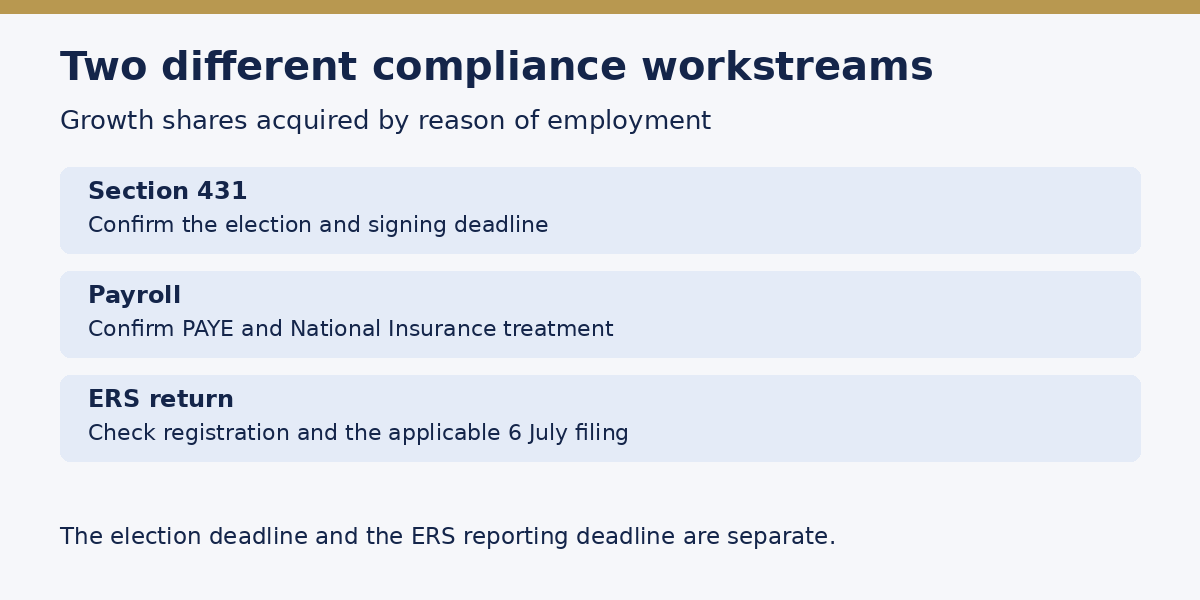
A section 431 election and the employment-related securities (ERS) return are separate workstreams. The election deals with the applicable treatment of restrictions. The employer should confirm with its adviser whether there is a reportable event, whether a scheme must be registered, whether any exception applies and which filing is required. For a return that is required, HMRC states the deadline is 6 July following the tax year.
Send payroll a signed-off instruction that explains the award, acquisition date, valuation basis and consideration. Ask the tax adviser to confirm whether PAYE or National Insurance applies, with particular attention to a likely sale or other arrangements that could affect the analysis. Do not categorise an award solely by how it is described in the board paperwork.
The return owner needs the data in the required format and enough time to reconcile it. Match the acquisition date, price and share count to the records used by the solicitor and valuer. Review entries for all affected employees, including late changes to the requested number of shares or a transaction that did not proceed. If a scheme is registered, ask about nil returns and the final reporting steps if it is closed.
Give the filing owner a deadline and ask for a copy or confirmation to keep in the award file. See HMRC guidance on registration and reporting and the annual returns guidance for the requirements that apply to the type of scheme.
7. Run a final check before issuing the shares
Before authorising the issue, ask a person outside the drafting team to compare the award schedule, valuation, election and payroll instruction. Give them three questions: Do these documents cover the same shares? Do they use the acquisition date the solicitor confirmed? Can we trace the amount paid and the value used by payroll back to evidence? Resolve mismatches before the issue meeting where possible.
Add a route for last-minute changes. If the share terms or payment change, update the adviser brief and record which people cleared the revision. If a participant will not sign, ask the advisers to explain the alternatives before assuming the company should proceed with the same terms. The issue decision needs a view of both the employee and company implications.
Use the same file when the shareholder leaves or the company prepares for a sale. A buyer or adviser may ask what rights were issued, how the award was valued and what records support the company’s reporting. Preserve the reasoning behind the decisions as well as the signed documents. Useful records answer why the company chose a particular route without disclosing more information than is needed.
If you are still working through the rights, start with the growth shares and articles of association checklist. Once the award terms and date are clear, Consult EFC can scope growth share valuation support for the valuation basis identified by your tax adviser. Ask the legal and tax advisers to confirm the signed terms, election and reporting treatment.
Pre-issue decisions and supporting records
One record should make it clear which necessary decisions have been made and which are outstanding. For example, the company may already know the number of shares and the likely acquisition date while the tax adviser has yet to confirm whether a draft provision is a statutory restriction. In that situation, list the open provision, give it an owner and record how it could affect the valuation and payroll.
If the employee pays for shares, capture the basis on which the amount was set and when payment is expected. If £1,000 is due on acquisition, the finance team should be able to match it to the subscription agreement and bank or other agreed payment evidence. Where advisers identify separate costs or tax payments, record who is expected to fund each one and on what date.
Keep the instructions and report consistent across the team. A solicitor may give a class-rights interpretation, the valuer may apply it to the forecast, and the tax adviser may advise which market value basis is needed. Record which source supports each assumption. Where the tax advice depends on the figures or the issue being implemented exactly as drafted, add a condition to the closing checklist.
Ask the team to bring the confirmed deadline forward into the working calendar rather than rely on a spreadsheet saved during the project. If several acquisitions occur, the responsible person can check whether every signed agreement is in place against its own date. The finance owner can then confirm the reporting status after the election window has closed.
For a later funding round, give investors a summary of the rights and share counts and consider with advisers what evidence should be shared. A clean record is particularly useful if a change to the terms was agreed on the day of issue. The updated documents should be easy to distinguish from drafts that were circulated but never adopted.
For the broader structure, see how UK growth shares work. The pre-issue growth share valuation checklist explains what to send the valuer.
Frequently asked questions
Is a section 431 election compulsory for growth shares?
No. Its relevance depends on whether the shares are employment-related restricted securities and the applicable rules. The employer and employee should take advice on the acquisition and any later restricted-securities charge before deciding.
When does the 14-day period for a section 431 election start?
It runs from acquisition of the securities. HMRC treats acquisition as day one and gives until midnight at the end of day 15. Ask your adviser to confirm the actual acquisition date for the award.
Can we sign the election before acquisition?
HMRC says an election may be made in advance if it meets the requirements. Confirm that it covers the award actually made and check the share class, parties and supporting terms before relying on it.
Does unrestricted market value mean valuing the growth shares as ordinary shares?
No. It means assessing the relevant growth shares on the appropriate statutory basis with the relevant restrictions disregarded. Ask your advisers to identify which provisions are restrictions and which define the class’s economic rights.
Does signing a section 431 election replace ERS reporting?
No. The election and any employment-related securities reporting are separate. Confirm registration, reporting and deadlines with your tax adviser and keep the evidence together.
Not sure where your business stands right now?
Book a free 30-minute call with Kish. Bring your numbers, your questions, or just your situation. You will leave with a clearer picture than you arrived with.
Book a Free Strategy Call
Over 12 years across Big Four audit, Investment Banking, and corporate advisory. Kish works with SaaS founders, tech companies, and ambitious UK SMEs from £1M to £50M in revenue on fundraising, valuations, exit planning, and financial strategy. ICAEW regulated. Big Four trained. Based in London.