


The value of a share in a private UK company is the value of the whole business divided by the number of shares, then adjusted for what that particular holding carries: voting rights, the size of the stake and how easily it could be sold. The method you use, and the discount or premium you apply, depends on why you need the number. A figure for a fundraise, a gift to a family member, an employee option scheme and a shareholder dispute can each call for a different answer.
This guide explains how share value works in practice, which methods are used and when, what moves the number up or down, and when HMRC or the law expects a formal valuation.
TL;DR
- Nominal value is a label fixed in the company’s constitution. Market value is what the shares are worth, and it is the one that matters for tax, funding and exits.
- The usual route is: value the whole company, divide by shares in issue, then adjust for the rights and size of the specific holding.
- Earnings multiples, discounted cash flow and net assets are the main methods. No single one is best; the purpose of the valuation and the quality of your data decide.
- Discounts for minority stakes or lack of marketability are judgement calls, not fixed percentages.
- For tax, HMRC works from an open-market value, so a valuation prepared with that test in mind saves arguments later.
Table of Contents
- What share value actually means
- The three-step logic behind most share valuations
- Share valuation methods and when each fits
- What pushes share value up or down
- How rights, percentage and marketability change a holding’s value
- When you need a formal share valuation
- Our perspective: valuation is a management tool, not just a compliance exercise
- How to prepare for a share valuation
- Getting a share valuation from Consult EFC
- Common mistakes to avoid
- FAQ
- Sources
What share value actually means
Two numbers are often confused in a private company.
Nominal (par) value is the fixed amount attached to each share when it is created, often £1 or a penny. It sets the legal minimum a shareholder owes on the share and has little to do with what the share is worth today.
Market value is what a share could realistically be sold for. For a private company there is no screen price, so it has to be worked out.
The gap between the two shows up when new shares are issued. Where shares are issued for more than their nominal value, the difference is a share premium, which goes into a separate, non-distributable account, as the explanatory notes to the Companies Act 2006 describe. So a founder who subscribed at 1p and an investor who pays £12.50 for the same class of share are both holding shares with a nominal value of 1p. Only one of those prices tells you much about the business.
Academic commentary has long argued that par-value concepts are of limited use for judging what a modern company is worth. One review of UK capital maintenance law notes that the Company Law Review Steering Group would have abolished it were it not for EU constraints at the time. Treat nominal value as paperwork, and market value as the figure you plan around.
The three-step logic behind most share valuations
Whatever method sits underneath, most private-company share valuations follow the same shape.
- Value the business as a whole. This is the enterprise or equity value, using one or more of the methods below.
- Work out the pro-rata value per share. Equity value divided by the shares in issue. If different classes exist, you first need to allocate value between them according to their rights.
- Adjust for the holding. A 70% stake that controls the board is not worth the same per share as a 5% stake that cannot force a sale or a dividend.
Step three is where valuations diverge most, and where a founder doing a back-of-envelope calculation tends to be furthest from what a buyer, investor or HMRC would accept.
A simple worked example
The figures below are illustrative, not a real company.
A UK services company has maintainable post-tax earnings of £400,000 after normalising for one-off costs. Based on its sector, size and growth, a valuer concludes that a multiple of 5 is reasonable. Assuming no debt or surplus cash, equity value is £2,000,000. There are 100,000 ordinary shares in issue, so the pro-rata value is £20 per share.
A shareholder with 25,000 shares holds a pro-rata value of £500,000. But that shareholder cannot control the company, and the shares cannot easily be sold. A valuer may apply a discount for that. If, say, the facts supported a 20% discount, the holding would be valued at £400,000. If the same 25,000 shares were instead being valued as part of a sale of the entire company, no such discount would normally apply, because the buyer is acquiring control.
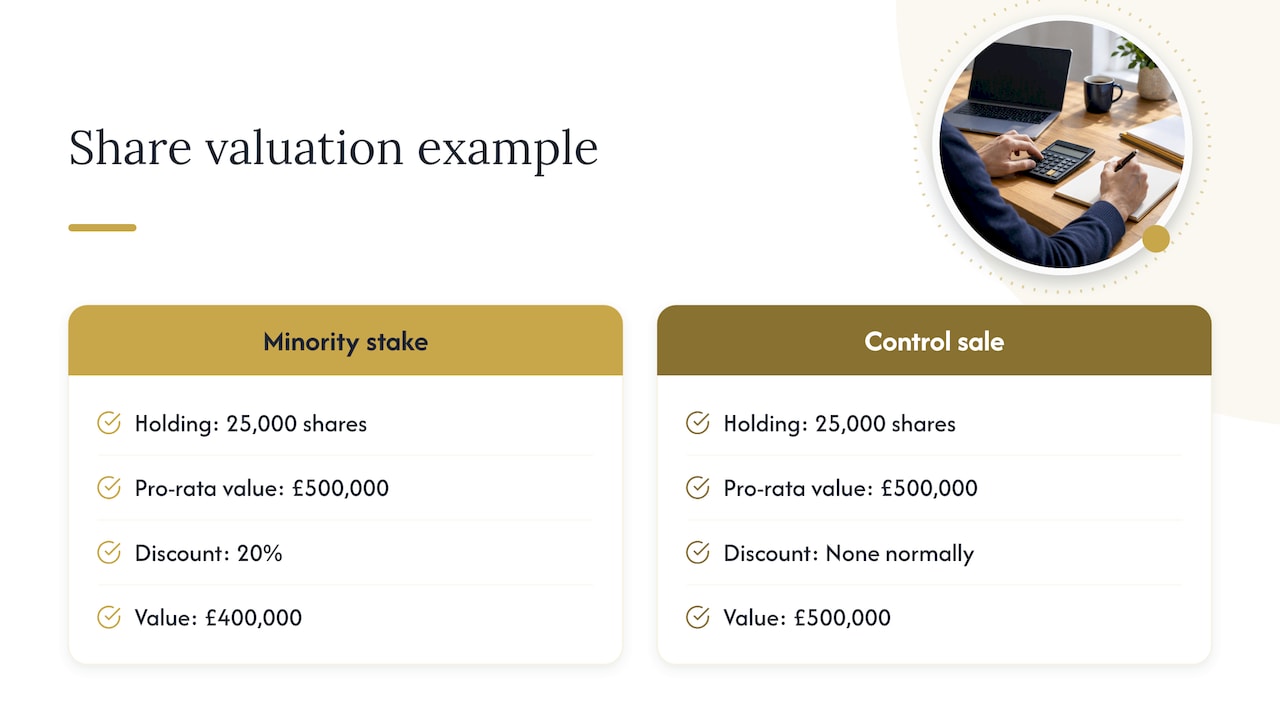
The example shows why the same share can legitimately carry two values on the same day: the purpose and the circumstances change the answer.
Share valuation methods and when each fits
The International Valuation Standards (IVS 103) group valuation approaches into three families: market, income and cost. They advise choosing the most appropriate approach for the circumstances and intended use, and the standards stress that no single method is inherently superior, with observable market data used wherever it is reliable and professional judgement applied throughout.
| Method | Family | Best suited to | Main limitation |
|---|---|---|---|
| Earnings multiple | Market / income | Profitable, stable trading businesses; the most common basis in sale negotiations | Depends on a defensible multiple and properly normalised earnings |
| Discounted cash flow (DCF) | Income | Businesses with reliable forecasts and predictable cash flow, including many subscription and SaaS companies | Highly sensitive to growth and discount-rate assumptions |
| Net asset value | Cost | Property or investment holding companies, businesses being wound up | Ignores goodwill and future earnings in a trading company |
| Dividend yield | Income | Minority holdings where dividends are the only return | Meaningless if the company does not pay dividends |
| Recent transaction price | Market | Companies that have just raised funds or bought out a shareholder | Stale quickly; may reflect special rights or a particular investor |
Earnings multiples
This method takes the business’s maintainable earnings and multiplies them by a multiple that reflects risk, growth and sector. The earnings step matters as much as the multiple. Owner salaries that are above or below market rate, one-off costs and unusual income all need adjusting so the number reflects what a new owner would actually earn. Our guide on EBITDA, profit and cash in UK valuations shows how different earnings measures change the result.
Discounted cash flow
DCF values the business as the present value of the cash it is expected to produce. It suits companies with visible, contracted or recurring revenue, and it rewards good forecasting discipline. It also exposes weak assumptions: a small change in the growth rate or discount rate can move the value by a large amount. A model built on defensible scenarios, of the kind we describe in our piece on financial modelling and forecasting, gives a DCF something solid to stand on.
Net assets
Assets minus liabilities gives a floor, and in some businesses the answer. For a property investment company it is often the natural starting point. For a software or services company it will usually understate value, because most of what a buyer pays for is not on the balance sheet. Our guide to asset versus earnings valuation for a UK SME helps you decide which lens fits your business.
For a wider tour of approaches, see our guide to business valuation methods.
What pushes share value up or down
Two companies with the same profit can be worth very different amounts. The factors that most often explain the gap:
- Revenue quality. Recurring, contracted revenue with low churn is worth more than one-off project income. For a SaaS business, stable MRR and a clear churn picture are central to the story.
- Customer concentration. If one client provides a large part of turnover, a buyer will price in the risk of losing it.
- Owner dependence. A business that cannot run without its founder is harder to sell and is worth less.
- Growth and its credibility. Projections carry weight only if the track record and the pipeline support them.
- Size and sector comparables. Larger, more diversified businesses tend to attract higher multiples than very small ones, and sector trends move multiples over time.
- Quality of financial information. Timely, reconciled management accounts reduce the discount a buyer applies for uncertainty.
Most of these are things you can improve before a valuation date. Our small business valuation guide walks through them for UK owners.
How rights, percentage and marketability change a holding’s value
After the company is valued, the holding is adjusted. Three things matter most.
Rights attached to the shares. Voting rights, dividend rights, rights on a sale or liquidation, and pre-emption or transfer restrictions in the articles or a shareholders’ agreement all change value. Growth shares and EMI options sit at the extreme end, where the rights are designed to give value only above a threshold. We cover those in our guides to growth shares valuation and EMI valuations.
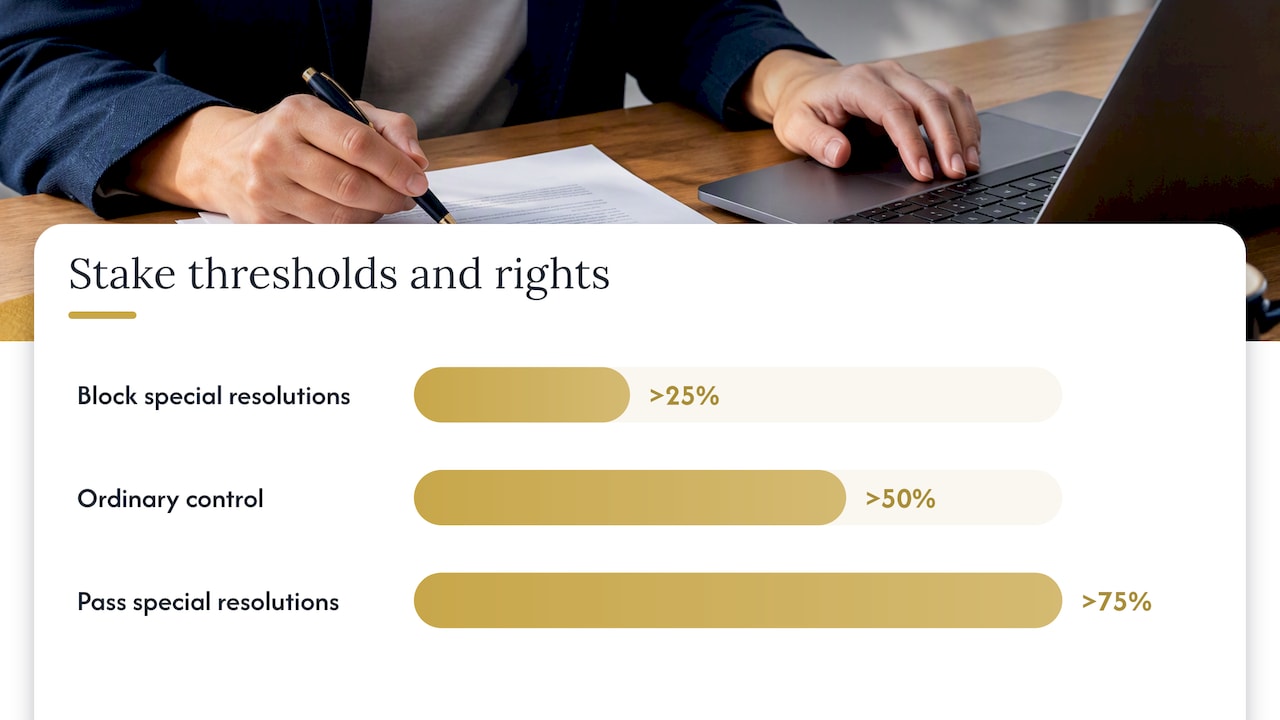
Size of the stake. A stake above 50% controls ordinary resolutions. One above 75% can pass special resolutions. A blocking stake of more than 25% can stop them. Each threshold changes what the shareholder can actually do, and so what a buyer would pay.
Marketability. Private shares cannot be sold at the touch of a button. Valuers often reflect that with a discount for lack of marketability.
There is no formula for those discounts. An academic paper on valuing shareholdings in private companies cautions that published tables of discounts should not be applied mechanically, and that their use has to be tested against the circumstances of the company and the purpose of the valuation. Research from Vlerick Business School reaches a similar conclusion: a standard marketability discount is usually wrong, and company characteristics and the rights tied to a holding give a more accurate guide. In short, if someone quotes you a flat 25% or 30% without looking at your articles and your shareholders, ask why.
Where shareholders disagree about the answer, the valuation needs to be independent and defensible. Our page on independent share valuations for shareholder disputes explains how that works.
When you need a formal share valuation
Many owners go years without one. The triggers are usually one of these:
- Fundraising. Setting the price of a round, or agreeing how much equity an investor receives.
- Share schemes. Agreeing the value of shares for EMI or growth share arrangements.
- Gifts, transfers and inheritance. Where shares move between family members or on death.
- Selling or buying a stake. Management buyouts, a shareholder leaving, or an exit.
- Disputes. Where a shareholder believes they are being treated unfairly, or a buy-out price cannot be agreed.
- Divorce or restructuring. Where the value of a holding has to be fixed for a settlement or reorganisation.
How HMRC looks at it
For capital gains tax, market value is the price the asset might reasonably fetch on the open market. HMRC’s Capital Gains Manual explains that a valuation of unquoted shares is needed only where a statutory rule displaces the price actually paid or received, and defines market value by reference to a hypothetical willing seller and buyer. For inheritance tax, unlisted shares are valued on the open-market basis set by sections 160 and 168 of the Inheritance Tax Act 1984.
In some situations the basis of value is fixed by statute, for example under section 272 of the Taxation of Chargeable Gains Act 1992, as ICAEW’s research guide on business and share valuation points out. That is why a valuation for tax is not simply the price you would like to agree with a relative or a co-shareholder. It has to withstand the hypothetical open-market test. Our article on how HMRC values shares in a private UK company goes deeper, including how a valuation can be prepared to support a position with HMRC.
Our perspective: valuation is a management tool, not just a compliance exercise
Most owners meet share valuation at a stressful moment: an investor’s term sheet, a shareholder leaving, a letter from HMRC. We think that is the wrong time to find out what the business is worth.
Our view, shaped by working with founders raising their first round, SaaS companies working on their MRR and churn, and owners planning a sale in the next one to three years, is that a valuation is most useful when it is built before it is needed. A good one tells you which assumptions carry the number, which parts of the business a buyer will discount, and what you could change in the next twelve months to move it. That is a finance leadership task as much as a technical one, which is why we do this work as ICAEW Chartered Accountant-led fractional CFOs rather than as a one-off report factory.
The common failure we see is a figure worked out from a rule of thumb and a spreadsheet that nobody has checked against the articles, the cap table or the earnings quality. The number then breaks the first time an investor’s adviser or a tax inspector asks where it came from. Documented assumptions, normalised earnings and a clear link between the method and the purpose are what make a valuation survive scrutiny.
— Kishen Patel
How to prepare for a share valuation
A valuer’s job is faster, cheaper and more reliable when the inputs are in order. Before you start:
- Define the purpose and the valuation date. Tax, fundraising, a buy-out and a dispute each need a slightly different basis of value.
- Read your articles of association and any shareholders’ agreement. They may restrict transfers, set a valuation mechanism or create different share classes, all of which change the answer.
- Gather three years of accounts and current management accounts. Add a reconciled list of one-off items and any owner costs that would not continue.
- Prepare a forecast. A credible budget with the main assumptions written down supports an income-based method.
- Produce an up-to-date cap table. Include options, warrants, convertible instruments and anything promised but not yet issued. Our note on cap table mistakes that stall fundraises lists the usual errors.
- Know your customer data. Concentration, contract terms and, for SaaS, churn and MRR by cohort.
- Agree who sees what. Valuations involve sensitive information, so sort out confidentiality before sharing.
If the aim is a sale, preparing the same material early also shortens due diligence. Our exit planning service and 90-day exit readiness programme are built around that.
Getting a share valuation from Consult EFC
We prepare independent share valuations for UK companies, including valuations for HMRC purposes, fundraising, share schemes, exits and shareholder matters. Our Business Valuation UK service starts from £2,500 as a one-off fee. The final scope and price depend on the purpose, the complexity of the share structure and the information available.
If you need ongoing senior finance input around the valuation, such as building the forecast, cleaning up the numbers or preparing for investors, our fractional CFO services give you ICAEW Chartered Accountant-led leadership without the cost of a full-time hire.
Common mistakes to avoid
- Using nominal value as the answer. It tells you the legal par amount and not much else.
- Applying a flat discount. Marketability and minority discounts depend on the facts, and the research above is clear that standard percentages are unreliable.
- Ignoring share classes. Preference rights or growth share thresholds can shift value between holders even when the company value is not in question.
- Using unadjusted profit. Without normalising for one-offs and owner pay, a multiple is applied to the wrong number.
- Valuing once and filing it away. Value moves with trading, the market and the cap table. A valuation for one purpose or date should not be reused for another without checking it still fits.
- Treating a tax valuation as a negotiation. Where HMRC is involved, the basis is set by law, and the figure must be supportable on that basis.
FAQ
How is the value of a share calculated?
In a private company, you value the whole business, divide by the number of shares in issue, and then adjust for the rights and size of the holding. Public companies are easier because the market gives a daily price. For a private company the method, such as an earnings multiple or DCF, is chosen to suit the business and the purpose of the valuation.
What is the difference between nominal value and market value?
Nominal value is the fixed par amount given to each share when it is created, often £1 or 1p. Market value is what the share would realistically sell for. When shares are issued above nominal value, the excess is a share premium, so the price paid can be far higher than the par amount.
Can an accountant do a share valuation?
Yes. Chartered accountants regularly value private company shares, particularly for tax, transactions and share schemes. What matters is relevant valuation experience, independence from the parties where there is a dispute, and a report that sets out its method and assumptions clearly. Our valuations are led by an ICAEW Chartered Accountant.
Do I need a valuation to give shares to family or employees?
Often you do, or at least you should have a well-supported figure. For tax, HMRC looks at open-market value, and for some gifts or share schemes that value has to be agreed or evidenced. A documented valuation prepared at the time is far easier to defend than an estimate reconstructed years later.
How long does a share valuation take?
It depends mostly on how quickly you can supply accounts, forecasts, the cap table and the company’s legal documents. A tidy company with clear records is much faster than one where the share register and management accounts need work first. Tell us the purpose and the deadline when you get in touch, and we will give you a realistic timetable.
Sources
- Companies Act 2006 explanatory notes, share premium
- Reforming capital maintenance law: the Companies Act 2006 (Singapore Academy of Law Journal)
- International Valuation Standards, effective 31 January 2025
- Valuation of shareholdings in private companies
- Is a private company really worth 20 to 40% less than a similar listed company? (Vlerick)
- HMRC Capital Gains Manual CG59540
- HMRC Inheritance Tax Manual IHTM18131
- Business and share valuation, ICAEW research guide
Recommended
- How HMRC Values Shares in a Private UK Company
- Valuation of a Company for Sale: the UK Founder’s Guide
- Independent Share Valuations for UK Shareholder Disputes
- Small Business Valuations: What is Your UK Company Worth?
This article is for general information only and is not professional advice.
Not sure where your business stands right now?
Book a free 30-minute call with Kish. Bring your numbers, your questions, or just your situation. You will leave with a clearer picture than you arrived with.
Book a Free Strategy Call
Over 12 years across Big Four audit, Investment Banking, and corporate advisory. Kish works with SaaS founders, tech companies, and ambitious UK SMEs from £1M to £50M in revenue on fundraising, valuations, exit planning, and financial strategy. ICAEW regulated. Big Four trained. Based in London.