

A sale valuation is a defensible range built from the right earnings base, at least two valuation methods, and a clear adjustment from enterprise value to seller proceeds — not a single headline multiple your broker mentions over the phone.
Before you do anything else, gather these:
- Three years of management accounts and your most recent statutory accounts
- A schedule of owner add-backs (personal expenses, above-market salary, one-off costs)
- Your top ten customers by revenue and their contract status
- A list of recurring versus one-off revenue lines
- Details of any debt, finance leases, or deferred tax liabilities
Once you have those, the first decision is which earnings metric fits your business. Use Seller’s Discretionary Earnings (SDE) if you run an owner-operated company where your salary and personal benefits are baked into the P&L. Use EBITDA if the business has a management team that would continue without you. That single choice shapes every multiple conversation that follows.
A headline multiple is the start of negotiation, not the end. Deal structure, earnouts and post-close adjustments can move the cash you actually receive at completion by a material amount relative to the number on the term sheet.
Pro Tip: Document every add-back with a receipt, invoice, or board minute before you go to market. Buyers will challenge anything that lacks paper support, and a disputed add-back can reduce your earnings base — and therefore your headline price — faster than almost any other single item.
Table of Contents
- What does a business valuation for sale actually measure?
- Why an accurate valuation changes the entire sale process
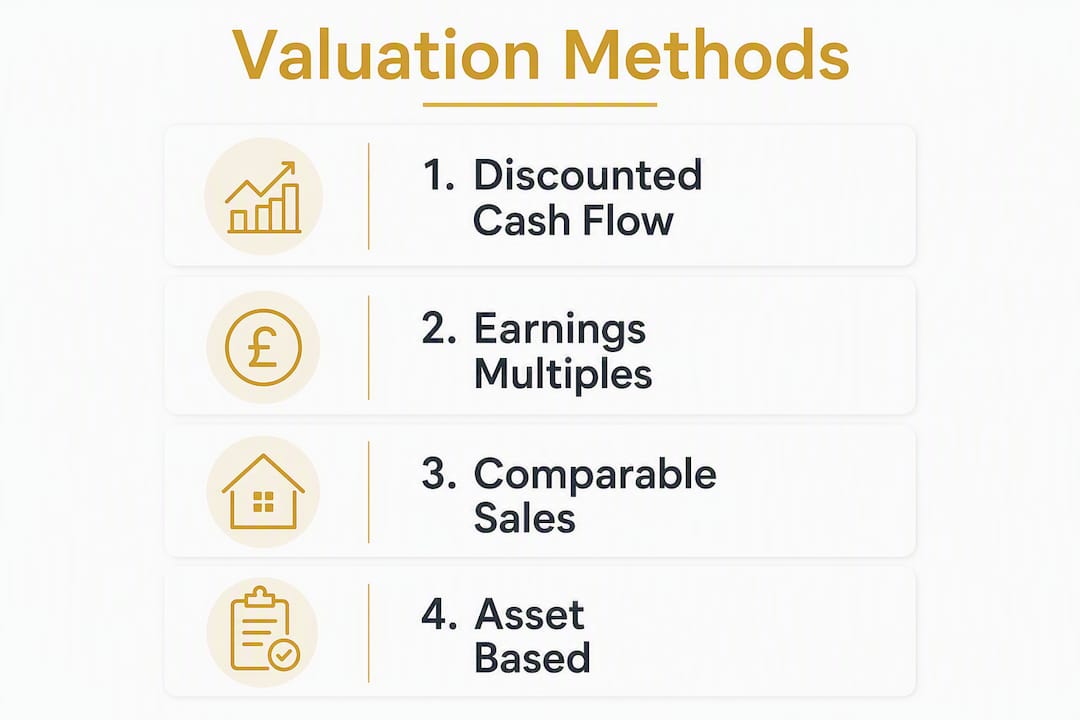
- What are the main valuation methods for a company sale?
- How do you choose the right method mix for your business?
- How do financial adjustments and deal structure affect what you receive?
- How do you prepare your company to improve its valuation?
- What does a UK sale process cost and how long does it take?
- What should a professional valuation report contain?
- How Consult EFC supports UK SMEs preparing to sell
- Key takeaways
- A Chartered Accountant’s view on what actually moves the needle at exit
- Consult EFC: valuation readiness for UK founders and SMEs
- Useful sources and further reading
What does a business valuation for sale actually measure?
A sale-focused valuation answers one question: what would a willing, informed buyer pay for this business today? That is different from a valuation prepared for tax purposes (which follows HMRC’s share valuation guidelines), for a bank loan (which focuses on asset cover), or for an internal management review (which may use replacement cost). Each has a different audience and a different standard of evidence.
The concept buyers and their advisers work with is enterprise value (EV): the total value of the operating business, including debt. What the seller actually receives is equity value: enterprise value minus net debt (borrowings less cash), adjusted for working capital relative to a normalised target, and further reduced by transaction costs. This conversion from EV to equity proceeds is where many owners get a surprise — a £3m enterprise value does not mean £3m in the bank on completion day.
Common sale scenarios in the UK that typically require a formal valuation include:
- Trade sale to a strategic acquirer or competitor
- Private equity (PE) investment or buyout, where the investor will commission their own valuation and you need a credible counter-position
- Management buyout (MBO), where the incoming management team needs financing and lenders require a defensible number
- Partial sale or minority investment, where you are selling a stake but retaining control
- Shareholder exit or dispute, where an independent valuation is needed to agree a fair price between parties
A formal valuation is worth commissioning any time a third party will scrutinise the number. A desk estimate from a broker is useful for orientation; it is not sufficient for a PE data room or an MBO financing package.
Why an accurate valuation changes the entire sale process
A well-prepared, defensible valuation does more than give you a number to put on a teaser document. It changes how buyers behave. When a buyer receives a valuation report with clear assumptions, documented normalisations, and a reconciled range, they spend less time trying to unpick the earnings base and more time assessing strategic fit. That shortens due diligence, reduces the number of renegotiation rounds, and protects the headline price through to completion.
The gap between headline price and cash at close is real and often underestimated. A buyer may offer £4m, but structure £800k of that as an earnout tied to two years of post-sale revenue targets. Another £200k sits in escrow for twelve months against indemnity claims. Transaction costs — legal fees, adviser fees, tax — consume a further slice. Earnouts in particular should be treated as option value rather than guaranteed cash, because post-close performance targets are frequently missed when the seller is no longer running the business day-to-day.
Statistic to note: Research on SME transactions consistently shows that earnout provisions are among the most common sources of post-close disputes, with sellers frequently receiving less than the full deferred amount.
Poor normalisations compound the problem. If your add-backs are aggressive or undocumented, a buyer’s accountant will strip them out during Quality of Earnings (QoE) review. Each £100k removed from the earnings base at a 5x multiple reduces enterprise value by £500k. Owner dependence has a similar effect: a business where the owner holds all key client relationships, technical knowledge, or supplier agreements will attract a lower multiple or a longer earnout to retain the seller post-close. Both outcomes reduce what you take home.
What are the main valuation methods for a company sale?
Running multiple valuation methods and reconciling them into a defensible range is the standard professional practice. No single method is definitive; each illuminates a different aspect of value.
Discounted cash flow (DCF)
DCF projects future free cash flows and discounts them back to a present value using a risk-adjusted discount rate (the weighted average cost of capital, or WACC). It is most useful when a business has predictable, recurring revenue — SaaS businesses with contracted ARR, for example — or when you need to justify a premium above current earnings. The weakness is sensitivity: small changes in growth assumptions or discount rate produce large swings in value, so DCF works best as a cross-check against market-based methods rather than a standalone answer.
Earnings multiples (SDE and EBITDA)
This is the dominant method for UK SME transactions. You take a normalised earnings figure and multiply it by a market-derived multiple. For owner-operated businesses, use SDE; for management-run businesses, use normalised EBITDA. Multiples are sourced from comparable transaction databases, broker market data, and sector reports. As illustrative starting points, owner-operated SMBs have historically traded at moderate SDE multiples, while larger management-run businesses typically attract higher EBITDA multiples — though the actual range for any specific business depends on sector, growth rate, customer concentration, and deal size.

Comparable transactions and precedent deals
This approach looks at what similar businesses actually sold for. It is persuasive in negotiation because it grounds the conversation in real market evidence rather than theoretical models. The challenge in the UK SME market is data availability: most private transactions are not publicly disclosed, so you rely on databases such as BvD Zephyr, sector-specific broker reports, or your adviser’s proprietary deal history.
Asset-based approach
The asset-based method values the business by reference to the net realisable value of its assets. It sets a floor for asset-heavy businesses (manufacturing, property, plant-intensive operations) and for distressed situations where earnings are negative or unreliable. For most profitable SMEs and SaaS businesses, it produces a value well below what a going-concern buyer would pay, so it functions as a sanity check rather than a primary method.
| Method | Best suited to | Primary metric | Main limitation |
|---|---|---|---|
| DCF | Recurring-revenue SaaS, high-growth businesses | Free cash flow | Highly sensitive to assumptions |
| Earnings multiples | Owner-operated SMBs, management-run mid-market | SDE or EBITDA | Requires comparable market data |
| Comparable transactions | Any business with available market comps | EV/EBITDA or EV/Revenue | Limited data in private UK market |
| Asset-based | Asset-heavy manufacturing, distressed businesses | Net asset value | Understates going-concern value |
The recommended practice is to run two or three methods, note where they converge and diverge, and present a low/base/high range with explicit assumptions. For a deeper walkthrough of each method with worked examples, the complete guide to business valuation methods on the Consult EFC site covers the mechanics in detail.
Pro Tip: Build a simple sensitivity table showing how your base-case value changes if the multiple moves by 0.5x in either direction, or if normalised EBITDA shifts by 10%. Buyers will run their own sensitivities; presenting yours first signals confidence and controls the framing.
How do you choose the right method mix for your business?
The SDE versus EBITDA decision comes down to one question: could the business continue at its current performance level if you, the owner, were replaced by a salaried manager? If the answer is no — because you hold the client relationships, do the technical work, or are the primary face of the brand — then SDE is the right earnings base. SDE adds back your full compensation (salary, dividends, benefits, personal expenses) to net profit, reflecting the total economic benefit the owner extracts. A buyer prices in the cost of replacing you.
If the business has a management team, documented processes, and revenue that does not depend on your personal involvement, EBITDA is the appropriate metric. It represents earnings available to any owner, which is what a financial buyer or PE firm is actually acquiring.
Size matters too. Businesses with EBITDA below roughly £500k are typically bought by individual owner-operators or small strategic acquirers; those above £1m–£2m attract PE interest and institutional buyers who expect EBITDA-based pricing, audited accounts, and a management team. The buyer type shapes both the metric and the multiple.
For SaaS and recurring-revenue businesses, revenue multiples (EV/ARR) are common alongside EBITDA multiples, particularly at earlier stages where EBITDA margins are thin. The ARR multiples guide for SaaS businesses explains how growth rate, net revenue retention, and churn interact to drive those multiples. For asset-heavy sectors, the asset floor becomes a more meaningful input.
Buyers will expect supporting evidence for whichever metric you use:
- A documented replacement salary calculation (for SDE add-back)
- An organisational chart showing management depth
- Signed contracts for recurring revenue lines
- A customer concentration schedule (revenue by customer, top ten at minimum)
- Three years of management accounts with consistent accounting policies
Pro Tip: Run the owner-dependence test before you go to market: ask a trusted adviser to assess what would happen to revenue in year one if you stepped back entirely. If the answer is “significant decline”, that is exactly what a buyer’s QoE team will conclude — and they will price it in. Better to address it 12–18 months before sale than to negotiate around it at heads of terms.
How do financial adjustments and deal structure affect what you receive?
Enterprise value is a starting point. What lands in your account on completion day is a different number, shaped by a series of adjustments and the structure of the deal itself.
Common financial adjustments
- Normalisations and add-backs: one-off costs, above-market owner salary, personal expenses, and non-recurring items are added back to produce a maintainable earnings figure. Each must be documented.
- Net debt adjustment: borrowings (bank loans, finance leases, director loans) are deducted; cash is added. A business with £500k of debt and £100k of cash has net debt of £400k, which reduces equity proceeds by that amount.
- Working capital peg: buyers expect to receive the business with a “normal” level of working capital (debtors minus creditors, adjusted for stock). If working capital at completion is below the agreed peg, the seller pays the shortfall.
- Deferred capital expenditure: if the business has underinvested in assets or systems, buyers will model a catch-up capex requirement and reduce their offer accordingly.
- Tax items: deferred tax liabilities, PAYE or VAT arrears, and any open HMRC enquiries reduce equity value and must be disclosed.
Buyer-side protections
Buyers routinely retain a portion of proceeds post-close. Escrow accounts hold back a portion for several months against warranty and indemnity claims. Representations and warranties insurance (RWI) is increasingly common on mid-market UK deals and can reduce escrow requirements, but it adds cost. Indemnities for specific known risks (a customer dispute, a lease liability) may sit outside the general escrow and have their own retention period.
Deal structures and their practical effect
Cash at close is the cleanest outcome: you receive the full equity value (after adjustments) on completion day. Buyers with strong balance sheets or PE backing typically offer this; it commands a slight discount to headline because the buyer takes all execution risk.
Seller financing (a vendor loan note) means you lend part of the purchase price back to the buyer, repaid over two to five years with interest. It can increase headline price but introduces credit risk — if the business underperforms post-sale, repayment may be at risk.
Earnouts tie a portion of the price to post-close performance. They bridge valuation gaps when buyer and seller disagree on future growth, but earnouts frequently represent option value rather than guaranteed cash. Sellers should negotiate hard on the metric (revenue is more controllable than EBITDA post-close), the measurement period, and acceleration clauses that trigger full payment on a change of control or buyer breach.
Understanding the legal implications of how a deal is structured — whether as an asset purchase or a share purchase — materially affects your tax position and post-sale liabilities. The asset purchase versus share purchase comparison from Matthew Fornaro’s legal practice is a useful primer on the structural trade-offs.
Pro Tip: If an earnout is unavoidable, negotiate a cap on the buyer’s ability to change the business’s cost structure post-close. A buyer who loads the acquired business with management charges or intercompany allocations can suppress the EBITDA metric your earnout is measured against — and there is nothing you can do about it without contractual protection.
How do you prepare your company to improve its valuation?
The businesses that achieve the best outcomes in a sale process are rarely the ones that started preparing six weeks before going to market. Twelve to twenty-four months of deliberate preparation is the realistic window for meaningful value improvement.
Practical preparation checklist
- Produce monthly management accounts to a consistent standard for at least 24 months before sale
- Prepare a formal add-back schedule with supporting documentation for every normalisation
- Clear aged debtors and tidy up any overdue receivables that will flag in diligence
- Formalise all customer contracts, especially recurring revenue arrangements — verbal agreements do not survive buyer scrutiny
- Prepare a customer concentration schedule and, if any single customer exceeds 20% of revenue, have a plan for how you will address that risk
- Document key supplier agreements and check for change-of-control clauses that could be triggered by a sale
- Build or strengthen the management team so the business can operate without your daily involvement
- Tidy up the corporate structure: remove dormant entities, resolve any director loan accounts, and address any outstanding HMRC correspondence
Typical 12–24 month preparation timeline
- Months 1–3: Commission a valuation readiness review. Identify gaps in financial reporting, governance, and documentation. Agree the earnings base and begin normalising accounts.
- Months 4–6: Address the highest-priority issues: management accounts, add-back documentation, contract formalisation, and any obvious diligence red flags.
- Months 7–12: Focus on value drivers — grow recurring revenue, reduce owner dependence, and improve gross margin. Begin building the management team if it is thin.
- Months 13–18: Prepare the information memorandum (IM) and financial model. Commission a Quality of Earnings review for founder-led businesses to pre-empt buyer challenges.
- Months 19–24: Go to market with a prepared data room, a signed valuation report, and a management team that can present credibly to buyers without you carrying every conversation.
UK-specific items to address include: ensuring your management accounts are prepared under consistent accounting policies (buyers will restate them if not), checking for any outstanding HMRC enquiries or undisclosed tax liabilities, and confirming that all statutory filings at Companies House are current and accurate.
Pro Tip: A Quality of Earnings pack prepared by your own advisers before going to market is one of the highest-return investments a seller can make. It surfaces issues you can fix before a buyer finds them, and it signals to buyers that you have nothing to hide — which accelerates trust and reduces the risk of a price chip during diligence.
What does a UK sale process cost and how long does it take?
A realistic sale process for a UK SME takes longer than most owners expect and costs more than a broker’s initial fee schedule suggests.
Typical timeline phases
- Due diligence — (2–3 months): financial, legal, commercial and tax diligence by the buyer’s team
Total elapsed time from starting preparation to completion: typically 12–18 months for a well-prepared business, longer if diligence uncovers issues that require remediation.
Indicative costs in the UK market
Valuation costs in the UK vary significantly by complexity and deal size. A simple desk estimate or screening valuation for a small business costs materially less than a formal, signed appraisal with comparable evidence and sensitivity analysis. Adviser-led sale processes for mid-market businesses typically involve a retainer plus a success fee calculated as a percentage of enterprise value, with the percentage declining as deal size increases (the Lehman or double-Lehman scale is common). Legal fees for a straightforward share sale add further cost. Budget for transaction costs to consume a meaningful share of gross proceeds, particularly on smaller deals where fixed costs represent a higher proportion.
A quick desk estimate is acceptable for internal planning or an early-stage conversation with a potential buyer. A formal valuation report — signed by a qualified accountant, with documented assumptions and comparable evidence — is justified whenever a third party will rely on the number: a PE investor, an MBO lender, or a trade buyer conducting structured diligence.
Statistic to note: Transaction costs on smaller UK SME deals can represent a higher proportion of proceeds than on larger transactions, making preparation and a clean process particularly valuable at the lower end of the market.
What should a professional valuation report contain?
A sale-focused valuation report is not a one-page summary with a number at the bottom. Buyers and their advisers will scrutinise it, and the credibility of the report directly affects how much negotiating room you have.
A well-constructed report covers:
- Scope and purpose: the report states it is prepared for sale purposes, names the instructing party, and sets out the standard of value used (typically fair market value or fair value)
- Earnings base: the chosen metric (SDE or EBITDA), the normalisation adjustments applied, and the resulting maintainable earnings figure
- Methods used: at least two methods, with the rationale for each and the weight given to each in the reconciled conclusion
- Comparable evidence: named transaction databases or sector reports used to derive multiples, with the selection criteria explained
- Sensitivity and scenario analysis: a table showing how value changes under different multiple assumptions and earnings scenarios (low/base/high)
- Reconciled value range: a low, base, and high conclusion with the assumptions underpinning each
- Limitations and caveats: what the report does and does not cover, and any reliance on management-provided information
The trust signals buyers look for are specific. An ICAEW or CIMA-qualified signatory gives the report professional standing. Transparent assumptions mean a buyer can follow the logic without having to ask for clarification. Reconciled multiples with source data for comparables show the number is grounded in market evidence, not wishful thinking. A sensitivity table demonstrates the preparer has stress-tested the conclusion.
During diligence, buyers will check the report against:
- Statutory accounts and management accounts for the periods covered
- Bank statements and cash flow records
- Customer contracts and revenue recognition policies
- Payroll records (to verify owner salary add-backs)
- Asset registers and depreciation schedules
Pro Tip: Present the valuation report as part of a management pack rather than as a standalone document. A well-structured pack — executive summary, IM, financial model, valuation report, and data room index — signals a prepared seller and reduces the number of information requests a buyer needs to make in the first two weeks of diligence.
How Consult EFC supports UK SMEs preparing to sell
Consult EFC works with UK SMEs and SaaS founders at every stage of exit preparation, from an initial valuation readiness review through to transaction support during a live sale process.
The practical services that map directly to the preparation checklist above include:
- Investor-grade financial modelling: three-statement models with scenario analysis that buyers and their advisers can interrogate
- Quality of Earnings preparation: pre-empting buyer QoE findings by identifying and addressing earnings quality issues before going to market
- Buyer-ready reporting: management accounts, KPI dashboards, and financial due diligence support that reduces the time buyers spend in the data room
The practical outcomes owners typically see from this work are a reduction in post-LOI price chipping (because diligence findings are fewer and less material), improved multiple positioning through documented recurring revenue and reduced owner dependence, and a faster completion timeline.
Consult EFC’s ICAEW Chartered Accountant, Kishen Patel, leads all valuation and exit advisory engagements. The firm’s business valuation service for UK SMEs covers the full scope from earnings normalisation through to a signed, professional valuation report.
Pro Tip: Engage a fractional CFO or valuation adviser at least 12 months before you intend to go to market. The value of the engagement is not just the report — it is the 12 months of financial improvement, documentation, and governance work that makes the report credible.
Key takeaways
A defensible sale valuation is a range built from the right earnings base, at least two methods, and an explicit conversion from enterprise value to seller proceeds — not a single multiple applied to last year’s profit.
| Point | Details |
|---|---|
| Choose the right earnings base | Use SDE for owner-operated businesses; use EBITDA when a management team runs the business independently of the owner. |
| Run two or three methods | Triangulate DCF, earnings multiples, and comparable transactions to produce a low/base/high range with documented assumptions. |
| Translate EV to proceeds | Deduct net debt, apply the working capital peg, and account for earnouts and escrows before treating headline price as cash in hand. |
| Prepare 12–24 months ahead | Normalise financials, formalise contracts, reduce owner dependence, and commission a QoE pack before going to market. |
| Consult EFC | Provides ICAEW-grade valuation reports, financial modelling, and QoE preparation for UK SMEs and SaaS founders preparing for exit. |
A Chartered Accountant’s view on what actually moves the needle at exit
Most owners spend the months before a sale focused on finding the right buyer. The ones who achieve the best outcomes spend those months making the business easier to buy.
The single biggest lever I see in practice is not the multiple — it is the earnings base. A business with £800k of well-documented, defensible EBITDA will outperform a business with £1m of EBITDA that includes £200k of contested add-backs, every time. Buyers do not pay for earnings they cannot verify. They pay for earnings they can take to their investment committee, their lender, or their board with confidence.
Owner dependence is the second issue that consistently surprises sellers. Founders often believe their involvement is a strength — and it is, while they own the business. The moment they try to sell it, that same involvement becomes a risk that buyers price in. A business where the owner holds three of the top five client relationships, manages the key supplier, and is the primary technical expert is not a business a buyer can acquire cleanly. It is a business they need to retain the seller in for two or three years, which is exactly what an earnout achieves from the buyer’s perspective.
The practical implication is straightforward: start reducing your personal footprint in the business at least 18 months before you intend to sell. Delegate client relationships. Document processes. Build a management layer. The multiple improvement that comes from demonstrating a business can run without you is often larger than anything you could achieve by timing the market or negotiating harder on the multiple itself.
Improving recurring revenue and reducing owner dependence compounds value more reliably than attempting to time market peaks. The businesses that sell well are the ones that were prepared to sell — not the ones that happened to go to market in a good quarter.
Consult EFC: valuation readiness for UK founders and SMEs
If you are planning a sale in the next one to three years, the most useful first step is understanding where your valuation stands today and what is holding it back.
Consult EFC offers a valuation readiness review for UK SMEs and SaaS founders: a structured diagnostic that identifies your current earnings base, flags the add-backs and normalisations that will face buyer scrutiny, and maps the gap between your current financial position and a sale-ready one. From there, engagements typically cover financial modelling, QoE preparation, and ongoing fractional CFO support through to transaction close.
There is no long-term commitment required to start. An initial scoped engagement gives you a clear picture of where you stand and a road map for what to address before going to market. For founders who want hands-on support through the full process, fractional CFO services are available on a retainer basis, with the scope adjusted to your stage and timeline.
To request a valuation readiness review or discuss a specific transaction, contact Consult EFC directly through consultefc.com.
Useful sources and further reading
The sources below support the key claims in this guide and are worth consulting for deeper reading on specific topics.
| Source | What it covers |
|---|---|
| How to Value a Company: 6 Methods and Examples, HBS Online | A clear academic primer on valuation methods including DCF, comparables, and asset-based approaches; useful for method foundations. |
| Business Valuation Methods Guide, Consult EFC | Detailed walkthrough of UK-relevant valuation methods with worked examples for SMEs and SaaS businesses. |
| Quality of Earnings for Founder-Led Businesses, Consult EFC | Explains the QoE process and the specific issues buyers test in founder-led businesses. |
| Business Valuation UK, Consult EFC | Service page describing professional, ICAEW-grade valuation reports for UK SMEs preparing for sale or investment. |
| How Much Does a Business Valuation Cost?, Entrepreneurs Hub | UK-specific guidance on valuation fees by deal size and complexity; useful for budgeting. |
| Asset Purchase vs Share Purchase, Matthew Fornaro P.A. | Legal explanation of deal structure options and their implications for price, tax, and post-sale liability. |
| Business Due Diligence Explained for Entrepreneurs, Matthew Fornaro P.A. | Practical primer on what buyers examine during diligence and how sellers can prepare documentation. |
| Financial Due Diligence for UK SMEs, Consult EFC | Describes the financial due diligence process and how to protect headline value through a clean data room. |
| SaaS ARR Multiples, Consult EFC | Sector-specific multiple guidance for SaaS founders, covering how ARR growth rate and retention affect valuation. |
Recommended
- Business Valuation for UK Founders: Raise, Sell, or Wait?
- Sell My Business UK | M&A Advisor for SMEs – Consult EFC
- Why Free Broker Valuations Fail UK Founders in Due Diligence
- What Exit Readiness Means for UK Founders | Consult EFC
Not sure where your business stands right now?
Book a free 30-minute call with Kish. Bring your numbers, your questions, or just your situation. You will leave with a clearer picture than you arrived with.
Book a Free Strategy Call
Over 12 years across Big Four audit, Investment Banking, and corporate advisory. Kish works with SaaS founders, tech companies, and ambitious UK SMEs from £1M to £50M in revenue on fundraising, valuations, exit planning, and financial strategy. ICAEW regulated. Big Four trained. Based in London.