

Fractional FD services | UK SMEs
Fractional FD Services for UK Businesses
Month-end is late again and nobody owns the cash review. Who will take charge?
What the finance director takes on first. Agree who owns each reconciliation, when the close is reviewed and what management needs to see. A first close can leave you with a dated timetable, a list of unresolved balances and a cash review with actions. If you want someone to run the underlying ledger and close too, see the outsourced finance function.
Hands-on finance director support for reporting, cash, controls and a clearer month-end routine, alongside your existing team and accountant.
Consult EFC provides part-time finance director support to UK companies that need oversight of the close, reporting, cash and the finance team.
See the thinking behind the service
Fractional Finance Director
A fractional FD is an experienced finance director engaged for an agreed part of the week or month. The role can combine hands-on financial management, reporting, cash planning and team direction, without the commitment of a full-time appointment.
Who does what in a fractional FD engagement
Three tasks for the first month-end close
- Close the books. The finance team prepares the reconciliations. The fractional FD reviews unresolved balances and agrees what to clear before reporting.
- Review cash. The part-time finance director checks the forecast against payroll, supplier dates and realistic collections. The team assigns an owner and deadline to each action.
- Explain the numbers. The fractional FD reviews the management accounts with the team and brings material variances and decisions to management.
Where an outsourced finance director works with an existing accountant, agree who prepares the figures, who reviews them and who follows up. See ICAEW’s financial management resources for background.
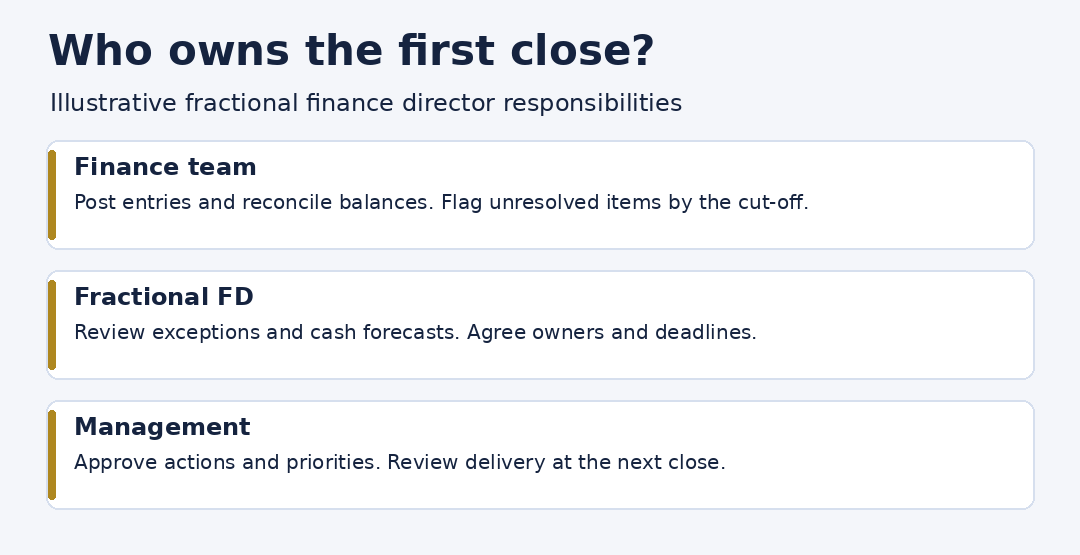
The finance team prepares the numbers
Agree who posts entries, prepares reconciliations and runs the close calendar. The finance director reviews exceptions and follows up with the person who owns each issue.
Management reviews and decides
The finance director explains cash and performance and agrees actions with management. For funding strategy and board-level decisions on growth, see our fractional CFO service.
The service
What does a part-time finance director do?
A fractional FD is an experienced finance director engaged for an agreed part of the week or month. The role can combine hands-on financial management, reporting, cash planning and team direction, without the commitment of a full-time appointment.
When it helps
Good people. Growing business.
Finance still feels reactive.
The month-end answer arrives too late
You are making decisions before the management accounts are ready. Establish a realistic close timetable, named owners and checks that make the reporting dependable.
Profit is not turning into cash
Collections, supplier terms, stock and delivery commitments can absorb cash as trading grows. Bring these movements into a forward-looking view with actions the team can own.
Everything comes back to the founder
Approvals, financial explanations and reporting sit with you. Clarify responsibility and build repeatable routines so finance can support the business as it becomes more complex.
What fractional FD services can take on first
An FD engagement suits a finance team that needs senior oversight of its close, reporting and cash routines. In the first month, Kishen Patel ACA, Lead Partner, can review the close process, agree who prepares and reviews key reconciliations and set an escalation process for cash or reporting issues.
Share who owns the ledger and approvals, the current close timetable and where reporting is delayed. Agree the responsibilities and outputs for the first reporting cycle.
Scope
An FD who gets close
to how finance actually works.
Management accounts and commentary
Agree a useful reporting pack, reconcile key balances and explain the movements behind the result. The output should distinguish a trading issue from a timing or accounting issue.
Cash and working capital
Set up an appropriate cash forecast, review collections and payment commitments, and identify practical levers. Assign responsibility for assumptions and keep the forecast current.
Budgets and rolling forecasts
Connect revenue, staffing, overheads and investment to the operating plan. Compare actuals with expectations and revise the outlook when the evidence changes.
Finance team direction and month-end close oversight
Work with your bookkeeper, accountant and internal team. Define handovers, review responsibilities and identify gaps in capacity, skills or processes.
Controls that fit the business
Review approvals, reconciliations, spending visibility and reporting ownership. Prioritise changes that reduce avoidable errors and help the team operate consistently.
Management and lender conversations
Prepare clear financial information and support questions about performance, cash and the plan. Any funding application or specialist assignment has an agreed scope.
Explore the detail
From month-end to management action
Explore the emphasis of a practical FD workstream. These examples do not prescribe a package or a delivery timetable.
Close with a clear handover
Define the close checklist, reconcile key balances and review the management accounts before explaining the result.
A clearer brief. Practical outputs.
Turn month-end into an accountable operating routine
Close and reconcile
Agree the close timetable, input owners and balance-sheet reconciliations. Surface missing information early rather than waiting until the reporting deadline.
Explain the performance
Prepare the agreed management pack and commentary. Separate revenue, margin, cost and working-capital movements, with the source of each material explanation visible.
Act and update
Review cash and forecast changes with management. Assign actions, update assumptions and track unresolved finance-process issues through the next cycle.
Performance
Profit and loss, balance sheet and relevant operational measures, reconciled to the agreed underlying records.
Liquidity
A weekly or rolling forecast, collection priorities, payment commitments and commentary on forecast-to-actual differences.
Ownership
Controls, close tasks, evidence gaps and process improvements, with named owners and realistic review dates.
This is an illustrative pack structure. We agree the actual contents, close timetable and responsibilities with you. If the accounts need reconstruction or catch-up, that work is scoped before promising a reporting date.
Fractional FD and CFO titles overlap in practice. Choose the scope that fits: closer finance-function direction and reporting ownership here, or broader strategic and stakeholder priorities through fractional CFO support ↗. Your existing accountant can remain responsible for the statutory and tax work agreed with them.
Your working rhythm
Close the month.
Open a better conversation.
A typical cycle starts with complete records and reconciliations, then moves to management accounts, variance analysis, forecast updates and agreed actions. The value is in the connection between those stages.
We first assess your current information and team capacity. A reporting timetable needs to be achievable, rather than an ambitious deadline that produces unreliable numbers. Urgent cash decisions can be handled before a wider reporting redesign.
The frequency, meeting attendance and time commitment are set around the business. An FD engagement does not automatically include bookkeeping, statutory accounts, tax filings or company secretarial work.
FD or CFO?
Choose the work you need.
Then agree the title.
Businesses use FD and CFO titles differently. An FD brief often emphasises reliable reporting, cash management, controls and a functioning finance team. A CFO brief may place greater emphasis on capital allocation, board strategy, funding and transactions. There is substantial overlap.
We define responsibilities rather than promise a fixed distinction. If you need senior ownership of a wider financial agenda, explore fractional CFO services. If the core requirement is recurring analysis and forecasting, FP&A support may be the better starting point. A broader systems and process redesign belongs in finance transformation.
Getting started
Build from the position
you are actually in.
Understand the pressure points
Discuss the business model, current reporting, cash concerns, team and decisions that cannot wait.
Review the information
Assess recent accounts, balance-sheet reconciliations, cash forecasts and existing responsibilities. Identify the main reliability and ownership gaps.
Agree the first priorities
Set the deliverables, responsibilities, availability, fee, VAT treatment and review arrangements before work starts.
Establish the routine
Deliver the agreed reporting and planning cycle, track actions and review support as your team develops.
Read further
Useful thinking for
your next decision.
From the journal
Fractional CFO: The Finance Leader Powering Serious Growth
Explore the detail, then discuss how it applies to your business.
From the journal
Budget vs Forecast vs Plan, a UK founder’s playbook for using each one properly
Explore the detail, then discuss how it applies to your business.
Your questions
Fractional Finance Director, explained.
How is a fractional FD different from a bookkeeper?
A bookkeeper maintains transaction records within their agreed scope. A fractional FD helps organise financial management, reviews reporting, interprets performance and supports decisions. We work with the record-keeping team rather than assume their duties are included.
Do you replace our existing accountant?
Usually the roles can work together. We agree ownership of records, management reporting, statutory accounts, tax and advice, so responsibilities are clear and work is not duplicated.
Can you help if our accounts are behind?
We can review the position and prioritise recovery work. The data clean-up, accounting support and people required are scoped first. Reliable reporting depends on complete records and appropriate reconciliations.
How much does a part-time finance director cost?
Fees depend on the responsibilities, complexity, time and support required. We agree the fee, VAT treatment, deliverables and availability before starting. Additional clean-up or transaction work may require a separate brief.
How many days a month do we need?
That depends on your reporting cycle, internal team and current decisions. We assess the workload and agree a practical commitment, then review it as needs change.
Will you manage our finance team?
Team direction and review can form part of the agreed scope. We clarify reporting lines, decision rights and management responsibilities, including what remains with your directors.
Can an FD help prepare us for a future sale?
Yes. Better reporting, reconciliations, forecasts and financial ownership can support readiness. A sale process or dedicated seller preparation engagement is scoped separately.
Who will lead the work?
Kishen Patel leads Consult EFC engagements. He is an ICAEW Chartered Accountant with experience across Big Four audit, investment banking and corporate advisory. The people involved and any specialist support are agreed in advance.
Can a fractional FD lead our existing finance team?
Finance-team direction, reporting responsibilities and review routines can be included in the agreed scope. We establish who prepares, checks and approves each output and what remains with management.
Can you promise a five-day month-end close?
A close timetable must reflect the records, systems, reconciliations and team capacity. We assess the starting position and agree a practical target and improvement plan rather than promise the same deadline for every business.
Work directly with the adviser
Bring the decision.
We will help frame the work.
Tell us what is changing, what you need to achieve and any important deadline.
Kishen Patel leads Consult EFC engagements. He is an ICAEW Chartered Accountant with a background in Big Four audit, investment banking and corporate advisory. Consult EFC has advised 100+ businesses and remains sector agnostic.
We agree the scope, deliverables, responsibilities, fee, VAT treatment and timing before work starts. An introductory conversation does not commit you to an engagement.